
What Is a Pour-Over Will in Florida? How It Works and What It Does

A pour-over will can direct certain assets left outside a living trust into that trust, but it won’t keep those assets out of probate. If you’re asking what is a pour-over will in Florida, think of it as a backup: it names a trust as the recipient of qualifying property still in your name at death. The catch is important. Assets transferred under the will generally must go through probate first.
It’s understandable to wonder how a will and trust work together, especially if you’re concerned that an account or other asset was left outside the trust. The distinction is that the will can direct certain assets, while transferring appropriate assets into the trust during your lifetime may keep them from needing probate.
This article explains how a Florida pour-over will works with a revocable living trust, which assets may still pass through probate, and what the document can’t accomplish on its own. You’ll also find practical questions to discuss with Florida estate-planning counsel so your will, trust, and asset-transfer plan work together.
Table of Contents
What Is a Pour-Over Will in Florida, and What Is It For?
A pour-over will is a will that directs certain assets subject to probate to the person or trust named in the document. In a trust-based plan, it names a revocable living trust as the recipient of qualifying assets that remain in the will-maker’s name at death. That direction does not, by itself, keep those assets out of probate.
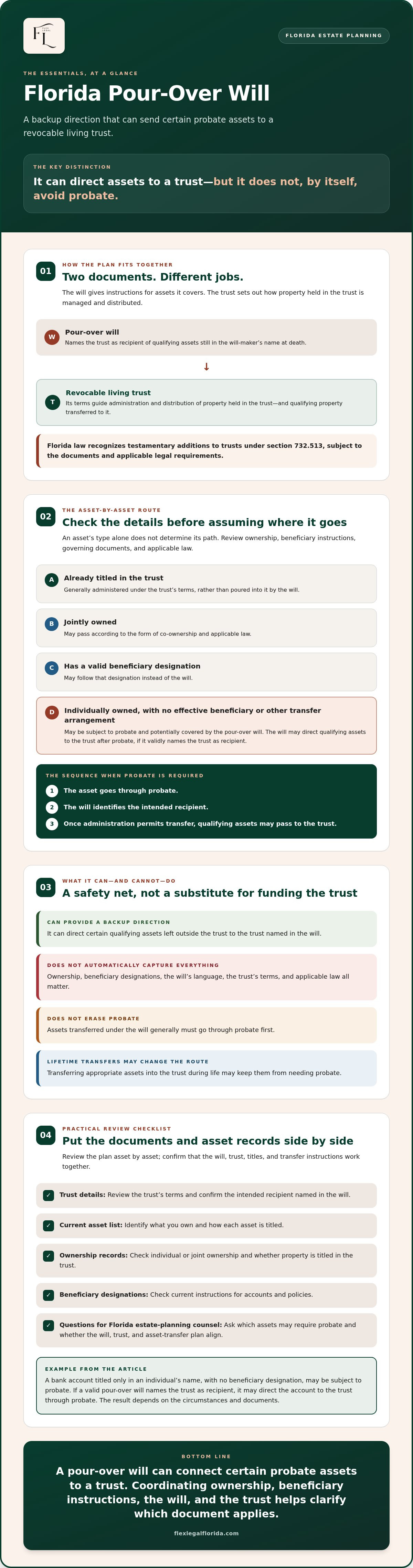
The will and trust are separate legal documents with different roles. The will gives instructions for assets it covers; the trust sets out how property held in the trust is managed and distributed. Florida law recognizes testamentary additions to trusts under section 732.513, subject to the documents and applicable legal requirements. For a general overview of the concept, see Pour-over will.
How does a pour-over will work with a Florida living trust?
The will names the trust as the intended recipient of covered assets. If an asset is subject to probate, it may need to pass through the probate process before it can be transferred to the trust. The trust’s terms then guide its administration and distribution. This differs from an asset already titled in the trust, which may be administered under the trust rather than directed there by the will. For broader background, read this revocable trust guide for West Palm Beach.
Why is it sometimes called a safety-net will?
It’s called a safety net because it can provide a backup direction for certain assets that weren’t transferred to the trust during the owner’s lifetime. It doesn’t automatically capture every omitted asset. Ownership, beneficiary designations, the will’s language, the trust’s terms, and applicable law all matter.
Hypothetical example: A person creates a revocable living trust but leaves a bank account titled only in their individual name, with no beneficiary designation. If that account is subject to probate and the pour-over will validly names the trust as recipient, the will may direct the account to the trust through probate. The result depends on the circumstances and documents.
The practical takeaway is that a pour-over will can connect certain probate assets to a trust, but it isn’t a substitute for transferring assets into the trust during life. Coordinating the will, trust, and asset ownership can help clarify which document applies to each part of an estate plan.
What Happens to Assets Under a Florida Pour-Over Will?
A pour-over will doesn’t make every asset part of probate or send every asset to a trust. To understand what may happen, review each asset in order: identify it, check how it’s owned and whether a beneficiary or other transfer arrangement applies, then determine whether probate is required under Florida law. The legal definition of a pour-over will describes the general concept, but the transfer path depends on the asset and the plan’s details.
Probate assets are assets that generally require court-supervised administration to transfer after death. Other assets may pass directly to a joint owner or designated beneficiary, or be administered under a trust. You can’t determine the route from an asset’s type alone. Title, beneficiary instructions, the governing documents, and applicable law all matter.
Which assets might pass under the will?
An asset owned individually at death, with no effective beneficiary designation or other transfer mechanism, may be subject to probate and potentially covered by a pour-over will. But a financial account, real estate, or personal property doesn’t automatically fall into one category. Check the actual ownership records and transfer instructions.
Jointly owned property may pass according to the form of co-ownership and applicable law. An account or policy with a valid beneficiary designation may follow that designation instead of the will. Assets already titled in the living trust are generally handled under the trust’s terms, rather than poured into it by the will. If you’re asking what is a pour-over will in Florida in practical terms, the answer depends on these asset-by-asset details.
What happens after probate begins in Palm Beach County?
If an asset requires probate, the process may involve a probate court and a personal representative. The will’s directions can help identify the intended recipient, but they don’t eliminate the required court process. Once the administration permits transfer, qualifying assets may pass to the trust for handling under its terms.
Procedures and filing requirements can change. For current local information, check with the Palm Beach County Clerk of the Circuit Court & Comptroller. You can also read this guide to probate and estate administration in Palm Beach County for broader process context.
A useful review starts with a current asset list, ownership records, and beneficiary designations. West Palm Beach-area readers who want help coordinating those details with a will and trust can learn more about estate-planning guidance from Flex Legal.
Does a Pour-Over Will Avoid Probate in Florida?
No, not for assets that require probate. A pour-over will directs certain assets to a trust, but it doesn’t bypass the court process needed to transfer those assets through the estate. The legal definition of a pour-over will describes its connection to a trust. The practical distinction is whether an asset was transferred into the trust during the owner’s lifetime or remains subject to probate.
Having both a will and a revocable living trust doesn’t prove that every asset was transferred or has the right beneficiary designation. The plan depends on how each asset is owned and the applicable transfer rules. Florida homestead and creditor issues can also affect an estate plan, so don’t assume a particular result based only on the document names. Ask an attorney to review those issues against your circumstances.
When might probate still be required?
An asset titled solely in the deceased person’s name, with no effective beneficiary designation or other transfer route, may need probate before it can pass under the will. Whether the estate requires formal or summary administration depends on the estate’s circumstances and current Florida law. The will’s direction to transfer an asset to a trust doesn’t, by itself, determine which probate process applies or guarantee that probate can be avoided.
How is a pour-over will different from a funded living trust?
A funded trust holds assets transferred to it during the owner’s lifetime. A pour-over will is a backup direction for certain remaining assets, which may have to pass through the estate before reaching the trust. The two documents serve related but distinct functions; the will doesn’t replace trust funding. For a closer look at trust planning, see this revocable trust guide for West Palm Beach.
That distinction helps explain what is a pour-over will in Florida and what it can realistically do: it may direct qualifying assets toward a trust, but it isn’t a stand-alone probate-avoidance strategy. Review your will, trust, and asset ownership together, especially if property, creditor concerns, or homestead rights may be involved. West Palm Beach-area readers can explore estate-planning and probate guidance when considering a coordinated review.
How to Review a Pour-Over Will and Trust in Florida
A useful review checks more than whether both documents exist. The goal is to see whether the will, trust, and current asset records still work together. If you’re asking what is a pour-over will in Florida, reviewing these connections helps clarify what the will directs and whether your current ownership arrangements support that plan.
What should you check in the documents?
Start with the basics. Confirm that the trust named in the will is clearly identifiable and that its name and relevant dates or references match across the documents. Check who is named to receive assets under the will, and consider whether the successor trustee and personal representative are still appropriate. Review alternate choices, too, in case a named person can’t serve.
Compare the documents: Check names, dates, and references to the trust for consistency. Have counsel resolve unclear or conflicting terms rather than editing legal language yourself.
Review ownership: Compare the trust’s asset information with current account statements, property records, and other title documents. Include real estate and jointly owned property, since transfer rules depend on the specific ownership.
Check beneficiary designations: Review current designations on accounts and policies. A designation may affect how an asset transfers, so don’t assume the will controls it.
Confirm execution: Florida’s will formalities generally require a written document signed by the testator at the end and witnessed by two people who sign in the testator’s presence and in each other’s presence. Ask counsel to confirm the current requirements and whether your documents were properly executed.
This is a review checklist, not a universal template. The appropriate language and signing process depend on the documents and circumstances.
When should a Florida estate plan be reviewed?
Consider a coordinated review after a major family change, a move, a business change, the purchase or sale of property, or a trust amendment. New assets can also change the transfer plan. There’s no single review interval that fits every household; revisit the documents when something material changes.
For Palm Beach County residents, local estate-planning counsel can assess the documents alongside Florida law and the actual ownership and beneficiary records. Bring the will, trust, current asset-title information, and beneficiary designations so the review addresses the whole plan. For additional guidance, see this West Palm Beach estate-planning attorney guide.
If your documents or assets have changed, request a coordinated review of your will and trust.
When to Ask a Florida Estate-Planning Attorney About a Pour-Over Will
A pour-over will can direct certain assets toward a trust, but it doesn’t replace funding the trust or determining which assets may require probate. An attorney can review the will, trust, and asset-transfer details together, especially when your family or finances raise questions the documents can’t answer on their face.
Individual guidance may be especially useful if your plan involves minor children, Florida homestead property, special-needs planning, or real estate outside Florida. These circumstances can involve separate legal considerations, so don’t assume a pour-over will resolves them automatically.
What questions should you bring to a consultation?
Bring your questions along with documents and records that can help answer them. For example, ask:
Which assets may pass through probate, and which may transfer through trust ownership, joint title, or a beneficiary designation?
Does the will identify the intended trust consistently, and do both documents meet current Florida requirements?
Could guardianship nominations or planning for minor children affect the broader plan?
How might Florida homestead rules, special-needs considerations, or property in another state affect the documents and asset-transfer plan?
If you’re trying to pin down what is a pour-over will in Florida for your own situation, these questions can move the conversation from a general definition to the details of your estate plan.
What is a practical next step for West Palm Beach families?
Gather your current will and trust, asset-title information, beneficiary designations, and a list of questions. Include records for real estate and jointly owned property, along with notes about family, residence, or business changes since the documents were prepared. A complete picture helps counsel assess how the documents work together, rather than reviewing the will in isolation.
Flex Legal, PLLC provides estate-planning and probate services, including wills and revocable living trusts. For West Palm Beach families, a coordinated review can help identify issues to discuss and clarify what further planning may be appropriate. No document can promise a particular probate outcome, but reviewing the plan against your current circumstances can help you make informed decisions.
Make Your Will and Trust Work Together
Understanding what is a pour-over will in Florida starts with one key distinction: the will can direct certain assets to a trust, but it doesn’t replace funding the trust or assessing whether an asset must go through probate. The way an asset is titled and any beneficiary designation can affect how it transfers, so review those details alongside your documents.
A practical next step is to gather your will, trust, current asset records, and beneficiary designations. A coordinated review can help you identify questions about ownership, probate, and whether your documents still reflect your wishes, especially after changes in your family or finances.
Flex Legal, PLLC is a Florida estate-planning and probate practice serving West Palm Beach. Founded and operated by Jennifer L. Flexer, Esq., the firm provides services that include wills and revocable living trusts. If you’re ready to discuss how your documents fit together, discuss your Florida estate plan with Flex Legal. A clearer plan can begin with one informed conversation.
Frequently Asked Questions
What is a pour-over will in Florida?
A pour-over will in Florida is a will that directs certain assets covered by its terms to a named trust, often a revocable living trust. It’s commonly used as a backup for assets that weren’t transferred into the trust during the owner’s lifetime. Its effect depends on the will’s validity, the trust’s terms, asset ownership, and applicable Florida law, so review the will and trust together.
Can a pour-over will transfer property into a trust after death?
It may direct covered probate assets to a trust after death, but the transfer isn’t necessarily automatic or outside court. The outcome can depend on whether the will is valid, what the trust says, how the property is owned, and applicable law. Before relying on a pour-over provision for a particular home, account, or other asset, ask a Florida estate-planning attorney to review both documents and the ownership records.
Does a pour-over will need to be witnessed in Florida?
Yes. Florida Statute 732.502 generally requires a will to be in writing, signed at the end by the person making it, and witnessed by two people who sign in the presence of the testator and each other. A separate self-proving procedure may also be available. Because execution errors can create challenges, confirm current requirements and the signing process with a Florida attorney rather than relying only on an online form.
What happens if an asset is not listed in a Florida living trust?
First check the asset’s title and whether it has a valid beneficiary designation or another transfer arrangement. A pour-over will may direct some assets to the trust, but it doesn’t guarantee that every omitted asset will avoid probate or reach the trust without court involvement. Reviewing account records, property titles, and the will while the owner is living can help identify gaps and possible next steps.
Is a pour-over will enough if I have a living trust in Florida?
It can be a useful part of a trust-based plan, but it doesn’t replace transferring appropriate assets into the trust or reviewing beneficiary designations. The right plan depends on your family, property, and goals. Have the will, trust, asset titles, and designations reviewed together under current Florida law. For West Palm Beach residents, a coordinated review can help identify whether the documents still align with current circumstances.
Can a Florida pour-over will name a guardian for minor children?
A will may include a nomination for a guardian of minor children, but the nomination’s effect depends on the circumstances and applicable Florida law. The pour-over provision itself doesn’t resolve guardianship questions. Parents can discuss their preferred guardian, alternate choices, and related planning with a Florida attorney. Review the nomination if family circumstances change, including a change in the people available or willing to serve.
Should Palm Beach County residents have a Florida attorney review a pour-over will?
An attorney review can help check whether the will and trust work together under current Florida law and reflect how assets are actually titled. It may be especially useful if the plan involves real estate, Florida homestead, minor children, or property outside the state. Palm Beach County residents can bring their documents and asset information and ask what probate process may apply to their specific estate.


Comments