
Florida Guardianship for Elderly Parents: 2026 Guide

Could pursuing guardianship help protect your parent, yet take away more decision-making authority than necessary? If you’re weighing the Florida guardianship process for elderly parents, it’s understandable to want clear answers before taking a step that may affect your parent’s independence. Guardianship is a court-supervised safeguard, not an automatic response to aging or family concern.
This guide explains how Florida courts assess incapacity, what the general process involves, and how the court considers the rights and needs of the person at its center. You’ll also learn how tools such as a durable power of attorney or health care surrogate designation may help in some situations, while recognizing that planning documents don’t automatically prevent every guardianship proceeding.
We’ll cover the key stages, the difference between guardianship of the person and guardianship of the property, and the information families can organize before seeking legal guidance. The goal is to help you understand your options and your parent’s circumstances before deciding what to do next.
Table of Contents
When Is Guardianship for an Elderly Parent Necessary in Florida?
It can be unsettling to see a parent miss bills, struggle to arrange care, or make decisions that seem unsafe. Those concerns deserve attention, but age, memory changes, or a medical diagnosis alone don’t establish legal incapacity. Florida guardianship is a court-supervised arrangement that may authorize another person to make specific personal decisions, property decisions, or both when the court finds it necessary.
Before a guardian can be appointed, a Florida court must determine that the person is incapacitated under Chapter 744 of the Florida Statutes. The court’s decision is not a general judgment about whether someone is elderly or needs help. It concerns the person’s ability to manage some or all of their property or meet essential health and safety requirements. The court’s findings guide which rights, if any, may be delegated to a guardian.
That distinction matters. A parent may need reminders, transportation, help understanding paperwork, or support with appointments while still being able to make their own decisions. Families can also review planning documents that may already address some needs. A durable power of attorney or health care surrogate designation, for example, may provide authority in certain areas, but neither automatically resolves every circumstance.
What does incapacity mean under Florida guardianship law?
Needing support is not the same as meeting Florida’s legal standard for incapacity. Under Chapter 744, the court evaluates a person’s ability to manage property or meet essential health and safety needs. It considers the person’s actual abilities and circumstances, rather than treating a diagnosis as an automatic conclusion.
The court makes the legal determination. Its findings should reflect the evidence and the particular areas where decision-making support may be needed. Florida’s guardianship framework also recognizes the role of the Florida Department of Elder Affairs, which oversees the Office of Public and Professional Guardians. For a family, the central question is what authority is genuinely necessary for this parent.
Which concerns might prompt a family to explore guardianship?
Families may seek legal guidance when practical problems persist and less restrictive support does not appear to address them. Examples can include unpaid bills despite repeated assistance, difficulty keeping essential services in place, unsafe decisions that create an immediate care concern, or an inability to arrange needed medical or daily support. A pattern of specific events is more useful to discuss than a broad statement that a parent “can’t manage.”
These examples are reasons to examine the situation, not proof of incapacity. They don’t determine what a court will decide, and the same concern may have different explanations or solutions. Keep factual notes: what happened, when it occurred, what help was offered, and how your parent responded. Avoid assumptions about motive or ability.
Guardianship should respond to demonstrated decision-making needs, not age alone. If a court appoints a guardian, the authority should be tied to the court’s findings. It should not be assumed to cover every personal or financial choice. Understanding that boundary is a useful first step in considering the Florida guardianship process for elderly parents.
How the Florida Guardianship Process Works, From Petition to Court Decision
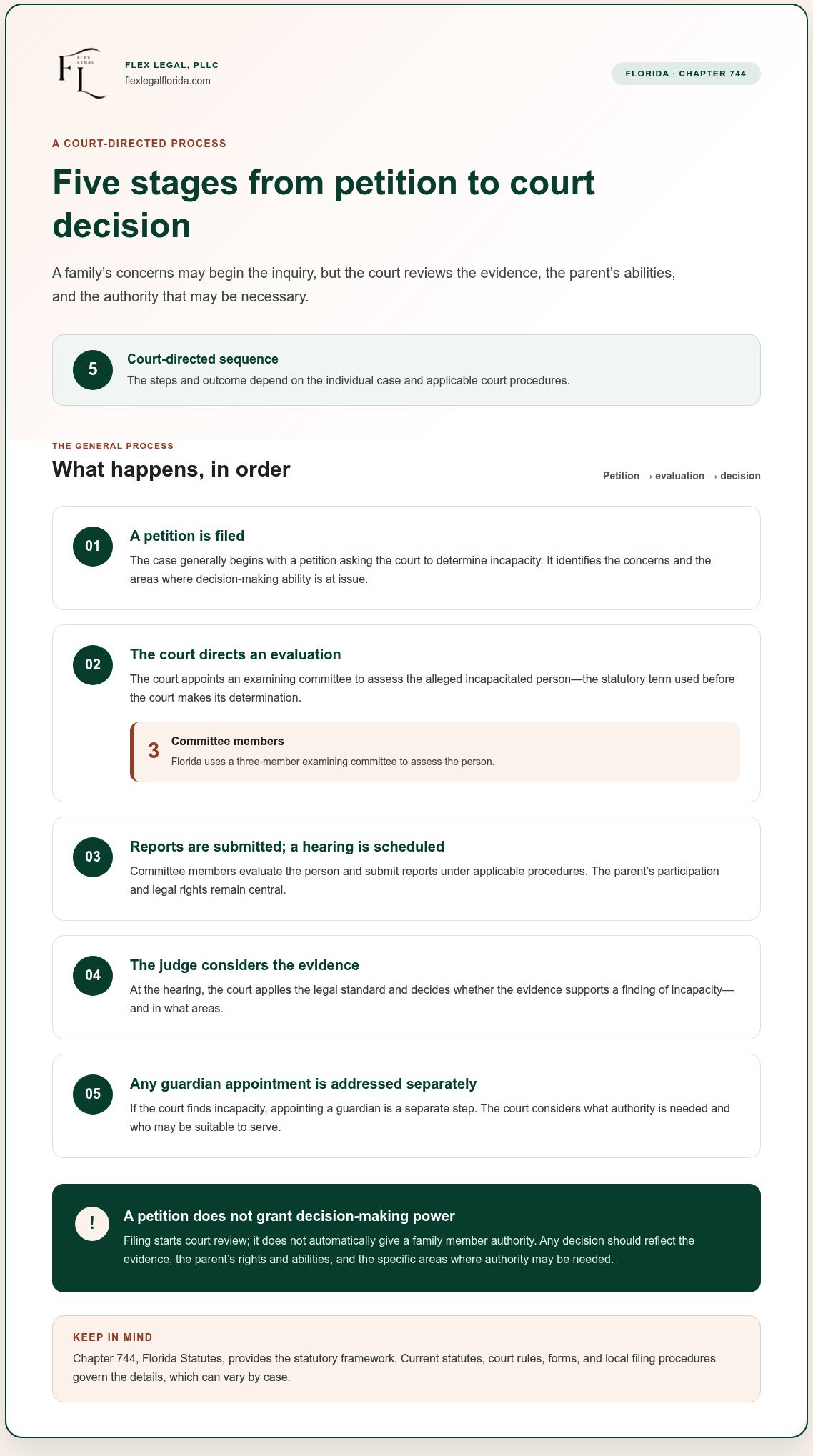
The Florida guardianship process for elderly parents follows a court-directed sequence. A family’s concerns may start the inquiry, but they don’t decide the outcome. The court reviews the evidence, considers the parent’s rights and abilities, and determines whether guardianship is legally appropriate and, if so, what authority is needed.
Chapter 744, Florida Statutes, provides the statutory framework for Florida guardianship. The sequence below is a general overview. Current statutes, court rules, forms, and local filing procedures govern the details, which can vary by case.
1. A petition is filed. The case generally begins with a petition asking the court to determine incapacity. The petition identifies the concerns and the areas where decision-making ability is at issue.
2. The court directs an evaluation. The court appoints an examining committee to assess the alleged incapacitated person, the statutory term used before a court makes its determination.
3. The committee reports and a hearing is scheduled. The committee members evaluate the person and submit reports under the applicable procedures. The parent’s participation and legal rights remain central.
4. The judge considers the evidence. At the hearing, the court applies the legal standard and decides whether the evidence supports a finding of incapacity, and in what areas.
5. Any guardian appointment is addressed. If the court finds incapacity, appointment of a guardian is a separate step. The court considers the authority needed and who may be suitable to serve.
What happens after a Florida guardianship petition is filed?
Filing a petition doesn’t automatically give a family member decision-making power. The court reviews the matter and directs the next steps, including the evaluation process. Florida uses a three-member examining committee to assess the alleged incapacitated person. The parent’s rights, including the opportunity to participate in the proceeding, remain important throughout. The precise procedures depend on current law and the facts.
What should families expect at the incapacity hearing?
The judge considers the committee’s evaluations and other relevant evidence. Florida’s standard is clear and convincing evidence. The court may find that incapacity hasn’t been established, or may find incapacity in some areas and preserve the person’s rights in others. A finding does not mean a guardian is automatically appointed; the court must separately address whether an appointment is warranted and its scope.
The incapacity decision determines whether and where decision-making ability is legally limited; a separate decision addresses whether a guardian should be appointed. This distinction helps families understand why a petition is not simply a request to transfer all authority to a relative.
There’s no single timeline families should rely on. Evaluations, court scheduling, the evidence involved, and disagreements can all affect how long a case takes. Organizing relevant documents and a clear account of the concerns can make legal discussions more focused. Flex Legal, PLLC handles guardianship proceedings in Florida. For guidance on whether court-supervised guardianship proceedings fit your parent’s circumstances, an attorney can review the situation and explain the procedural next steps.
Guardianship or a Less Restrictive Option? Florida Families’ Key Comparison
Before pursuing court-supervised authority, consider whether an existing planning document can address the specific decision causing concern. Each option works differently: documents may authorize a trusted person to act in defined circumstances, while guardianship involves court oversight and can affect the parent’s legal rights. The right fit depends on the parent’s abilities, the documents in place, and the decisions that need support.
Can a durable power of attorney or health care surrogate help?
These documents can support a parent’s advance planning by naming someone to act within defined areas. A durable power of attorney addresses authority granted to an agent, while a health care surrogate designation concerns health care decisions. Review the actual document, when it takes effect, what authority it grants, and whether it remains valid. A Florida durable power of attorney guide explains this financial-planning tool, but individual circumstances still matter.
An informal promise to help is different from legal authority. A relative may assist with calls or appointments, for example, but that support alone may not authorize them to access accounts or make health care decisions. A trust or planning document may address some concerns without resolving every issue that arises.
How does Florida’s least restrictive approach shape guardianship?
Florida law directs attention to the person’s remaining abilities and the authority actually needed. Depending on the court’s findings, a limited guardianship may be considered when only certain rights need to be delegated; broader authority should not be assumed. Seeking guardianship doesn’t mean every right must be removed. The court determines the scope based on the case record and applicable law.
For families weighing the Florida guardianship process for elderly parents, the practical question is which decisions remain manageable with existing documents or support, and which may require court authority. A durable power of attorney or surrogate designation doesn’t automatically eliminate the need for court action. Reviewing the documents alongside the parent’s current needs can clarify whether an alternative may be sufficient or whether guardianship proceedings warrant further consideration.
Preparing for an Elderly Parent’s Florida Guardianship Case
Thoughtful preparation can make an initial legal discussion more useful and keep the focus on your parent’s actual needs. You don’t need to build a court case on your own or predict what a judge will decide. Start by gathering relevant records, noting specific events, and identifying what remains unclear. For families considering the Florida guardianship process for elderly parents, an organized picture of the situation can help clarify possible alternatives and next steps.
What information should adult children organize first?
Collect documents that may already give someone authority to assist, along with records that help explain the concern. Keep copies together and note when documents were signed, if known. A focused file might include:
Planning documents: Any durable power of attorney, health care surrogate designation, living will, revocable trust, or pre-need guardian designation.
Specific observations: A dated account of a decision or event, what you personally observed, and what followed. Separate firsthand knowledge from information another person shared.
Relevant financial records: Statements, notices, or correspondence that show a concrete issue, with unrelated sensitive information kept private.
Care information: Appointment summaries, care plans, or notes about support being provided, where relevant to the decisions at issue.
Questions and family context: List what authority may be needed and note disagreements without presenting a family conflict as proof of incapacity.
Use neutral language. “The insurance premium was paid twice in March” is more useful than “Dad can’t handle money.” A diagnosis may provide context, but it is not your legal conclusion to make. Keep medical information, observed behavior, and your interpretation clearly separate.
What should Palm Beach County families verify before filing?
A guardianship case is handled through the appropriate Florida circuit court. Before taking filing steps in Palm Beach County, review the current forms, filing instructions, and procedures through official court or clerk sources. Confirm where and how documents are submitted, what the current process requires, and how notices or hearings are handled. Local procedures can change, so instructions from another Florida county may not apply in Palm Beach County.
This preparation is a starting point, not a mandatory evidence checklist. Which records matter depends on the circumstances, and no collection of documents can guarantee a particular ruling. Review current statutory requirements and court procedures before filing.
Broader planning can also help families understand which documents may address particular needs. West Palm Beach families can explore estate planning options alongside guardianship concerns. For help organizing the facts and assessing whether guardianship proceedings or another planning approach may fit, discuss your family’s guardianship concerns with Flex Legal.
Getting Legal Guidance for a Florida Guardianship Case
Families don’t need to decide on their own whether a court proceeding is the right answer. A Florida guardianship attorney can review the parent’s circumstances, available records, and existing planning documents, then help identify whether court action or another response may fit. For families considering the Florida guardianship process for elderly parents, the goal is a clear, individualized assessment, not an assumption that guardianship is inevitable.
What should a guardianship consultation help clarify?
A focused discussion can turn general worry into specific legal questions. Share the events that prompted concern, the decisions involved, any steps already taken to help, and documents that may grant someone authority. This context can help the attorney assess whether those documents address the issue or whether guardianship proceedings may need to be considered.
Possible options: Whether existing authority, further planning, or a court-supervised arrangement may fit the concern.
Rights and scope: Which decisions are at issue and how to avoid seeking broader authority than the circumstances support.
Next steps: What procedural requirements may apply and what information could help prepare, without promising a timeline or court outcome.
Legal guidance should keep the parent’s rights in view throughout. A family’s concerns matter, but they don’t replace the court’s decision or establish the authority a guardian may receive. An attorney can explain how the facts and applicable procedures affect the options, while helping the family distinguish documented events from assumptions or disagreements.
How can families plan ahead for future incapacity?
Planning ahead can give a person more opportunity to express preferences and identify trusted decision-makers. A durable power of attorney, health care surrogate designation, and designation of pre-need guardian each serve a different planning purpose. Their usefulness depends on the document’s terms, the person’s circumstances, and the decision that may arise. Planning can help, but it doesn’t guarantee that court action will never be needed.
Durable power of attorney: Can name an agent for authority described in the document.
Health care surrogate designation: Can identify someone to make health care decisions as authorized.
Designation of pre-need guardian: Can record a preference for who should serve if a guardian is later needed.
These tools work best as part of a plan tailored to the person’s needs, values, and existing arrangements. Review them after major life changes, and make sure family members understand where the documents are kept and who has been named. If concerns have already surfaced, legal guidance can help connect advance planning with the immediate question of whether guardianship proceedings may be appropriate.
Flex Legal helps Florida families assess guardianship concerns, review relevant planning documents, and understand potential next steps with the parent’s rights and needs in focus. Discuss Florida guardianship guidance with Flex Legal.
Take the Next Step With Your Parent’s Wishes in Focus
The next conversation can be less about choosing a legal path and more about understanding what your parent values, what support they would accept, and how to respect their preferences as circumstances change. When possible, include your parent in planning discussions. Their perspective can help shape a response that addresses the concern without overlooking their independence.
If you’re unsure how those priorities fit with the Florida guardianship process for elderly parents, legal guidance can help turn questions into a thoughtful plan. Flex Legal, PLLC handles guardianship proceedings and related incapacity planning to help families consider options in light of their parent’s circumstances.
Discuss your Florida guardianship questions with Flex Legal. A clear next step can help your family move forward with greater confidence and care.
Frequently Asked Questions
Can an adult child file for guardianship of an elderly parent in Florida?
Yes, an adult child may petition the court, but filing doesn’t automatically appoint them as guardian. In the Florida guardianship process for elderly parents, the court considers evidence of incapacity, the parent’s rights, statutory qualifications, and the proposed guardian’s suitability. Before filing, make a clear record of the concern and identify any existing documents that may already authorize help. The court decides whether guardianship is appropriate and who may serve.
How long does the Florida guardianship process take?
There’s no single timeline that fits every Florida guardianship case. Evaluations, required filings, hearing availability, and objections from the parent or relatives can affect how the case proceeds. A delay in one stage may also shift later court dates. West Palm Beach families should review current Palm Beach County court procedures and discuss case-specific timing with counsel rather than rely on estimates from another county or a different family’s experience.
What happens if an elderly parent refuses guardianship in Florida?
A parent’s objection doesn’t automatically end the case or prove incapacity. The court follows the applicable procedures, considers the evidence, and accounts for the parent’s rights and participation. Families should listen carefully to the reasons for the objection and share them with counsel, especially if the parent disputes specific claims or proposes another way to address the concern. The court, not the family, determines the legal outcome based on the case.
Can a Florida guardian sell an elderly parent’s home?
Not simply because they’ve been appointed. A guardian’s authority depends on the court order, the property’s status, and applicable Florida law, and a proposed sale may require court approval and additional steps. For example, a home may have legal protections or ownership details that affect how it can be handled. Before listing or transferring property, have counsel review the guardianship order, title information, and requirements for that specific situation.
Does a Florida guardian have to report to the court?
Guardians may have ongoing court reporting duties, but required filings depend on the type of guardianship, the authority granted, and current law. A guardian should follow the court’s orders and verify applicable forms and deadlines rather than assume one schedule covers every case. Families evaluating a proposed guardian can discuss the responsibilities involved, including how records of decisions and property management may need to be maintained.
Can a family member who lives outside Florida serve as a guardian?
Possibly. Florida law allows certain relatives who live outside the state to be considered, but eligibility depends on statutory qualifications and the circumstances of the case. The court also evaluates whether the proposed guardian is suitable for the responsibilities involved. Families should raise the person’s state of residence, relationship to the parent, and practical ability to carry out the role during legal review. An out-of-state address alone doesn’t answer the question.


Comments