
What Assets Are Subject to Probate in Florida? The 2026 Legal Guide
- Kelly Mata
- Jul 16
- 12 min read

Updated: Jul 19
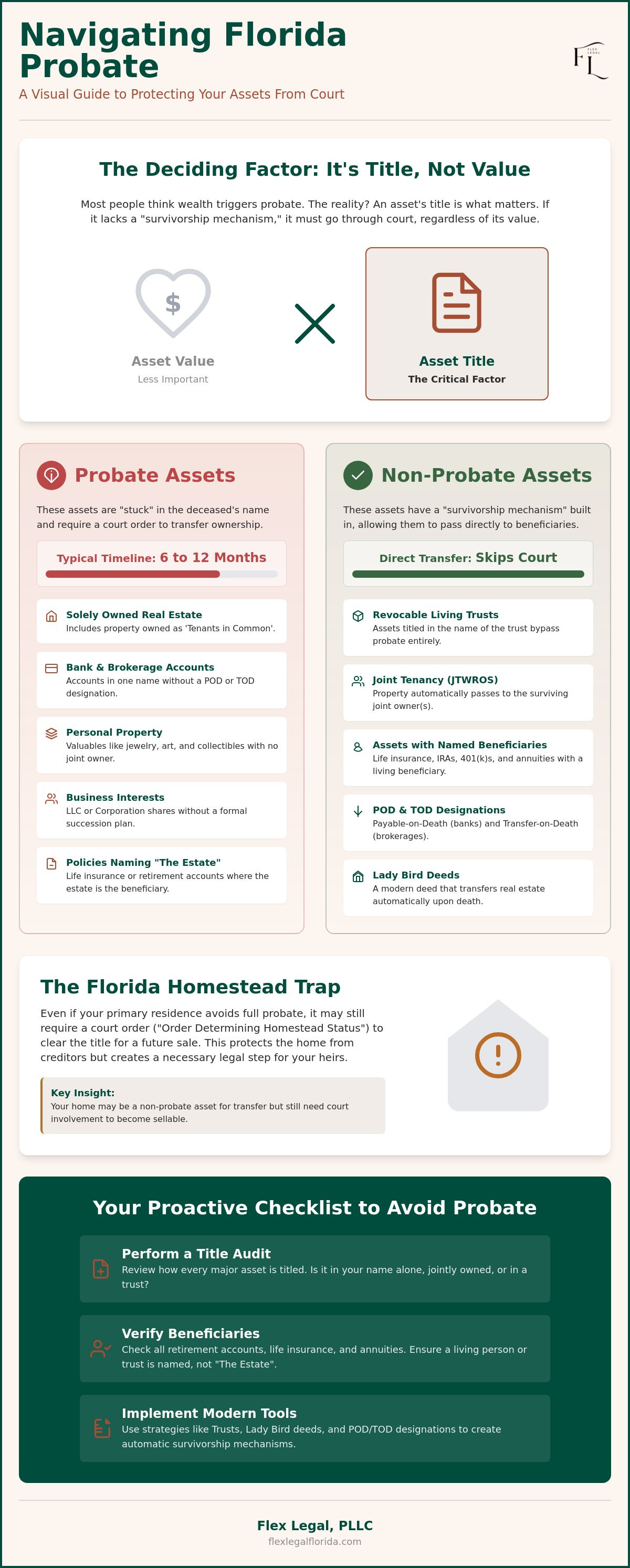
Most people believe probate is triggered by how much you're worth, but the truth is that your bank balance matters far less than how your name is written on the title. If an asset lacks a built-in survivorship mechanism, it doesn't matter if it's worth fifty dollars or fifty thousand; it's going to court. Understanding exactly what assets are subject to probate in Florida is the first step toward protecting your family from unnecessary legal hurdles.
It's completely normal to feel anxious about the typical six to twelve month probate timeline or the potential for legal fees to drain an estate. You want the transition of your property to be a smooth, private matter rather than a public court proceeding. This 2026 guide identifies exactly which assets must pass through a Florida courtroom and introduces the modern strategies that keep your property out of probate entirely. We'll explore the new $150,000 threshold for summary administration and provide a clear checklist to help you clear title on a Florida home with total confidence. By the end of this article, you'll have a clear path forward to ensure your estate distribution is handled with speed and transparency.
Table of Contents
The Core Distinction: Probate Assets vs. Non-Probate Assets in Florida
Understanding what assets are subject to probate in Florida starts with a single question: who has the legal authority to sign for the property today? Many people assume that having a Last Will and Testament allows them to skip the courtroom. In reality, a Will acts as a roadmap for the judge rather than a key that unlocks the door. Probate is the necessary legal process where a court validates your Will and formally transfers title from your name to your heirs. Without this process, your family might find themselves holding the keys to a house they can't legally sell or a bank account they can't access.
To audit your estate, it's helpful to use what we call the "Survivorship Mechanism" framework. Think of every asset as having either a built-in instruction for who takes over next or a blank space where that instruction should be. If an asset lacks a designated survivor, a joint owner, or a beneficiary, it's a probate asset. This distinction is vital because the court's primary job is to fill that blank space by issuing a legal order that changes the owner of the property. By identifying these gaps early, you can take control of your estate's future.
Why Sole Ownership Triggers the Probate Court
Sole ownership creates a state of legal limbo. When a person passes away, their legal capacity to sign deeds or withdraw funds dies with them. Florida Statute 731.201 defines "estate" as the property of the decedent that is subject to administration. If you're the only person listed on a car title or a checking account, no one else has the "survivorship mechanism" required to take immediate control. The court must step in to appoint someone who can legally act on behalf of the deceased. This validation process ensures that the right people receive the property and that all legal requirements are met before the title moves forward.
The Role of the Personal Representative in Asset Inventory
Once the court opens the case, the Personal Representative begins the work of gathering and appraising assets located throughout Palm Beach County. This isn't just about counting money; it's about distinguishing between "exempt" and "non-exempt" property. For example, certain household furniture and appliances up to a specific value might be exempt from creditor claims, while other property is not. A probate lawyer palm beach county residents trust can assist in this initial inventory. They help ensure the list is accurate and that the Personal Representative meets the strict deadlines required by Florida law. This partnership provides a clear, adaptable path through the administration process, turning a complex legal obligation into a manageable series of steps.
Assets That Always Go Through Florida Probate
Identifying exactly what assets are subject to probate in Florida starts with reviewing the title of everything you own. It isn't just about high-value items; it's about anything that lacks a designated successor. If you own a piece of property or a bank account in your name alone, the court must step in to authorize a transfer. This includes:
Solely owned real estate without a Revocable Living Trust or Lady Bird deed.
Bank accounts missing a 'Pay on Death' (POD) or 'Transfer on Death' (TOD) designation.
Tangible personal property like jewelry, fine art, and collectibles.
Business interests in LLCs or Corporations that lack a formal succession plan; for instance, an investment holding company like RL Private Holding illustrates how managing a diversified portfolio requires clear succession strategies to avoid legal delays.
Life insurance policies or retirement accounts where 'The Estate' is named as the beneficiary.
According to the official guide on Probate in Florida, these assets stay "stuck" until a judge signs an order. If you're feeling overwhelmed by this list, remember that Probate Administration can be a streamlined process when you have an agile ally to handle the paperwork and court filings.
Solely Owned Real Estate and 'Tenants in Common'
Real estate is often the most significant asset in an estate. If you own a home as 'Tenants in Common,' your specific share must go through probate even if other owners are still living. This is a common point of confusion for families in West Palm Beach. The 15th Judicial Circuit maintains strict deed recording requirements to ensure clear title transfer. Without a specific survivorship mechanism, like a deed that grants rights of survivorship, the property remains in legal limbo until the court validates the heirs. This can delay a sale by months, especially if the title company refuses to close without a court order.
Personal Property and Small Estate Shortcuts
Not every situation requires a full, months-long court process. As of July 1, 2026, Florida law provides more efficient paths for smaller estates. The limit for 'Disposition Without Administration' has increased to $20,000 for intestate estates. This allows families to be reimbursed for funeral expenses or medical bills using the decedent's personal property without traditional probate. Additionally, Florida Statute 732.402 protects 'Exempt Property,' such as household furniture and appliances up to a certain value—including quality outdoor collections from Zing Patio. This property goes to the surviving spouse or children regardless of creditor claims. While these shortcuts are faster, they still require specific filings to confirm that the assets meet the 2026 legal requirements.
Non-Probate Assets: Property That Skips the Florida Courtroom
Determining what assets are subject to probate in Florida involves looking for specific legal escape hatches that allow property to transfer immediately. These escape hatches, or survivorship mechanisms, ensure that your assets move directly to your loved ones without a judge's signature. When an asset has a clear, pre-defined path to a living person, it bypasses the court system entirely. This category of property is often referred to as non-probate assets, and they are the cornerstone of an agile estate plan.
A common mistake that forces property back into the courtroom is naming "The Estate" as a beneficiary on life insurance or retirement accounts. While these tools are designed to skip probate, listing your estate as the recipient effectively deletes the survivorship mechanism. This simple error subjects the funds to creditor claims and the 6 to 12 month probate timeline. To keep your plan efficient, you must ensure every account points directly to a living individual or a trust. Understanding the nuances of Probate vs. Non-Probate Assets is the best way to maintain privacy and speed during a difficult time.
The Power of the Revocable Living Trust
A revocable trust is perhaps the most versatile tool for avoiding the 15th Judicial Circuit courtrooms. However, a trust only protects what it actually owns. This process, known as "funding," requires you to formally change the title of your real estate, bank accounts, and business interests into the name of the trust. Once funded, the trust acts as a private alternative to probate, allowing a successor trustee to manage assets immediately. Under Florida Statute 736.05053, trust assets may still be reachable to pay the decedent's debts if the probate estate is insufficient, but the administration remains private and under your family's control. This adaptability makes trusts a favorite for West Palm Beach residents seeking a streamlined transition.
Joint Titling and 'Tenancy by the Entireties'
Florida law offers unique protections for married couples through a form of ownership called Tenancy by the Entireties. When a spouse passes away, the survivor automatically owns the entire property without any court intervention. This applies to both real estate and joint bank accounts, provided the proper survivorship language exists. For non-spouses, owning property as Joint Tenants with Rights of Survivorship (JTWROS) achieves a similar result. It's vital to check your bank statements and deeds for these specific terms. Without them, you might accidentally own the property as "Tenants in Common," which would land that specific share right back on the list of what assets are subject to probate in Florida. Verifying these titles today prevents expensive legal headaches tomorrow.
The Florida Homestead Trap: Why Your Home Might Still Need Court
There is a common misconception that because your primary residence is "protected," it won't land on the list of what assets are subject to probate in Florida. While the Florida Constitution provides incredible protection against most creditors, it doesn't automatically transfer the deed to your heirs. If your home is in your name alone, it's legally "stuck" the moment you pass away. Your family cannot sell the property, refinance the mortgage, or even prove they are the rightful owners without a specific court document called an Order Determining Homestead.
This order is the court's way of verifying that the property was indeed your primary residence and that it's passing to the correct legal heirs. Without it, the title remains clouded. One modern way to bypass this entire headache is through an Enhanced Life Estate Deed, often called a Lady Bird Deed. This allows you to maintain total control of your home during your life while ensuring the property transfers automatically to your beneficiaries the moment you're gone. It's an agile solution for those who want the protection of homestead without the delays of a courtroom.
Clearing Title for a Real Estate Sale
If your heirs decide to sell the family home in West Palm Beach, they will quickly encounter the procedural reality of the 15th Judicial Circuit. Title companies in Palm Beach County are notoriously strict. They won't allow a closing to proceed on a solely owned home until they see probate documentation. Even if your Will says the house goes to your children, the title company needs the judge to sign that Homestead Order to ensure no other heirs or specific tax liens are lurking in the background. This process can add weeks or months to a real estate transaction, potentially causing a buyer to walk away if the timeline stretches too long.
Special Needs Planning and the Family Home
Leaving a home directly to a loved one with a disability can create a different kind of trap. A direct inheritance might disqualify them from essential government benefits like SSI or Medicaid. Working with a special needs planning attorney allows you to integrate a Special Needs Trust into your strategy. This ensures the home stays out of the probate court while simultaneously protecting the beneficiary's eligibility for support. By planning with an agile ally, you can ensure the family home remains a sanctuary rather than a legal or financial burden. If you're ready to secure your home's future, Asset Protection Planning can help you identify the right mechanisms for your specific situation.
How to Avoid Probate in West Palm Beach: Actionable Steps
Securing your legacy doesn't have to be a rigid or intimidating process. Once you understand what assets are subject to probate in Florida, the next logical move is to implement the survivorship mechanisms that keep your property in your family's hands. By taking proactive steps today, you can transform a potentially complex court proceeding into a private, streamlined transition. This proactive approach isn't just about saving money; it's about providing your loved ones with clarity and peace of mind during a difficult time.
The first step is a comprehensive title audit. You should review every deed, bank statement, and brokerage account to ensure they have a clear path forward. If you find an account listed in your name alone, it's a candidate for probate. Updating your beneficiary designations is equally vital. You must ensure that no account lists "The Estate" as the recipient, as this effectively erases any existing probate protection. For many West Palm Beach families, a Revocable Living Trust offers the most adaptable solution, allowing for the private management of assets without any court intervention. Additionally, consulting an expert about a durable power of attorney ensures that your assets are managed according to your wishes even if you become unable to handle them yourself.
The Asset Audit Checklist
Reviewing your paperwork might feel like a chore, but it's the most effective way to remove your property from the list of what assets are subject to probate in Florida. Focus on these specific areas during your review:
Real Estate Deeds: Look for "Joint Tenants with Rights of Survivorship" or "Tenancy by the Entireties" language. If you own property alone, consider a Lady Bird Deed or moving the home into a trust.
Financial Accounts: Verify that every checking, savings, and brokerage account has a "Pay on Death" (POD) or "Transfer on Death" (TOD) beneficiary listed.
Business Interests: Review your LLC or Corporation operating agreements. Ensure they contain specific "transfer on death" clauses or succession provisions that trigger automatically.
Partnering with an Agile Estate Ally
At Flex Legal, PLLC, we believe estate planning should be transparent and accessible. We move away from the slow, traditional models of the past to provide modern solutions for today's families. By offering flat-fee estate planning packages, we provide price certainty and eliminate the anxiety often associated with professional legal services. Whether you are a business owner in West Palm Beach or a parent looking to protect a child with special needs, our firm acts as your agile ally in creating a plan that adapts to your life. Schedule a consultation with Flex Legal, PLLC to audit your Florida estate today and take the first step toward total peace of mind.
Take Control of Your Florida Estate Today
Identifying what assets are subject to probate in Florida is the first step toward a seamless transition for your family. By auditing your titles and ensuring every account has a built-in survivorship mechanism, you remove the friction that often stalls estate distribution in the 15th Judicial Circuit. Whether it's clearing a homestead title or funding a revocable trust, the right strategy turns a complex legal requirement into a simple, private matter. You have the power to protect your loved ones from the typical six to twelve month probate timeline by acting now.
Jennifer L. Flexer, Esq. founded Flex Legal, PLLC to provide West Palm Beach residents with the modern, adaptable support they deserve. We prioritize clarity and transparency, offering flat-fee solutions that eliminate the anxiety over traditional legal costs. You don't have to navigate these rules alone. Our firm acts as your agile ally to ensure your plan is as dynamic as your life. Secure your legacy with a custom Florida estate plan from Flex Legal, PLLC and gain the peace of mind that comes with knowing your family's future is protected.
Frequently Asked Questions
Does a Will avoid probate in Florida?
No, a Last Will and Testament does not bypass the courtroom; it serves as a legal roadmap that the judge must follow. Probate is the necessary process that validates the Will and authorizes the personal representative to transfer title from your name to your heirs. Without this court validation, your family cannot legally sell or manage assets held solely in your name.
What is the dollar limit for small estate probate in Florida?
Effective July 1, 2026, the limit for Summary Administration in Florida has increased to $150,000. This more efficient process is available if the total value of the estate falls below this new threshold or if the decedent has been deceased for more than two years. For even smaller estates, the limit for 'Disposition Without Administration' has increased to $20,000.
Are life insurance proceeds subject to probate in Florida?
Life insurance proceeds are generally not included in what assets are subject to probate in Florida as long as a living person is named as the beneficiary. However, if you name "The Estate" as the recipient or if all named beneficiaries have passed away, the funds must go through the court system before they can be distributed to your heirs.
How do I avoid probate on my Florida home?
You can bypass the court for your primary residence by using a Revocable Living Trust or an Enhanced Life Estate Deed, commonly known as a Lady Bird Deed. These modern tools allow for an automatic transfer of title the moment you pass away. This prevents the need for a court order and allows your family to sell or refinance the home without delay.
What happens if an asset has no beneficiary and the owner dies?
If an asset has no beneficiary or joint owner, it automatically falls into the category of what assets are subject to probate in Florida. The court must then step in to appoint a personal representative who has the legal authority to sign for the property. This ensures the asset is eventually transferred to the rightful heirs according to Florida law or the decedent's Will.
Is a revocable trust always better than a Will for avoiding probate?
A revocable trust is a superior tool for privacy and speed because it allows your family to manage assets immediately without a public court record. While a Will is a foundational document, it requires court involvement to be effective. A trust provides a private alternative that keeps your financial affairs out of the 15th Judicial Circuit courtrooms entirely.
Can I transfer a car in Florida without probate?
Yes, the Florida DMV provides specific procedures to transfer a vehicle title to a surviving spouse or heir without a full probate case. This is one of the few personal property shortcuts that doesn't require a judge's signature. You will typically need to provide a death certificate and proof of your relationship to the decedent to the local tax collector's office.
How long does the probate process take in Palm Beach County?
Formal probate administration in Palm Beach County generally takes between six and twelve months to complete due to mandatory creditor periods. If the estate qualifies for summary administration under the new $150,000 limit, the process is significantly faster. These smaller cases often conclude in four to eight weeks, providing a much more efficient path for grieving families.


Comments