
Florida Living Trust vs. Will: Which is Right for Your Estate in 2026?
- Kelly Mata
- 12 minutes ago
- 12 min read

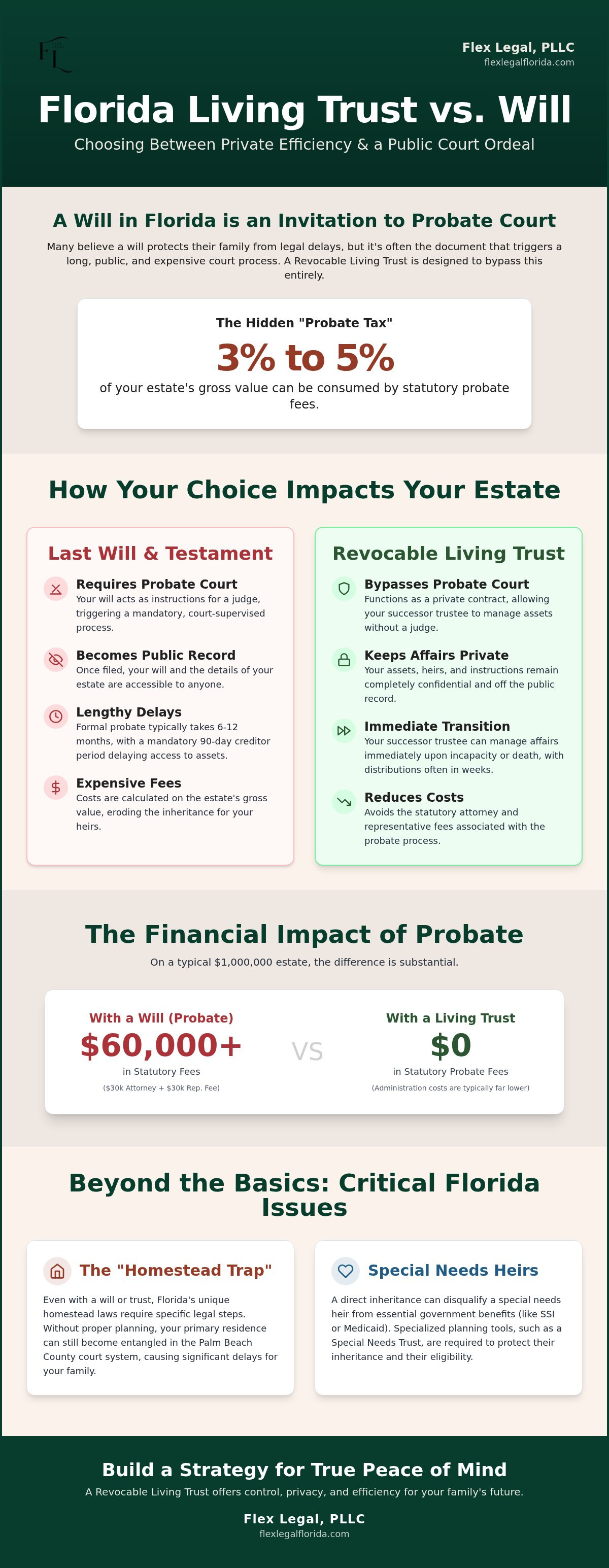
Did you know that in Florida, a Last Will and Testament is actually a formal letter of invitation to the probate court? Many families believe a will is the ultimate shield against legal delays, but it's often the very document that triggers a long, public, and expensive court process. When weighing a Florida living trust vs will, you aren't just choosing between two legal documents. You're choosing between a private, efficient transition and a court-supervised ordeal that can consume 3% to 5% of your estate's value in statutory fees.
It's natural to feel anxious about the complexity of Florida's homestead laws or how to protect a special needs heir without risking their essential benefits. We understand that you want a plan that adapts to your life rather than a rigid set of rules that leaves your family stuck in a West Palm Beach courtroom for months. This guide clarifies how a revocable living trust can bypass probate entirely while keeping your private matters off the public record. We'll break down the 2026 legal updates, including the new $150,000 summary administration threshold, so you can build a strategy that offers true peace of mind.
Table of Contents
Understanding the Core Difference: Florida Will vs. Living Trust
Choosing between a Florida living trust vs will isn't just about paperwork. It's a choice between two different legal engines. A Last Will and Testament acts as an instruction manual for the Florida probate court. It only takes effect after you pass away. A Revocable Living Trust, however, is a separate legal entity that holds your assets while you're alive and continues to function if you become incapacitated. When you compare a Florida living trust vs will, the most significant difference is when and how the document starts working for you.
A Revocable Living Trust functions as a private contract that avoids the need for a judge to "prove" your intent, keeping your family's business behind closed doors.
How a Last Will and Testament Works in Florida
When you use a will, you must appoint a Personal Representative. This person is responsible for gathering your assets, paying your debts, and eventually distributing what remains. However, they can't simply start this work on their own. They must file your will with the Palm Beach County Clerk of the Circuit Court to open a probate case. The court then oversees every step of the process to ensure the instructions are followed correctly.
This is necessary because a will only governs assets held in your individual name. If an account doesn't have a named beneficiary or a joint owner, the bank or the land records office needs a court order to move that asset to your heirs. This reliance on the court system is why wills are often slower and more public than most West Palm Beach families prefer. Your will becomes a public record once it's filed, meaning anyone can see what you owned and who is receiving it.
The Mechanics of a Revocable Living Trust
A Revocable Living Trust operates under the broader framework of U.S. Trust Law, but it's tailored to your specific family goals. You typically serve as the initial Trustee. This means you keep total control over your property, investments, and accounts. You can buy, sell, or change the trust terms at any time. It's a flexible tool that adapts as your life changes.
The real value appears during life's transitions. If you become ill and can no longer manage your affairs, your Successor Trustees take over immediately. There's no need for a public, expensive guardianship proceeding. Upon your death, the trust continues to exist, allowing for the private distribution of assets without court intervention. To make this work, you must complete a step called "funding." This is the process of retitling your assets into the name of the trust. Without funding, the trust is like an empty safe; it's secure, but it doesn't protect the valuables left sitting on the counter.
The Florida Probate Reality: Why Your Choice Matters
Probate isn't just a legal formality; it's a mandatory court process for any assets you own in your name alone at the time of death. If you rely solely on a will, your family must ask a judge for permission to distribute your property. When comparing a Florida living trust vs will, it's vital to recognize that probate makes your private life a public matter. Once filed, your will is accessible to anyone through the court clerk's records. This lack of privacy is often a significant concern for families in West Palm Beach.
When evaluating a Living Trust vs. Will, the financial impact of the "probate tax" is often the deciding factor. Florida statutes set out "presumptively reasonable" fees for attorneys and personal representatives. For an estate valued at $1,000,000, the statutory attorney's fee alone is $30,000. When you add the personal representative's commission, which is another 3% of the first million, the cost of passing assets through probate quickly erodes the inheritance you intended for your loved ones. These fees are calculated on the gross value of the assets, not the equity, meaning a mortgaged home can still trigger high costs.
Time and Delay in the Florida Court System
Efficiency is where the Florida living trust vs will debate becomes most practical. Formal administration in Florida typically lasts 6 to 12 months. During this window, your heirs might wait months just to access basic funds because the law requires a 90-day creditor notification period. A trust operates differently. Because the trust already owns the assets, your successor trustee can often begin distributions within weeks. There is no need to wait for a judge's signature or a court date.
The Cost of Probate vs. the Cost of a Trust
Probate involves a series of unavoidable expenses. You'll face court costs, filing fees of approximately $402 for formal administration, and the statutory fees mentioned earlier. While a living trust requires a higher upfront investment for drafting and funding, it's designed to save your estate thousands in back-end court fees. It removes the friction of the legal system.
Many families find that probate lawyer palm beach county services are far more expensive than proactive planning. At Flex Legal, PLLC, we believe in providing modern solutions that protect your wealth from these unnecessary court costs. If you want to see how an adaptable plan can safeguard your family, exploring our flat-fee options is a great first step.
The Florida Homestead Trap and Special Needs Planning
Florida's constitution provides some of the strongest protections in the country for your primary residence. Many homeowners assume this protection means their house is automatically exempt from the legal system when they pass away. It isn't. While your home is protected from most creditors, it is not exempt from the probate court. If your home is titled in your name alone, your heirs must still petition a judge for an "Order Determining Homestead Status" to legally transfer the title. This is the core of the Florida living trust vs will dilemma for homeowners; a will doesn't stop the court from needing to verify that the property qualifies for protection.
A revocable living trust offers a layer of defense that a will simply cannot provide. Because the trust owns the property, the transfer of your home happens privately and immediately. You avoid the "Homestead Trap" where a house sits in legal limbo for months, unable to be sold or refinanced while the probate case drags on. For families in West Palm Beach, this efficiency is often the primary reason they choose a trust over a standard will.
Navigating Homestead in Your Florida Estate Plan
Your West Palm Beach home is likely your most significant investment. Under a standard will, your house might not pass to your heirs as smoothly as you expect. Florida law actually restricts how you can leave your homestead if you have a surviving spouse or minor children. If your will contradicts these rules, the court may distribute your home according to state statutes instead of your personal wishes.
Using a living trust allows you to navigate these complex constitutional rules while maintaining control. This is especially critical for those searching for asset protection lawyers near me to secure high-value homesteads. By proactive planning, you ensure the home transitions to the next generation without the friction of a public court order.
Protecting Vulnerable Heirs with Special Needs Planning
A simple will can be a disaster for a loved one with disabilities. If you leave an outright inheritance to someone receiving Medicaid or Supplemental Security Income (SSI), those funds could instantly disqualify them from their essential benefits. They would be forced to "spend down" their inheritance on basic care before they could regain their government support. It's a heartbreaking and avoidable situation.
Integrating a Special Needs Trust into your broader estate plan prevents this risk. Unlike a will, which just hands over assets, a trust allows a trustee to manage funds for the heir's "supplemental" needs, such as specialized therapy, travel, or electronics, without affecting their eligibility for public assistance. Consulting a special needs planning attorney ensures your plan is resilient enough to protect your most vulnerable family members. This level of adaptability is a key reason why the Florida living trust vs will comparison favors trusts for modern, diverse family dynamics.
Which Is Right for You? A Comparative Analysis
Deciding between a Florida living trust vs will depends on your current assets and your long-term goals for your family. There isn't a one-size-fits-all answer. Some West Palm Beach residents need the comprehensive protection of a trust, while others find that a simple will covers their basic needs. The Florida living trust vs will decision often comes down to how much you value privacy and how much friction you want to remove for your heirs.
When to Choose a Last Will and Testament
A will is often the right starting point for young adults with few assets and no children. If your estate consists mostly of "payable on death" bank accounts, those assets bypass probate through beneficiary designations anyway. In these cases, a will acts as a backstop for personal belongings. It's also the only legal document where you can name guardians for your minor children. If you're on a strict budget and understand that your heirs will face the probate process later, a will provides a foundational level of security.
When a Revocable Living Trust is the Modern Standard
For homeowners and parents, a trust is usually the superior choice. If you own real estate in Florida, a trust keeps that property out of the court system. It also ensures your family's financial details remain private. A trust is particularly powerful because it plans for your lifetime, not just your death. It works in tandem with a durable power of attorney to provide a seamless transition if you're ever unable to make your own decisions. It's an adaptable tool that grows with your wealth.
Even with a trust, you still need a "Pour-Over Will." This document acts as a safety net. It catches any assets you forgot to retitle into your trust and "pours" them into it after you pass away. While these items might still go through probate, they'll eventually end up exactly where you intended. This combination ensures your plan is resilient and complete.
Ready to see which path fits your family? Schedule a strategy session with Flex Legal, PLLC today to build your custom estate plan.
Taking the Next Step with Flex Legal, PLLC
Traditional law firms often feel like rigid, distant institutions where every interaction is formal and every minute is billed. At Flex Legal, PLLC, we've replaced that outdated model with a partnership-based approach that prioritizes your comfort. We act as your agile ally in West Palm Beach, helping you resolve the Florida living trust vs will debate with absolute clarity. Our goal is to provide sophisticated legal support that feels accessible and modern, rather than intimidating or overly complex.
One of the biggest anxieties in estate planning is the unknown cost. As we've discussed, traditional probate can consume a significant portion of your legacy through statutory fees that surprise many families. We solve this by using a flat-fee model. This approach ensures you have total cost certainty from the very beginning. You'll never receive a surprise bill for a quick phone call or a clarifying question. Our focus remains entirely on the quality of your plan and the results we deliver for your family, not the number of hours we can bill.
We understand that your life is dynamic, and your estate plan should be too. Whether you're navigating the complexities of special needs planning or seeking robust asset protection for your homestead, we tailor our services to your specific family dynamic. We don't believe in one-size-fits-all solutions. Instead, we build adaptable systems that protect your wealth and ensure a smooth, private transition that keeps your loved ones out of the Palm Beach County probate court.
The Modern Estate Planning Experience
We've streamlined our entire process to respect your time and energy. By using modern tools for data collection and maintaining direct, purposeful communication, we remove the friction often associated with professional legal services. Your plan isn't just a static set of papers; it's a living strategy designed to grow alongside your wealth. We avoid the dense jargon that can alienate readers, opting instead for straightforward declarations of value. This ensures you always understand exactly how your assets are being protected.
Schedule Your West Palm Beach Consultation
Securing your family's future shouldn't be a source of constant stress or confusion. When you finally complete your estate plan, you gain more than just a set of legal documents; you gain the peace of mind that comes from knowing your legacy is secure. Whether you're ready to start the process today or want to explore the details further through our revocable trust guide, we're here to support you. Book a strategy session with Flex Legal, PLLC today to take control of your Florida living trust vs will decision and build a plan that truly fits your life.
Take Control of Your West Palm Beach Legacy
Choosing between a Florida living trust vs will is a decision about how much of your hard-earned legacy you want to protect from the public court system. We've explored how a trust can bypass the expensive Florida probate process, safeguard your homestead property, and ensure heirs with disabilities aren't disqualified from vital benefits. While a will serves as a basic foundation, an adaptable living trust offers the privacy and speed that modern West Palm Beach families need.
At Flex Legal, PLLC, we act as your agile legal allies. We combine specialized special needs expertise with transparent flat-fee pricing so you can plan with absolute confidence. You shouldn't have to worry about surprise bills or the slow pace of traditional law firms. Secure your family’s future with a flat-fee estate plan from Flex Legal, PLLC. Taking this step today ensures your family is supported by a dynamic system rather than a static set of rules. You've worked hard for what you have; let's make sure it stays exactly where you intended.
Frequently Asked Questions
Does a living trust avoid probate in Florida?
Yes, a living trust avoids probate for any assets properly titled in the trust's name. Because the trust is a separate legal entity that doesn't "die," there's no need for a judge to oversee the transfer of its property. This process keeps your family out of the public court system entirely. It's a faster, private alternative to a will, which must go through probate to be legally effective.
Is a living trust more expensive than a will in West Palm Beach?
Initially, a living trust has a higher upfront cost because it requires more detailed drafting and asset retitling. However, when comparing a Florida living trust vs will, the trust often saves thousands in the long run. It eliminates statutory attorney fees, which are typically 3% of the estate's value, and mandatory court filing fees. Proactive planning with a flat-fee model provides cost certainty that probate simply cannot match.
Can I change my Florida living trust after it is signed?
Yes, a revocable living trust is designed to be adaptable. You can amend the terms, add or remove assets, or change your successor trustees at any time as long as you have mental capacity. This flexibility allows your estate plan to grow with your family and reflect changes in Florida law. It is a dynamic tool that functions as a support system rather than a static set of rules.
Does a will protect my assets from creditors in Florida?
No, a will does not provide asset protection from creditors. In fact, the probate process requires your personal representative to notify creditors and give them a 90-day window to file claims against your estate. While Florida homestead laws protect your primary residence from most creditors, other assets governed by a will are generally available to satisfy outstanding debts before your heirs can receive their intended inheritance.
Do I need an attorney to create a living trust in Florida?
While you aren't legally required to use an attorney, the complexity of Florida's homestead and tax laws makes professional guidance essential. An error in drafting or a failure to fund the trust properly can result in your estate landing in probate anyway. Working with a West Palm Beach legal ally ensures your trust is resilient, legally sound, and tailored to your specific family dynamic and asset protection goals.
What happens if I die in Florida without a will or a trust?
If you die without a plan, your assets are distributed according to Florida's "intestacy" laws. The state essentially writes a generic will for you, which may not align with your wishes. For example, if you have children from a previous marriage, your spouse might only receive half of your estate. This process is entirely public and requires a full probate administration, regardless of how simple your family structure might be.
Can a living trust help with special needs planning?
Absolutely. A living trust can incorporate specialized provisions to protect heirs with disabilities. By using a third-party special needs trust within your plan, you can provide for a loved one's supplemental needs without disqualifying them from government benefits like Medicaid or SSI. This level of customization ensures that your inheritance enhances their quality of life rather than creating a legal hurdle for their essential support and medical care.
How does Florida homestead law affect my trust?
Florida homestead law places strict limits on how you can transfer your primary residence if you have a surviving spouse or minor children. When weighing a Florida living trust vs will, you must ensure the trust is drafted to respect these constitutional protections. If done correctly, the trust allows your home to pass to your heirs privately and immediately, avoiding the need for a court order to determine homestead status.


Comments