
Funding a Revocable Living Trust in Florida: The 2026 Step-by-Step Guide
- Kelly Mata
- 4 hours ago
- 13 min read

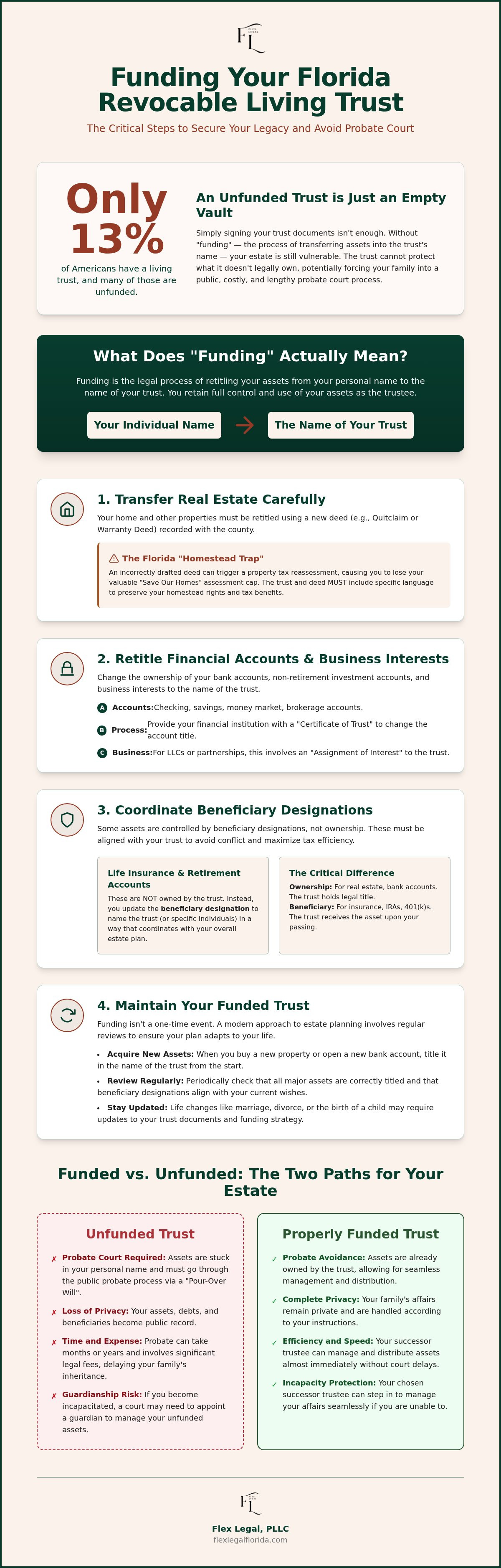
Did you know that only about 13% of Americans have a living trust? Even more surprising is how many of those legal documents sit completely empty, failing to protect the families they were meant to serve. Simply signing your paperwork doesn't secure your legacy. Funding a revocable living trust in Florida is the critical next step that actually moves your assets into the safety of the trust. Without this process, your estate could still end up in a lengthy probate court battle despite your best intentions.
You likely feel a bit overwhelmed by the technicalities of deeds, assignments, and bank retitling. It's common to worry that one wrong move might jeopardize your Florida homestead tax exemption or lead to a mountain of paperwork. We understand that you want a clear, streamlined path to protection without the traditional legal jargon. You deserve a plan that works as hard as you do.
This 2026 guide provides the exact roadmap you need to transfer your assets with confidence. You'll learn how to handle real estate, protect your homestead rights, and coordinate your financial accounts. We'll show you how to bridge the gap between a legal document and a functional estate plan, ensuring your family stays out of court and your affairs stay private.
Table of Contents
What Does It Mean to Fund a Living Trust in Florida?
Signing your estate planning documents is a major milestone, but it's only half the battle. Think of your trust like a high-tech vault. If you don't actually put your valuables inside, the vault serves no purpose. This process, known as funding a revocable living trust in florida, is the mechanical step of changing ownership from your individual name to the name of the trust. Without this transfer, your trust is effectively an empty bucket. It remains a piece of paper that doesn't control anything you own, leaving your legacy vulnerable to the very complications you're trying to avoid.
Under the Florida Trust Code, specifically Chapter 736, a trust only governs the assets it legally holds. If an asset isn't "linked" to the trust through proper retitling, it remains part of your individual estate. The primary goal here is clarity and protection. By properly funding your trust, you ensure your family won't need to hire a probate lawyer Palm Beach County to settle your affairs. You're building a bridge between your current holdings and a future where your estate stays private and out of court. In 2026 estate planning, signing the document is just the foundation; funding is the structure that actually protects you.
The Legal Mechanism of Asset Transfer
When you fund a trust, you're shifting "legal title" while retaining the "beneficial interest." You might wonder, What is a Living Trust? at its core. It's a legal entity capable of holding property. As the grantor, you still use and enjoy the assets just as you did before. You also typically act as the Trustee, which gives you full control over every bank account, deed, or investment. Florida law requires a specific showing of intent to transfer these items. It isn't enough to just list your house on a "Schedule A" at the back of the document. You must physically change the titles at the bank or record a new deed with the county to make the transfer legally binding.
Consequences of an Unfunded Florida Trust
Many people rely on a "Pour-Over Will" as a fallback, but this is a safety net with holes. While this document catches assets you forgot to fund, it doesn't bypass the court. Anything caught by a Pour-Over Will must go through probate before it can be distributed. This leads to several avoidable issues:
Loss of Privacy: Probate is a public record. Anyone can see your asset list, who gets what, and any family disputes that arise.
Guardianship Risks: If you become incapacitated and your accounts aren't in the trust, a court might need to appoint a guardian to manage them, which is a slow and expensive process.
Time and Expense: Probate can take many months, delaying the financial support your family may need immediately.
Funding your trust is the only way to ensure your plan is dynamic and responsive to your needs. It transforms your estate plan from a static set of rules into an active support system that works for you every day.
Transferring Florida Real Estate: Navigating the Homestead Trap
Your home is likely your most significant investment. Moving it into your trust is a vital part of funding a revocable living trust in florida. In the West Palm Beach area, this process typically involves drafting a Quitclaim Deed or a Warranty Deed. While the paperwork might seem like a simple administrative task, the stakes are high. If the deed isn't prepared with specific legal precision, you could accidentally lose the very protections that make Florida real estate ownership so attractive.
You must be careful to avoid the "Homestead Trap." Florida's Save Our Homes amendment limits how much your property's assessed value can increase each year, protecting you from sudden tax spikes. If a transfer is handled poorly, the property appraiser may view it as a change in ownership that triggers a full reassessment at current market rates. To prevent this, your trust and the new deed must contain specific language that preserves your right to the homestead tax exemption and the assessment cap. This Florida Bar consumer guide outlines how these protections function and why they are so vital for residents.
Many homeowners also worry that transferring a mortgaged property will trigger a "due-on-sale" clause. Thankfully, the federal Garn-St. Germain Act protects you. Lenders cannot accelerate your loan simply because you moved your primary residence into a revocable trust. While you don't strictly need the bank's permission, sending a courtesy notice to your mortgage servicer is a proactive step that maintains transparency and ensures your records stay updated.
Recording Deeds in Palm Beach County
In Palm Beach County, the new deed must be filed with the Clerk of the Circuit Court & Comptroller. This filing is the formal act that alerts the world to the change in legal title. After the deed is recorded, you should follow up with the Palm Beach County Property Appraiser to confirm your homestead status remains intact for the 2026 tax year. Don't forget your title insurance. Contact your insurer to see if a simple name change or a specific endorsement is required to keep your policy active under the trust's name.
Out-of-State Property Considerations
If you own property outside of Florida, your trust becomes even more valuable. Without it, your family might face "ancillary probate," which is a separate, costly court process in every state where you own land. By retitling that mountain cabin or beach house into your Florida trust, you consolidate your assets under one administrative umbrella. You'll want to coordinate with local counsel in those jurisdictions to ensure the deeds meet their specific recording requirements while remaining consistent with your overall plan.
For a streamlined approach to these transfers, consider partnering with Flex Legal to ensure every document is filed correctly and your tax exemptions are fully protected.
Retitling Financial Accounts and Business Interests
Once your real estate is secured, the next phase of funding a revocable living trust in florida focuses on your liquid assets and business holdings. This step is often where the tedious work happens, but it's essential for ensuring your daily finances are protected. You'll need a "Funding Toolkit" to get started. This typically includes your Certificate of Trust and your Social Security number, which serves as the tax ID for most revocable trusts in 2026. Having these ready prevents unnecessary friction when dealing with busy bank representatives.
Retitling your bank and brokerage accounts follows a logical 5-step path. First, contact your financial institution to identify their specific trust department requirements. Second, present your Certificate of Trust to prove your authority as Trustee. Third, sign new signature cards. Fourth, review your automatic payments and direct deposits to ensure they remain linked to the retitled account. Finally, verify the title change on your next monthly statement. This process is a cornerstone of Putting Your Legal and Financial Affairs in Order and ensures your cash is immediately available to your successor trustee if needed.
Don't overlook your business interests and tangible goods. For Florida LLCs or corporations, you must execute an "Assignment of Interest" to move your membership or stock into the trust. For your physical belongings like jewelry or fine art, a "General Assignment" document serves as the legal bridge. This catch-all document ensures that even your personal property is technically owned by the trust, avoiding probate for smaller items that might otherwise cause family friction.
Working with Florida Financial Institutions
When you walk into a bank in West Palm Beach, you don't need to hand over your entire trust document. In fact, you shouldn't. Florida Statute 736.1017 allows you to use a Certificate of Trust to prove your authority while keeping your private distribution terms confidential. Ask your banker: "I need to retitle my personal account into the name of my revocable trust; what is your specific process for updating the signature cards?" Remember to address your safe deposit box as well. If the box isn't retitled, your successor might need a court order just to look for your original documents.
Funding Closely-Held Business Interests
Moving a business into a trust requires a bit more agility. You must first review your Operating Agreement or Bylaws for any transfer restrictions that might trigger a buy-sell provision. Once cleared, you can execute a formal assignment. This step is a vital component of your broader business succession planning. By linking your business to your trust, you ensure that the company can continue operating without interruption if you are suddenly unable to lead. It's about creating a dynamic support system for your professional legacy that responds to changes in your life and the market.
Coordinated Beneficiary Designations: Life Insurance and Retirement
Not every asset is moved by recording a deed or retitling a bank account. Some of your most valuable holdings move through contracts known as beneficiary designations. Managing these forms is a subtle but vital part of funding a revocable living trust in florida. Retirement accounts, such as IRAs and 401ks, are unique because they usually shouldn't be "owned" by the trust while you're alive. Attempting to change the owner of an IRA to your trust would likely trigger a massive tax bill. The IRS would treat that transfer as a full distribution of the account. Instead, you control these assets by naming the trust as a beneficiary on the account's paperwork.
The SECURE Act 2.0 has significantly shifted the landscape for 2026. Under these rules, most non-spouse beneficiaries must now empty inherited retirement accounts within ten years. If you want your trust to receive these funds, it must be drafted as a "See-Through" trust. This specific legal structure allows the IRS to look through the trust to the individual human beneficiaries, ensuring they can still use that ten-year withdrawal window. Without this coordination, the account might have to be emptied in just five years, leading to much higher tax rates for your heirs.
Life insurance follows a different logic. You can name the trust as the primary beneficiary if you want the Trustee to manage the payout for minor children or protect it from creditors. Alternatively, many clients name a spouse as the primary and the trust as the contingent beneficiary. This creates a safety net. If your spouse passes away before you, the money flows into the trust's protective structure rather than going through a probate court proceeding.
Life Insurance and the Irrevocable Alternative
For many families, a revocable trust is the perfect home for insurance proceeds. It centralizes the money and avoids court delays. However, if your total estate value is high, you might consider an Irrevocable Life Insurance Trust (ILIT). While a revocable trust keeps you in control, an ILIT can remove the death benefit from your taxable estate entirely. This is a specialized tool for high-net-worth planning. Regardless of the trust type, you must verify that your Trustee has the explicit legal power to collect death benefits and use them to settle your final affairs.
Retirement Accounts and Special Needs Beneficiaries
This is where standard estate plans often fail. If you have a loved one with a disability, a direct beneficiary designation can be a financial disaster. Inheriting an IRA or life insurance payout directly can instantly disqualify a person from vital programs like SSI or Medicaid. Working with a special needs planning attorney ensures these funds flow into a Third-Party Special Needs Trust instead. This coordination is a key part of your total asset protection strategy. We help you align every form with your trust's goals so no asset is left unprotected. If you're ready to secure your family's future, contact Flex Legal today to review your beneficiary designations.
Maintaining Your Funded Trust with Flex Legal’s Modern Approach
The process of funding a revocable living trust in florida is a dynamic journey, not a one-time destination. Your financial life is constantly in motion. You might buy a new car, open a high-yield savings account, or receive an inheritance as you move through 2026. Each of these events requires a conscious effort to ensure the new asset is titled in the name of your trust. If you fail to maintain this alignment, you risk leaving "orphan" assets that will trigger the exact probate process you worked so hard to avoid.
We recommend a "One-Year Review" to all our clients. This annual audit acts as a safety check to ensure no stray assets have slipped through the cracks. It's also the perfect time to update your "Schedule A," which is the master list of assets held by the trust. Keeping this list current is a gift to your successor trustee. It eliminates the stress of a document scavenger hunt during a difficult time. Our flat-fee model is designed specifically to support this ongoing maintenance. You shouldn't have to worry about hourly billing every time you have a quick question about retitling a new investment.
The Flex Legal Difference in West Palm Beach
Traditional law firms often act as "document mills." They hand you a heavy binder and leave you to figure out the funding on your own. We believe that a trust is only as strong as the assets it holds. Our agile approach prioritizes the funding phase, turning complex Florida statutes into clear, actionable steps for your family. We act as your partner, coordinating directly with your financial advisors and CPAs to ensure every part of your wealth is synchronized with your estate plan. This collaborative method ensures your plan is a responsive system rather than a static stack of paper.
Next Steps for Your Estate Plan
The best way to start is with a personal audit of your current asset titles. Check your bank statements, property tax bills, and brokerage summaries. If your name appears individually without the trust designation, your protection is incomplete. In situations where you may face sudden incapacity, a durable power of attorney is an essential tool that allows your chosen agent to complete the funding process on your behalf. If you're ready to ensure your legacy is fully secured, scheduling a consultation with an estate planning attorney West Palm Beach is the final step toward true peace of mind.
Securing Your Legacy Through Action
Your estate plan is more than a binder on a shelf; it's a dynamic shield for your family. By mastering the nuances of funding a revocable living trust in florida, you ensure your home stays protected under homestead laws and your bank accounts remain accessible without court interference. You now have the roadmap to retitle assets and coordinate beneficiary designations, which are the final, essential steps to bypass the probate process.
We pride ourselves on being modern, accessible legal allies in West Palm Beach. Our team specializes in the intersection of Special Needs and Asset Protection, providing the expertise you need for complex family dynamics. With our flat-fee pricing model, you get total transparency and support throughout the entire funding journey without the stress of hourly billing. We're here to act as your agile partner in protecting what you've built.
Secure your legacy with a professionally funded Florida trust—Contact Flex Legal today. You've done the hard work of planning. Now, let's make sure it actually works for the people you love most.
Frequently Asked Questions
Do I need a new deed for my West Palm Beach home to put it in a trust?
Yes, you must record a new deed to officially move your home into your trust. This is typically done through a Quitclaim Deed or a Warranty Deed filed with the Palm Beach County Clerk. This step is the only way to ensure the property bypasses the court system. Simply listing the address in your trust document isn't enough to complete the legal transfer of title.
What happens if I buy a new car after my Florida trust is created?
When you purchase a new vehicle, you can choose to title it in the name of your trust at the dealership. In Florida, many residents keep cars in their individual names because the DMV has simplified transfer processes for heirs. However, for high-value or collector vehicles, titling them in the trust adds a layer of protection. You should always notify your insurance carrier to ensure your policy stays valid.
Will funding my trust cause my Florida property taxes to go up?
No, provided your deed includes the correct legal language. Funding a revocable living trust in florida does not trigger a property tax reassessment or a loss of your Save Our Homes assessment cap. As long as you maintain the right to live in the home as your primary residence, your homestead exemption remains safe. We focus on these specific statutory details to ensure your tax benefits stay fully protected.
Can I still use my bank accounts normally once they are in the trust?
Your daily banking experience stays exactly the same. You'll use the same debit cards, write checks from the same book, and access your accounts through the same mobile app. The only difference is the legal name listed on the bank's internal records. As the Trustee, you have total authority to spend or move your money whenever you wish. It is a modern solution designed for your total convenience.
Is a Certificate of Trust the same thing as the full trust document?
It is a shortened version of your trust that proves your authority without exposing your private distribution terms. Florida banks and financial institutions prefer this document because it's concise and easy to process. Using a Certificate is a key part of funding a revocable living trust in florida because it keeps your beneficiaries' names and your specific inheritance instructions confidential. It provides the proof banks need while maintaining your family's privacy.
Do I need a new tax ID number (EIN) for my funded revocable trust?
In most cases, you don't need a separate EIN while you are alive. Your revocable trust is considered a "grantor trust" by the IRS, so it uses your Social Security number for tax purposes. You'll continue to file your income taxes on your standard Form 1040. A separate tax ID is usually only required after the grantor passes away or if the trust is designed to become irrevocable for specific planning reasons.
What is the biggest mistake Florida residents make when funding a trust?
The most frequent error is failing to finish the job. Many people sign their trust documents but never actually retitle their bank accounts or record their new deeds. This leaves the trust "unfunded" and essentially useless for avoiding probate. Another common mistake is forgetting to update beneficiary forms on retirement accounts. These oversights create a "gap" in your plan that can lead to expensive court proceedings and unnecessary family stress.
Can I fund my trust with assets located outside of Florida?
You certainly can, and it's highly recommended. Moving out-of-state real estate into your Florida trust is the best way to avoid "ancillary probate" in those other states. If you own a vacation home or rental property in another jurisdiction, retitling it into your trust centralizes your estate. This allows your successor trustee to manage all your holdings under one set of instructions, saving your family from multiple court cases in different states. For those with assets in California, the Law Offices of Robert P. Bergman can provide guidance on Heggstad petitions to help secure property that wasn't properly funded.


Comments