
West Palm Beach Parent Death: Florida Family Checklist

Updated: Oct 2
The first priority after a parent dies isn’t dividing belongings or paying every bill. It’s preserving information and property while confirming who has legal authority to act. If you’re trying to figure out what to do when a parent dies in West Palm Beach, separating immediate needs from later estate decisions can help prevent rushed choices from adding stress.
Grief can make practical tasks difficult to sort through. You may be unsure which documents to find, who can speak with banks, or whether your parent’s home and accounts need to go through probate. You don’t have to resolve everything at once, and not every estate requires probate.
This checklist covers what to handle first, what can wait, which records to gather, and how to safeguard property. It also explains why family members should avoid transferring assets, closing accounts, or distributing belongings until authority is clear. Probate or trust administration may apply depending on how assets were owned and whether a trust exists. A West Palm Beach law firm such as Flex Legal can help clarify responsibilities and possible next steps based on your family’s circumstances.
Table of Contents
First Steps After a Parent Dies in West Palm Beach
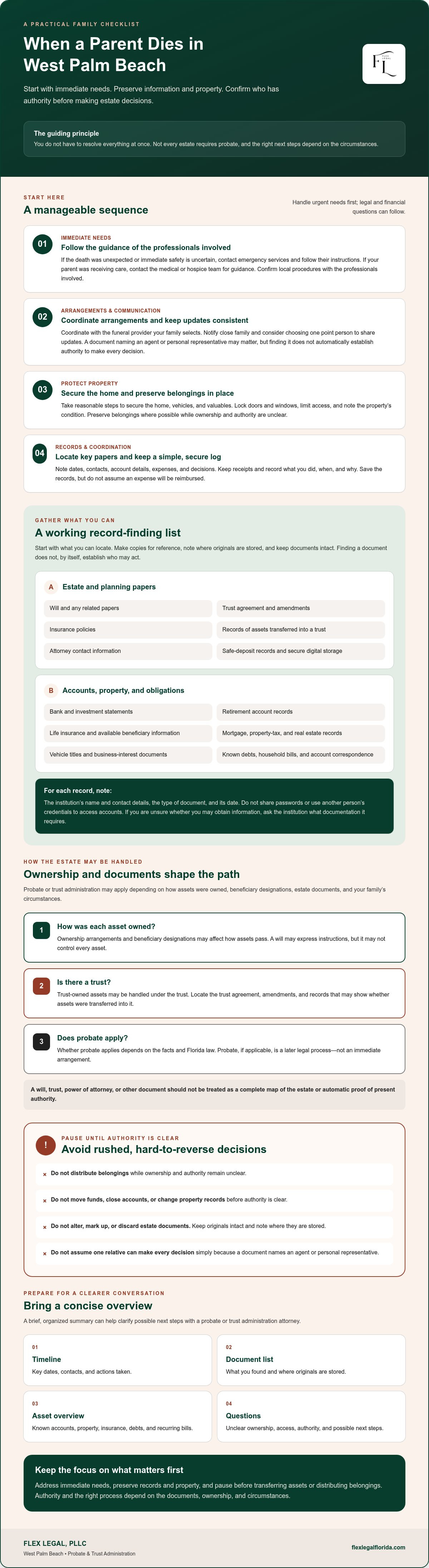
You don’t need to solve every legal and financial question at once. Start with immediate health or safety needs, then turn to arrangements and records as you’re able. The first steps depend on the circumstances, including whether the death was expected and whether your parent left documents naming someone to act.
If the death was unexpected or there’s uncertainty about immediate safety, contact emergency services and follow their instructions. If your parent was receiving care, contact the medical or hospice team for guidance on appropriate next steps. Local procedures can vary, so confirm instructions with the professionals involved rather than relying on assumptions. Paperwork that isn’t needed for immediate arrangements can wait.
Focus first on immediate needs, preserving records, and protecting property. Keep a simple, secure log of dates, contacts, account details, expenses, and decisions. This helps family members stay coordinated and gives an attorney a clearer picture if you seek legal guidance.
Handle immediate arrangements and notifications
Coordinate with the funeral provider your family selects about arrangements and the information they need—independent funeral directors such as Ashley Edwards often provide clear outlines of the initial steps and records required. A document naming an agent or personal representative may be relevant, but finding it doesn’t automatically establish who can make every decision. Review the document and circumstances before assuming one relative has authority. Notify close family, and consider choosing one point person to share updates so everyone receives consistent information.
Probate, if applicable, is a later legal process, not an immediate arrangement. For general background on the probate process, see this overview. Whether probate applies to your parent’s estate depends on the facts and Florida law.
Secure the home and preserve important records
Take reasonable steps to secure your parent’s West Palm Beach home, vehicles, and valuables. Lock doors and windows, limit access, and note the property’s condition. Preserve belongings in place where possible. Avoid removing or distributing property while ownership and authority remain unclear.
Locate identification, insurance information, account records, and any known will, trust, or other estate documents. Make copies for reference and note where originals are stored. Don’t alter or discard them. If you pay an expense or take an action to protect property, save the receipts and record what you did, when, and why. Keep these records, but don’t assume an expense will be reimbursed.
Which Documents and Records Should You Find in West Palm Beach?
As you work through what to do when a parent dies in West Palm Beach, gathering records can help show what your parent owned, owed, and planned. Start with what you can locate. You don’t need to interpret every paper or settle every question right away. Finding a will, trust, or power of attorney also doesn’t automatically establish who may act for the estate now. Authority depends on the document, the circumstances, and applicable law.
A will expresses instructions, but it may not control every asset. Some assets may pass according to beneficiary designations or ownership arrangements, while trust-owned assets may be handled under the trust. Keep documents intact and avoid treating any one paper as a complete map of the estate.
Locate the will, trust, and related estate papers
Check home files, safe-deposit records, attorney contact information, and secure digital storage your parent used. Look for a will, trust agreement and amendments, insurance policies, and records showing whether assets may have been transferred into a trust. Make copies for reference and write down where originals are stored. Don’t mark up, alter, or discard documents. Seek legal guidance before relying on unclear terms.
Collect account, insurance, and property information
Gather records that may help identify assets, debts, and potential beneficiaries. A working list may include:
Bank and investment statements, plus retirement account records
Life insurance policies and available beneficiary information
Mortgage, property-tax, and real estate records
Vehicle titles, business-interest documents, and known debts
Recurring household bills and account correspondence
For each record, note the institution’s name and contact details, the type of document, and its date. Don’t share passwords or use another person’s credentials to access accounts. If you’re unsure whether you’re authorized to obtain information, ask the institution what documentation it requires.
Keep a simple inventory in a secure location. Note missing records and questions as you find them instead of filling gaps with assumptions. This helps distinguish what’s documented from what still needs confirmation. If a trust or will contains unclear language, preserve the wording and ask a qualified professional how it may apply to your family’s circumstances.
If questions about estate documents or asset ownership remain, speaking with a lawyer may help clarify whether probate administration or trust administration could be relevant. Families seeking case-specific guidance can learn more about probate and trust administration through Flex Legal, a West Palm Beach law firm.
How Florida Probate and Trust Administration May Affect a Parent’s Estate
Part of understanding what to do when a parent dies in West Palm Beach is determining how each asset is owned and whether it has a beneficiary designation. Probate is a court-supervised process for addressing qualifying estate matters. It may involve identifying estate assets, addressing claims, and transferring property under applicable law and court oversight. Whether probate applies depends on the documents, ownership records, beneficiary designations, and your family’s specific facts.
A will can provide instructions, but it doesn’t necessarily avoid probate or authorize relatives to distribute assets immediately. A personal representative’s authority depends on Florida law and the court process, including appointment when required. Until authority is clear, don’t assume you can access, sell, or transfer estate property.
When probate may be part of the process
Probate may be relevant for assets held solely in a parent’s name without an effective beneficiary designation or another transfer arrangement. For example, a solely owned account or real estate interest may need review, but the outcome depends on its title, documents, and circumstances. A jointly owned asset may pass differently if it includes a right of survivorship. These examples don’t determine what will happen with a particular estate.
Filing deadlines, required notices, and court procedures can depend on the matter and current Florida rules. Confirm them before acting, including current Palm Beach County court and clerk instructions. For a broader local overview, see this Palm Beach County probate guide.
When a trust or beneficiary designation may guide administration
Trust administration is distinct from probate. A successor trustee may administer assets held in a trust under its terms and applicable law, but a trust may not hold every asset a parent owned. Property left outside the trust may need separate review. Similarly, life insurance or retirement benefits may be directed by beneficiary designations, depending on the policy or account records and the circumstances.
Compare account titles, current beneficiary information, and estate documents rather than relying on the will alone. A Florida revocable trust guide offers more context on how trusts fit into estate planning. These general distinctions can help organize questions, but they don’t determine the correct process for a specific asset.
What Should You Avoid Doing Before Authority Is Clear?
After a death, relatives may want to settle bills or divide belongings quickly, especially when they agree about what seems fair. But ownership and legal authority aren’t always obvious from family relationships, a will, or verbal conversations. Family agreement alone may not establish legal authority to act. Before transferring funds, changing records, or giving away property, pause to confirm who can act and what the relevant documents allow.
Preserve information that can help explain what happened and what remains to be addressed. Keep account statements, receipts, letters, emails, and records of the home or other property’s condition. If an urgent safety, security, insurance, or mortgage issue arises, contact the relevant provider or a qualified professional promptly to ask what steps are appropriate. Don’t assume a relative can make decisions about an account or property without confirming their authority.
Pause before paying debts or distributing property
Collect bills and record their due dates, but don’t assume you can use a particular source of funds to pay them. Avoid using a deceased person’s bank account, debit card, or credit card unless your right to do so has been confirmed. Don’t sell, gift, or divide belongings based only on informal family agreement. An asset may have a specific owner, beneficiary, or trust arrangement, and the correct process depends on the circumstances.
If a bill appears urgent, document it and ask the relevant institution what information it needs. For decisions about estate funds or property, case-specific legal guidance can help your family understand its options before taking an action that may be difficult to reverse.
Protect family members and preserve options
Keep communication factual and save copies of important messages and decisions. If relatives disagree, address the issue before anyone changes property, moves money, or discards records. A brief written record of what’s disputed and what everyone has agreed to preserve can help prevent misunderstandings while the family seeks guidance.
If a dependent with disabilities may inherit or receive funds, pause before making distributions. An inheritance could have implications for benefits or planning, depending on the person’s circumstances. Seek advice from a professional familiar with special needs planning before transferring assets or changing arrangements.
Questions about authority, potential probate, or trust administration don’t mean every family must follow the same legal path. If you’re unsure what action is appropriate, contact Flex Legal to discuss probate or trust administration before distributing assets or paying obligations from estate funds.
Getting Help With Probate or Trust Administration in West Palm Beach
Legal guidance may be useful when family members aren’t sure who can act, a will or trust raises questions, or it’s unclear how particular assets should be handled. An attorney can help explain the personal representative’s role, assess whether probate may apply, or clarify trust administration responsibilities. That doesn’t mean every estate needs an attorney or a court proceeding. The right approach depends on the estate’s documents, ownership records, family circumstances, and current Florida and Palm Beach County requirements.
Before speaking with a lawyer, prepare a short, factual overview. Include the date of death, key events since then, people already contacted, and decisions made. Add copies or a list of known wills, trusts, account records, insurance documents, property information, and outstanding bills. Note which originals you’ve located and where they’re kept. You don’t need a complete inventory to ask useful questions.
Timing and next steps can vary. Check filing requirements, notices, deadlines, and property concerns against the facts and current procedures rather than assuming they match another family’s experience or a general article.
Questions to ask about the next steps
Bring the questions causing the most uncertainty. For example, ask:
Which assets may need probate, and which might transfer through a trust, beneficiary designation, or ownership arrangement?
Who has authority to act, and what documents could confirm that authority?
Are there deadlines, notices, or concerns involving the home, insurance, or mortgage that need attention in this specific situation?
Clear answers can help your family distinguish what requires action from what can wait, without making assumptions about the outcome or timing.
Discuss the estate with a West Palm Beach law firm
Flex Legal, PLLC is a West Palm Beach law firm offering probate administration and trust administration. A conversation can help clarify whether either service may fit your family’s circumstances. Not every death requires probate, and trust administration is a distinct process. Share the documents and questions you have, even if some information is missing. Case-specific guidance is more useful than treating a general checklist as a legal determination.
To discuss possible next steps, contact Flex Legal about estate administration. Start with the basic timeline and records you’ve gathered, then ask what additional information may help clarify your family’s situation.
Take the Next Step With Clarity
After a parent dies, you don’t have to settle every question at once. Focus first on immediate needs, preserve important records and property, and confirm who has authority before paying debts or distributing assets. Whether probate or trust administration may apply depends on how assets were owned, the documents in place, and your family’s circumstances.
Knowing what to do when a parent dies in West Palm Beach starts with a steady plan, not rushed decisions. Record what you’ve found and what remains uncertain. Then seek case-specific guidance if questions about the personal representative’s role, probate, or a trust are difficult to resolve.
Flex Legal is a West Palm Beach-based Florida law firm offering probate administration and trust administration. The firm is owned and operated by founding attorney Jennifer L. Flexer, Esq. If you need help assessing possible next steps, contact Flex Legal about probate or trust administration. Bring the timeline and records you’ve gathered so you can discuss your family’s situation.
Frequently Asked Questions
What should I do immediately after my parent dies in Florida?
First, address immediate health and safety needs. If the death was unexpected or you’re unsure what to do, contact emergency services and follow their instructions. If your parent was receiving medical or hospice care, ask that team for guidance. Then notify close family, coordinate with the funeral provider your family selects, and take reasonable steps to secure the home and vehicle. Paperwork that isn’t needed for immediate arrangements can wait.
Do I need to file a will with the Palm Beach County court?
Florida’s current guidance says the person holding the will must file it with the clerk of court within 10 days after learning of the death. Filing the will doesn’t necessarily mean probate is required or establish who may immediately manage estate assets. Because court procedures can change, confirm the current filing process with the Palm Beach County Clerk of the Circuit Court or a Florida probate attorney.
Can I use my deceased parent’s bank account to pay funeral expenses?
Don’t use your parent’s bank account or payment cards unless you’ve confirmed you’re authorized to do so. A family relationship or access to account credentials doesn’t necessarily grant authority. Contact the bank to ask what documentation and procedures apply, and keep funeral-related bills and receipts. If the account is jointly owned or has a designated beneficiary, its treatment may depend on the account terms and circumstances.
Does every estate in West Palm Beach have to go through probate?
No. Whether probate is needed depends on how assets were owned, whether beneficiary designations apply, what estate documents exist, and your family’s circumstances. Some assets may pass through a trust or another transfer arrangement, while other property may require court-supervised administration. A will alone doesn’t necessarily avoid probate. For a West Palm Beach family, reviewing titles and account records can help identify questions to confirm with a Florida attorney.
How long does probate take in Palm Beach County?
There isn’t one reliable timeline for every Palm Beach County probate. The process can depend on the type of administration, the estate’s assets and debts, required notices, court procedures, and whether disputes arise. Don’t rely on another family’s experience as a prediction. Before making plans around a deadline, ask a probate attorney to review the estate’s circumstances and verify current Palm Beach County court requirements.
What happens if my parent dies without a will in Florida?
If a parent dies without a will, Florida’s intestacy laws generally determine how probate assets are distributed. The result depends on the family situation and which assets are subject to probate. Beneficiary-designated or trust-owned property may follow different rules. Don’t assume that being a child automatically gives you authority to manage the estate. A Florida probate attorney can help clarify who may serve and which assets may be affected.
Can I sell my parent’s house before probate is complete?
Don’t assume you can sell the house before probate is complete. The answer may depend on how title is held, whether the property is in a trust or jointly owned, and who has authority to act. A will or family agreement alone may not be enough. Before listing, signing a contract, or transferring the deed, confirm the ownership and authority requirements with a Florida probate or trust administration attorney.


Comments