
How to Fund a Special Needs Trust in Florida: A 2026 Tactical Guide
- Kelly Mata
- Jul 18
- 12 min read

Updated: Jul 21
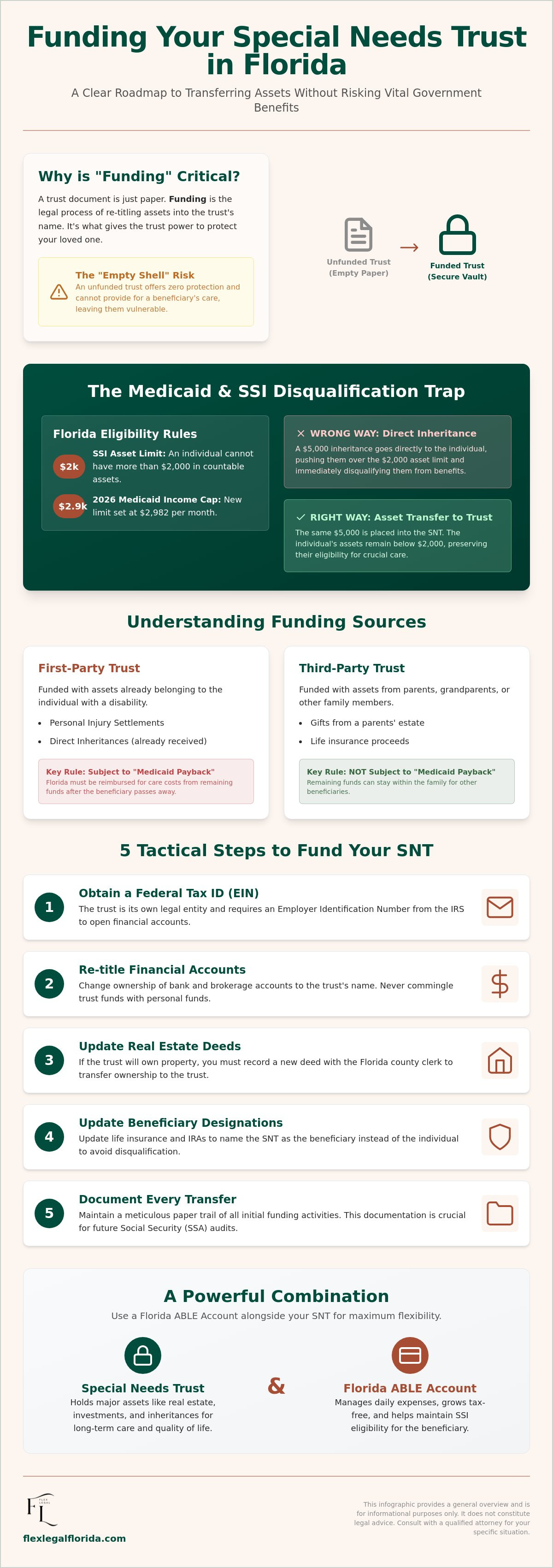
Setting up the legal paperwork is only half the battle; the real risk lies in the actual transfer of assets. One misplaced deposit or an incorrectly titled account can immediately trigger a Medicaid disqualification, leaving your loved one without the support they rely on. If you're feeling overwhelmed by "payback" rules or the sheer volume of financial forms, you aren't alone. Most families in Palm Beach County worry that a single tactical error while learning how to fund a special needs trust in Florida will jeopardize their child's future eligibility for SSI or long-term care.
This guide provides a clear roadmap to move assets without risking vital government benefits. We'll show you how to manage the 2026 requirements, including the new $2,982 Medicaid income cap and the latest ABLE account integration strategies. You'll learn the exact steps to move cash, real estate, and life insurance into a secure structure that provides lasting peace of mind. We break down the specific mechanics of asset transfer, ensuring your family's legacy acts as a bridge to a better life rather than a barrier to essential care.
Table of Contents
What Does it Mean to Fund a Special Needs Trust in Florida?
Drafting a trust document is a vital first step, but the document itself doesn't protect your loved one until it actually owns something. Funding is the formal, tactical process of re-titling assets from your personal name into the name of the trust. Think of the trust as a high-tech vault; if you don't physically move the valuables inside and lock the door, the vault's sophisticated security features are useless. In the legal world, we call an unfunded trust an "empty shell." It exists on paper, but it lacks the assets necessary to provide for a beneficiary's care.
When families ask about how to fund a special needs trust in Florida, they often wonder about timing. You can choose immediate funding, which happens while you're alive, or testamentary funding, which occurs after you pass away through your will or life insurance. For many, a hybrid approach works best to maintain flexibility. Understanding What is a Special Needs Trust? is the foundation, but executing the transfer of titles is what actually preserves government benefits. In Florida, where Medicaid and SSI rules are strictly enforced, the way you move these assets determines whether your child remains eligible for state-funded programs.
First-Party vs. Third-Party Funding Sources
The source of the money changes the rules of the game. First-party funding involves assets that already belong to the disabled individual, such as a personal injury settlement or a direct inheritance they've already received. These trusts are subject to "payback" rules, meaning Florida Medicaid must be reimbursed for care costs after the beneficiary passes away. Third-party funding uses money from parents or grandparents. Because this money never belonged to the beneficiary, these trusts aren't subject to Medicaid payback, allowing remaining funds to stay within the family for future generations.
The Medicaid and SSI Disqualification Trap
Florida's 2026 eligibility rules are unforgiving. For an individual to qualify for Supplemental Security Income (SSI), they cannot have more than $2,000 in countable assets. Countable assets for Florida Medicaid purposes include cash, bank accounts, stocks, mutual funds, and any real estate that does not serve as the individual's primary residence. If a well-meaning relative leaves a direct gift of $5,000 in a will, that "accidental" funding can immediately trigger a benefits cutoff. Proper funding ensures assets are held by the trust rather than the individual, keeping them below the $2,000 threshold while still providing for their specialized needs and quality of life.
Tactical Steps: How to Fund an SNT with Cash and Real Estate
Moving from the theory of trust creation to the reality of asset transfer requires a shift in focus. You're no longer just signing documents; you're coordinating with financial institutions and government offices to ensure every asset is correctly labeled. This execution phase is where the protection actually begins. When you're ready to learn how to fund a special needs trust in Florida, the process starts with four foundational steps designed to satisfy both bank requirements and federal oversight.
Obtain a Federal Tax ID (EIN): The trust is its own legal entity and cannot use the beneficiary's Social Security number for tax reporting. You'll need an Employer Identification Number (EIN) from the IRS to open any financial accounts.
Re-title existing accounts: You don't simply "add" the trust to an account. You must change the ownership of bank and brokerage accounts into the name of the Trustee on behalf of the trust.
Update Florida real estate deeds: If the trust will own property, you must record a new deed with the county clerk to reflect the trust's ownership.
Document every transfer: Keep a clear paper trail of the initial funding. This documentation is vital for maintaining eligibility for public assistance benefits during future Social Security Administration (SSA) audits.
Transferring Bank and Investment Accounts
Working with Florida banks requires precision. You'll need to present the bank with a "Certificate of Trust" rather than the full document to protect privacy. Ensure the account name follows the exact legal format; typically "The [Name] Special Needs Trust dated [Date]." It's essential to avoid commingling funds. Trust money should never sit in your personal checking account, even for a day. Keeping these assets strictly separate prevents the SSA from viewing trust money as your personal "countable" income. If you need help organizing these initial transfers, our team at Flex Legal specializes in Special Needs Planning to help you get the details right.
Florida Homestead and the Special Needs Trust
Many West Palm Beach families worry that moving a home into a trust will cause them to lose their Florida Homestead tax exemption. It's a valid concern because the exemption provides significant property tax savings and protection from creditors. Fortunately, Florida law allows you to transfer a primary residence into a third-party special needs trust while keeping the Homestead status intact, provided the trust is drafted correctly. You must ensure the beneficiary retains the "equitable title" or the right to reside in the home for life. Navigating these constitutional protections is complex, but it's a vital part of protecting the family home for a child's future while maintaining current tax benefits.
Funding Through Beneficiary Designations: Life Insurance and IRAs
While re-titling a bank account is a visible, immediate action, beneficiary designations are the "hidden" gears of your financial plan. These designations act as a private contract between you and your financial institution, often bypassing your will entirely. If you name a disabled child as a direct beneficiary on a life insurance policy or retirement account, the payout becomes their personal property the moment you pass away. This oversight can instantly disqualify them from essential programs like Florida Medicaid. To avoid this, you must learn how to fund a special needs trust in Florida using precise beneficiary language that directs funds to the trust instead of the individual.
Coordinating these designations requires a thorough audit with your West Palm Beach estate planning attorney. You'll need to review every policy, from employer-sponsored life insurance to private brokerage accounts. For additional context on managing these complex assets, AGED, Inc. Special Needs Trust Information provides excellent Florida-specific resources for families navigating these choices. The goal is to ensure that your "contractual" assets align perfectly with your "titled" assets, creating a seamless safety net that doesn't trigger a benefits cliff.
Maximizing Life Insurance for Future Care
Life insurance is often the most efficient way to provide a significant influx of cash to a trust. Many families utilize "Second-to-Die" or survivorship policies, which pay out only after both parents have passed. These policies are generally more affordable and provide capital exactly when the child's primary caregivers are no longer there to provide support. To update your policy, you must request a Change of Beneficiary form from your carrier and use specific phrasing such as: "The Trustee of the [Child's Name] Special Needs Trust, dated [Date]." To protect the beneficiary's eligibility, the Trust must be the designated recipient of the death benefit so the funds never touch the child's personal bank account.
IRAs, 401(k)s, and the SECURE Act Exception
Retirement accounts present a unique opportunity under current tax laws. While the SECURE Act generally requires inherited IRAs to be emptied within ten years, disabled individuals often qualify as "Eligible Designated Beneficiaries." This status allows the trust to "stretch" the required minimum distributions over the child's entire lifetime, providing a steady stream of supplemental income while deferring taxes. When determining how to fund a special needs trust in Florida with retirement assets, your attorney will likely recommend an "Accumulation Trust" structure. Unlike a standard "Conduit Trust," an Accumulation Trust allows the trustee to keep IRA distributions within the trust's protective shell rather than being forced to pay them out directly to the beneficiary, which would count as income for SSI purposes.
The ABLE Account: A Complementary Funding Tool
While a trust is the heavy lifter for long term asset protection, the Florida ABLE account (Florida ABLE United) serves as a nimble, daily financial tool. In 2026, the annual contribution limit for an ABLE account has risen to $20,000. These accounts offer tax free growth and distributions, provided the funds are used for disability related costs. Because of the ABLE Age Adjustment Act, individuals who developed their disability before age 46 are now eligible to open these accounts, significantly expanding access for many Florida families. The strategy for how to fund a special needs trust in Florida often involves using the trust to "feed" the ABLE account, creating a flexible system for managing smaller, frequent expenses.
It's vital to monitor the balance closely. While the first $100,000 in an ABLE account is disregarded for Supplemental Security Income (SSI) purposes, any amount over that threshold will cause SSI payments to be suspended. Medicaid eligibility, however, typically remains intact even if the balance exceeds this limit. This makes the ABLE account a perfect companion to a trust; the trust holds the large, multi generational assets, while the ABLE account handles the liquid cash needed for immediate quality of life improvements.
ABLE Account vs. Special Needs Trust
An ABLE account is generally less expensive to establish than a formal trust and allows the beneficiary more direct control over their spending. However, the strict annual contribution limits make it unsuitable for holding large inheritances or life insurance payouts. A unique advantage in Florida is that funds remaining in an ABLE account upon the beneficiary's death are not subject to Medicaid recovery, which differs from first party trusts. A Qualified Disability Expense is any expense related to the beneficiary's disability that is made for their benefit, including housing, health prevention, and basic living expenses.
The Funding Loop: Moving Money Between ABLE and SNT
One of the most effective tactical moves for Palm Beach County families is using the "funding loop." If a trustee pays for a beneficiary's rent directly from a Special Needs Trust, it can trigger a reduction in SSI benefits due to "In-Kind Support and Maintenance" rules. By moving money from the trust into the ABLE account first, the beneficiary can then pay for housing from the ABLE account without any SSI penalty. This strategy keeps more money in the child's pocket while maintaining the trust's protective shell. To build a coordinated plan that utilizes both tools, reach out to us for Special Needs Planning to ensure your funding strategy is as efficient as possible.
Executing Your Funding Plan with a West Palm Beach Attorney
Completing the legal paperwork is a significant milestone, but the protection doesn't truly begin until the assets are moved. This transition from drafting to execution is where many families feel the most friction. To bridge this gap, we provide a "Funding Letter" for our clients. This document serves as a tactical instruction manual that you can hand directly to your bank teller, insurance agent, or financial advisor. If you are currently working with a firm like MRA Advisory Group for your investment management, they can use this letter to ensure your portfolio transitions seamlessly into the trust. It clearly outlines the legal requirements for how to fund a special needs trust in Florida, ensuring that your financial institutions title every account correctly on the first attempt.
Navigating Florida's specific probate and trust laws requires a precise touch. Attempting to handle these transfers without professional guidance often leads to "leaks" where assets accidentally remain in a personal name, triggering the very Medicaid disqualifications you've worked to avoid. At Flex Legal, we've designed a modern approach to special needs planning that prioritizes clarity and speed. Our flat-fee packages provide the financial certainty you need, allowing us to focus entirely on the strategic alignment of your assets rather than billable hours.
The Role of the Trustee in Ongoing Funding
Funding isn't a one-time event; it's a lifelong commitment to the trust's integrity. Your chosen trustee must understand how to accept future gifts from well-meaning relatives or unexpected inheritances without disrupting the beneficiary's SSI eligibility. We recommend an annual review of the trust's asset list to ensure no new accounts or properties have been acquired outside the trust's protective shell. If you're still in the early stages of this process, carefully Choosing a Trustee for a Special Needs Trust in Florida is the most critical decision you'll make to ensure these tactical transfers are managed correctly for decades to come.
Next Steps for Palm Beach County Families
The path to a secure future starts with a clear inventory of what you own. Before our first meeting, we suggest preparing a comprehensive list of your bank accounts, real estate holdings, and life insurance policies. This preparation allows us to move quickly into the tactical phase of your plan. Our process is designed to be streamlined and accessible, acting as an agile ally for West Palm Beach families who value results over traditional legal formality. Secure your child's future with a strategic funding plan today. We're here to help you turn your legal documents into a functional, funded safety net.
Build a Functional Safety Net for Your Child
Protecting your child's future is about more than just the legal language in a folder; it requires the active, ongoing management of your family's assets. You now have the tactical knowledge to understand how to fund a special needs trust in Florida, from re-titling bank accounts to auditing your life insurance beneficiaries. By integrating ABLE accounts and utilizing precise funding letters, you can ensure your loved one stays within the strict 2026 Medicaid and SSI eligibility limits. These steps transform a static legal document into a dynamic support system that adapts as your family's needs evolve.
At Flex Legal, we simplify this complex process through our specialized expertise in Florida Special Needs Planning. We provide personalized funding instructions for every client and use transparent, flat-fee pricing so you always know what to expect. You don't have to navigate these technical transfers alone. Our team acts as your modern ally, helping you execute a plan that preserves both your legacy and your child's vital benefits. Book a Flat-Fee Special Needs Planning Consultation today to start building a roadmap that offers true peace of mind. Your child's future is worth the precision of a well-funded plan.
Frequently Asked Questions
Can I fund a Special Needs Trust with my own house in Florida?
Yes, you can transfer your primary residence into a third party trust while maintaining Florida's vital Homestead tax exemption. This process requires specific language in the trust deed to ensure the beneficiary retains the equitable right to reside in the home. It protects the property from the beneficiary's potential creditors while ensuring they have a permanent, stable place to live.
Is there a limit to how much money can be in a Special Needs Trust?
There is no legal cap on the total value of assets held within a Special Needs Trust. Unlike ABLE accounts, which can affect SSI eligibility once the balance exceeds $100,000, a trust can hold millions of dollars without jeopardizing government benefits. This makes the trust the superior tool for managing large life insurance payouts or significant family inheritances over many decades.
What happens if I forget to fund the trust before I die?
If the trust isn't funded during your lifetime, it remains an "empty shell" until your assets are transferred through your probate estate or via beneficiary designations. This is known as testamentary funding. While it still works, it often means your family must navigate the Florida probate process before the money becomes available to support your loved one's needs.
Can family members contribute to the Special Needs Trust directly?
Family members can contribute to a third party trust at any time, which is a common strategy for grandparents or extended family. They can make direct gifts or name the trust as a beneficiary in their own wills and retirement accounts. We help families coordinate these efforts so everyone knows how to fund a special needs trust in Florida without accidentally triggering a benefits cliff for the child.
Does funding a Special Needs Trust protect assets from creditors in Florida?
Funding a trust provides powerful asset protection because the assets are legally owned by the trustee, not the beneficiary. Since the beneficiary doesn't own the property and can't control the distributions, creditors generally cannot reach the trust's principal to satisfy debts. This creates a secure financial shield that protects your loved one from lawsuits or financial exploitation.
What is the difference between funding a first-party and third-party trust?
The difference is determined by whose money is being used. A first party trust is funded with the beneficiary's own money, such as a lawsuit settlement, and requires a Medicaid "payback" upon death. A third party trust is funded by assets from anyone else and allows the remaining funds to stay in the family without reimbursing the state for Medicaid costs.
How do I move an existing IRA into a Special Needs Trust?
You cannot move your own IRA into a trust while you're alive without triggering a massive tax bill. Instead, you update the beneficiary designation form with your IRA custodian to name the trust as the primary beneficiary. This ensures the account transfers into the trust's protective shell only after you pass away, allowing for tax efficient distributions over the child's lifetime.
Will the state of Florida take the money back after the beneficiary dies?
Florida only seeks reimbursement for Medicaid expenses if the funds are held in a first party trust. If you use a third party trust funded with your own assets or life insurance, the state has no legal claim to the money. This allows you to name other children or relatives as remainder beneficiaries, ensuring your family's wealth stays within the family tree.


Comments