
How to Contest a Will in Palm Beach County: The 2026 Florida Guide

Emotional outrage alone will not overturn an unfair estate plan; Florida probate courts demand concrete evidence and decisive action before the statutory clock runs out. If you are facing sudden exclusion from an estate or suspect undue influence behind a suspicious last-minute revision, knowing how to contest a will in Palm Beach County is essential to protect your rightful inheritance.
Discovering that you have been unexpectedly disinherited is deeply unsettling, especially while confronting strict procedural deadlines and unfamiliar legal jargon. You don't have to face that pressure without clarity. In this 2026 guide, you'll discover the exact legal grounds required to invalidate a disputed document, the unforgiving deadlines enforced under Florida law, and the specific procedural filing steps mandated by the 15th Judicial Circuit. We will examine how to evaluate your standing, gather decisive proof, and take strategic action to protect your family's estate assets.
Table of Contents
Legal Grounds and Standing for Contesting a Will in Florida
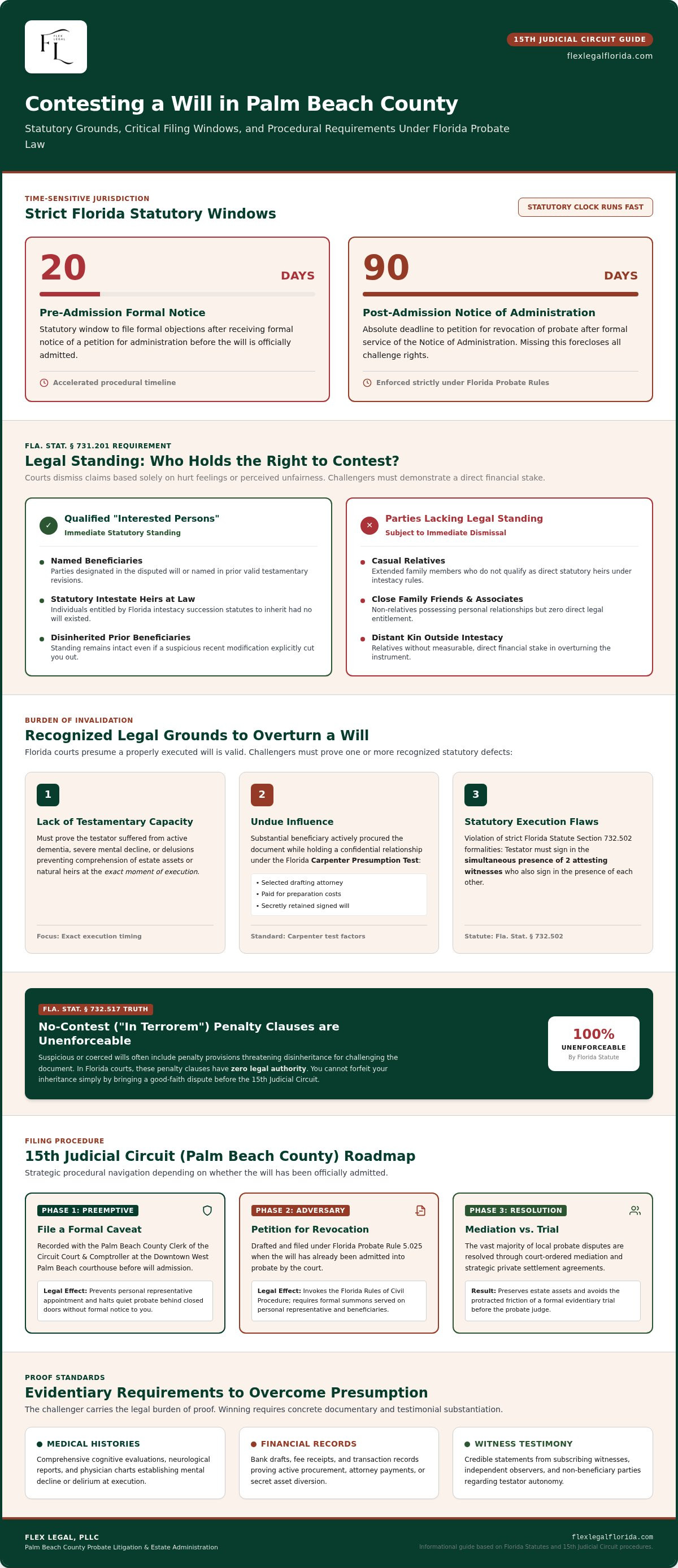
Challenging a testamentary document requires far more than showing hurt feelings or perceived unfairness. To understand how to contest a will in Palm Beach County successfully, you must establish immediate statutory standing and demonstrate recognized legal defects before the probate court.
Who Has Legal Standing to File a Contest?
Under Florida Statute Section 731.201, only an "interested person" can dispute an estate plan. You must possess a direct, financial stake in the outcome. Standing generally belongs to:
Beneficiaries named in the disputed document or prior versions
Intestate heirs at law who would inherit if no will existed
Casual relatives, family friends, and distant relatives who don't inherit under intestacy rules lack standing to sue. Even if a suspicious recent revision explicitly disinherited you, your standing under a prior valid will or statutory intestacy preserves your legal right to challenge the change.
The Legal Bases for Invalidating a Florida Will
Florida courts presume a properly executed will is valid. Overturning it requires establishing recognized common grounds for contesting a will under Florida law:
Lack of Testamentary Capacity: Proving the testator suffered from active dementia, severe mental decline, or delusions that prevented them from understanding their assets or natural heirs at the precise moment of execution.
Undue Influence: Demonstrating that a substantial beneficiary actively procured the document while holding a confidential relationship. Under Florida's established Carpenter presumption test, judges evaluate factors like who selected the drafting attorney, who paid for the preparation, and whether the beneficiary secretly retained the signed instrument.
Statutory Execution Flaws: Florida Statute Section 732.502 requires strict formalities. A will is invalid if the testator failed to sign in the simultaneous presence of two attesting witnesses who also signed in front of each other.
The Truth About Florida No-Contest Clauses
Suspicious or coerced wills often include intimidating penalty language, known as in terrorem or no-contest clauses. These provisions threaten to disinherit anyone who challenges the document. Under Florida Statute Section 732.517, penalty clauses for contesting a will are completely unenforceable.
You cannot forfeit your inheritance simply by bringing a good-faith dispute before the 15th Judicial Circuit. While you should evaluate the evidentiary strength and assets involved before filing, fear of an empty penalty clause shouldn't hold you back. Knowing how to contest a will in Palm Beach County gives you the clarity to dismantle bad-faith maneuvers and protect your rightful legacy.
Steps to File a Will Contest in the 15th Judicial Circuit
Initiating a formal dispute requires strict compliance with local court procedures. To navigate how to contest a will in Palm Beach County, you must follow a methodical path through the 15th Judicial Circuit to ensure your claims are heard before estate assets disperse.
Filing a Caveat Before the Will Is Admitted
If you suspect an invalid will is about to surface, proactive defense is your best strategy. Filing a caveat with the Palm Beach County Clerk of the Circuit Court & Comptroller halts proceedings before the court admits the document or appoints a personal representative.
Once a caveat is recorded at the downtown West Palm Beach courthouse, the clerk cannot admit any will without providing formal notice to the caveator. This requirement forces the proponent to serve you formal papers, preventing executors from quietly probating a defective document behind closed doors.
Petitioning for Revocation of Probate Post-Admission
When the court has already admitted the will, your procedural remedy shifts. You must draft and file a formal Petition for Revocation of Probate under Florida Probate Rule 5.025.
This filing initiates a formal adversary proceeding, which immediately invokes the Florida Rules of Civil Procedure. Your petition must state the exact statutory defects, name all interested parties, and be served alongside formal summons to the personal representative and every named beneficiary. Establishing your legal standing to contest a will within this initial complaint is essential to prevent immediate dismissal by the presiding probate judge.
Gathering Critical Pre-Trial Discovery and Records
Winning a will challenge hinges on swift fact-gathering. The adversary designation unlocks comprehensive civil discovery tools, allowing your legal team to assemble undeniable proof:
Subpoenaing medical records, neurological exams, and pharmacy logs from treating physicians and local Palm Beach County healthcare facilities
Deposing the drafting attorney to uncover who arranged the consultations, who gave drafting instructions, and who paid the legal retainers
Examining financial statements to trace sudden joint account changes or suspicious asset transfers just prior to signing
Building this record demands experienced local insight. Review our guide to working with a probate lawyer in Palm Beach County to see how an agile strategy protects family assets throughout formal administration. If you are preparing to challenge an invalid filing, partnering with Flex Legal gives you direct access to focused counsel right here in West Palm Beach.
Critical Deadlines: Florida Statutory Windows You Cannot Miss
Timing controls everything in probate disputes. If you miss a statutory cut-off by even a single afternoon, the court will dismiss your case outright. Mastering how to contest a will in Palm Beach County requires constant vigilance over the calendar, as Florida law enforces two distinct, highly unforgiving deadlines.
The 90-Day Notice of Administration Window
Once a will is admitted to formal probate, the personal representative must serve interested parties with a formal document known as the Notice of Administration. This is typically delivered via certified mail with return receipt requested.
Under Florida Statute Section 733.212, receipt of this document triggers an inflexible three-month (approximately 90-day) window to file your objection. If you submit your petition on day 91, the court has no jurisdiction to hear your grievance. The clock starts ticking the moment you or your designated agent accepts service, making an immediate legal review essential to assemble supporting evidence before that window snaps shut.
The Accelerated 20-Day Formal Notice Rule
A far more dangerous procedural trap occurs before the court ever admits the will. If the petitioner chooses to serve you with formal notice of the Petition for Administration under Florida Statute Section 733.203 prior to probate entry, your response timeline drastically contracts.
You have exactly 20 calendar days from the date of formal service to draft, file, and serve written defenses challenging the petition. Failing to respond within this 20-day sprint results in a procedural waiver. You lose the legal right to challenge the will's validity later, allowing the questionable document to proceed directly into probate administration completely uncontested.
Exceptions and Jurisdictional Bars to Late Filings
Florida probate judges treat statutory deadlines as strict jurisdictional bars rather than flexible guidelines. While civil court rules occasionally grant relief for excusable neglect, probate divisions apply the statute of limitations with uncompromising rigidity.
Narrow exceptions exist only under extraordinary circumstances, such as proven extrinsic fraud where an adversary deliberately hid the decedent's death or actively concealed court filings to prevent you from knowing about proceedings. Outside of direct deception, judges in the local probate divisions will not forgive a blown statutory window. Proactive strategy is the only safeguard. Exploring advice from an estate planning attorney in West Palm Beach illuminates how clear, early preparation keeps potential litigation risks from derailing an estate. Complying with strict 15th Judicial Circuit Probate Division procedures ensures your family retains its rightful voice when learning how to contest a will in Palm Beach County.
Evidentiary Requirements to Prove Your Will Contest Case
Contesting a testamentary document requires substantiating your allegations with clear, admissible proof. In Florida probate proceedings, the initial burden rests on the will proponent to establish proper execution. Once established, the evidentiary burden shifts entirely to the challenger to prove incapacity, fraud, or undue influence.
Demonstrating Undue Influence with the Carpenter Factors
Because bad-faith actors rarely operate openly, undue influence relies heavily on circumstantial proof. Florida courts evaluate specific non-exclusive criteria to decide if active procurement occurred:
The substantial beneficiary was physically present when the testator discussed or signed the will.
The beneficiary recommended or directly retained the attorney who drafted the disputed terms.
The influencer held private knowledge of the will's contents prior to execution.
The influencer systematically isolated the decedent from lifelong family connections, screening calls and blocking visits.
Establishing these active procurement patterns triggers a legal presumption of undue influence, forcing the proponent to justify the sudden changes.
Medical Evidence for Lack of Testamentary Capacity
Occasional memory lapses or eccentric quirks do not prove legal incapacity. Florida law presumes a person is competent unless you can demonstrate they lacked capacity at the exact moment of signing.
Securing contemporary clinical records is vital. Your legal team must subpoena Mini-Mental State Examination scores, clinical nursing notes, and neurologist assessments recorded around the execution date. When these records reveal heavy narcotics, advanced delirium, or late-stage Alzheimer's disease, retained medical experts can interpret these diagnostics to show the probate judge that the testator could not understand the nature and extent of their property.
Financial Forensics and Communication Paper Trails
Documenting a decedent's mental state is only half the battle; tracing asset diversions is equally critical. Fiduciaries acting in bad faith often make suspicious financial maneuvers right alongside testamentary revisions.
Forensic discovery focuses on sudden changes to joint checking accounts, modifications to payable-on-death designations, and uncharacteristic liquidations. Subpoenaed text messages and emails often capture instances of manipulation or coercion. Comparing these sudden, erratic transfers against long-standing estate directives, such as a prior revocable trust, highlights deliberate deviations from the decedent's true legacy plans.
Uncovering these hidden paper trails is central to mastering how to contest a will in Palm Beach County. If you need a decisive advocate to expose predatory estate practices, contact Flex Legal to build a strategic evidentiary case in West Palm Beach.
Resolving Probate Disputes: Settlement, Mediation, and Trial
Filing a formal petition doesn't automatically mean enduring years of bitter courtroom warfare. Most contested estate disputes in South Florida resolve long before a judge issues a final ruling. Understanding how to contest a will in Palm Beach County involves knowing when to negotiate strategically and when to present your case at trial.
The Role of Mandatory Mediation in Probate
Judges in the 15th Judicial Circuit routinely refer contested probate matters to mandatory mediation before granting a trial date. This structured conference requires all parties to meet with a neutral, court-certified mediator to explore a resolution.
Mediation provides significant advantages over trial. Proceedings remain strictly confidential, keeping private family finances and sensitive medical records out of the public court docket. A mediated settlement agreement allows families to redistribute contested estate assets equitably on their own terms. Settling out of court eliminates unpredictable litigation expenses, saves months of delay, and avoids protracted appellate challenges.
Taking a Contested Will Case to Bench Trial
When settlement talks fail, your dispute moves to a formal evidentiary hearing. Florida probate trials are bench trials, meaning a single judge decides the outcome without a jury.
Your litigation counsel must present a tight, compelling narrative using treating physician testimony, drafting attorney cross-examinations, and forensic financial evidence. If the judge rules the will invalid due to undue influence, execution errors, or mental incapacity, the court revokes probate. Estate administration then proceeds under the terms of a prior valid will or distributes assets according to Florida statutory intestacy.
How Flex Legal Protects Your Inheritance Rights
Challenging an improper testamentary instrument demands swift, decisive representation without traditional legal friction. Flex Legal, PLLC, led by Jennifer L. Flexer, Esq., delivers modern, results-driven advocacy directly in West Palm Beach. Our firm pairs direct attorney access with transparent pricing models, ensuring you never face unpredictable billing friction during sensitive family transitions.
We cut through administrative delays to protect what belongs to you. Whether negotiating a balanced settlement or presenting decisive evidence at a court hearing, we serve as an agile ally in your corner. If you are ready to evaluate your legal options and learn how to contest a will in Palm Beach County, schedule a consultation with Flex Legal today.
Protect Your Legacy Before the Statutory Clock Expires
Successfully challenging an unfair estate plan comes down to swift timing, concrete proof, and knowledgeable procedural navigation. Understanding how to contest a will in Palm Beach County ensures you meet strict statutory filing deadlines, identify valid legal defects like undue influence or execution flaws, and present compelling evidence before the 15th Judicial Circuit.
You don't have to navigate strict court procedures or high-stakes family tension alone. Flex Legal, PLLC, led by founding attorney Jennifer L. Flexer, Esq., delivers direct, client-focused representation without intimidating legal bureaucracy. Our West Palm Beach office pairs deep local knowledge of Palm Beach County probate court operations with agile advocacy designed to resolve disputes efficiently.
Suspect an unfair or invalid will? Contact Flex Legal to evaluate your probate rights today. With decisive action and the right local ally in your corner, you can protect your rightful inheritance and bring clarity to your family's future.
Frequently Asked Questions
How much time do I have to contest a will in Palm Beach County?
You have three months from the service date of a Notice of Administration to file an objection. If you receive pre-probate formal notice of a Petition for Administration instead, your response window drops to just 20 calendar days. Missing these statutory deadlines permanently bars your claim in the 15th Judicial Circuit.
Can I contest a will if I was completely disinherited?
Yes, you can challenge a will if a recent revision left you with nothing. Your legal standing derives from being an intestate heir under Florida law or a named beneficiary in an earlier, valid will. When learning how to contest a will in Palm Beach County, establishing that prior economic interest is the key to entering the courthouse.
Will a no-contest clause penalize me for challenging a Florida will?
No, Florida courts do not enforce penalty or no-contest clauses. Under Florida Statute Section 732.517, any provision designed to disinherit a beneficiary for disputing an estate plan is void. You can initiate a good-faith will challenge before a West Palm Beach judge without forfeiting your existing statutory rights.
What is the most common legal ground for overturning a will in Florida?
Undue influence is the most frequently litigated basis in local probate divisions. Challengers must demonstrate that a trusted confidant actively procured the testamentary changes for their personal benefit while the decedent was vulnerable. Lack of testamentary capacity and improper signing formalities serve as other frequent statutory grounds.
Do will contest cases have jury trials in Palm Beach County?
Probate disputes do not involve juries. Contested will proceedings are bench trials, meaning a single presiding circuit judge evaluates witness credibility, reviews medical documentation, and decides the validity of the document. Most proceedings take place at the main Palm Beach County Courthouse in downtown West Palm Beach.
Can I contest a will before the testator passes away?
No, Florida law strictly prohibits challenging a will while the person who created it is still alive. A will remains revocable and conveys no legal rights until death occurs. If you suspect an elder is suffering exploitation or cognitive decline during life, a separate petition for guardianship proceedings is the proper legal route.
Who pays attorney fees in a Florida will contest proceeding?
Litigants typically cover their own legal fees during ongoing proceedings. The court holds statutory discretion to assess costs and attorney fees against specific parties or order them paid from the estate, especially if an executor defends an invalid document in bad faith. Knowing how to contest a will in Palm Beach County with clear evidence protects you from meritless litigation risks.


Comments