
Grounds for Contesting a Will in Florida: A 2026 Legal Guide
- Kelly Mata
- 1 day ago
- 12 min read

You discover a sudden, late-stage change to a loved one's estate plan that favors a recent caregiver or a distant relative, and the inheritance you expected has vanished. It's a gut-wrenching moment that often leads to more questions than answers. While the feeling of unfairness is real, the law requires more than just a sense of betrayal to intervene. You must prove specific grounds for contesting a will in Florida to protect your rights and ensure your loved one's true intentions are actually honored.
It's completely natural to feel anxious about legal costs or potential family conflict when you suspect foul play. We understand that you're looking for clarity, not more complexity. This 2026 guide is designed to validate your concerns and provide a straightforward path forward. You'll learn exactly who has the legal "standing" to file a claim, the four pillars required to challenge a document, and the strict three-month deadline that governs these cases. From understanding how the latest 2026 probate thresholds affect your strategy to filing a petition in Palm Beach County, we've outlined the essential steps to help you act as an agile protector of your family's legacy.
Table of Contents
Who Has Standing to Contest a Will in Florida?
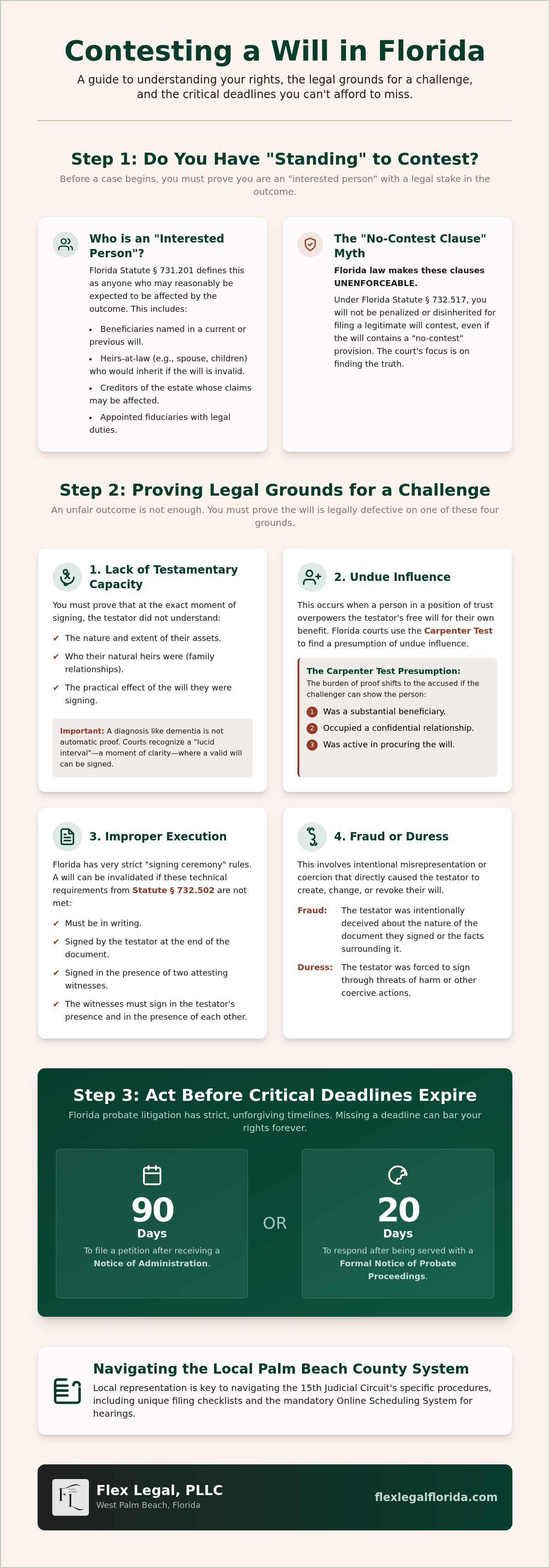
Before you can argue the specific grounds for contesting a will in Florida, you must prove you have a seat at the table. In legal terms, this is known as "standing." Florida Statute § 731.201 defines an "interested person" as anyone who may reasonably be expected to be affected by the outcome of the probate proceeding. This isn't a broad, catch-all label. It's a specific legal hurdle. If the court decides you don't have a direct financial or legal stake in the result, your case will be dismissed before the evidence is even heard.
Many people assume that being a close relative provides an automatic pass, but that isn't always true. Standing often comes from your position in a previous version of the estate plan. If a Will contest successfully invalidates the current document, the court typically looks to the most recent valid version. If you were a beneficiary in a 2022 version but were suddenly removed in a suspicious 2026 update, you have standing. Even fiduciaries or creditors can sometimes qualify as interested parties if the estate's administration directly impacts their legal claims or duties.
Heirs-at-Law vs. Named Beneficiaries
When there isn't a prior will to fall back on, Florida's intestacy laws dictate the path forward. Heirs-at-law, such as spouses or children, usually have standing because they'd inherit the assets if the court tosses the current will. However, disinherited children still need to show that the contested document is the only barrier to their inheritance. Florida's homestead laws add another layer of complexity. Because the state has strict rules about how a primary residence can be devised, a surviving spouse or minor child often has standing regardless of what the written will claims.
The 'No-Contest' Clause Myth in Florida
It's common for people to hesitate because they fear a "no-contest" clause. These are provisions designed to scare off challengers by threatening to revoke their inheritance if they lose in court. In many states, these clauses are a serious risk. But in our state, Florida Statute § 732.517 makes these clauses completely unenforceable. You won't lose your designated inheritance just for filing a challenge based on valid grounds for contesting a will in Florida. Florida is one of the few states that strictly prohibits these penalty clauses, ensuring that the court's primary focus remains on the truth rather than intimidation tactics.
The 4 Primary Grounds for Contesting a Will in Florida
While standing gets you through the courthouse door, your case ultimately rests on proving one of the specific grounds for contesting a will in Florida. Under Florida Statute 732.518, the law focuses on the testator's state of mind and the circumstances surrounding the will's creation. You aren't just arguing that a document feels unfair; you're proving it's legally defective. Florida courts generally recognize four main categories of challenges, ranging from mental capacity to the technical way the document was signed.
Proving Lack of Capacity
Lack of capacity is often the first suspicion when a will changes late in life. To prove this, you must show the testator didn't understand the nature of their assets, who their natural heirs were, or the practical effect of the document they signed. It's a common misconception that a diagnosis of dementia or Alzheimer’s automatically invalidates a will. Florida courts recognize the concept of a 'lucid interval,' which is a temporary window of mental clarity during which a person with a cognitive impairment can still execute a valid legal document. Proving incapacity requires looking at the specific moment the pen hit the paper, rather than a general medical history.
The Carpenter Test for Undue Influence
Undue influence is more subtle than capacity issues. It occurs when someone uses their position of trust to overpower the testator's free will. To navigate this, Florida judges rely on the 'Carpenter Test.' This test creates a presumption of undue influence if a substantial beneficiary occupied a 'confidential relationship' with the testator and was active in procuring the will. Factors of 'active procurement' include things like recommending the attorney, being present during the signing, or keeping the will in their possession after execution. If these elements exist, the burden of proof shifts, requiring the beneficiary to prove the will wasn't the result of coercion. If you feel a caregiver or relative crossed the line, an agile ally in probate administration can help you evaluate these specific factors.
Fraud, Forgery, and Improper Execution
Finally, fraud and improper execution round out the list of grounds for contesting a will in Florida. Fraud involves intentional deception, like tricking someone into signing a document they don't realize is a will. Improper execution is a purely technical failure. If the witnesses weren't in the same room or the testator didn't sign at the very end of the document, the will may be void regardless of the person's intent. Florida is incredibly strict about these formalities, and even a small deviation from the required 'signing ceremony' can be enough to invalidate an entire estate plan.
Technical Grounds: Improper Execution and Insane Delusions
Sometimes, the most effective grounds for contesting a will in Florida have nothing to do with the testator's overall mental health or the influence of a third party. Instead, the challenge focuses on the mechanics of the document itself. Florida is a "strict compliance" state. This means that if the specific rituals of the "signing ceremony" aren't followed to the letter, the court can throw out the entire will, regardless of whether it accurately reflects the deceased person's wishes. It's a high bar that requires an agile legal eye to navigate.
Technical defects often provide a clearer path to invalidating a suspicious document than the subjective arguments of undue influence. If a will was signed in a hospital bed or a rushed home meeting, the likelihood of a procedural error increases. These technicalities serve as a vital safeguard within the Florida Probate Code, ensuring that every estate plan meets a minimum standard of reliability and transparency.
Florida's Strict Execution Formalities
Florida Statute § 732.502 dictates exactly how a will must be signed. The testator must sign at the very end of the document in the presence of at least two attesting witnesses. Crucially, those witnesses must sign in the presence of the testator and in the presence of each other. While some states allow for "substantial compliance," Florida probate judges don't accept "close enough." If a witness stepped into the hallway for a phone call while the other was signing, the document is likely void. In 2026, while digital and remote witnessing protocols are more common, they still require strict identity verification and real-time audio-visual monitoring to satisfy the "conscious presence" requirement. Any slip in these digital logs can become a primary reason for a challenge.
The Insane Delusion Doctrine
An insane delusion is a specific ground for a challenge that's distinct from general dementia or lack of capacity. It occurs when a testator holds a fixed, false belief that has no basis in reality, even when faced with evidence to the contrary. For example, if a father suddenly disinherits a daughter because he's convinced she's a secret agent, despite having no reason to believe so, that's a legal delusion. To succeed, you must pass the "But-For" test: you have to prove that the will would not have been written the way it was but for that specific delusion. This often requires sophisticated medical testimony to distinguish between a "bad opinion" or a family grudge and a true monomania that invalidated the testator's free will.
The Florida Probate Litigation Timeline: Deadlines You Can't Miss
Timing is the invisible hurdle in every estate dispute. You might have ironclad grounds for contesting a will in Florida, but the court won't even look at your evidence if you miss the filing window. Florida law is unforgiving regarding time. Once the probate process begins, the clock starts ticking immediately. This creates a high-pressure environment where speed and precision are your best assets. You can't challenge a will while the testator is still alive; however, the moment they pass and a petition is filed, you must be ready to act.
During a contest, the Personal Representative typically continues to manage the estate, though their power to distribute assets is usually frozen until the dispute is resolved. They have a fiduciary duty to defend the will using estate funds, which is why having an agile ally on your side is vital to balance the scales. If you wait too long, the assets you're fighting for could be distributed, making recovery significantly more difficult.
Statutes of Limitations in Florida Probate
The primary deadline is the 90-day window established by Fla. Stat. § 733.212. This period begins the moment you're served with a "Notice of Administration." This isn't a suggestion; it's a jurisdictional bar. If you don't file your objection within those three months, your claim is "forever barred" under Florida law. An even more dangerous trap is the 20-day "Formal Notice." If you receive notice of a petition for administration before the will is even admitted to probate, you have only 20 days to file your objection. Missing this in Palm Beach County means the court will likely admit the will without further input from you, regardless of any suspicions of fraud or lack of capacity.
The Litigation Process: From Petition to Trial
Your journey begins by filing a "Petition for Revocation of Probate." This document formally outlines your grounds for contesting a will in Florida and asks the judge to set the document aside. Once filed, you enter the discovery phase. This is where we dig deep into medical records, financial audits, and depositions of witnesses who were present during the signing. Most Florida probate courts require mediation before a case can proceed to trial. This is a streamlined opportunity to reach a settlement without the friction of a full courtroom battle. If you've received a formal notice and need to protect your interests, our team can provide the probate administration support you need to meet these strict deadlines.
Navigating a Will Contest in Palm Beach County with Flex Legal
Challenging an estate plan is a high-stakes endeavor that requires more than just a list of legal arguments. While you now understand the grounds for contesting a will in Florida, applying that knowledge within the 15th Judicial Circuit demands a specific, localized strategy. At Flex Legal, we act as your agile ally, moving quickly to secure evidence and meet the court's strict procedural requirements. We don't just provide a static set of services; we adapt our approach to the unique family dynamics and financial complexities of your case. We prioritize streamlined communication and transparent billing to reduce the anxiety often associated with legal fees. You'll always know where your case stands and what the next adaptive step will be.
Why a Local West Palm Beach Attorney Matters
The 15th Judicial Circuit in Palm Beach County has its own set of rules that can trip up even experienced litigators. For example, the court requires a specific ten-category checklist to be filed with certain petitions. If this isn't handled correctly, your case can be rejected before it even reaches a judge's desk. Having a local Probate Lawyer in Palm Beach County is essential for managing these administrative nuances, including the use of the circuit's Online Scheduling (OLS) system for proposed orders. Local representation also provides a distinct advantage when it involves valuing high-value South Florida real estate, which often serves as the centerpiece of these disputes. We understand the local market and the specific expectations of West Palm Beach probate judges.
Strategic Asset Protection During Litigation
Litigation can be particularly draining for families with vulnerable members. We often integrate our expertise in Special Needs Planning into our litigation strategy to ensure that a contest doesn't accidentally disqualify a beneficiary from essential government benefits during the dispute. In many cases, we find that a revocable trust might have been a more secure option for the testator, as trusts often avoid the public scrutiny and technical execution traps inherent in wills. Our goal is to protect the estate from depletion during a long legal battle, ensuring that the assets remain for the rightful heirs. If you're ready to protect your inheritance and seek a resolution based on valid grounds for contesting a will in Florida, scheduling a consultation with Jennifer L. Flexer, Esq. is your next step toward clarity.
Securing Your Family’s Legacy in 2026
Challenging a suspicious estate plan is about more than a financial dispute; it’s about restoring the true intentions of your loved one. Successfully navigating this path requires a clear understanding of the grounds for contesting a will in Florida and the discipline to meet strict probate deadlines. Whether you suspect undue influence or a technical failure in the signing ceremony, the window to act is narrow. Missing a 90-day filing deadline can permanently bar your claim, making immediate, strategic action essential.
Flex Legal, led by Jennifer L. Flexer, Esq., provides the modern, transparent support you need to handle complex probate litigation in West Palm Beach. We act as an agile partner, prioritizing clarity and results over rigid, traditional models. You don't have to face this uncertainty alone. Protect your inheritance—schedule a consultation with Flex Legal today. By choosing a forward-thinking ally, you can move toward a resolution that honors your family and secures your future.
Frequently Asked Questions
Can you contest a will in Florida if you were left out?
Yes, you can contest a will if you qualify as an "interested person" who would inherit if the document were invalidated. Simply being disinherited doesn't mean you'll win, but it gives you the legal right to file a claim. You must then prove specific grounds for contesting a will in Florida, such as undue influence or a lack of mental capacity, to succeed in court.
What is the time limit for contesting a will in Florida?
The standard time limit is 90 days after you receive a formal Notice of Administration. However, if you're served with a "Formal Notice" before the will is even admitted to probate, your window shrinks to just 20 days. These deadlines are strictly enforced by Florida judges. Once these periods pass, your right to challenge the document is generally barred forever, making speed essential.
Is it hard to prove undue influence in Florida?
Proving undue influence is complex because coercion often happens behind closed doors. However, the "Carpenter Test" simplifies this by shifting the burden of proof. If you show a beneficiary had a confidential relationship with the testator and was active in procuring the will, they must prove the document wasn't the result of pressure. This legal shift makes it much more manageable for families to seek justice.
Does Florida recognize no-contest clauses in a will?
No, Florida doesn't recognize no-contest or in terrorem clauses. Under Florida Statute § 732.517, these provisions are completely unenforceable. You can challenge a document without risking the inheritance already designated for you in that specific version. This protection ensures that beneficiaries can bring valid concerns to the court's attention without fear of financial retaliation or being penalized for seeking the truth.
How much does it cost to contest a will in Florida?
Costs vary based on the complexity of the litigation and the discovery phase. You'll face initial court filing fees, such as the $401 charge for formal administration in Palm Beach County. Beyond these fees, expenses often include depositions, medical experts, and financial audits. We focus on modern, transparent billing methods to ensure you have a clear understanding of the financial landscape as we move forward together.
Can a will be contested after probate is closed in Florida?
It's extremely difficult to contest a will once the estate is closed and the assets are distributed. Florida law prioritizes the finality of estate administration to protect heirs and creditors. Unless you can prove "fraud on the court" or show that you were never given proper legal notice of the proceedings, the court won't reopen the case. Acting during the initial 90-day window is vital.
What happens to the estate while a will is being contested?
While a contest is pending, the estate's assets are typically held in place to prevent improper distribution. The Personal Representative continues to manage property and pay necessary taxes, but they cannot distribute inheritance until the court rules on the will's validity. This "freeze" ensures assets remain available for the rightful heirs once the grounds for contesting a will in Florida are fully resolved.
Can a power of attorney change a will in Florida?
No, an agent acting under a Power of Attorney cannot sign or change a will on behalf of the principal. A will is a personal document that requires the testator's own signature and specific intent. If someone uses a Power of Attorney to alter an estate plan or move assets into a trust they control, it often provides strong evidence for an undue influence claim in court.


Comments