
What Is a Health Care Surrogate in Florida? A 2026 Legal Guide
- Kelly Mata
- 2 days ago
- 12 min read

What if your family is forced to guess your medical wishes during a crisis because your voice isn't legally documented? It's a heavy burden to leave on loved ones, yet many people delay this conversation until it's too late. You might be wondering, what is a health care surrogate in Florida and how does it actually function when you're in a hospital bed? In Palm Beach County, having a clear plan isn't just about paperwork; it's about maintaining control over your body and your future.
We understand that thinking about medical emergencies feels overwhelming. You want to ensure your family doesn't argue over your care or keep you on life support against your wishes. This guide explains how a Florida health care surrogate protects your medical autonomy and outlines the exact steps to designate one effectively. We'll explore the specific signing requirements for 2026, clarify the differences between surrogates and Living Wills, and help you build a modern estate plan that offers true peace of mind. By the end of this article, you'll have a clear path forward to protect your rights and simplify the process for those you love most.
Table of Contents
What Is a Health Care Surrogate in Florida?
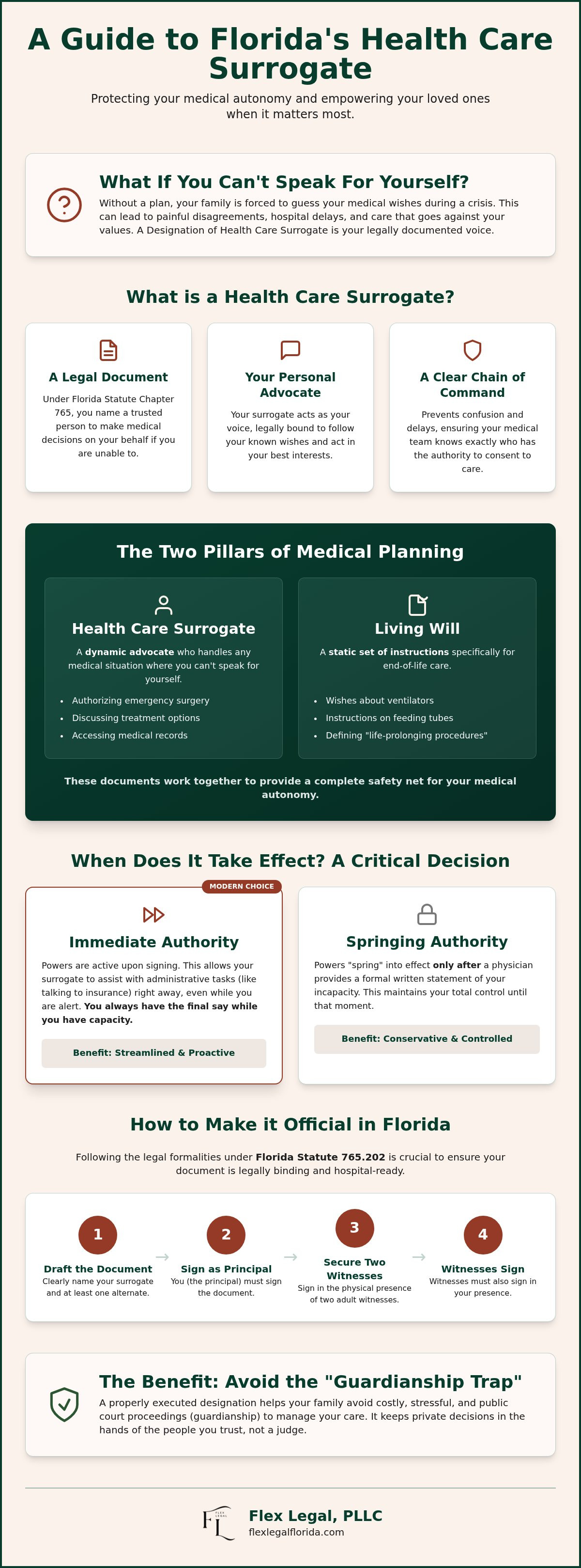
Under Florida law, specifically Chapter 765 of the Florida Statutes, a Designation of Health Care Surrogate is a legal document that allows you to name a trusted person to make medical decisions on your behalf. This role, sometimes called a Health Care Proxy in other jurisdictions, provides a clear chain of command for your medical team. Your surrogate's primary responsibility is to act as your voice. They don't just guess what you want; they're legally bound to make decisions based on your known preferences and best interests.
Many people mistakenly believe that their spouse or adult children can automatically make these choices. While Florida has a "proxy" hierarchy for those who haven't planned ahead, relying on it is risky. Without a formal designation, hospitals may face internal delays or legal confusion while trying to determine who has the authority to sign consent forms. Having a designated surrogate ensures that your care isn't paused while a hospital's legal department debates your next of kin's status. It's a proactive way to maintain control over your treatment, even when you're unconscious or otherwise unable to communicate.
Surrogate vs. Living Will: Do You Need Both?
It's common to confuse a Health Care Surrogate with a Living Will, but they serve different purposes. A Living Will is a static set of instructions regarding end-of-life care, such as your wishes about ventilators or feeding tubes. In contrast, a surrogate is a dynamic advocate who handles any medical situation where you can't speak for yourself. For example, if you suffer a stroke and need immediate surgery but aren't in a terminal state, a Living Will won't apply. However, your surrogate can step in to review the risks with your doctor and authorize the procedure. These two documents work together to provide a complete safety net for your medical autonomy.
When Does the Designation Take Effect?
Before a 2015 update to Florida law, most designations were "springing," meaning they only became active after a doctor formally declared you incapacitated. This often created a "wait and see" period that frustrated families. Today, you can choose to give your surrogate "immediate" authority. This doesn't mean they can override you while you're alert; it simply allows them to help with administrative tasks like talking to insurance companies or picking up medical records while you're still capable of making your own clinical choices. A health care surrogate serves as your legal medical advocate and HIPAA-authorized representative, holding the power to access your records and make clinical decisions on your behalf.
Immediate vs. Springing Authority: A Critical Florida Distinction
Understanding what is a health care surrogate in Florida changed significantly on October 1, 2015. This legislative update, reflected in Florida Statute 765.202, gave residents more flexibility in how they empower their medical advocates. You now have two primary choices for when your surrogate's powers begin: immediate or springing authority. Trust is the engine of this choice. While both options protect your autonomy, they function differently during the early stages of a medical event.
Springing authority remains the more conservative approach. It acts as a dormant safety net that only activates when a physician provides a formal written statement of incapacity. This ensures you maintain total control as long as you can communicate. However, it can create friction. Families often face stressful delays while waiting for a doctor to finalize the paperwork required to "trigger" the document. In a fast-moving medical crisis, these extra steps can feel like unnecessary hurdles.
Immediate authority is a modern, agile solution that streamlines support. It allows your surrogate to assist with administrative tasks, like talking to insurance companies or reviewing lab results, while you're still alert and oriented. It doesn't mean they can override your decisions. As long as you're conscious, you remain the primary driver of your care. This option is popular in West Palm Beach for those who want a partner to handle the complex "red tape" of modern healthcare without waiting for a clinical crisis.
The Role of Capacity in Florida Law
Capacity is a clinical determination, not a legal one. In Florida, your attending physician typically makes this call if you're unable to understand the risks and benefits of a proposed treatment. Once incapacity is documented, your surrogate is notified and takes over the decision-making process. It's helpful to remember that while this document covers your body, a durable power of attorney is the necessary counterpart for managing your finances during that same period. Both documents work together to provide a seamless transition of authority.
HIPAA and Information Access
Privacy laws are intentionally strict. Without specific HIPAA language, a hospital might refuse to share your records with your loved ones. A standard medical release often lacks the longevity needed for long-term incapacity. A well-drafted document clarifies what is a health care surrogate in Florida by including robust HIPAA authorizations. This ensures your surrogate is recognized as your "personal representative" under federal law, allowing them to speak with specialists and insurance carriers without being blocked by bureaucratic hurdles. If you're ready to secure your autonomy, exploring flexible estate planning options can provide the legal clarity you need.
Choosing the Right Health Care Surrogate in West Palm Beach
Legally, the bar for who can serve as your medical advocate is straightforward. Any competent adult over the age of 18 qualifies. Florida law doesn't even require your surrogate to be a resident of the state. However, understanding what is a health care surrogate in Florida requires looking beyond these legal minimums. You're choosing a medical advocate who may have to make life-altering choices under extreme pressure. Choosing the right person clarifies what is a health care surrogate in Florida by moving the role from a legal abstraction to a practical, life-saving partnership.
You need someone with high emotional intelligence who can separate their own grief from your stated wishes. This person must remain calm when a surgeon is explaining a high-risk procedure at 2:00 AM. They should also be comfortable with conflict resolution. If family members disagree on your care, your surrogate must be willing to stand firm and follow your instructions, even if those choices are unpopular with other relatives. Proximity also matters. While a friend in another state can legally serve, a local West Palm Beach resident can be physically present in a Palm Beach County hospital room within minutes to advocate for you in person.
The Importance of Alternate Surrogates
Don't stop at naming just one person. Life is unpredictable. Your primary surrogate might be ill, traveling, or simply unable to handle the emotional weight of the situation when the time comes. We recommend naming at least one, if not two, alternate surrogates. This structure ensures there's never a gap in your representation. Also, be mindful of changing family dynamics. In Florida, if you designate your spouse and later a petition for dissolution of marriage is filed, that designation is typically revoked automatically. Keeping your documents updated ensures your current intentions are always legally clear.
Communicating Your Values
Signing the legal document is only half the battle. You must have a candid conversation with your surrogate about your medical philosophy before a crisis occurs. Do you prioritize longevity at all costs, or is quality of life your main focus? Discuss your views on pain management, religious preferences, and experimental treatments. Be specific about what "quality of life" means to you personally. If you or a loved one has unique medical considerations or a chronic condition, it's wise to document these values during a special needs planning attorney consultation to ensure your specific care requirements are legally integrated into your broader plan.
Legal Formalities: How to Execute the Document in Florida
Once you've decided who to trust with your medical advocacy, you must follow specific legal steps to make it official. Understanding what is a health care surrogate in Florida includes knowing that the document is only as strong as its execution. Florida Statute 765.202 outlines the requirements for a valid designation. Failing to meet these technical standards can lead to your wishes being ignored in a medical emergency when timing is everything.
To ensure your document is legally binding and hospital-ready, follow these five essential steps:
Draft for Compliance: Ensure the document explicitly follows the language and requirements set by Florida Statute 765.202 to avoid rejection by hospital risk management teams.
Sign with Witnesses: You must sign the document in the presence of two adult witnesses who are also present at the same time.
Apply the Non-Relative Rule: At least one of your two witnesses cannot be your spouse or a blood relative.
Distribute Copies: Provide clear copies to your primary surrogate, your alternates, and your primary care physician so the form is already in your medical file.
Choose Accessible Storage: Keep your original document in a safe, fireproof location at home that your surrogate can access. Do not store it in a locked safe deposit box, as these are often inaccessible on weekends or after banking hours.
Witness Requirements and Restrictions
The rules for witnesses are designed to prevent fraud, but they often trip up families who attempt to sign papers at home. Your designated surrogate cannot serve as a witness. This is a common pitfall that can invalidate the entire document. Additionally, having a "disinterested" witness-someone not related to you by blood or marriage-is a non-negotiable requirement in Florida. While Florida law doesn't strictly require a notary for a health care surrogate designation, it's a recommended best practice. Notarization adds a layer of formal authenticity that helps avoid delays in hospital settings where staff may be hesitant to accept a non-notarized signature.
Updating and Revoking Your Designation
Your medical wishes aren't set in stone. You can revoke a surrogate designation at any time by creating a new one or by clearly communicating your intent to cancel the old document to your health care provider. We suggest a review of your incapacity plan every 3 to 5 years. Major life events, such as a divorce, a new health diagnosis, or the death of a named surrogate, are also vital triggers for an immediate update. If you need assistance ensuring your forms meet these strict standards, professional document preparation provides the legal security you need to protect your autonomy.
Why Work with a West Palm Beach Estate Planning Attorney?
The temptation to download a generic form from the internet is strong. However, understanding what is a health care surrogate in Florida involves more than just filling in blanks on a template. Generic online forms often lack the specific Florida statutory language required for immediate hospital acceptance. If a form is rejected during a crisis, your loved ones are left without the legal authority to help you. Professional guidance ensures your documents are resilient, adaptable, and recognized by medical providers across Palm Beach County.
Working with an expert also helps you avoid the "Guardianship Trap." Without a valid designation, your family might be forced to petition the court for guardianship to make even basic medical decisions. This process is public, expensive, and emotionally draining. A professionally drafted surrogate designation acts as a private, streamlined alternative that keeps your medical care out of the courtroom. It's a key component of a modern strategy that includes a revocable trust to ensure your financial and physical well-being are managed in harmony.
Preventing Probate and Guardianship Disputes
Clear documentation is the best defense against family litigation. When medical wishes are vague, well-meaning relatives often disagree on the best path forward. These disputes can escalate into legal battles that require the intervention of a probate lawyer in Palm Beach County to resolve. Proactive planning is significantly more affordable than a single day in court. By clarifying what is a health care surrogate in Florida within your own plan, you provide your family with a clear roadmap, reducing stress and preventing long-term resentment during an already difficult time.
The Flex Legal Advantage
Flex Legal, PLLC offers a fresh approach to incapacity planning. We prioritize your comfort and clarity, moving away from the rigid models of traditional law firms. Our process is designed to be agile and accessible, providing West Palm Beach families with the tools they need to secure their medical autonomy without unnecessary friction. We offer flat-fee pricing for document preparation, so you know exactly what to expect without hidden costs or confusing hourly billing. This solution-oriented method ensures your plan is tailored to your unique lifestyle and health needs.
Don't leave your medical future to chance or generic templates. You deserve an ally who understands the local legal landscape and the importance of your personal autonomy. Secure your medical future and protect your family from the burden of guesswork with a comprehensive estate planning package from Flex Legal.
Take Control of Your Medical Future
Protecting your medical wishes shouldn't be a source of constant anxiety. By now, you understand what is a health care surrogate in Florida and why this document is a cornerstone of a modern, adaptable estate plan. Whether you prefer immediate authority for administrative help or a springing trigger for crisis management, the most important step is documenting your choice before it's needed. You've learned how to select a resilient advocate and why meeting Florida's strict witness requirements is essential for hospital acceptance.
Flex Legal has served West Palm Beach since 2021, providing specialized expertise in Florida incapacity law. We offer flat-fee estate planning packages designed to provide clarity without the friction of traditional billing models. Our goal is to act as your agile ally, ensuring your medical autonomy is legally protected and your family is spared from difficult guesswork during a crisis. We prioritize streamlined communication and accessible legal support that fits your lifestyle.
Schedule a Consultation with Flex Legal to Designate Your Health Care Surrogate today to secure your peace of mind. You deserve a plan that respects your values and protects your future.
Frequently Asked Questions
Can my Health Care Surrogate also handle my finances in Florida?
No, a health care surrogate's authority is strictly limited to medical and health-related decisions. If you want someone to manage your bank accounts, pay bills, or sell property, you must execute a Durable Power of Attorney. These two documents serve as the pillars of a comprehensive incapacity plan. Keeping them separate ensures that your medical advocate can focus on your care while your financial agent handles your assets.
What happens if I haven't named a Health Care Surrogate and I become incapacitated?
If you haven't named someone, Florida law provides a default hierarchy of proxies to make decisions for you. This list typically starts with a court-appointed guardian, then moves to your spouse, adult children, and parents. This process can lead to family disputes or delays in care. Without a clear designation, your family might eventually face a costly and public guardianship proceeding in a Palm Beach County court to regain control.
Is a Florida Health Care Surrogate the same as a Medical Power of Attorney?
Yes, these terms are often used interchangeably in other states, but Florida law uses the specific term "Designation of Health Care Surrogate." While the name is different, the function is the same. It's a legal tool that empowers an agent to make medical choices when you're unable to do so. Understanding what is a health care surrogate in Florida helps you navigate the local medical system with the correct terminology for hospital staff.
Can I name more than one person to act as my surrogate at the same time?
You can legally name co-surrogates, but it's rarely the best path forward. If your co-surrogates disagree on a life-saving treatment, the resulting deadlock can paralyze your medical team. It's much more effective to name one primary advocate and a clear list of alternates. This streamlined approach ensures a single, decisive voice is always available to communicate with your doctors without unnecessary friction or delay.
Does my Florida Health Care Surrogate designation work in other states?
Most states recognize advance directives that were legally executed in another state through the principle of reciprocity. However, if you spend a significant amount of time in another state, it's wise to have an attorney there review your Florida documents. Each state has unique signing requirements. Ensuring your Florida surrogate designation is robust and clear makes it more likely to be honored by out-of-state hospitals during a medical emergency.
How do I choose between 'Immediate' and 'Springing' authority for my surrogate?
Your choice depends on your current health and level of trust in your advocate. Immediate authority allows your surrogate to assist with insurance and records while you're still alert. It's a modern, proactive choice for those who want administrative support now. Springing authority only activates after a formal clinical finding of incapacity. This provides a traditional layer of protection but can cause delays during a fast-moving medical crisis while doctors finalize paperwork.
Can a doctor override my Health Care Surrogate's decisions?
Doctors are generally required to follow a surrogate's instructions as if they were your own. However, a physician can't be forced to perform a procedure that violates the law or falls below the medical standard of care. The surrogate's role is to stand in your shoes. If they make a choice that clearly contradicts your documented wishes, the hospital's ethics committee or a court might be asked to intervene.
Do I need to file my surrogate designation with the court in Palm Beach County?
No, you don't need to file this document with any court or government agency. It's a private legal agreement that stays between you, your surrogate, and your medical providers. In fact, keeping it out of the public record is one of the primary benefits of private estate planning. Simply ensure your surrogate has an accessible copy and that your primary care physician has uploaded a digital version to your medical portal.


Comments