
Florida Minor Guardianship: 2026 Legal Guide for Families
- Kelly Mata
- 5 days ago
- 12 min read

What if a stranger in a courtroom decides where your child sleeps tonight? It's a chilling thought that keeps many parents awake, yet many families remain unprepared for the specific legal requirements regarding guardianship of a minor in Florida. You likely feel overwhelmed by technical jargon and the fear that the state might step in if you haven't filed the right paperwork. We understand that this isn't just about court filings. It's about the peace of mind that comes from knowing your child's life won't be upended by bureaucracy.
We promise to help you replace that anxiety with a clear, actionable strategy. This 2026 guide breaks down the complexities of the Florida court system into manageable steps that prioritize your family's stability. You'll learn the vital distinctions between custody and guardianship, how to secure a child's inheritance or insurance proceeds, and how to create a modern estate plan that adapts to your family's evolving needs. We'll walk through the court requirements together, showing you how to move from confusion to legal certainty with a smooth, empathetic approach.
Table of Contents
What is Guardianship of a Minor in Florida? (2026 Overview)
At its core, guardianship of a minor in Florida is a formal legal relationship established by a court. It grants a responsible adult the authority to act on behalf of a child when the parents cannot. While the term might sound clinical, it's a vital safety net designed to protect those who cannot yet protect themselves. The court's primary objective is always the "best interests of the child" standard, ensuring that every decision made aligns with the minor's safety, health, and emotional well-being.
This process isn't just about who the child lives with. It often involves managing complex financial assets or making life-altering medical choices. In the Florida legal system, we treat these proceedings as a dynamic support structure rather than a rigid set of rules. It ensures that a child's future is guided by a trusted ally rather than being left to the whims of chance or state intervention.
Natural Guardians vs. Court-Appointed Guardians
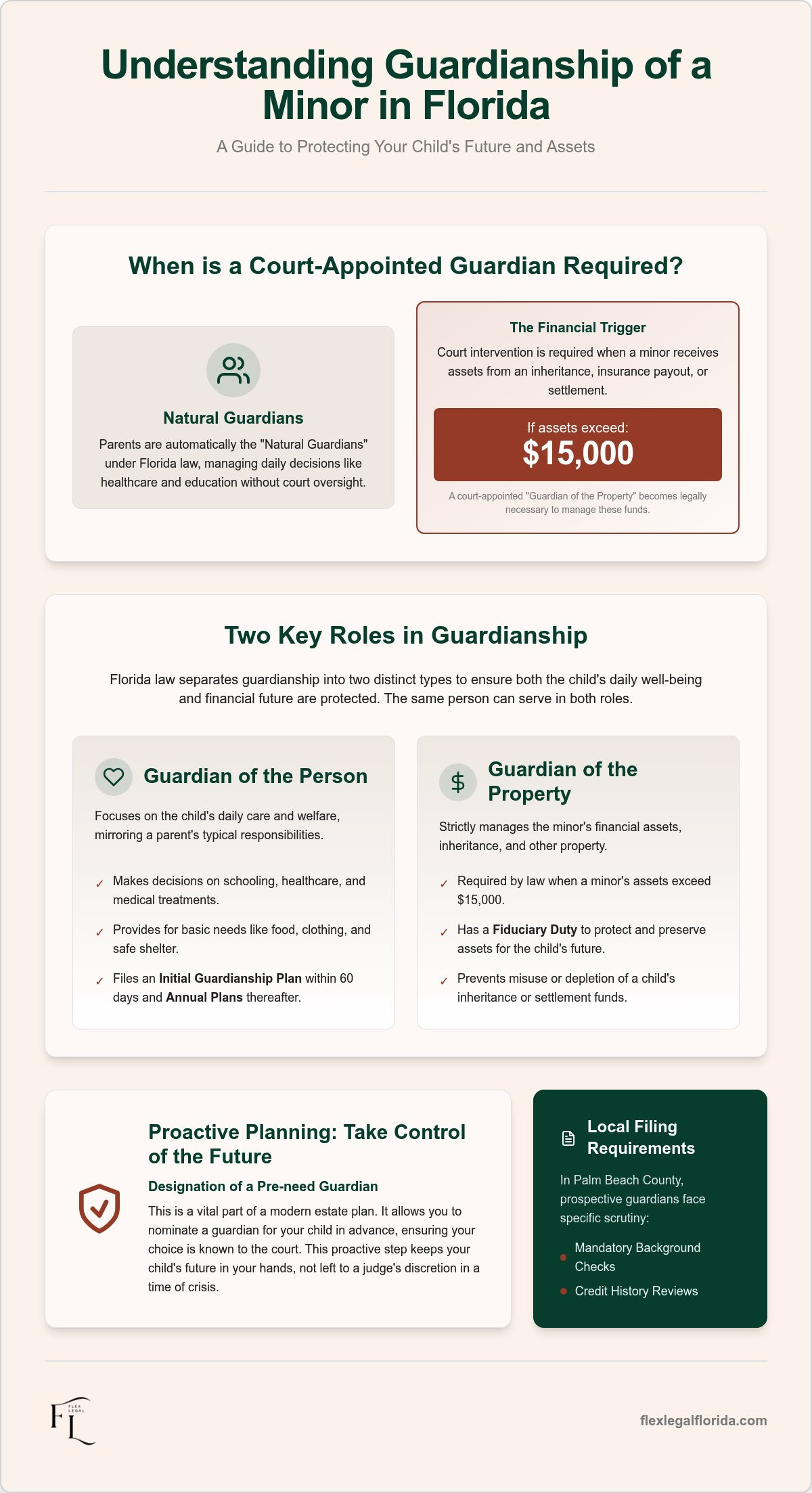
Most parents are surprised to learn they are already guardians. Under Florida Statute 744.301, both parents are recognized as the "natural guardians" of their children. This status allows you to make daily decisions about education and healthcare without court permission. However, this natural authority has a specific financial ceiling. If your child receives an inheritance, insurance payout, or legal settlement exceeding $15,000, the law requires a court-appointed guardian of the property.
It's also essential to distinguish this from "legal custody" discussed in family court. While divorce proceedings handle residential schedules, probate guardianship of a minor in Florida focuses on the legal right to manage a minor's person or property when a parent is deceased, incapacitated, or otherwise unfit. We help families bridge this gap, ensuring that the transition from natural to court-appointed guardianship is handled with empathy and precision.
The Legal Necessity of a Guardian
Court intervention becomes necessary when a child's needs outpace a parent's ability to provide them. This might occur due to a tragic accident or a sudden medical crisis. In these moments, a guardian steps in to provide stability. They handle everything from signing school permission slips to authorizing emergency surgeries. The court maintains a watchful eye, requiring regular reports to ensure the guardian is fulfilling their fiduciary duties. This oversight prevents conflicts of interest and ensures that a child's assets are preserved for their adult life rather than being misused by those in charge.
Types of Florida Minor Guardianships: Person vs. Property
Florida law recognizes that caring for a child's physical needs and managing their financial future require different skill sets. Because of this, the state divides guardianship into two primary types. While the same person often handles both, the court treats them as separate legal responsibilities with distinct reporting requirements. If you're unsure which path fits your family's situation, exploring professional guardianship proceedings support can clarify your next steps.
When establishing guardianship of a minor in Florida, the court may grant plenary or limited authority. Plenary guardianship gives the guardian full power over all delegable legal rights. For minors, this is common because children lack the legal capacity to make their own decisions. Limited guardianship is rarer for children but can be adapted for specific situations where only certain rights need to be transferred.
Guardian of the Person: Daily Care and Welfare
This role mirrors the daily responsibilities of a parent. The guardian of the person makes the "big picture" decisions that shape a child's life. They have the legal authority to choose schools, select healthcare providers, and consent to medical treatments. Beyond these major decisions, they're responsible for the child's basic needs, including food, clothing, and safe shelter.
The court doesn't just walk away once the appointment is made. Guardians must file an Initial Guardianship Plan within 60 days of their appointment. This document outlines how they'll meet the child's medical, mental, and social needs. Every year after that, an Annual Guardianship Plan is required. These reports ensure the minor is thriving and that the guardian continues to act in the child's best interest.
Guardian of the Property: Managing the Minor's Assets
This role is strictly about the money. As we noted previously, Florida law requires a court-appointed guardian when a child's assets exceed $15,000. This often occurs when a minor is named as a beneficiary on a life insurance policy or inherits property through a probate case. The state's goal is to ensure these funds are available for the child's future rather than being spent on daily living expenses that a parent or guardian should otherwise provide.
To protect the minor, the court implements several safeguards:
Guardian's Bond: This is a form of insurance that protects the child's funds against mismanagement or theft. The court usually requires the guardian to post this bond before they can access any money.
Annual Accounting: Every year, the guardian must file a detailed report showing every dollar that entered or left the child's account. You'll need to provide receipts and bank statements for everything.
Restricted Accounts: In many cases, the court requires the funds to be placed in a "designated depository." This means you cannot withdraw money without a specific court order for each expense.
Managing these requirements ensures that the guardianship of a minor in Florida remains a transparent, solution-oriented process that protects the child's financial legacy.
The Guardian's Role: Rights, Responsibilities, and Legal Limits
Accepting the guardianship of a minor in Florida means you've stepped into a role defined by fiduciary duty. This is the highest standard of care recognized by the legal system. It requires you to act with total loyalty to the child, placing their interests above your own in every decision. You aren't just a substitute parent; you're a legal steward held accountable by the state. This means you can't use the child's assets for your own benefit, even if you intend to pay them back later. Such actions are considered a conflict of interest and can lead to immediate legal consequences.
Court oversight is a constant part of this relationship. The court doesn't simply take your word for it. It requires proof that the minor's needs are being met and their assets are secure. Remember that while parents are natural guardians by default, a court-appointed role carries formal reporting duties that don't apply to everyday parenting. This relationship usually lasts until the child reaches the age of 18. At that point, the guardianship terminates. You'll file a final report, the court will review the records, and the young adult will take direct control of their life and property.
Mandatory Reporting and Court Audits
Compliance begins almost immediately. You must file an Initial Guardianship Report within 60 days of your appointment. This document creates a baseline for the child's health and finances. For families managing smaller estates, Florida courts sometimes allow simplified annual accounting to reduce the paperwork. However, precision is non-negotiable. Missing a deadline or failing an audit can result in court sanctions. We help our clients manage these requirements through a modern, streamlined process that ensures every filing is accurate and timely.
Who Can Serve as a Guardian in Florida?
Florida law is picky about who can serve. Residency is a major factor. If you live outside of Florida, you can generally only serve as a guardian if you're a blood relative or a close family member by marriage. The state also bars anyone with a felony conviction from taking on this role. The court looks for "unworthiness," which is a broad term covering financial instability or a history of poor judgment. Sometimes, a family member is perfect for daily care but lacks the time or expertise to manage a large inheritance. In those cases, we might suggest a professional guardian for the property while the family member serves as the guardian of the person. This adaptable approach ensures the child gets the best of both worlds.
The Legal Process in Palm Beach County Courts
The process of securing guardianship of a minor in Florida requires a specific sequence of filings and screenings. In Palm Beach County, this journey begins with a formal Petition for Appointment of Guardian. This document tells the court why the guardianship is necessary and why you're the right person for the job. Because this is a probate matter, working with a probate lawyer in Palm Beach County ensures that your paperwork meets the exact standards of the 15th Judicial Circuit.
The court's vetting process is thorough. You'll need to undergo electronic fingerprinting for a criminal background check and submit to a credit history review. These steps aren't meant to be intrusive; they're safeguards to ensure the minor's safety and financial security. Additionally, the court will appoint an Attorney ad Litem. This is an independent lawyer whose sole job is to represent the minor's interests and provide the judge with a recommendation on the appointment. The final hearing is usually the culmination of this work. If all requirements are met, the judge will sign the Letters of Guardianship, officially granting you legal authority.
Step-by-Step Filing Guide
Your path to appointment involves more than just signing forms. Once the petition is filed, you must formally notify the minor's next of kin and any other interested parties. This transparency prevents legal challenges later. Florida also requires all non-professional guardians to complete a mandatory 8-hour guardianship training course. This class provides practical advice on your fiduciary duties and reporting requirements. Completing this early shows the court you're committed to the role. For help starting this process correctly, consider our guardianship proceedings support.
Local Nuances in the 15th Judicial Circuit
Palm Beach County has a highly efficient but strict probate department. The Clerk's audit department is known for its meticulous review of annual accountings and plans. Understanding their specific preferences can save you weeks of back-and-forth corrections. In West Palm Beach, a standard guardianship approval can take several weeks depending on how quickly background checks clear. Local representation speeds up this process because we understand the internal workflows of the local courthouse. We act as your agile ally, navigating the technical hurdles so you can focus on your family's well-being.
Proactive Planning: The Pre-Need Guardian Designation
Most legal guides focus on reactive measures taken after a tragedy occurs. We believe the most effective way to handle guardianship of a minor in Florida is through proactive planning that eliminates uncertainty before a crisis ever arises. A Designation of Pre-need Guardian is a formal legal document where you identify exactly who you want to care for your children if you become incapacitated or pass away. It's a solution-oriented tool that keeps you in the driver's seat of your family's future.
This document carries significant legal weight. In the eyes of a Florida judge, your designation creates a "rebuttable presumption." This means the court is legally required to appoint the person you've chosen unless they're found to be unfit. It's a much stronger shield than a simple conversation or an informal note. For a truly comprehensive strategy, many families integrate this designation with a revocable trust. This pairing ensures that while your chosen guardian manages your child's daily life, the trust provides the financial structure to fund their education and upbringing without constant court interference.
Avoiding the 'Court-Picked' Guardian
Without a pre-need designation, a judge who has never met your family will decide who raises your child. This often sparks painful family feuds as well-meaning relatives battle for control in a courtroom. By documenting your choice now, you ensure your personal values and parenting style are respected even in your absence. While many parents include guardianship wishes in a Last Will and Testament, a standalone designation is often superior. A Will only takes effect after death, but a pre-need designation can be triggered if you're temporarily incapacitated by an illness or accident, providing seamless protection for your children.
Flexible Planning for Modern Families
Life is dynamic, and your estate plan should be too. We recommend naming primary and alternate guardians to ensure your plan remains adaptable if your first choice's circumstances change. Perhaps a relative moves out of state or experiences their own health challenges. You can easily update these designations as your children grow and your family's needs evolve. If you're ready to build a secure foundation for your family, reaching out to a special needs planning attorney can help you navigate these choices with clarity and confidence.
Moving Forward with Legal Certainty for Your Family
Establishing a secure foundation for your child shouldn't feel like an uphill battle against the court system. By understanding the nuances of guardianship of a minor in Florida, you've already taken the first step toward replacing uncertainty with a clear, adaptable plan. Whether you're navigating an immediate need for property management or proactively designating a pre-need guardian, your focus remains on your child's stability and long-term well-being.
At Flex Legal, PLLC, we combine sophisticated, modern estate planning strategies with deep expertise in the Palm Beach County Probate Court. We act as your agile ally, providing the empathetic legal guidance you need to navigate complex filings and fiduciary duties without the stress of traditional, rigid law firms. You don't have to leave your child's future to chance or wait for a crisis to act.
Ready to build a comprehensive plan that protects what matters most? Schedule a Consultation with Flex Legal, PLLC to Protect Your Minor Child. We're here to help you move forward with confidence, knowing your family's legacy is in safe hands.
Frequently Asked Questions
Is guardianship of a minor the same as adoption in Florida?
No, guardianship and adoption are legally distinct processes with different long-term outcomes. Adoption is a permanent arrangement that terminates the biological parents' rights and creates a new, lifelong legal relationship. Guardianship of a minor in Florida is usually a temporary solution that ends when the child turns 18. It focuses on immediate care or asset management without permanently altering the child's birth certificate or legal identity.
Can a parent name a guardian in their Will?
Yes, parents can nominate a guardian within their Last Will and Testament, but this serves as a recommendation to the court rather than an automatic appointment. The judge will give great weight to your choice but must still confirm the person is fit to serve. For the most robust protection, we recommend a standalone Designation of Pre-need Guardian, which carries a legal presumption in your favor during court proceedings.
How much does it cost to file for guardianship in Palm Beach County?
The total cost includes several different fees set by the Palm Beach County Clerk of the Circuit Court and Comptroller. You'll need to account for the initial filing fee, the cost of electronic fingerprinting for background checks, and potential audit fees for property accountings. These fees are subject to change by the state legislature, so it's best to verify the current schedule on the Clerk's official website before filing your petition.
Does a guardian have to live in Florida?
A guardian isn't strictly required to be a Florida resident, but the state has very specific rules for out-of-state applicants. Under Florida law, a non-resident can only serve as a guardian if they're a blood relative or a close family member by marriage. If you wish to name a trusted friend who lives in another state, the court will likely reject the application in favor of a local or related candidate.
What happens if a child inherits money without a named guardian?
If a minor receives an inheritance or insurance payout exceeding $15,000, the court must appoint a guardian of the property to manage the funds. Without a named guardian in your estate plan, the court will choose someone to oversee the money until the child reaches adulthood. This process often involves higher legal costs and may result in a professional guardian being appointed if no suitable family members are available.
Can a guardianship be temporary in Florida?
Yes, Florida law allows for an Emergency Temporary Guardianship (ETG) when there is an immediate threat to a child's welfare or assets. These appointments are specifically designed for crisis situations where a permanent guardian cannot be appointed fast enough. An ETG typically lasts for 90 days, providing a window of stability while the court evaluates a more permanent, long-term solution for the child's care.
Do I need an attorney to file for guardianship of a minor?
Yes, Florida Probate Rules require nearly every guardian to be represented by an attorney. This isn't just a suggestion; it's a legal requirement because the responsibilities involving guardianship of a minor in Florida are technically demanding. Having a legal ally ensures you stay in compliance with strict court deadlines and fiduciary duties, protecting you from personal liability or court sanctions throughout the duration of the guardianship.
What is the 8-hour guardianship training requirement?
Florida requires all non-professional guardians to complete a court-approved 8-hour training course within four months of their appointment. This class covers your legal obligations, how to manage a minor's assets, and the specifics of filing annual reports. The goal is to ensure every guardian has a clear roadmap for success. Many families find this training helpful for understanding the sophisticated balance of authority and responsibility the role requires.


Comments