
How to Get Letters of Administration in Florida: A 2026 Probate Guide
- Kelly Mata
- 22 hours ago
- 12 min read

Imagine standing at a bank teller window, death certificate in hand, only to be told you cannot access your parent's accounts without a specific court order. It's a frustrating moment that turns grief into a legal headache. Learning how to get letters of administration in florida is the vital first step toward unlocking those assets and fulfilling your duties. These documents aren't just paperwork; they are your legal shield and the definitive proof that you have the authority to manage the estate.
We understand that the Florida probate process often feels like a maze of jargon and rigid deadlines. You want to honor your loved one's legacy without getting bogged down in court delays or high costs. This 2026 guide simplifies the path forward. You'll learn the exact requirements for formal administration, the updated $150,000 threshold for summary proceedings, and the specific Palm Beach County procedures required by the 15th Judicial Circuit. From filing the initial petition to working with a West Palm Beach attorney, we'll show you how to streamline the process and gain the legal authority you need.
Table of Contents
What Are Letters of Administration in Florida Probate?
Technically, Letters of Administration are a specific type of court order that officially appoints you as the Personal Representative of an estate. Think of this document as the "Golden Key" to a decedent's financial life. Without it, you're essentially locked out of the accounts and property your loved one left behind. Banks, investment firms, and title companies won't recognize your authority just because you're the next of kin; they require this specific, court-stamped mandate to move forward.
Once the court issues these Letters, your status changes from a family member to a legal fiduciary. This gives you the power to step into the decedent's shoes. You can close bank accounts, transfer stock, sign deeds for real estate, and even access safe deposit boxes. Learning how to get letters of administration in florida is about more than just checking a legal box. It's about securing the protection you need to handle these responsibilities without personal liability while ensuring the estate's assets are distributed correctly.
Why a Will Isn't Enough on Its Own
Many people assume that being named as the "Executor" in a Last Will and Testament provides immediate authority. In reality, a Will is simply a written request to a judge. It outlines who the decedent wants to manage their affairs, but it has no legal weight until a probate judge validates it. The court must confirm the Will is authentic and that the person nominated is actually eligible to serve under Florida law. Letters of Administration are the official court mandate for estate management. Until the judge signs that order, you're a nominee, not a representative.
Common Situations Requiring Letters of Administration
Most families realize they need to understand how to get letters of administration in florida when they hit a "brick wall" with a third-party institution. Here are the most frequent scenarios where this document is non-negotiable:
Accessing Financial Accounts: Banks will freeze any account held solely in the decedent's name until they see court-certified Letters.
Selling Real Estate: If you're trying to sell a home that was owned only by the person who passed away, a title company will require Letters to authorize the sale.
Legal Actions: If the estate needs to file a wrongful death lawsuit or manage complex litigation, the court must formally appoint a Personal Representative first.
Tax Filings: Handling final federal income tax returns or estate tax issues often requires proof of court appointment to communicate with the IRS.
Obtaining these Letters transforms you into an agile ally for the estate. It provides the clarity and comfort needed to resolve outstanding debts and ensure that beneficiaries receive their rightful inheritance without unnecessary friction.
Formal vs. Summary Administration: Which Path Leads to Letters?
Choosing the right probate path is the most critical decision you'll make when figuring out how to get letters of administration in florida. Florida law provides two primary tracks: Formal Administration and Summary Administration. If your goal is to walk away with a document that grants you ongoing authority to manage an estate, you are likely looking for Formal Administration. While Summary Administration is often called "probate lite," it's important to understand that it usually ends with a final court order rather than the issuance of Letters. This distinction matters because many financial institutions and out-of-state entities won't talk to you without a court-appointed Personal Representative.
As of July 1, 2026, the landscape for these filings has changed significantly. The legislative updates in Chapter 2026-57 increased the threshold for Summary Administration from $75,000 to $150,000 for non-exempt assets. This means more families can use the faster process, but speed isn't always the best strategy. Some banks and insurance companies strictly refuse to release funds based on an Order of Summary Administration. They insist on seeing a person with the full fiduciary power that only comes with Formal Administration. For a broader look at these rules, The Florida Bar's 'Probate in Florida' guide offers an excellent overview of how these two paths differ at a state level.
When Formal Administration is Mandatory
You must file for Formal Administration if the estate's non-exempt assets exceed $150,000. It's also required if the decedent passed away less than two years ago and there are known or potential creditors who need to be notified. If the estate owns a business that requires active management or if there is a dispute among heirs, the court will insist on the full oversight that Formal Administration provides. In these cases, obtaining Letters is the only way to legally protect the estate's value while resolving complex issues. If you're unsure which path fits your family's needs, consulting with a modern legal ally can help you avoid filing the wrong petition and wasting court fees.
The Role of the Personal Representative
Only Formal Administration grants you the official title of Personal Representative. This role comes with a significant fiduciary duty to act in the best interests of the beneficiaries and creditors. You aren't just a messenger; you're a legal steward responsible for inventorying assets and settling debts. For a deep dive into these responsibilities, our Probate Lawyer in Palm Beach County guide explains the daily duties of a Personal Representative in detail. Mastering how to get letters of administration in florida ensures you have the legal standing to perform these duties with confidence and court-backed authority.
Who Can Be Appointed as a Personal Representative in Florida?
Choosing the right person to lead an estate isn't just a matter of trust; it's a matter of law. Florida has some of the strictest eligibility requirements in the country for those seeking court appointment. When families research how to get letters of administration in florida, they often assume the person named in the Will has an automatic right to serve. In reality, the judge must first verify that the nominee meets several baseline criteria. Every Personal Representative must be at least 18 years old, mentally and physically capable of performing the job, and must never have been convicted of a felony.
Beyond these basics, the "Florida Resident" rule is the most common hurdle for modern families. Florida law generally requires the Personal Representative to be a permanent resident of the state at the time of the decedent's death. This rule exists to ensure the court has jurisdiction over the person managing the assets. If your chosen executor lives in another state, the court will likely reject the petition unless they fall into a specific category of "qualified non-residents."
The Resident vs. Non-Resident Conflict
The law provides a narrow exception for out-of-state family members. Even if they don't live in Florida, the following people can still serve as your Personal Representative:
A legally adopted child or adoptive parent.
A spouse, sibling, parent, child, or other close relative related by lineal consanguinity.
A spouse of a person otherwise qualified, such as a son-in-law or daughter-in-law.
This means your sister in California can serve, but your lifelong best friend in New York cannot. Under 2026 Florida statutes, non-relatives must be Florida residents to qualify for appointment as a Personal Representative. If there is no Will, the judge follows a specific order of preference. This starts with the surviving spouse, then the person selected by a majority of the heirs, and finally the heir in the nearest degree of kinship. This structure ensures that the estate remains in capable, legally recognized hands.
Disqualifying Factors to Watch For
Even a resident family member can be barred from service. A felony conviction is a permanent disqualifier in Florida probate. There's no "look-back" period; any felony on a person's record will cause the judge to deny the petition. Additionally, the court may find a person "unfit" if they demonstrate a lack of integrity or a conflict of interest that would harm the beneficiaries. In complex cases, families might choose a professional Personal Representative, such as a bank or trust company authorized to do business in Florida. This adaptability allows you to select a representative who can handle the specific demands of the estate without friction.
The 5-Step Process to Obtain Your Letters of Administration
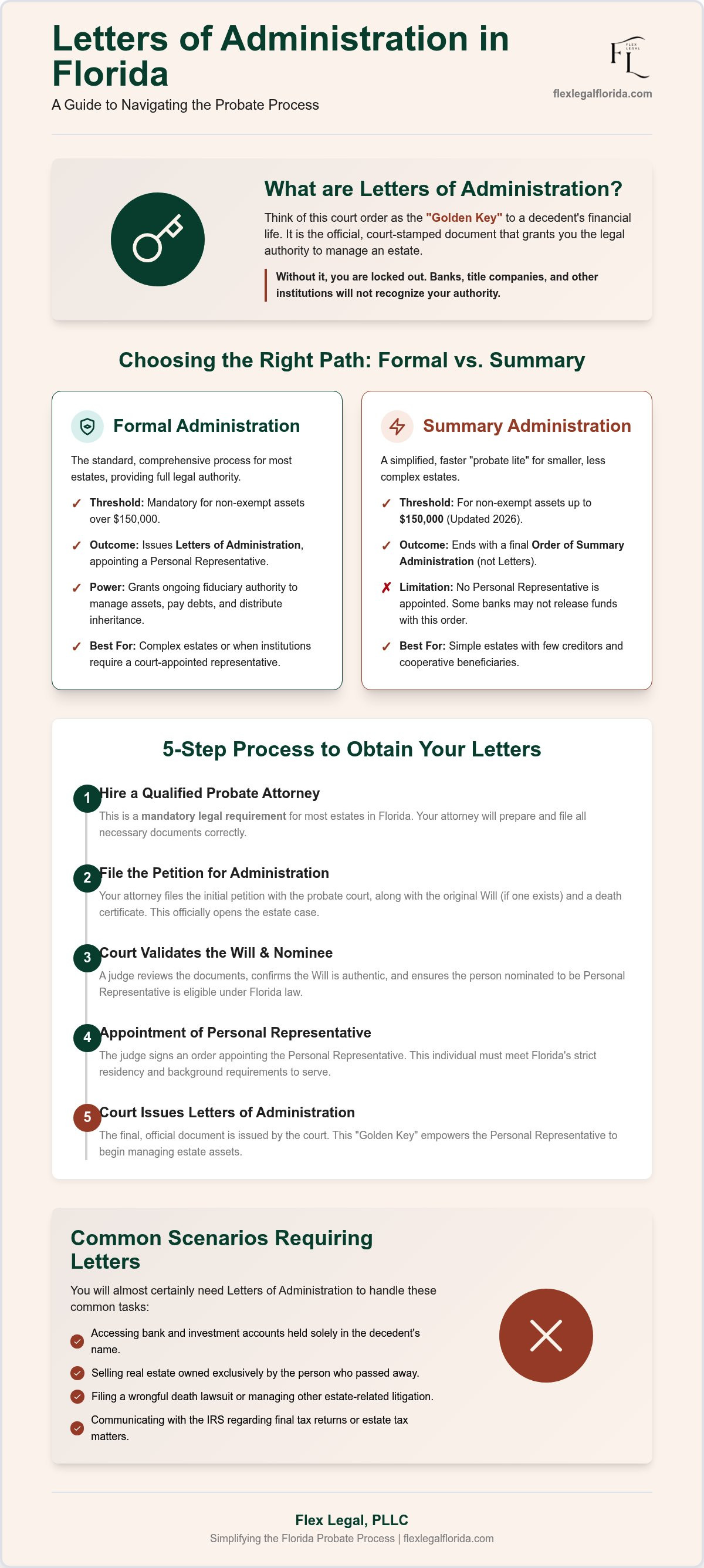
Securing court authority involves a specific sequence of legal filings that must align with Florida Probate Rules. The first step is hiring a qualified Florida probate attorney. Under Florida Probate Rule 5.030, almost every Personal Representative must be represented by an attorney because the process involves complex fiduciary duties. Once you have legal counsel, your attorney will draft and file the Petition for Administration. If a Will exists, you must also deposit the original document with the Clerk of the Circuit Court & Comptroller in Palm Beach County within 10 days of receiving notice of the death. This starts the formal clock on your case.
The third step involves submitting your "Oath of Personal Representative" and a "Designation of Resident Agent." These documents confirm you'll follow the law and provide the court with a local point of contact for legal service. After these filings, a judge reviews the petition to ensure all requirements are met. If the judge approves, they sign an Order Appointing Personal Representative. The final step occurs when the Clerk of Court issues the actual Letters of Administration. This document is the tangible proof of your authority that you'll present to banks and other institutions. If you're ready to begin this process, our team at Flex Legal, PLLC can help you file correctly the first time.
The Essential Filing Checklist
Success depends on the accuracy of your initial documents. You'll need to gather a certified copy of the death certificate; however, it must be the "short form" version that excludes the social security number and cause of death to protect privacy in public records. You must also provide a complete list of all heirs and "interested parties," including their current addresses. In some cases, the judge may require a probate bond. This acts as an insurance policy to protect the estate's beneficiaries from potential mismanagement. Having these items ready before you research how to get letters of administration in florida will significantly speed up your filing.
Timeline: How Long Does It Take?
In Palm Beach County, the initial phase from filing the petition to receiving your Letters typically takes between 2 and 4 weeks. This timeline assumes the court's Online Scheduling (OLS) system is used correctly and all checklists are complete. Delays often happen when heirs can't be located or if the original Will is missing. Incomplete paperwork is the most common reason for a "rejection" from the 15th Judicial Circuit. Working with an agile legal team ensures your paperwork is formatted to local standards, minimizing back-and-forth with the judge's office. Understanding how to get letters of administration in florida efficiently means preparing for these procedural hurdles before they cause a bottleneck.
Navigating the Palm Beach County Probate Court
Every circuit in Florida has its own personality. In West Palm Beach, the 15th Judicial Circuit Court oversees all probate matters. While the statutes are statewide, the procedural nuances in Palm Beach County can be the difference between a smooth approval and a frustrating rejection. Judges here rely heavily on specific checklists mandated by Administrative Order 6.202. If your petition lacks even a single required attachment or follows the wrong format, the court's Online Scheduling (OLS) system will likely flag it for correction. Understanding how to get letters of administration in florida requires a deep familiarity with these local rules of the road.
Once the judge signs the order and you receive your Letters, the real work of administration begins. You aren't just holding a piece of paper; you're managing a legal timeline. You must immediately address the "Notice to Creditors," which starts a mandatory three month window for any claimants to file a debt against the estate. Missing these windows or failing to follow the 15th Circuit's specific formatting for proposed orders can stall the process for months. Local expertise isn't just a luxury; it's the mechanism that keeps your case moving through the West Palm Beach system without friction.
Local Court Procedures in West Palm Beach
The Palm Beach County Clerk of the Circuit Court & Comptroller manages the physical and digital filing of all estate documents. As of 2026, the court filing fee for a formal administration is $401.00. Electronic filing is mandatory for attorneys; the 15th Circuit is known for its efficiency when paperwork is submitted perfectly. However, the system is designed for precision, not trial and error. After you obtain your Letters, you have exactly 60 days to file a verified inventory of the estate's assets. If you're looking to avoid this complex court process for your own heirs in the future, our Estate Planning Attorney in West Palm Beach guide discusses proactive strategies like Revocable Living Trusts.
Why You Need a Modern Ally Like Flex Legal, PLLC
Navigating probate shouldn't feel like a second job. Flex Legal, PLLC acts as your local ally by simplifying the complex filings required by the West Palm Beach probate division. We prioritize price certainty through clear fee structures, so you aren't surprised by hidden costs during an already stressful time. Our approach is built on adaptability and transparency. We handle the heavy lifting of court deadlines and creditor notifications, allowing you to focus on your family's healing rather than legal logistics. If you're ready to secure your authority and settle your loved one's affairs, schedule a consultation with Flex Legal, PLLC today. We'll help you master how to get letters of administration in florida with the professional authority and modern accessibility you deserve.
Moving Forward with Confidence and Authority
Securing Letters of Administration is about more than just legal compliance; it's about gaining the official authority to protect your family's legacy. We have covered the essential residency rules and the specific procedural checklists required by the 15th Judicial Circuit in West Palm Beach. By following these steps, you ensure that the probate process remains a path toward resolution rather than a source of ongoing stress.
Understanding how to get letters of administration in florida is much simpler when you have an agile ally by your side. Led by Jennifer L. Flexer, Esq., Flex Legal, PLLC specializes in Palm Beach County probate administration and offers fixed-price estate planning packages to provide total price certainty. We manage the complex court filings and deadlines so you can focus on your family's healing. Secure Your Letters of Administration with Flex Legal, PLLC today. You don't have to face the probate system alone; let's move your case forward together.
Frequently Asked Questions
Do I legally need a lawyer to get Letters of Administration in Florida?
Yes, you almost always need an attorney to secure these documents. Florida Probate Rule 5.030 mandates that every Personal Representative must be represented by a member of the Florida Bar, except in very rare and limited circumstances. This rule ensures that the estate's fiduciary duties are handled correctly and that the court’s strict procedural requirements are met. Having a modern legal ally helps you avoid the common technical pitfalls that cause delays in the 15th Judicial Circuit.
How much does it cost to get Letters of Administration in 2026?
The court filing fee for a formal administration in Palm Beach County is $401.00 as of 2026. Beyond this initial fee, you should budget for additional costs such as certified copies of the death certificate, newspaper publication for the mandatory Notice to Creditors, and statutory attorney’s fees. Every estate is unique, and total costs will depend on whether the assets qualify for a streamlined summary administration or require a full formal proceeding.
Can a non-Florida resident be a Personal Representative?
A non-Florida resident can only serve as a Personal Representative if they are a close relative of the decedent. This exception includes a spouse, sibling, parent, child, or other direct blood relative. If you aren't related by blood or marriage, you must be a permanent Florida resident to qualify for appointment. This is a strict residency rule that judges in West Palm Beach enforce during the initial petition review phase.
What happens if there is no Will? Can I still get Letters?
You can still obtain Letters of Administration even if your loved one passed away without a Will. This is known as an "intestate" administration. When researching how to get letters of administration in florida without a Will, keep in mind that the court follows a specific legal hierarchy for appointment. The surviving spouse has the first priority, followed by the individual selected by a majority of the estate's heirs.
How long are Letters of Administration valid in Florida?
Letters of Administration remain valid until the judge signs an order of discharge and officially closes the estate. There's no specific expiration date printed on the document itself. However, most financial institutions and title companies will require a "certified copy" issued by the clerk within the last 60 days. This ensures your authority hasn't been revoked and that the probate case is still active and ongoing.
What is the difference between an Executor and a Personal Representative?
The only difference is the terminology used. While many people use the word "executor" colloquially or in out-of-state documents, Florida law exclusively uses the term "Personal Representative." Both terms describe the person responsible for managing assets, paying debts, and distributing the inheritance. If an out-of-state Will names an "Executor," the Florida court will simply appoint that person as the Personal Representative provided they meet eligibility rules.
Can a bank refuse to honor my Letters of Administration?
Banks cannot legally ignore a valid court order, though they often impose their own internal hurdles. Effective July 1, 2026, Florida Statute 733.6125 provides you with a powerful legal mechanism to enforce your authority. If a financial institution refuses to cooperate with your Letters, you now have the right to sue for compliance and recover your attorney’s fees and costs from the bank for their non-cooperation.
What if the named Personal Representative is unable or unwilling to serve?
If the person named in the Will is unable or unwilling to serve, the court looks to the successor nominee listed in the document. If no successor is named, or if there is no Will, the heirs must agree on a replacement candidate. The court will then verify the new candidate's eligibility, ensuring they meet the age, residency, and background requirements before formally issuing the Letters of Administration.


Comments