
Asset Protection Trust Florida: The 2026 Guide to Securing Your Wealth
- Kelly Mata
- 10 minutes ago
- 12 min read

What if the greatest threat to your wealth isn't a volatile market, but a single, unexpected lawsuit in one of the most litigious states in the country? It's a valid concern for any successful professional or family in the Sunshine State. You likely feel that your hard-earned savings deserve a shield, yet you might worry that advanced planning feels "shady" or overwhelming. You're right to be cautious, but securing your legacy shouldn't feel like a legal maze.
This guide explores how a modern asset protection trust Florida strategy acts as an adaptable, transparent defense against creditors. We'll clear the confusion between revocable and irrevocable structures while showing you how to maintain control over your lifestyle. You'll discover the difference between domestic and offshore options and learn how West Palm Beach families are using flat-fee planning to gain total price certainty. By the end, you'll have a clear, actionable plan to protect your home and savings without the friction of traditional, slow-moving law models.
Table of Contents
The Reality of Asset Protection in Florida: Why a Strategy is Essential
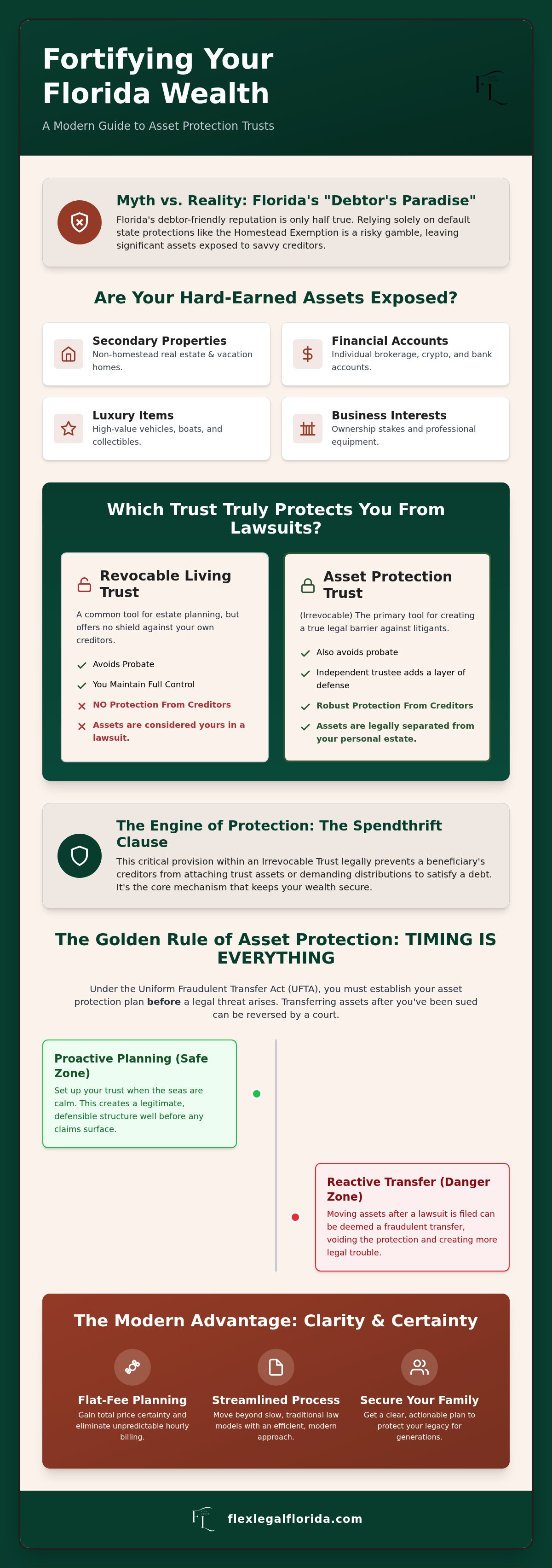
Florida is often called a "debtor's paradise," but this reputation is only half true. While the state constitution offers some of the strongest protections in the nation, relying on them as your only defense is a risky gamble. Many residents assume that just by living here, their wealth is untouchable. In reality, statutory protections like the Homestead Exemption have clear boundaries. If you haven't built a proactive strategy, you're leaving the door open to creditors who know exactly how to navigate these legal limits. Understanding What is an Asset Protection Trust? is the first step toward moving beyond passive defense.
A common misconception involves the Revocable Living Trust. While these are excellent tools for avoiding probate, they offer zero protection from your own creditors. Because you maintain total control and can revoke the trust at any time, a judge can simply order you to pull the money out to pay a judgment. To truly shield your legacy, you need a specific asset protection trust Florida framework that creates a legal barrier between you and potential litigants.
The Litigation Landscape in Palm Beach County
West Palm Beach is home to a high concentration of successful professionals, business owners, and medical practitioners. This success makes you a visible target for professional liability suits and predatory litigation. Even if you carry a robust umbrella insurance policy, those limits can be exhausted quickly in a catastrophic claim. Proactive planning acts as vital legal leverage. When a creditor sees that your assets are held within a properly structured trust, their incentive to pursue a lengthy, expensive court battle often disappears, leading to more favorable settlements.
Exempt vs. Non-Exempt Assets: A Quick Audit
The Florida Constitution provides a solid foundation through the Homestead Exemption and Tenancy by the Entireties for married couples. However, many of your most valuable holdings likely fall outside these protections. Non-exempt assets are those properties or financial holdings that a court can legally seize or force you to sell to satisfy a civil judgment against you.
Vulnerable assets typically include:
Non-homestead real estate and vacation homes
Individual brokerage accounts and crypto holdings
Luxury items, including high-value vehicles or boats
Business interests and equipment
Building an asset protection trust Florida ensures these vulnerable pieces of your portfolio are just as secure as your primary residence. It transforms your financial profile from a collection of easy targets into a fortified estate that is difficult and costly for creditors to attack.
How a Florida Asset Protection Trust Works
To shield wealth effectively, you must move beyond the standard revocable structures used for simple estate planning. The primary tool for true security is the Irrevocable Trust. Once assets are transferred into this type of entity, they're no longer considered part of your personal estate for creditor purposes. This transition is governed by the Florida Trust Code, which outlines the specific requirements for creating a valid legal barrier. By relinquishing the power to unilaterally revoke the trust, you gain a level of protection that a standard living trust simply can't provide.
The engine of an asset protection trust Florida strategy is the "Spendthrift Clause." This provision prevents a beneficiary from voluntarily or involuntarily transferring their interest in the trust. It's a powerful shield because it legally bars a creditor from attaching trust assets or demanding a distribution to satisfy a debt. However, for this shield to hold, the trust must be structured carefully regarding who it protects. While Florida law is very protective of third-party trusts, where you set up funds for a spouse or children, "self-settled" trusts require a more nuanced approach to ensure they stand up in local courts.
Maintaining the integrity of this shield often requires an independent trustee. If you retain too much control over distributions, a court may view the trust as your "alter ego" and allow creditors to pierce the protection. An agile ally can help you structure these roles to balance security with your family's needs. If you're ready to explore these structures, our team specializes in asset protection planning that fits your specific professional profile.
The Anatomy of a Spendthrift Provision
A spendthrift clause works by stripping the beneficiary of the right to assign their interest in the trust. Because the beneficiary doesn't own the assets directly, their creditors can't claim them either. The most effective provisions rely on discretionary distributions. When a trustee has the sole power to decide when and if to release funds, a creditor has no legal ground to force a payment. If the settlor has unfettered access to the trust principal, the protection fails. The goal is to create a clear separation between personal ownership and trust management.
Domestic vs. Offshore Asset Protection Trusts
Many people believe they need to move money to the Cook Islands or Nevis to find safety. While offshore trusts offer high levels of secrecy and a difficult "jurisdictional hurdle" for creditors, they're also expensive and complex to maintain. For most West Palm Beach families, a domestic asset protection trust Florida approach is more practical. These trusts are cost-effective, court-recognized, and easier to manage within your overall financial plan. While offshore trusts create a significant jurisdictional hurdle by requiring creditors to litigate in foreign courts, a domestic Florida strategy offers a more cost-effective and legally recognized balance for most local professionals.
Asset Protection Trust vs. Revocable Trust vs. Homestead
Many Florida residents mistakenly believe that a single legal document can solve every financial threat. It's a common trap. You might have a Revocable Living Trust to handle your inheritance, but it won't stop a creditor from seizing those same assets tomorrow. Understanding the legal definition of an asset protection trust is vital because it reveals why these tools are distinct from your standard estate plan. While a revocable trust is excellent for probate avoidance, it leaves your assets fully exposed to lawsuits because you still maintain total ownership and control in the eyes of the court.
Florida's homestead laws are legendary for their strength, yet they are intentionally narrow. They protect your primary roof, but they don't guard your liquid savings, investment accounts, or business interests. This is why an asset protection trust Florida strategy is often described as the "outer wall" of a financial fortress. It secures the significant portion of your wealth that falls through the cracks of basic statutory exemptions. By integrating these tools, you create a comprehensive defense that covers both your home and your hard-earned capital.
The "Homestead Trap" for Palm Beach Residents
If you own a vacation home in Jupiter or a rental property in Delray Beach, you're more exposed than you think. Florida's homestead protection only covers your primary residence. Any equity in secondary real estate is a prime target for a judgment creditor. An Irrevocable Trust can hold title to these non-primary properties, effectively shielding that equity from professional liability or personal lawsuits. For a deeper look at how these interact with your inheritance plans, check out our Revocable Trust Guide to see the full picture of estate security.
LLCs and Limited Partnerships as Trust Components
Modern wealth protection often requires a multi-layered approach. By placing your business interests or professional practices inside an LLC, you gain a layer of liability protection. However, if a creditor sues you personally, they could still try to seize your ownership interest in that LLC. This is where the synergy between asset protection lawyers near me and sophisticated business planning pays off. When an asset protection trust Florida owns the LLC, it creates a double barrier. A creditor is often limited to a "charging order," which gives them a right to distributions that the trustee can simply choose not to make, leaving the creditor with a tax bill but no actual cash.
Setting Up Your Shield: Steps and the Fraudulent Transfer Rule
Implementing an asset protection trust Florida strategy is a deliberate, proactive process. It is not a last-minute reaction to a legal crisis. To ensure your shield holds up under scrutiny, you must follow a specific sequence of actions that establish a clear separation between your personal identity and your trust's holdings. This begins with a thorough audit of your non-exempt assets and an honest assessment of your professional risks. Once you've identified what needs protection, the focus shifts to selecting an independent trustee who can manage distributions without being viewed as your "alter ego" by a court.
Drafting and funding the trust requires precision. You'll need to re-title assets, such as brokerage accounts or real estate deeds, into the name of the irrevocable trust. After the initial setup, maintenance is vital. You cannot treat trust assets like a personal piggy bank. Mixing personal funds with trust capital or ignoring the formalities of the trust agreement gives creditors a roadmap to pierce your protection. If you're ready to start this process with a transparent partner, you can schedule a flat-fee consultation to build your custom shield.
Timing is Everything: The FUFTA Warning
The most common mistake is waiting too long to act. Under Florida's Uniform Fraudulent Transfer Act (FUFTA), a judge can unwind transfers made with the intent to keep assets away from a known creditor. Generally, Florida law applies a four-year statute of limitations for most fraudulent transfer claims. If a claim has already "arisen," any transfer you make might be viewed as a "voidable" transaction. Under Florida law, "actual intent to hinder, delay, or defraud" is often proven through "badges of fraud," such as transferring assets to an insider or retaining control over the property after the transfer occurs.
Funding the Trust Correctly
Successful funding involves moving high-value, non-exempt assets like cash, securities, and non-homestead real estate into the trust's name. However, some assets, like certain retirement accounts that already enjoy statutory protection, might be better left outside the trust. The process of re-titling is a technical step that requires coordination with banks and county recorders to ensure the legal "owner" is officially the trust. As you reorganize your holdings, remember that a durable power of attorney is a critical backup for your trust management. It ensures that if you become incapacitated, your chosen agent can continue to oversee your affairs and coordinate with your trustee without delay.
Modern Asset Protection with Flex Legal: The Flat-Fee Advantage
Securing a legacy shouldn't involve a guessing game about legal fees. Most traditional firms rely on hourly billing, which often creates a barrier to open communication. At Flex Legal, we've replaced that outdated model with a transparent, flat-fee approach. This provides you with total price certainty while we build your asset protection trust Florida framework. You gain an agile ally who prioritizes your protection over a ticking clock. Our goal is to make sophisticated legal strategies accessible and straightforward for every client we serve.
Our process is designed to be as efficient as it is thorough. We recognize that your financial life is dynamic, so your planning must be equally adaptable. Beyond just shielding wealth from lawsuits, we integrate these strategies with other critical needs, such as probate avoidance and special needs planning. This holistic view ensures that every piece of your estate works in harmony to protect the people you love. We don't just provide documents; we provide a partnership built on clarity and results.
The Flex Legal Planning Process
We begin every engagement with an initial strategy session to map your unique "vulnerability profile." This isn't a one-size-fits-all checklist. Instead, we look at your specific professional risks, family dynamics, and long-term goals. Every asset protection trust Florida plan is personally customized and drafted by founding attorney Jennifer L. Flexer, Esq. We believe that the best defense is one that's tailored to your life. Once the trust is drafted, we provide ongoing support for trust administration and the critical funding process to ensure your assets are correctly titled and fully shielded.
Securing Your West Palm Beach Legacy
Local expertise matters when you're navigating the specific nuances of Palm Beach County courts. We understand the regional legal landscape and how local judges interpret trust provisions. This specialized knowledge allows us to move you from a place of worrying about "predatory" lawsuits to a state of genuine peace of mind. You've worked hard to build your success; you deserve a modern legal partner who works just as hard to keep it safe. If you're ready to take the next step, schedule a consultation with Flex Legal today and start building your custom shield.
Start Building Your Financial Fortress Today
Securing your wealth in a litigious environment requires more than just good intentions; it demands a proactive strategy that balances statutory exemptions with modern trust law. You've learned that while the homestead exemption is powerful, it doesn't shield your investment accounts or vacation homes. Implementing a robust asset protection trust Florida strategy ensures those vulnerable gaps are closed before a legal threat ever appears on the horizon. By acting now, you move beyond the reach of the four-year look-back period and establish a legacy that's truly untouchable.
At Flex Legal, we believe that high-level planning should be transparent and accessible. Led by Jennifer L. Flexer, Esq., our firm provides the modern, adaptable strategies you need to navigate Palm Beach County's unique legal landscape. We offer flat-fee pricing for total transparency, so you can focus on your future without worrying about billable hours. It's time to transition from uncertainty to confidence.
Your hard work deserves a shield that's as resilient as your ambition.
Frequently Asked Questions
Can a Florida Asset Protection Trust protect me from a divorce settlement?
An irrevocable trust can provide significant protection if it's established and funded before a marriage begins. These assets are typically classified as non-marital property, which keeps them separate from the marital estate during a split. If the trust is created during the marriage, the legal situation becomes much more complex. We don't offer family law advice, so it's best to coordinate with a specialist to ensure your trust integrates correctly with your domestic situation.
How much does it cost to set up an asset protection trust in Florida?
Costs vary based on the complexity of your holdings and the specific goals of the trust. While some online services offer basic templates for a lower investment, professional planning with an attorney involves a higher cost that reflects the necessary customization. We use a flat-fee model to ensure you have total price certainty from the start. This approach eliminates the anxiety of hourly billing while providing a tailored, professionally drafted legal shield.
Do I lose control of my money if I put it in an irrevocable trust?
You relinquish direct ownership, but you don't necessarily lose all influence over how assets are managed. An asset protection trust Florida structure requires you to give up the power to revoke the trust at will. However, you can still define the trust's purpose and name your beneficiaries. By working with an independent trustee, you maintain a layer of security that prevents creditors from claiming you have unfettered access to the funds.
What is the difference between a domestic and an offshore asset protection trust?
A domestic trust is established under U.S. laws, while an offshore trust is located in a foreign jurisdiction like the Cook Islands. Domestic trusts are generally more cost-effective and easier to manage for West Palm Beach families. Offshore options provide a higher jurisdictional hurdle for creditors because they must litigate in a foreign court. For most professionals, the balance of security and convenience favors a well-structured, Florida-based plan that's court-recognized.
Can I be my own trustee for a Florida asset protection trust?
You can technically serve as your own trustee, but doing so significantly weakens your protection. If you maintain total control, a creditor can argue that the trust is merely your alter ego and ask a judge to pierce the shield. To ensure the trust holds up in court, it's vital to appoint an independent trustee. This separation of control is what legally prevents a creditor from forcing you to distribute funds to satisfy a judgment.
How does an asset protection trust affect my taxes in Florida?
Most of these structures are grantor trusts for federal income tax purposes. This means you continue to report the trust's income on your personal tax return. Since Florida has no state income tax, there's no additional state-level tax burden created by the trust. The primary goal of an asset protection trust Florida is shielding wealth from lawsuits rather than changing your basic income tax liabilities or your annual filing requirements.
Is an asset protection trust the same as a Medicaid trust?
They share some similarities but serve very different primary purposes. A Medicaid trust is specifically designed to help you meet asset limits for long-term care eligibility. An asset protection trust focuses on shielding your wealth from civil judgments and professional liability. While both are irrevocable, the specific language and look-back rules differ. We can help you determine which structure aligns with your specific long-term security and healthcare goals.
What happens if I am sued after I set up the trust?
If the trust was established and funded before the claim arose, your assets should remain protected behind the legal barrier. The creditor would have to prove a fraudulent transfer occurred, which is difficult if you planned proactively. This creates significant legal leverage during settlement negotiations. Most creditors are less likely to pursue a lengthy court battle once they realize your assets are held in a properly structured and independent irrevocable entity.


Comments