
Formal Probate Administration in Florida: A 2026 Guide for Families
- Kelly Mata
- Jul 17
- 13 min read

Updated: Jul 23
Most families view the court system as an expensive maze, but in 2026, the right legal framework is actually your best defense against lingering debts and title disputes. Formal Probate Administration in Florida often feels like an overwhelming burden when you are already grieving. It's natural to feel anxious about the court's timeline or fear personal liability as a personal representative. You want to honor your loved one's legacy without getting lost in a sea of confusing jargon and mounting paperwork.
We understand that you need a clear path forward rather than more complexity. This guide provides a straightforward roadmap for navigating the probate process, from filing the initial petition to the final distribution of assets. You'll learn how the new 150,000 dollar threshold for summary administration impacts your choices and what to expect regarding the 2026 statutory fee structures. We will break down the timeline and show you how to find a reliable legal ally in West Palm Beach to handle the heavy lifting while you focus on what matters most.
Table of Contents
What is Formal Probate Administration in Florida?
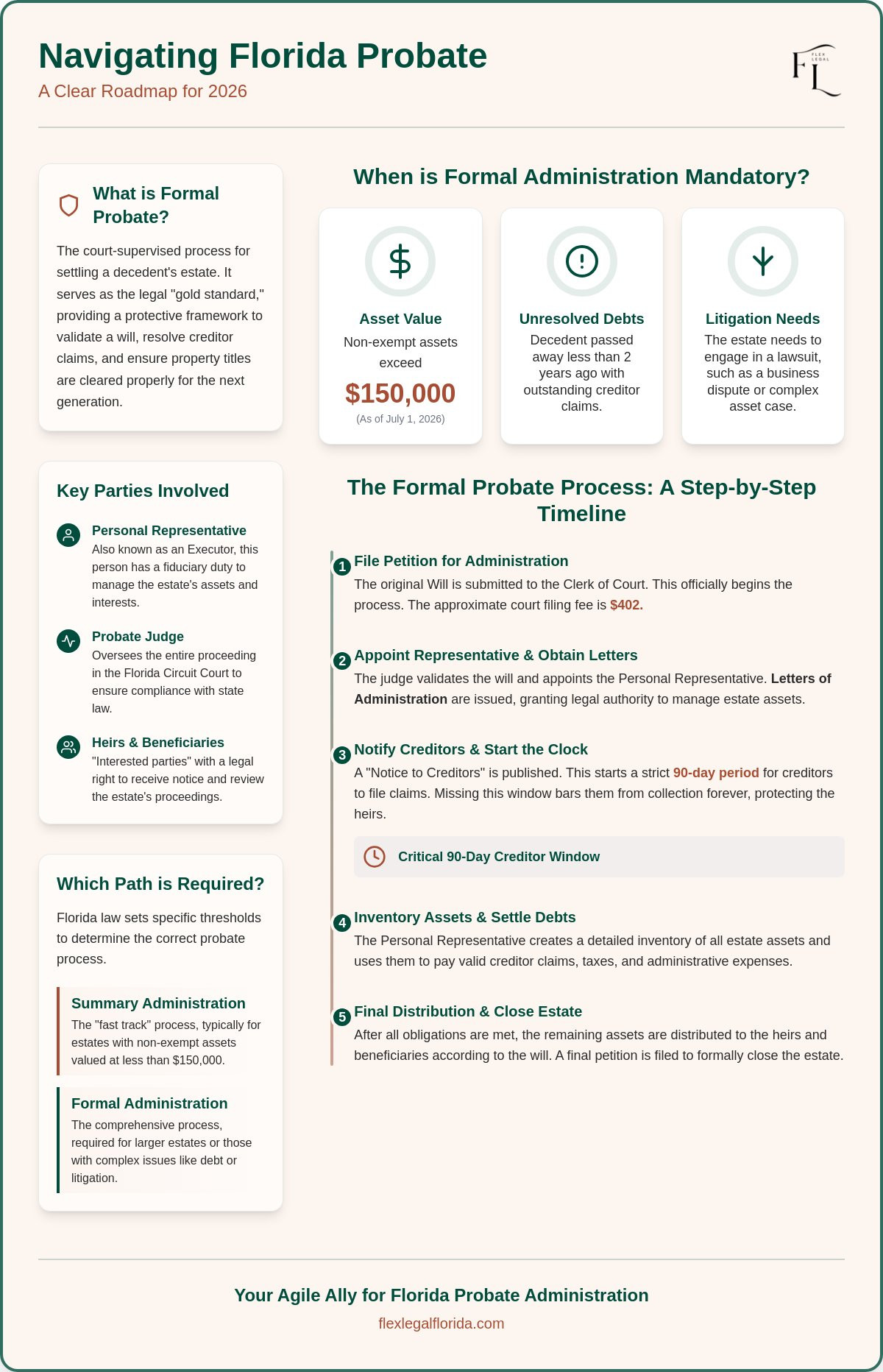
Formal Administration is the court-supervised process of settling a decedent's affairs. In many ways, Formal Probate Administration in Florida acts as the legal gold standard for closing an estate, providing a comprehensive framework to validate a will and distribute assets. It's governed strictly by the Florida Probate Code. These statutes ensure every step is transparent and legally binding for all parties involved. While families often worry about the complexity of the court system, this structured Probate Process actually serves as a vital protection. It provides a definitive resolution to creditor claims and ensures that property titles are cleared properly for the next generation. By following this path, you create an unassailable record of ownership that prevents future legal disputes.
When is Formal Administration Mandatory?
Florida law sets specific triggers that require the formal process rather than a simplified alternative. As of July 1, 2026, if the total value of non-exempt assets exceeds 150,000 dollars, you must use Formal Probate Administration in Florida. This updated threshold is a significant change designed to reflect modern estate values while maintaining rigorous oversight for larger holdings. You'll also find this process mandatory if the decedent passed away within the last two years and has unresolved debts. Because creditors have a right to seek payment, the formal route provides the necessary window for them to file claims. Additionally, if the estate needs to engage in litigation, such as a business succession dispute or a complex asset protection matter, the court must appoint a representative through this formal channel to act on the estate's behalf.
Key Parties Involved in the Florida Probate Court
The most central figure in this process is the Personal Representative. You may recognize this role by the traditional terms "executor" or "administrator." This individual carries a heavy fiduciary duty, which means they must legally prioritize the estate's interests above their own. They don't work in a vacuum; a Probate Judge in the Florida Circuit Court oversees the entire proceeding to ensure compliance with state law. The judge signs the orders that allow the estate to move from one phase to the next. Heirs, beneficiaries, and other "interested parties" also play a critical role. These individuals have a legal right to receive formal notice of the proceedings. This ensures that everyone with a stake in the outcome has the opportunity to review the inventory of assets and voice concerns before the final distribution occurs.
The Florida Formal Probate Process: A 2026 Timeline
Filing the Petition for Administration in a West Palm Beach court is the first official step in the journey. You must submit the original Will to the clerk of court to begin the legal transition. In 2026, the approximate court filing fee for formal administration is 402 dollars. This initial phase sets the stage for the court to recognize your authority and ensures the decedent’s wishes are handled with the oversight they deserve. It's a structured path designed to move from uncertainty to a clear resolution for the entire family.
Opening the Estate and Letters of Administration
Once the judge reviews your petition and confirms the validity of the Last Will and Testament, they issue Letters of Administration. Think of these documents as your "golden ticket." Without them, banks and financial institutions won't recognize your authority to manage the decedent’s accounts. These letters provide the legal power to move funds, sell real estate, and interact with the IRS. For estates involving commercial properties or community association assets, CREAM Real Estate Management provides professional brokerage and property oversight to maintain value during the transition. In the West Palm Beach court system, the judge also officially appoints the Personal Representative during this stage. Having an agile legal partner ensures these documents are processed quickly, helping you avoid the delays often found in more traditional, slower law offices.
Many families find the next phase, the creditor period, to be the most stressful part of Formal Probate Administration in Florida. You're required to publish a "Notice to Creditors" in a local newspaper and serve it directly to any known creditors. This starts a statutory 90-day clock. Creditors must file their claims within this window or risk being barred from collection forever. This period is a critical part of Probate in Florida because it provides a "clean slate" for the heirs, ensuring no surprise debts appear years later.
The Creditor Period and Asset Protection
While the 90-day window remains open, your legal team focuses on inventorying assets. This involves identifying every bank account, piece of jewelry, and real estate holding to determine the estate's total value. It's also the ideal time to apply strategic defenses. If you're concerned about how complex debts or business interests might impact the inheritance, consulting Asset Protection Lawyers Near Me can help secure the family's wealth before the final distribution begins. We prioritize high-level planning to ensure that the assets intended for your family stay with your family.
After the 90-day period passes and all valid debts are resolved, the process moves toward the finish line. The Personal Representative prepares a final accounting that shows every dollar that entered and exited the estate. Once the beneficiaries approve this report, the court authorizes the final distribution of assets. The final step is the formal discharge of the Personal Representative. This court order officially ends your liability and closes the case. If you're ready to start this process, our team can serve as your probate administration ally to ensure a smooth transition.
Summary vs. Formal Administration: Which Path Does Your Estate Require?
Choosing between summary and formal administration is one of the first critical decisions you'll face. While many families hope for the fastest route, the right choice depends entirely on the estate's size, its debts, and the nature of its assets. Summary administration acts as a streamlined alternative, but it's only available under specific conditions. As of July 1, 2026, the threshold for this "fast track" process has increased to 150,000 dollars. If the decedent's non-exempt assets fall below this amount, or if they passed away more than two years ago, summary administration might be an option. However, for larger estates or those with ongoing business interests, Formal Probate Administration in Florida remains the required and most protective path.
The 150,000 Dollar Rule and Its Exceptions
Calculating the value of an estate requires a precise look at "probate assets." These are items held solely in the decedent’s name without a designated beneficiary. Non-probate assets, such as those held in a living trust, don't count toward the 150,000 dollar limit. This distinction is vital for planning. You can explore how to set up these protections in our Revocable Trust Guide to simplify things for your heirs. Even small estates may choose the formal route if they need to resolve complex litigation.
Speed vs. Certainty: Comparing Timelines
Summary probate can often be completed in just a few weeks. In contrast, formal probate typically takes six to twelve months, or even longer for complex cases. This longer timeline isn't just bureaucracy; it's a window of protection. Formal administration provides a definitive end to creditor claims that summary administration cannot always guarantee. A probate lawyer in Palm Beach County can help you weigh these factors to ensure you don't trade long-term legal safety for a few weeks of speed.
Cost is another major factor in this decision. Summary administration is generally less expensive, often costing under 2,500 dollars for smaller estates. However, Formal Probate Administration in Florida offers a deeper level of service that justifies its higher cost, which typically ranges from 3% to 7% of the estate's value. This investment covers the work of a Personal Representative who can actively negotiate with creditors and manage complex tax filings. If you choose the "cheaper" route for a complex estate, you might end up paying more in the long run to fix title errors or resolve missed creditor claims. It's about finding the most adaptable solution for your family's unique circumstances.
Florida's homestead laws add another layer of complexity. Homestead property is often exempt from creditor claims, but the court must formally "determine" its status. In a summary administration, this happens quickly, but it doesn't offer the same broad protections against unknown creditors that the formal process provides. If there's any chance a creditor might challenge the homestead status, the formal route is the superior choice. We prioritize clarity here, ensuring you understand exactly where your risks lie before you file a single document with the court. This proactive approach turns a potentially messy legal situation into a manageable, structured transition.
Personal Representative Duties and Legal Fees in Florida
Being named a Personal Representative is a significant responsibility that carries a strict fiduciary duty. You must legally place the interests of the estate and its beneficiaries above your own at all times. In the context of Formal Probate Administration in Florida, this means you are accountable for every asset inventoried and every penny spent. Missteps can lead to personal liability or even probate litigation in Palm Beach County, which is why understanding your role is the first step toward a successful distribution. You aren't just an administrator; you are a protector of a loved one's legacy.
Navigating Florida Statutory Fees
Florida law provides a clear schedule for compensation to ensure the process remains fair and transparent. For estates valued up to 1 million dollars, the presumed reasonable fee for both the attorney and the Personal Representative is 3% of the estate's value. This structure provides predictability for families, though it isn't the only way to handle costs. In some cases, hourly billing might be more advantageous, especially for estates with high asset values but very few complex legal issues. Transparency is the cornerstone of our approach. You should always feel comfortable asking your attorney for a clear breakdown of how fees are calculated before the process begins.
The Personal Representative's Checklist
Your checklist starts the moment the court issues your Letters of Administration. You'll need to manage real estate, settle final utility bills, and ensure that all federal income tax filings are up to date. If the estate includes business-sponsored retirement plans, you may also need to coordinate with fiduciary experts like Admin316 to handle administrative compliance during the transition. A common point of confusion for many families involves the transition of authority. It is vital to remember that a Durable Power of Attorney in West Palm Beach expires the moment the principal passes away. At that point, the power to act shifts entirely to the court-appointed Personal Representative through the probate process.
Managing these moving parts requires an agile approach to avoid common pitfalls like missed filing deadlines or improper creditor notifications. When beneficiaries feel left in the dark, they are more likely to raise objections that can delay the case for months. By maintaining a steady, logical flow of information and adhering to your fiduciary duties, you can prevent these frictions before they start. If you feel overwhelmed by the legal requirements of Formal Probate Administration in Florida, our team provides the specialized probate administration support you need to fulfill your duties with confidence and ease.
Why Partner with Flex Legal for Florida Probate Administration?
Choosing a partner for Formal Probate Administration in Florida shouldn't feel like stepping back in time. Traditional law firms often rely on slow, paper-heavy processes that add unnecessary stress to grieving families. We take a different approach. Our firm balances professional authority with a modern, accessible style that prioritizes your comfort. We act as an agile ally, moving through the West Palm Beach court system with precision and speed. By handling the complex legal filings and creditor negotiations, we give you the space to focus on your family. We believe that professional legal support should be a source of relief, not another item on your to-do list.
Our deep roots in the West Palm Beach legal community allow us to anticipate the specific requirements of local judges and clerks. This local expertise is vital for avoiding the common procedural hiccups that can stall an estate for months. We offer transparent fee structures, whether you require the standard statutory percentage or an hourly arrangement better suited to your estate's complexity. You'll never have to guess about the status of your case or the cost of your legal support. We prioritize high-level planning and adaptability to ensure that the transition of assets is as smooth and frictionless as possible.
An Agile Ally in Palm Beach County Probate
We leverage modern technology to streamline every stage of the process. This means faster document filing and transparent communication that keeps you informed without the dense jargon. As a boutique firm, we offer direct access to Jennifer L. Flexer, Esq. You won't be passed off to a rotating cast of junior associates who don't know your story. This personal connection allows us to build tailored strategies for unique challenges. Whether you're dealing with special needs planning for an heir or navigating a complex business succession within the probate framework, we provide the specialized expertise needed to protect those interests.
Take the First Step Toward Settling the Estate
Readiness is the key to a smooth start. When you come for your initial consultation, bring the original Will and a certified copy of the death certificate. It is also helpful to have a preliminary list of known assets and potential creditors. We take it from there. Our team alleviates the anxiety of court appearances and the friction of dealing with persistent debt claims. We provide a clear, adaptable path forward that settles the estate efficiently and fairly. If you are ready to move from uncertainty to a resolved legal status, we are here to guide you. Schedule a consultation with a West Palm Beach probate attorney today.
Moving Forward with Confidence and Clarity
Settling an estate is more than just a legal requirement; it's a vital step in honoring a loved one's final wishes. You now have a clear understanding of when Formal Probate Administration in Florida is necessary and how the updated 2026 thresholds impact your family's timeline. By recognizing the weight of fiduciary duties and the structure of statutory fees, you can approach the court process without the usual anxiety. The right path isn't just about following rules. It's about choosing an adaptable strategy that protects every beneficiary and clears the way for the next generation.
We're here to serve as your agile ally throughout this transition. Our firm provides compassionate, modern legal representation in Palm Beach County. We offer fixed-fee estate planning options and specialized Special Needs Planning expertise to ensure no detail is overlooked. We handle the administrative friction so you can focus on your family's well-being. Don't let the complexity of the court system stall your progress. Secure Your Family's Future with a West Palm Beach Probate Expert and take the first step toward a seamless resolution today. You have the tools to navigate this. We are ready to help you succeed.
Frequently Asked Questions
How long does formal probate administration take in Florida?
Formal probate typically takes between 6 and 12 months to complete in the Florida court system. This window allows for the mandatory 90-day creditor notification period and the thorough inventorying of all assets. If the estate involves complex litigation or business interests, the process can extend beyond a year. We focus on maintaining a steady, logical pace to ensure your family moves forward without unnecessary delays.
Do I need a lawyer for formal probate in Florida?
Yes, Florida probate rules require almost every Personal Representative to hire a licensed attorney. The court views the role as a high-stakes fiduciary position that requires professional guidance to avoid legal errors. While a few rare exceptions exist for sole heirs, the complexity of the filing requirements makes legal counsel an essential ally for protecting the estate’s interests and reducing your personal liability.
What is the difference between an executor and a Personal Representative in Florida?
There is no functional difference between the two; Florida statutes simply use the term "Personal Representative" instead of "executor." Both titles refer to the individual appointed by the court to settle the decedent's affairs. Whether you are named in a Will or appointed by the judge in an intestate case, your responsibilities for managing assets and resolving valid debts remain exactly the same.
Can I avoid formal probate if there is a Will?
A Will does not bypass the court; it actually serves as the roadmap for the probate judge to follow. To avoid the Formal Probate Administration in Florida process entirely, assets must be held in a trust or have direct beneficiary designations. Without these planning tools, the court must still validate the Will and oversee the transfer of assets to ensure the decedent’s wishes are legally fulfilled.
How much are probate attorney fees in West Palm Beach?
Attorney fees are generally calculated as a percentage of the estate's value according to Florida’s statutory fee schedule. In 2026, the presumed reasonable fee is 3% for estates between 100,000 and 1 million dollars. While these rates provide a baseline, families can also discuss hourly structures or negotiated fees depending on the specific needs of the estate. We prioritize transparency so you always understand the value provided.
What assets are subject to formal probate in Florida?
Assets subject to Formal Probate Administration in Florida include any property or accounts held solely in the decedent’s name at the time of death. This often includes individual checking accounts, stocks without transfer-on-death instructions, and real estate not titled as "joint tenants with rights of survivorship." Assets held in a living trust or those with named beneficiaries are considered non-probate assets and pass directly to heirs.
Who is responsible for paying the decedent's debts during probate?
The estate’s assets are used to settle the decedent’s valid debts before any final distribution happens. The Personal Representative is responsible for identifying creditors and paying them from the estate's funds in a specific order of priority set by law. You are not personally responsible for these debts unless you distribute funds to beneficiaries before resolving the claims of known creditors during the probate window.
Can out-of-state residents serve as Personal Representatives in Florida?
Out-of-state residents can serve as a Personal Representative if they are a close relative of the decedent. This includes spouses, siblings, parents, children, or other blood relatives. If the person is not a relative, Florida law requires them to be a resident of the state to qualify for the role. This rule ensures the court has jurisdiction and easier access to the person managing the Florida-based assets.


Comments