
Florida Military Special Needs Planning: 2026 Guide

Updated: Sep 28
A new set of orders can change more than your address. It may disrupt care routines, provider relationships, and the people who know how to step in during a deployment or emergency. Special needs planning for military families Florida should account for those transitions while keeping your family member’s needs at the center.
You may be wondering whether an inheritance could affect benefits, who can make decisions while you’re away, or how a plan will hold up after a move. These questions are connected, but they may require different guidance. Estate documents can clarify responsibilities and provide a framework for care, while military and government benefit rules call for separate, qualified review.
This guide explains how to coordinate your estate plan, caregiving decisions, and benefits questions as family circumstances change. You’ll learn how wills, trusts, and incapacity-planning documents may work together, what to consider when naming people to step in, and which military, federal, and Florida programs to review with the appropriate professionals. A flexible plan can help your family prepare for transitions without assuming every detail will stay the same.
Table of Contents
Why Florida military families need a special needs plan that can move with them
How special needs trusts and military benefits fit into a Florida family plan
Common assumptions about military benefits, inheritance, and special needs planning
A practical checklist for coordinating care through deployment, PCS, and emergencies
Building a Florida special needs plan with the right legal and benefits support
Why Florida military families need a special needs plan that can move with them
A military move can change a family’s care arrangements in practical ways. A familiar provider may no longer be nearby, a new caregiver may need to learn daily routines, or a parent may be unavailable during deployment or travel. A plan that depends on one person’s memory or a single set of local contacts can be difficult to use after a transition. Special needs planning for military families Florida should make responsibilities and essential information easier to carry forward.
Benefits-aware special needs planning coordinates legal, care, and financial decisions while leaving benefit eligibility questions for qualified review. Estate planning can establish legal authority and address how assets may pass to family members. It doesn’t administer military benefits or replace medical and care coordination. Those areas may require input from program advisers, health care providers, and support teams.
How deployment and relocation can affect caregiving continuity
Before a parent deploys, travels, or becomes temporarily unavailable, identify who can handle day-to-day caregiving and who should be contacted if plans change. Share information caregivers may need, such as daily routines, provider details, communication preferences, and instructions for urgent situations. Make sure trusted people know where current documents and contact lists are kept and how to access them.
After a move, check whether those details are still useful. Update provider and program contacts, confirm that caregivers have current instructions, and make sure important records are accessible to the people who may need them. A relocation or deployment is a useful prompt to review the plan, not an automatic reason to change legal documents. Ask a Florida estate-planning attorney whether any document needs review based on your family’s circumstances.
What a coordinated plan is designed to address
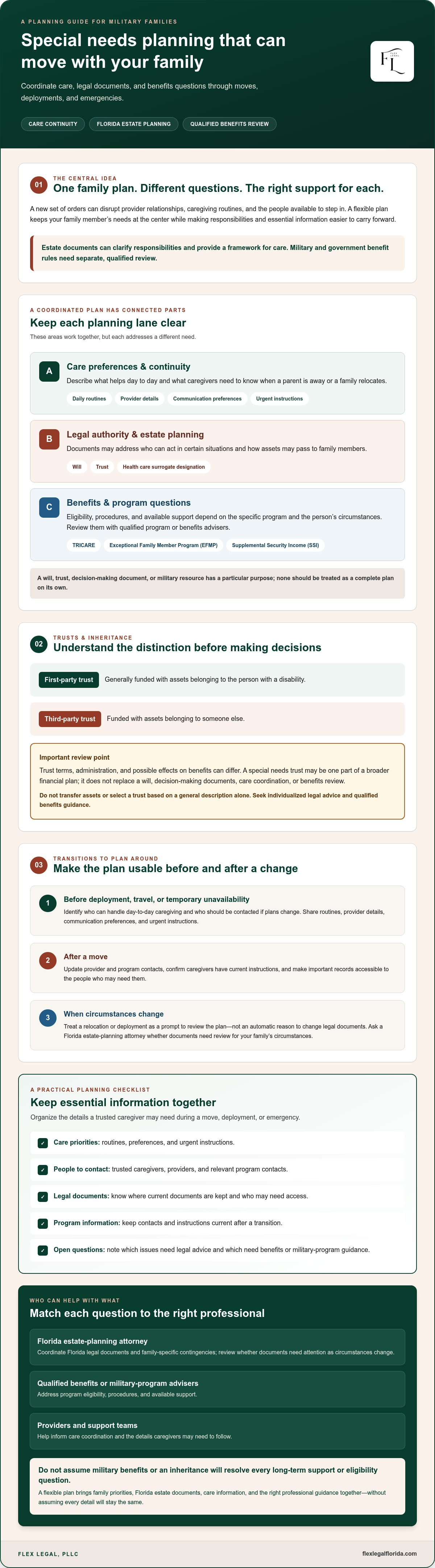
Separate the plan into connected questions. Care preferences describe what helps day to day. Legal documents address who may act in certain situations. Inheritance planning considers how assets should pass. Benefit questions depend on the specific program and the person’s circumstances. A Special Needs Trust may be one part of the financial plan, but its suitability and possible effect on benefits need individual legal and benefits review.
Each family’s support needs, available programs, and trusted helpers differ. A will, trust, health care surrogate designation, or military resource has a particular purpose, but none should be treated as a complete plan on its own. An estate-planning attorney can help coordinate Florida legal documents and family-specific contingencies. Qualified benefits or military-program advisers can address eligibility, procedures, and available support. Keeping these roles distinct helps families identify unanswered questions without assuming an outcome.
How special needs planning for military families Florida fits into a family plan
A special needs trust may be one tool within a broader estate plan. It can provide a structure for managing assets for a beneficiary, but it doesn’t replace a will, decision-making documents, care coordination, or review of public and military benefits. In special needs planning for military families Florida, the right approach depends on the beneficiary’s circumstances, the source of funds, and current program rules.
What families should understand before considering a special needs trust
First-party trusts are generally funded with assets belonging to the person with a disability; third-party trusts are funded with assets belonging to someone else. Their terms, administration, and possible effects on benefits can differ. Don’t transfer assets or select a trust based on a general description alone. Get individualized legal advice and qualified benefits guidance before acting.
Where military and public benefits questions belong
TRICARE, the Exceptional Family Member Program (EFMP), and Supplemental Security Income (SSI) are distinct programs, each with its own rules and procedures. The Exceptional Family Member Program (EFMP) is a resource to review for program information, but participation in a program doesn’t replace an estate plan or guarantee a particular benefit. Confirm current requirements with the relevant program office or a qualified adviser.
An estate-planning attorney can help coordinate Florida trusts, wills, and decision-making documents. A qualified benefits or military-program adviser can address program eligibility, procedures, and coverage questions. For veterans seeking guidance on disability evaluations and claim documentation, discover Global Vets Consulting (GVC4Vets) to explore their educational blog and resources. Before meetings, gather existing estate documents, benefit notices, care information, and questions about proposed gifts or inheritance.
Benefit effects depend on individual facts and current rules, so verify legal and program details before making decisions. West Palm Beach families can explore how Florida special needs planning may fit into a broader military-family plan while seeking qualified guidance on benefits questions.
Common assumptions about military benefits, inheritance, and special needs planning
Military benefits can be valuable, but families shouldn’t assume they cover every long-term support need or settle every care decision. Coverage, enrollment, and program procedures depend on individual circumstances and current rules. For example, a family may need to confirm what support is available during a move and what other arrangements may be needed if a service or provider changes. When navigating complex disability claims or rating disputes, veterans and their families can explore Veteran Claims Representation and VA Appeals to ensure their benefits are properly secured.
Does receiving military support remove the need for estate planning?
No. Benefits and legal documents serve different purposes. A program may provide access to specific services, while estate documents can address who may act in certain situations and how assets should pass. The MacDill Air Force Base EFMP page offers information about that program, but families should verify their own enrollment, coverage, and options with the relevant program office or a qualified adviser.
A care plan guides support, an estate plan sets out legal and financial arrangements, and a benefits determination applies program rules to an individual’s circumstances. Coordinating these pieces matters, but one doesn’t substitute for another or guarantee a specific outcome.
Can a family rely on a generic trust or old documents?
An inheritance doesn’t automatically mean benefits will end, and families shouldn’t assume it will have no effect. The result may depend on the benefit program, the beneficiary’s circumstances, and how assets are received or managed. A trust alone also doesn’t guarantee benefit protection. Its terms, funding, and administration matter, so families should get legal and qualified benefits review before transferring assets or relying on a trust to address eligibility concerns.
Generic or outdated documents may not reflect changed care needs, family responsibilities, or the people a parent now trusts to step in. A PCS move, new diagnosis, change in caregiver, or inheritance can be a useful prompt to review the plan with an attorney. A move doesn’t automatically require new documents, but families should ask whether their current plan still fits their circumstances.
A Florida revocable living trust guide can provide general context about this estate-planning document. In special needs planning for military families Florida, the next step is to connect that general understanding to the beneficiary’s specific needs and current benefit rules.
A practical checklist for coordinating care through deployment, PCS, and emergencies
A useful plan should be easy for trusted people to use when routines change. Start with the care priorities that matter most, then make sure the right people know what to do and where to find current information. Special needs planning for military families Florida is more useful when legal documents and practical handoff details are reviewed together.
Prepare a caregiver handoff and emergency information file
Use this checklist before a deployment, extended trip, or other period when a parent may be unavailable:
Set care priorities. Record daily routines, support needs, communication preferences, and details a new caregiver should know.
Name trusted emergency contacts. List primary and backup contacts, including relevant providers and program offices. Confirm that the people listed are willing and able to help.
Organize key information. Keep care instructions, current contact details, and copies or locations of relevant legal documents together. Tell trusted caregivers how to access the file.
Check decision-making authority. Confirm who may act under applicable documents and what those documents authorize. Informal notes can guide care, but they don’t create legal authority or replace properly prepared documents.
Share and confirm. Review the handoff with the people involved and make sure they know whom to contact if circumstances change.
Review the plan after a move or major family change
A PCS, deployment, change in caregiver, new provider, inheritance, or shift in family circumstances is a practical time to check whether the plan remains usable. Review your residence, care team, emergency contacts, assets, and relevant program contacts. Update the information file and confirm that the right people can access it.
If your family moves to another state, ask counsel familiar with the new jurisdiction to review your documents and arrangements. Don’t assume Florida documents or program procedures transfer unchanged. A move is a reason to review, not necessarily a reason to replace every document.
Decision-making documents deserve particular attention. A durable power of attorney addresses financial authority, while other documents may address health care decisions. For guidance on how Florida documents fit your family’s circumstances, discuss durable power of attorney planning with a qualified Florida estate-planning attorney.
Building a Florida special needs plan with the right legal and benefits support
A clear process can make a complex plan easier to manage. Start by identifying your family’s care priorities and the people who may need to step in. Gather existing legal documents, care information, asset details, and current benefit or program notices. Then sort out which questions belong with a Florida estate-planning attorney and which need a benefits counselor or military program representative. Finally, review the documents and contacts together so the plan reflects your family’s current circumstances.
Questions to bring to a Florida estate-planning consultation
Bring questions that connect legal documents to everyday responsibilities. For example: How would a proposed will or revocable living trust fit the beneficiary’s circumstances? Which decision-making documents may be relevant if a parent is unavailable? Would guardianship need to be considered, and what facts should guide that discussion?
Also ask what information the attorney needs to evaluate trust funding and how a proposed arrangement could raise benefit questions. The attorney can explain the legal planning issues, but current military benefits and program eligibility require case-specific confirmation from the appropriate program office or qualified adviser. Ask which questions should be referred for that review.
How Flex Legal can support the estate-planning portion
Flex Legal, PLLC offers special needs planning, revocable living trusts, wills, durable powers of attorney, health care surrogate designations, living wills, and guardianship proceedings. These services address the legal-document portion of a family’s plan. The firm isn’t a military benefits administrator or medical provider, so families should seek separate guidance for program eligibility, coverage, and care coordination.
West Palm Beach families can discuss how Florida documents may fit their needs and broader military-family plan. Ask how the attorney would approach your circumstances, what records to bring, and how to coordinate legal questions with benefits guidance. That conversation can help identify next steps without assuming that one document or program answers every concern.
For special needs planning for military families Florida, the goal is a legal plan that reflects your family’s priorities and can be reviewed as circumstances change. If you’re in the West Palm Beach area, contact Flex Legal to discuss your Florida estate-planning needs and the documents that may be relevant to your family.
Make your plan ready for the next change
A workable plan gives trusted people clearer direction when family routines shift, keeps legal documents aligned with care priorities, and leaves benefit questions for current, case-specific review. Special needs planning for military families Florida is an ongoing process, not a one-time set of papers. Revisit your choices as caregivers, family circumstances, and military assignments change.
Flex Legal offers special needs planning and estate-planning documents, including trusts, wills, and powers of attorney. An estate-planning attorney can help you consider how these documents fit together under Florida law. For military benefits and program eligibility, seek confirmation from the relevant program office or a qualified adviser.
You don’t have to resolve every question at once. Start by identifying your family’s priorities and gathering the records you already have. Then take the next step: discuss your Florida special needs planning with Flex Legal. A thoughtful review can help you build a plan that’s clearer today and easier to revisit as life changes.
Frequently Asked Questions
Does a military family in Florida need a special needs trust?
Not every military family needs a special needs trust. Whether one fits depends on the beneficiary’s circumstances, where the funds would come from, and the family’s goals. Trust terms and administration may affect how assets are handled, so don’t assume a trust automatically preserves eligibility for benefits. Discuss the options with a Florida estate-planning attorney and get qualified benefits guidance before creating or funding a trust.
Can an inheritance affect SSI or Medicaid eligibility in Florida?
It can raise eligibility questions, but an inheritance doesn’t automatically end SSI or Medicaid eligibility in every case. The outcome depends on the person’s circumstances, how the inheritance is received or managed, the benefit involved, and current rules. Before accepting, transferring, or spending inherited assets, consult a qualified benefits adviser and an attorney familiar with Florida planning. Families in West Palm Beach can also organize existing benefit notices and estate documents for review.
Does TRICARE cover all care for a family member with special needs?
No. Don’t assume TRICARE covers every service or long-term support your family member may need. Coverage depends on the person’s situation, plan, and applicable program rules. Ask the appropriate TRICARE office or qualified adviser to confirm covered services, authorization requirements, and any relevant options, including whether the Extended Care Health Option applies. Keep those answers with your care records and review them after a move or change in care needs.
What is the Exceptional Family Member Program, and does it replace estate planning?
The Exceptional Family Member Program (EFMP) supports eligible military families through identification and enrollment, assignment coordination, and family support. It does not replace a will, trust, power of attorney, or other estate-planning document, and it doesn’t determine what those documents should say. Confirm current enrollment procedures and available support with the relevant military program office. Coordinate that guidance with legal planning rather than treating it as a substitute.
What should military parents prepare before a deployment or PCS move?
Before a deployment or PCS, prepare current care instructions, routines, provider and program contacts, communication preferences, and details about where important records are stored. Confirm which trusted adults are available and understand the relevant documents. Review who has legal authority to make decisions, since an informal caregiver note doesn’t grant authority. After arrival, update contact details and check that caregivers can access the information they may need.
Should a military family use a Florida attorney if it may move to another state?
A Florida attorney can help prepare or review documents for a family’s Florida planning needs, even if a future move is possible. Before relocating, ask whether the documents and arrangements should be reviewed under the destination state’s rules. Don’t assume they will transfer unchanged. A lawyer familiar with the new jurisdiction can assess local considerations. This approach can help a West Palm Beach family plan for a move without treating it as a reason to delay planning.
How often should a military family review its special needs plan?
Review the plan when a deployment or PCS is approaching, a caregiver or provider changes, the beneficiary’s needs shift, or the family experiences a major change such as an inheritance. Also check periodically that contacts, records, and documents are current and accessible. There isn’t one review schedule that fits every family. Ask your attorney what timing makes sense for your documents, and verify benefit questions with the relevant program or adviser.


Comments