
Florida Living Will Requirements: A 2026 Guide to Protecting Your Final Wishes
- Kelly Mata
- Jul 13
- 12 min read

Updated: Jul 22
Imagine a quiet hospital room where your family is forced to guess your medical wishes because you're no longer able to speak for yourself. It's a heavy burden that no one wants to leave behind, yet many people mistakenly believe a verbal understanding is enough to guide doctors during a crisis. You likely already know that clear, written instructions are the only way to prevent unnecessary suffering and painful family disputes. However, failing to meet the specific Florida living will requirements can render your most personal decisions legally toothless when they matter most.
You deserve the peace of mind that comes from knowing your autonomy is protected by a document that actually holds up in a West Palm Beach medical facility. This 2026 guide breaks down the exact statutory steps to create a valid living will, from witness restrictions to the specific medical triggers that activate your choices. We'll also clear up the common confusion between a living will and a health care surrogate. You'll find a clear, adaptable path to securing your final wishes without the friction of traditional, overly complex legal processes.
Table of Contents
What is a Florida Living Will and Why Do You Need One?
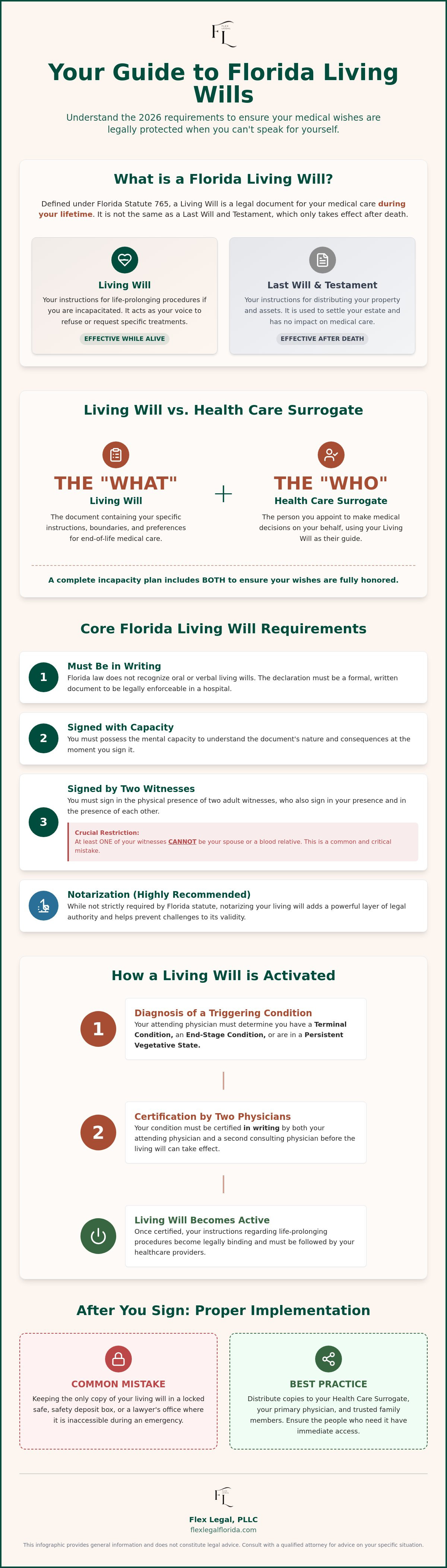
A Florida living will is a strategic legal document that functions as your voice during a medical crisis. Defined under Florida Statute 765.101, it is a primary component of a comprehensive advance healthcare directive. Its core purpose is to provide clear, written instructions regarding life-prolonging procedures. By formalizing these preferences, you decide whether to refuse or request specific treatments, such as artificial nutrition or mechanical ventilation, if you are ever diagnosed with a terminal or end-stage condition. Meeting the specific Florida living will requirements ensures that your medical team and family have a legally binding roadmap to follow, protecting your personal autonomy when you can no longer communicate.
It's vital to distinguish this document from a Last Will and Testament. A Last Will only takes effect after death to distribute assets and settle your estate. In contrast, a living will is an incapacity document. It operates during your lifetime, specifically when you're alive but unable to make medical decisions. Beyond the legal protections, there is a profound emotional benefit to this planning. When you have a valid living will, you remove the "burden of choice" from your grieving family members. Without it, your loved ones may be forced to make life-and-death decisions during a period of intense trauma, which often leads to conflict and long-term guilt.
Living Will vs. Health Care Surrogate
While people often use these terms interchangeably, they serve different roles in your incapacity plan. Think of your living will as the "what"—it contains your specific instructions and boundaries for medical care. Your Designation of Health Care Surrogate is the "who"—it names the specific person you trust to make decisions on your behalf. Having both is critical. A surrogate can handle various medical issues, but a living will provides the specific legal authority needed to address end-of-life scenarios. This dual approach ensures your advocate has the exact instructions they need to honor your wishes without hesitation.
The Role of Autonomy in Florida Law
Florida law is unique because it recognizes a strong constitutional right to privacy, which extends to your medical choices. A written living will acts as the ultimate expression of this autonomy. While some people assume that telling a spouse or child their wishes is enough, oral instructions are often difficult to prove and can be challenged in a hospital setting. A formal written declaration carries significant legal weight. It serves as clear and convincing evidence of your intent, ensuring that your healthcare remains a reflection of your values rather than a series of default medical protocols.
Core Florida Living Will Requirements for 2026
A valid living will in Florida isn't just a casual statement of intent. It's a formal, voluntary declaration that must adhere to strict statutory guidelines to be enforceable. One of the most fundamental Florida Living Wills Laws is that the document must be in writing. Florida doesn't recognize oral living wills. Even if you've clearly stated your wishes to your family for years, those verbal instructions won't carry the same legal weight as a signed, written document in a clinical setting.
At the time of signing, you must possess the mental capacity to understand the nature of the document. This means you're making a conscious, informed decision about your future medical care. The document must also contain specific language regarding the withholding or withdrawal of life-prolonging procedures. Without this precise phrasing, medical providers may find the document too vague to follow. Ensuring you meet every one of the Florida living will requirements is the only way to guarantee your voice is heard when you can't speak for yourself.
The Two-Witness Rule
Florida law requires you to sign your living will in the presence of two adult witnesses. This process ensures the document was signed voluntarily and without coercion. However, the identity of these witnesses is where many people make mistakes. At least one of your witnesses cannot be your spouse or a blood relative. This "non-relative" clause is designed to prevent even the appearance of a conflict of interest. Additionally, while it's tempting to ask a nurse or doctor to sign, many West Palm Beach hospital policies actually prohibit staff from witnessing legal documents. Choosing independent witnesses is the best way to ensure your document remains bulletproof.
Notary Public: Required or Recommended?
Strictly speaking, Florida statutes don't require a living will to be notarized. A document signed by you and two proper witnesses is technically valid. However, we consistently recommend notarization for our clients. A notary adds a layer of "self-proving" authority that clinical staff recognize immediately. In a fast-moving medical emergency, a notarized seal can prevent delays by removing any doubt about the signature's authenticity. If you're feeling overwhelmed by these technicalities, working with an estate planning professional can help you navigate the process with confidence. This proactive approach ensures your document meets every 2026 standard without the stress of "do-it-yourself" errors.
Understanding the Three Triggering Conditions
Your living will does not take effect immediately upon signing. Instead, it remains dormant until specific medical criteria are met. Under Florida Statute § 765.302, the document only "activates" when you are unable to communicate your wishes and your attending physician, along with one other consulting physician, certifies that you meet one of three specific conditions. This double-certification process is a vital safeguard. It ensures that no single person can unilaterally decide to implement your directives without a rigorous clinical consensus.
According to Florida law, life-prolonging procedures include any medical intervention that uses artificial means to sustain or supplant a vital function, which would only serve to prolong the dying process. A critical part of the Florida living will requirements involves deciding whether this definition includes or excludes "Nutrition and Hydration." Many people choose to make a specific election regarding feeding tubes. This is often the most emotionally charged aspect of end-of-life care, and being explicit about your wishes prevents your family from having to guess during a crisis.
Terminal vs. End-Stage Conditions
A "Terminal Condition" is a state caused by injury or disease from which there is no reasonable probability of recovery, even with medical treatment. Think of a patient in the final stages of a terminal illness where death is imminent. An "End-Stage Condition" is slightly different. It refers to an irreversible and progressive deterioration that will result in death, even if life-prolonging procedures are used. A practical example would be advanced dementia or end-stage heart failure, where the body is steadily failing despite modern medical support. Defining these choices early ensures your healthcare remains a reflection of your personal values.
Persistent Vegetative State (PVS)
Florida defines PVS as a permanent and irreversible condition of unconsciousness. In this state, a patient shows no voluntary action or cognitive behavior, though they may have sleep-wake cycles. This condition is frequently at the center of medical disputes because the body can often be kept alive for years through artificial means. Without a clear directive, families often disagree on whether to continue life support, leading to long legal battles. A well-drafted living will provides the clarity needed to avoid the kind of public, painful disputes seen in high-profile Florida cases like Terri Schiavo. It ensures your clinical definition of "quality of life" is the only one that matters.
Implementation: What to Do After Signing
Signing your document is a major milestone, but a piece of paper sitting in a locked safe doesn't help you in an emergency. One of the most dangerous mistakes is the "Original Document" trap. If your lawyer is the only person with the original, and you're rushed to a West Palm Beach hospital at 2:00 AM on a Sunday, the document might as well not exist. You need to distribute copies immediately. Provide a copy to your primary care physician to be scanned into your electronic medical record. Ensure your local hospital has it on file. Most importantly, you must have a deep, honest conversation with your designated Health Care Surrogate. They need to understand the nuances of your choices so they can advocate for you with confidence. Meeting Florida living will requirements is only the first step; accessibility is the second.
A living will is only one piece of the puzzle. To be truly protected, you should integrate it with a durable power of attorney to handle financial matters during incapacity. While the living will handles the "what" of your medical care, these other documents manage the "how" of your life's logistics. Following the Florida living will requirements provides the legal foundation, but active distribution is what makes the plan functional in the real world.
Digital Access and Portability
We live in a digital age, and your legal planning should reflect that. Scan your living will and store it in a secure cloud folder or on your smartphone. Both iPhone and Android devices have "Emergency Medical ID" features that first responders are trained to check. You can often upload a PDF or list your directive status there. Additionally, carry a "Notice of Living Will" card in your wallet. It's a simple, effective tool that tells emergency personnel exactly who to contact and where to find your full directive. This level of portability ensures your wishes travel with you, whether you're in West Palm Beach or traveling abroad.
Periodic Review and Updates
Your medical wishes aren't static. As technology and your personal health evolve, so should your directives. We recommend the "5 D’s" rule for updates: every new Decade, the Death of a loved one, a Divorce, a new medical Diagnosis, or a general Decline in health. For those looking to stay proactive about their health through modern diagnostic services and hormonal wellness, click here to learn more about the testing options at Stay Medical Clinic. If your life changes, your documents must adapt. To legally revoke or change a Florida living will, you can create a new document that explicitly replaces the old version or physically destroy the original. Staying current ensures your 2026 document isn't relying on outdated medical definitions or family dynamics that no longer exist.
As you stay proactive about your health through diagnostics and wellness planning, you may also be interested in following the latest breakthroughs in biotechnology; for those who explore high-quality research materials, check out Peptide Research AU.
If you're ready to move beyond generic forms and build a plan that truly fits your life, you can schedule a consultation with Flex Legal today to ensure your documents are both legally sound and practically accessible.
The Flex Legal Advantage: Modern Incapacity Planning
Flex Legal isn't a distant or rigid institution. We act as an agile ally for West Palm Beach residents who want their final wishes to be more than just a checked box on a hospital intake form. Traditional professional services often feel intimidating or overly formal, but we've built our practice on accessibility and transparency. By offering flat-fee estate planning packages, we remove the financial friction that often prevents families from completing their essential documents. You deserve a partner who prioritizes your comfort and clarity over dense, multi-clausal jargon.
We believe that adaptability is a core value in any modern legal strategy. Your family dynamic is unique, and your incapacity plan should reflect that reality. Whether you're managing complex medical needs or simply want to ensure your spouse has a clear path forward, we focus on high-level planning that works in the real world. As your partner in estate planning in West Palm Beach, we ensure your documents are dynamic support systems rather than static sets of rules.
Avoiding the Pitfalls of DIY Forms
Using a generic internet form to meet Florida living will requirements is a significant risk. These "cookie-cutter" templates often fail in clinical settings because they use ambiguous language that doctors find difficult to interpret. If your instructions are unclear, medical professionals may default to standard life-prolonging protocols to avoid liability. Furthermore, poorly drafted documents are a primary catalyst for probate litigation among surviving family members. Professional drafting ensures your intent is unmistakable, providing a legally bulletproof shield that protects your autonomy and your family's emotional well-being.
Next Steps: Secure Your Peace of Mind
Ready to move forward? Securing your future doesn't have to be a slow or painful process. We invite you to a consultation at our West Palm Beach office to discuss your specific goals and concerns. To make your initial planning session as efficient as possible, please bring a list of your current medical providers and the contact information for your intended health care surrogates. Our streamlined approach means we can typically move from identifying your challenges to finalizing a comprehensive incapacity plan in a matter of weeks. You can expect a steady, logical rhythm that delivers results without unnecessary friction.
Take Control of Your Future Medical Care
Protecting your wishes shouldn't be a source of anxiety. By understanding the specific Florida living will requirements, you've taken the first step toward ensuring your medical care remains in your hands. You now know how to navigate the two-witness rule, identify clinical triggers, and avoid the high risks associated with generic DIY forms. These steps aren't just legal formalities. They are gifts of clarity for the people you love most. When you document your choices today, you prevent future confusion and conflict during a crisis.
At Flex Legal, we act as your modern estate planning ally in West Palm Beach. We specialize in incapacity and special needs law, offering the flat-fee transparency you need to plan with complete confidence. Don't leave your final wishes to chance or let a hospital default to protocols that don't reflect your personal values. Our team is ready to help you create a document that is both legally sound and practically accessible in a medical emergency.
Schedule a Flat-Fee Consultation with Flex Legal Today to build a plan that's as adaptable as your life. Your peace of mind is within reach, and we're here to help you secure it.
Frequently Asked Questions
Is a Florida living will the same as a DNR (Do Not Resuscitate) order?
No, these are distinct documents with different purposes. A DNR is a specific medical order signed by a physician that instructs emergency responders not to perform CPR if your heart stops. A living will is a broader legal directive that outlines your preferences for various life-prolonging procedures, such as ventilators or feeding tubes, during end-stage conditions. You often need both to ensure your medical team understands your full range of wishes.
Can I write my own living will in Florida without a lawyer?
You can legally create your own document, but doing so carries significant risks. While the state provides a basic form, it often lacks the specific language needed to address complex medical scenarios. If your DIY form is ambiguous, it may not satisfy the strict Florida living will requirements when a hospital legal team reviews it. Professional drafting ensures your instructions are bulletproof and effectively communicate your intent to medical providers.
Do I need to file my living will with a Florida court?
No, you don't need to file this document with any court or government agency in Florida. Unlike a Last Will and Testament, which goes through probate after death, a living will is a private document. Its effectiveness depends entirely on its accessibility. You should provide copies to your primary care doctor, your health care surrogate, and your local hospital so it's available the moment a medical crisis occurs.
What happens if I have a living will from another state but now live in West Palm Beach?
Florida law generally recognizes out-of-state living wills if they were validly executed under the laws of the state where they were created. However, local medical facilities are most familiar with Florida-specific statutes and forms. To avoid any hesitation or delays in a fast-moving emergency, it's a best practice to update your directives to meet current Florida living will requirements. This ensures your plan is perfectly aligned with local clinical standards.
Can my family overrule my living will if they disagree with my choice?
Legally, your family cannot overrule a validly executed living will. The document is a formal expression of your constitutional right to privacy and self-determination. However, if the document is vague or improperly witnessed, family members might challenge its validity in court. A clearly drafted, legally sound directive prevents these disputes by removing any doubt about your wishes, ensuring your voice remains the final authority on your care.
Does a living will cover my funeral or burial preferences?
No, a living will is strictly for medical decisions made while you're still alive but incapacitated. Instructions for your funeral, burial, or cremation should be placed in your Last Will and Testament or a separate written declaration. Because a living will focuses on the "dying process" rather than what happens after death, it's important to have a complete estate plan that addresses both your medical care and your final arrangements.
How much does it cost to have a lawyer draft a living will in Florida?
The cost for professional drafting varies based on the complexity of your overall incapacity plan. Many traditional firms still use hourly billing, but modern practices often favor flat-fee transparency. This approach allows you to understand the total investment upfront without worrying about hidden charges. Most people choose to include a living will as part of a comprehensive package that features a health care surrogate and a durable power of attorney.
What is a 'Pre-Need Guardian' and do I need one with my living will?
A Designation of Pre-need Guardian is a document where you name the person you want to serve as your guardian if a court ever declares you incapacitated. While a living will gives instructions for medical care, a guardian manages your person and property if you can't. It's a vital safety net that prevents the court from appointing a stranger to manage your life. Including this in your plan provides a complete shield against unwanted state interference.


Comments