
Florida Guardianship: Roles, Rights, and What Families Should Know

Could protecting a loved one also mean limiting some of their ability to make decisions? In Florida, Guardianship gives a court-appointed guardian authority to help with specific personal or financial matters, with the scope set by the court. The goal is not simply to take over; it is to address the person’s needs while preserving as much independence as possible.
If you are unsure when a court may step in, or concerned about what your family member could lose, those questions are understandable. Florida’s terminology and responsibilities can feel unfamiliar, especially when families are also weighing less restrictive options. A guardian must act in the individual’s best interests and follow the authority and oversight established by the court.
This guide explains the roles and oversight involved in Florida guardianship, how authority may be tailored, and what rights and choices may remain with the individual. It also covers planning tools, including a durable power of attorney and health care surrogate designation, that may be relevant before a proceeding. For families in West Palm Beach and Palm Beach County, it explains what information to organize before discussing the circumstances and possible next steps with a lawyer.
Table of Contents
What Guardianship Means in Florida, and What It Does Not Automatically Decide
Florida Guardianship Types and the Decisions a Guardian May Handle
Does Guardianship Remove Every Right? Florida Safeguards and Alternatives
How Families Can Prepare for a Guardianship Matter in Palm Beach County
Guardianship Legal Support in West Palm Beach: Practical Next Steps
What Guardianship Means in Florida, and What It Does Not Automatically Decide
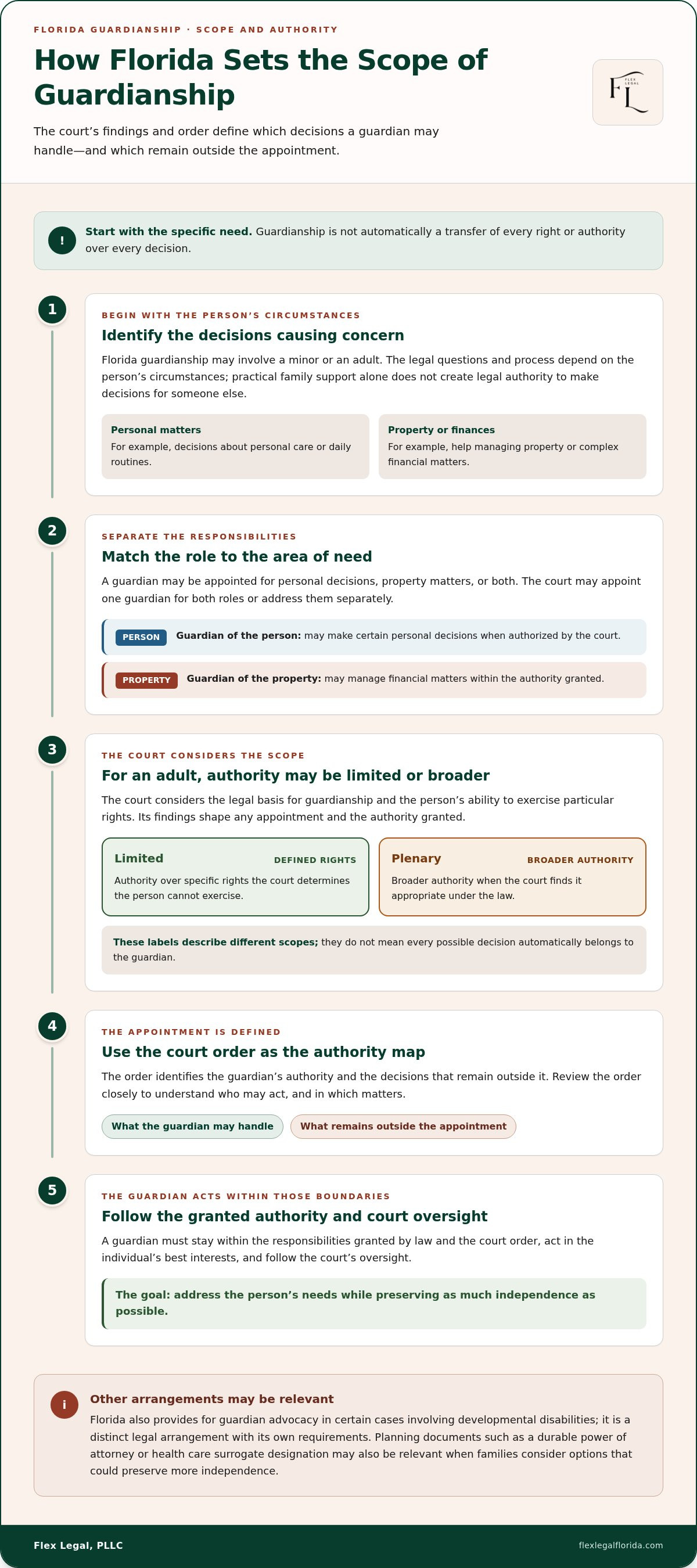
Under Florida law, guardianship is a legal relationship created through a court proceeding. The appointed guardian receives authority to act for another person, called a ward, within the limits set by law and the court. Guardianship may concern a minor or an adult, but the legal questions and process depend on the person’s circumstances. Florida’s statutes and the court’s orders, rather than a general description, determine the authority that applies.
The word can sound like a complete transfer of control. It does not automatically mean every right is removed or that a guardian can make every decision. The court’s findings and appointment order define the guardian’s authority. For broader background on the concept, see What is Guardianship?; Florida law governs how the arrangement works in this state.
Who may be involved in a Florida guardianship?
A ward is the person for whom a guardian is appointed. Depending on the case, the ward may be a child or an adult. A guardian is a decision-maker appointed by the court, with authority limited to the responsibilities granted under applicable law and the order. The guardian must stay within those boundaries and cannot assume control over matters outside the appointment.
Family members often provide essential everyday support, such as helping arrange appointments or organize paperwork. But providing support does not, by itself, create legal authority to make decisions for someone else.
A family caregiver may offer practical help, but only legal authority granted through the appropriate process allows a guardian to make decisions within the court-approved scope.
Why guardianship is not a one-size-fits-all arrangement
People’s needs differ. One person may need help with decisions about personal care, while another may need support managing property or finances. Florida law recognizes limited and plenary guardianship, and the court’s determination and order shape the authority granted. The label alone does not tell a family which decisions a guardian may make or which rights remain with the ward.
Consider a family member who can express preferences about daily routines but needs help managing complex financial matters. The family should not assume that one need answers every legal question. A court proceeding examines the circumstances and establishes the scope of any appointment. The result is not automatically a blanket answer to every concern.
Guardianship is not a substitute for a complete care plan or a resolution of every family disagreement. It addresses legal authority within the court’s framework. Identifying the specific decisions causing concern helps families ask focused questions about whether a proceeding may be appropriate and what planning documents or arrangements may already be relevant.
Florida Guardianship Types and the Decisions a Guardian May Handle
Florida law recognizes different guardianship roles because a person may need help in one area without needing the same support in another. A guardian of the person may be authorized to make certain personal decisions, while a guardian of the property may manage financial matters within the authority granted. Depending on the case, the court may appoint one guardian for both roles or address them separately.
Florida also distinguishes between limited and plenary guardianship for adults. A limited guardianship gives authority over specific rights the court determines the person cannot exercise. Plenary guardianship involves broader authority when the court finds it appropriate under the law. These terms describe different scopes, not a guarantee that every possible decision falls to the guardian.
The court order is the working map: it identifies the guardian’s authority and the decisions that remain outside it. Review the order closely to understand who may act and in which matters.
Guardianship involving a minor in Florida
Florida law generally recognizes a child’s parents as natural guardians, with legal authority and responsibilities established by statute. A court-appointed guardian has a different role. A minor guardianship may become relevant in circumstances such as a child receiving property that requires management or when a court determines an appointment is appropriate. A family’s need for practical support alone does not automatically mean a court proceeding is required.
The kind of appointment matters. A guardian may be responsible for a minor’s person, property, or both, depending on the circumstances and the court’s order. Managing an inheritance for a child, for example, raises different questions from arranging day-to-day care. A relative’s involvement does not automatically give them authority to manage the child’s assets or make every legal decision.
Guardianship involving an adult
For an adult, the court first considers the legal basis for a guardianship and the person’s ability to exercise particular rights. The court’s findings shape any appointment and its scope. Limited guardianship may apply when authority over defined rights is appropriate; plenary guardianship is broader. Florida also provides for guardian advocacy in certain cases involving developmental disabilities, a distinct legal arrangement with its own requirements.
For families, the practical question is not only whether help is needed, but what kind of help and legal authority fit the situation. A need for support with appointments, for instance, is not the same as a need for authority over property. The court’s findings and order guide the guardian’s role, so understand the details before decisions are made on the person’s behalf.
Legal guidance can help families understand how a proposed role fits the facts and Florida’s procedures. Flex Legal provides support for guardianship proceedings and can help clarify the questions to address and the responsibilities an appointment may involve.
Does Guardianship Remove Every Right? Florida Safeguards and Alternatives
No. A court appointment does not automatically erase every right or give a guardian unlimited control. In Florida, the effect depends on the court’s findings, applicable law, and the specific authority granted in the order. Read the order as a practical guide to what the guardian may do, not as a blanket transfer of every decision.
How Florida guardianship safeguards relate to autonomy
The court-supervised process connects a guardian’s authority to the legal determination in the case. A guardian must stay within the powers granted, while rights outside that scope remain with the individual. Oversight and reporting requirements may also apply, depending on the appointment and responsibilities. These safeguards do not make every arrangement identical: the degree of authority depends on the circumstances and court order.
For families, this means asking specific questions: Which decisions are at issue? What does the order authorize? What choices can the person continue to make? Reviewing those details can clarify how support and autonomy fit together.
Planning documents that may be relevant before a proceeding
Some families explore planning documents before a court case becomes necessary. A durable power of attorney can authorize an agent to handle specified financial or legal matters, while a health care surrogate designation names someone to make health care decisions in circumstances provided by Florida law and the document. Their effectiveness depends on valid documents and the person’s situation. Neither document automatically replaces guardianship in every case.
Families considering financial decision-making can learn more about a Florida durable power of attorney. For health care and disability-related planning, a special needs planning guide can help frame questions about long-term support. A revocable trust is another planning tool for managing assets under its terms, not a substitute for authority over personal decisions; see this Florida revocable trust guide for trust-related considerations.
These tools address different needs and may interact in complex ways. Comparing them can help a family identify what is already in place and where questions remain, without assuming that any one document will resolve every concern.
How Families Can Prepare for a Guardianship Matter in Palm Beach County
Before discussing a possible Guardianship matter, organize the facts that explain what support is needed and which decisions are causing concern. You do not need to predict what a court will decide. A clear, balanced summary and relevant records can help a lawyer understand the situation, identify questions, and discuss possible next steps with your family.
Before an initial legal discussion, gather a concise account of the person’s needs, the decisions at issue, existing legal documents, and records that provide useful context.
Information to organize before seeking guidance
Start with the concern, then collect information in a manageable order:
Describe the issue. Note the decisions that prompted concern, what support the person currently receives, and any changes you have observed. Separate firsthand observations from assumptions or secondhand reports.
Locate existing legal documents. Gather any durable power of attorney, health care surrogate designation, will, trust, or other planning document that may affect decision-making or property.
Collect relevant records. Depending on the concern, this might include care-related information, prior court papers, or financial records. Choose materials that explain the specific issue rather than gathering everything indiscriminately.
Keep materials organized and secure. Use a dated list or folder, note where original documents are stored, and protect sensitive personal, medical, and financial information.
Records provide context, not a guaranteed outcome. A care record, financial statement, or prior document may help counsel understand what has happened and what questions need attention. Avoid altering originals, and note where a document came from if that may help explain it later.
Understanding the local court context
For families in West Palm Beach, the local court context is the Palm Beach County Circuit Court. Court procedures, forms, and filing instructions can change, so verify current information through official Florida Courts and Palm Beach County court or clerk resources before taking procedural steps. Do not rely on an old checklist or another county’s instructions in place of current local guidance.
Focus on confirming which official instructions apply to the concern, rather than assuming a particular form, filing sequence, or hearing schedule. Counsel can help interpret relevant requirements and explain how your family’s information fits the issues being considered. Bring questions as well as records, especially if family members disagree about the support needed or existing documents may apply.
Flex Legal, PLLC provides legal support for guardianship proceedings in West Palm Beach. Once your information is organized, discuss your guardianship concerns with Flex Legal to clarify the issues and possible next steps.
Guardianship Legal Support in West Palm Beach: Practical Next Steps
Once a family has identified the decisions causing concern, the next step is understanding what Florida law requires and which options may fit the circumstances. A guardianship matter can involve sensitive questions about a person’s rights, family roles, and future support. Clear legal guidance helps turn those concerns into focused questions and a practical understanding of the process.
Advice should be specific to the person and the facts. A family may need to understand whether a court proceeding is relevant, what issues it would address, and how existing documents or arrangements could affect the analysis. Counsel can explain applicable requirements, help identify information relevant to the matter, and clarify procedural choices without promising a particular appointment or court decision.
What legal guidance can clarify
Families often arrive with several concerns at once. Some may require attention now, while others relate to longer-term planning. A legal discussion can help separate them. For example, questions about who can make a particular decision may differ from concerns about ongoing care or management of resources. Clarifying the issue makes it easier to identify which legal questions need answers first.
Counsel can explain how Florida requirements apply to the facts, what procedural steps may be relevant, and what information could help the family assess its options. If relatives have different views, a structured discussion of the legal issues can help distinguish family preferences from questions the court may need to consider. The aim is informed decision-making, not a predetermined result.
Bring a short account of the concern and the questions you want addressed. Organized information can make the conversation more focused, while legal guidance can help identify gaps or clarify which details matter. The process and appropriate next steps depend on the circumstances, so another family’s experience should not be treated as a prediction of your own.
When a conversation with Flex Legal may help
Families in West Palm Beach seeking guidance about a Florida guardianship matter can work with Flex Legal, PLLC. Founding attorney Jennifer L. Flexer, Esq. owns and operates the firm, which provides legal support for guardianship proceedings. The firm can help clarify the issues involved, the applicable process, and the questions your family may want to consider as it evaluates next steps.
Legal support can be useful whether your family is trying to understand a potential proceeding or already facing questions about how to move forward. You do not need to have every issue resolved before seeking guidance. Start by explaining what has changed, which decisions are difficult, and what you hope to understand.
For guidance tailored to your family’s circumstances, Discuss your Florida guardianship questions with Flex Legal.
Choose a Thoughtful Next Step for Your Family
A decision about Guardianship deserves care, but you do not have to resolve every question before moving forward. Start with the issue that feels most immediate, note what you still need to understand, and consider what outcome would best respect your loved one’s needs and preferences. A focused conversation can help turn uncertainty into a clearer path.
As you weigh your options, keep the person at the center of the discussion. Their circumstances may change, and the right approach should reflect the support needed now while leaving room to adapt as needs evolve. Legal guidance can help your family understand the questions to address and make informed choices without assuming a particular result.
Flex Legal, PLLC provides support for guardianship proceedings for families in West Palm Beach. Discuss your guardianship next steps with Flex Legal to move the conversation forward with greater clarity.
Frequently Asked Questions
Can a family member become a guardian in Florida?
Yes, a family member may ask the court to appoint them, but the court must approve the appointment. The proposed guardian’s eligibility and the person’s needs are considered under Florida law. A relative who has been providing day-to-day help should not assume that relationship alone grants legal authority. The court process determines who may serve and what responsibilities the appointment will involve.
What responsibilities can a Florida guardian have?
A Florida guardian’s responsibilities depend on the appointment and court order. They may involve personal matters, property management, or both. A guardian handling property may need to keep records of income, expenses, and assets; a guardian responsible for personal matters may need to report on the person’s situation. Read the order and applicable court instructions carefully, since duties and reporting requirements can differ by case.
Can a Florida guardianship be changed or ended?
Yes. A court may change an appointment or end it when the legal circumstances support that action. Someone may ask the court to consider whether the person can exercise rights previously placed under guardianship, or whether the appointed guardian should be replaced. The process depends on the case and current law. Keep copies of relevant court papers and get legal guidance before relying on an informal change.
Is guardianship the same as a power of attorney in Florida?
No. A power of attorney is a legal document in which a person authorizes an agent to act within the document’s terms. Guardianship is established through a court process, and the guardian’s authority comes from the appointment and applicable law. An existing power of attorney may be relevant when a family is assessing options, but it does not automatically prevent a court from considering a guardianship case.
Does a Florida guardian have to report to the court?
Often, yes, but the specific reporting duties depend on the guardian’s role and the court’s instructions. Reports or accountings may be required to document the person’s status or how property has been managed. Keep receipts, statements, and notes organized from the start, rather than trying to reconstruct activity later. Check the appointment order and current official court guidance for the requirements that apply to the case.
Can a person challenge a guardianship decision in Florida?
A person affected by a guardianship decision may have ways to ask the court to review or challenge it, depending on the decision and procedural posture. A ward or concerned family member should act promptly because deadlines and the correct procedure can vary. Gather the order, notices, and relevant records, then seek legal guidance about available options. An informal objection does not change the court’s order.
Where can families find Florida guardianship forms?
Start with the official Florida Courts website and the Palm Beach County Clerk of the Circuit Court’s official resources for current forms and filing instructions. Confirm that a form applies to the specific type of case and county; an outdated or incorrect form can cause confusion. Families in West Palm Beach can also get legal guidance to understand which instructions relate to their circumstances before preparing or filing documents.


Comments