
Estate Planning for Business Partners in Florida: Align Your Business and Personal Plans

Updated: 6 days ago
What happens to your company if a partner dies or can no longer make decisions? Does the surviving owner have a clear path forward, or will family members and business partners face uncertainty? Estate planning for business partners Florida owners need is more than a personal will or a buy-sell agreement. The business and personal plans must work together.
A trusted partner may know what you want, and a business agreement may address some contingencies. But assumptions can leave important gaps: who may inherit an ownership interest, how a buyout will be valued and funded, and who can act during incapacity. If business documents and an owner’s estate plan point in different directions, resolving the conflict can add confusion at an already difficult time.
This article outlines decisions partners should make together and those each owner should address individually. You’ll learn how operating and buy-sell agreements can align with wills or revocable living trusts, powers of attorney, and succession plans. You’ll also see what to review when ownership or family circumstances change. The goal is a coordinated Florida plan that supports business continuity and the people who depend on the business.
Table of Contents
Why Florida Business Partners Need a Shared Estate and Continuity Plan
Estate planning for business partners Florida owners need connects three concerns: who may own a business interest, who can keep operations moving, and what each owner wants for personal assets and family. These plans should coordinate, but they are not interchangeable. A company agreement can set expectations for ownership transitions. An individual estate plan addresses personal instructions and decision-making.
A company succession plan sets out how ownership or leadership may transition; an individual estate plan directs what happens to an owner’s personal assets and who may act on that owner’s behalf. Partners can use a Buy-Sell Agreement to document agreed terms for certain ownership changes. But a plan covering death alone may not explain what happens after incapacity, retirement, withdrawal, or a dispute. Each event raises different questions about authority, timing, valuation, and participation in the business.
The interests are connected. A surviving partner may need clarity about decision-making, while the deceased or incapacitated owner’s family may need to understand what happens to the ownership interest. Employees, clients, and vendors may also rely on steady operations. Planning cannot prevent every disruption or determine a legal outcome by itself. It gives partners a chance to discuss expectations before a difficult event puts pressure on the business and the people around it.
What can happen when a Florida business partner dies or becomes incapacitated?
Hypothetical: Two partners run a Florida company. One partner dies or becomes unable to participate, and the documents do not clearly say who may make business decisions or what happens to that partner’s ownership interest. The surviving partner, the affected owner’s family, and employees may all have questions. The legal outcome depends on the business structure, governing documents, personal estate plan, and applicable law. Operational uncertainty is a reason to make decisions in advance.
Which planning decisions belong to the partners, and which belong to each owner?
Partners should address shared business decisions together: how continuity will be managed, whether transfers are restricted, how an interest will be valued, and what buyout terms apply. Each owner separately chooses personal beneficiaries and fiduciaries and considers family protections through documents such as a will or revocable living trust. The plans do not need identical terms, but they should be reviewed together so personal instructions do not conflict with the partners’ agreed approach to ownership and operations.
How Florida Buy-Sell Agreements and Personal Estate Plans Fit Together
A business agreement and an owner’s estate documents have different jobs. A buy-sell agreement can describe how an ownership interest may be transferred after a defined event. A will or trust addresses an owner’s personal estate, while incapacity documents can identify who may act for that person. For estate planning for business partners Florida owners, the key is coordination: documents should reflect compatible intentions without trying to serve the same purpose.
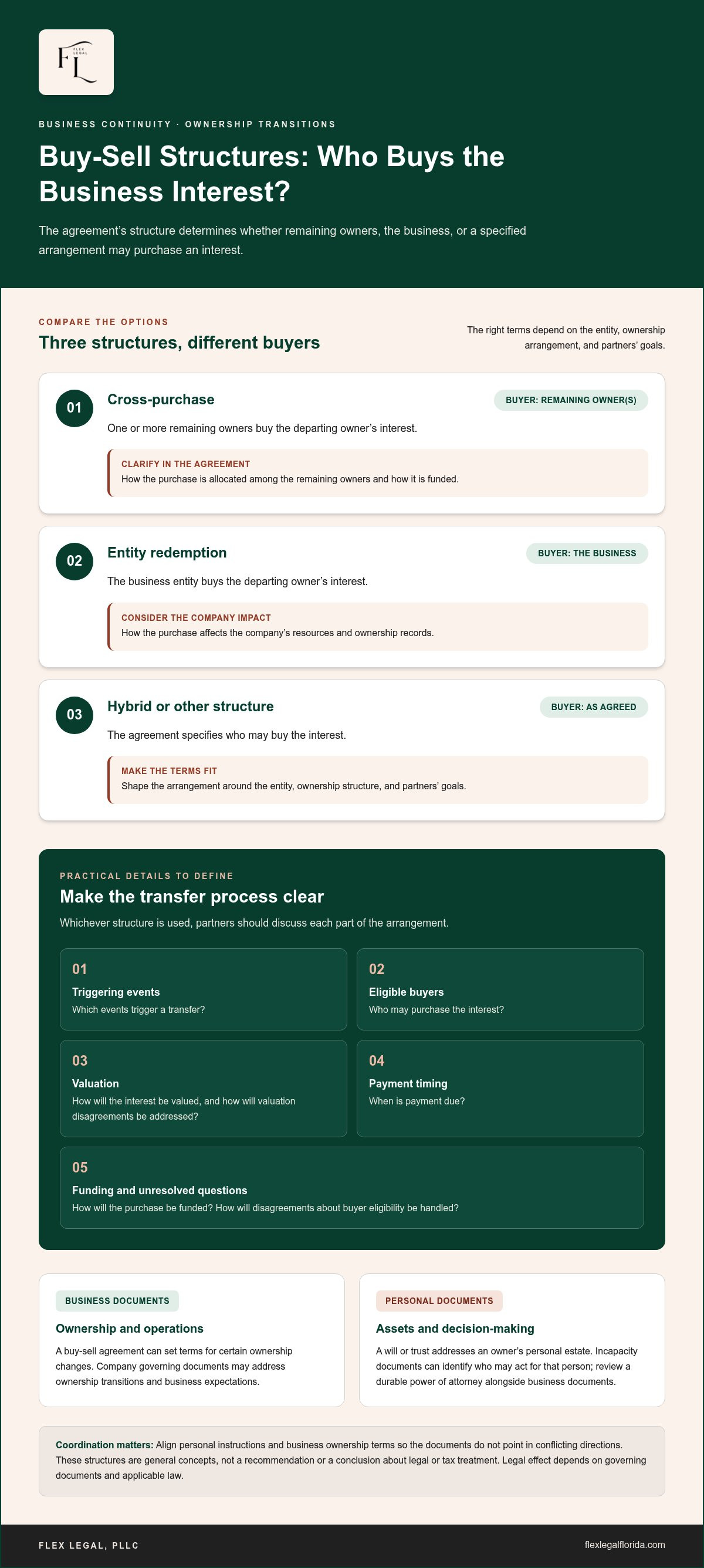
Buy-sell structures vary with the company and its governing documents. In a cross-purchase arrangement, the remaining owners buy the departing owner’s interest. In an entity-redemption arrangement, the business buys it. Partners may consider a hybrid or another approach that fits the ownership structure. The table describes general concepts, not a recommendation or a conclusion about legal or tax treatment.
Whatever the structure, discuss the agreement’s practical details: which events trigger a transfer, who is eligible to buy, how the interest will be valued, when payment is due, and how the purchase will be funded. Decide how to address disagreements about valuation or buyer eligibility. A written process can make expectations clearer, but its legal effect depends on the governing documents and applicable law. The U.S. Small Business Administration’s guidance on a business continuity plan can also help owners consider how operations will respond to unexpected events, beyond the transfer itself.
Coordinate personal and business documents
A will or trust addresses an owner’s broader estate, but should not be assumed to override the business’s governing agreement or automatically determine who controls company decisions. Align beneficiary choices and ownership-transfer terms so the documents do not point in conflicting directions. For trust fundamentals, see this Florida revocable trust guide. For incapacity planning, read the Florida durable power of attorney guide. Review a durable power of attorney alongside business documents to clarify whether the designated agent has authority relevant to business matters.
The appropriate arrangement depends on ownership structure and personal circumstances. Partners can review business succession and estate plans together with Florida business succession planning guidance.
Comparing Florida Business Succession Options for Partners
Partners can choose a path that prioritizes continued control, family involvement, or a sale. The right fit depends on the business’s goals, potential successors’ readiness, each partner’s preferences, and family expectations. A transfer plan is not the same as a management plan: the person who receives an ownership interest may not be prepared or permitted to run daily operations.
Match the path to partner and family priorities
A buyout may suit partners who want ownership to remain within the existing group. A family transfer may fit an owner who wants a relative considered as a successor. An outside sale could be an option if no internal or family successor is prepared, but a buyer is not guaranteed. Consider partner preferences and family expectations for each path, without assuming heirs can automatically take control.
Agree on valuation and funding before a transition
For estate planning for business partners Florida owners, entity rules, tax consequences, and professional licensing requirements can affect which options are workable. Review the proposed structure against the company’s governing documents and the owners’ circumstances with appropriate legal and tax guidance.
A Florida Business-Partner Checklist for Coordinating the Plan
Turn broad intentions into an organized review. For estate planning for business partners Florida owners, the goal is to make shared business decisions clear while preserving each owner’s control over personal estate choices. Use this workflow to identify gaps before revising documents.
Map ownership. Gather current ownership records, governing agreements, amendments, and existing transfer terms. Confirm who owns what and which documents describe the company’s decision-making process.
Identify the scenarios to plan for. Discuss death, incapacity, retirement, withdrawal, and disputes. Record what each event could mean for ownership, management, and continued operations.
Agree on business outcomes. Discuss successor roles, management authority, family involvement, valuation, buyout expectations, and how to address disagreements. Write down unresolved assumptions instead of treating them as settled.
Coordinate the documents. Review company agreements and records alongside each owner’s will or trust and incapacity documents. Business documents and personal estate plans serve different purposes, so neither should be treated as a substitute for the other. Each owner’s beneficiary choices remain personal and confidential.
Schedule plan reviews. Set a recurring time to revisit the plan, and review it sooner after a change in ownership, family circumstances, business structure, or major financial situation.
What to bring to a partner review
Start with the company’s ownership records, governing agreements, existing transfer terms, and a short list of each partner’s continuity priorities. Use the discussion to surface questions: Who could manage operations during an owner’s incapacity? How will the interest be valued? What role, if any, might family members have? How will the partners handle a disagreement? Individual beneficiary decisions do not need to be disclosed to the partnership. Focus on identifying conflicts between personal instructions and company arrangements.
Asset planning may involve both business interests and personal property. This Florida asset-protection planning guide offers context for considering those interests together, without assuming one strategy fits every owner.
Keep the plan current
There is no single review interval that fits every partnership. Choose a regular schedule, then revisit the plan sooner when circumstances shift. Changes in law or tax rules also call for current professional review before owners rely on older assumptions.
For help coordinating business succession and personal estate planning in Florida, explore planning guidance for business partners.
Build a Coordinated Business Succession and Estate Plan in West Palm Beach
A business succession plan and each owner’s estate plan should support the same overall goals. Aligning them can help partners make clearer decisions about ownership transitions, personal instructions, and continuity. The right approach depends on the company’s structure, the partners’ priorities, and each owner’s family circumstances. No single form answers every question.
What to expect from a coordinated planning review
A focused review starts with the current picture: who owns the business, which governing and transfer documents are in place, what each partner wants to protect, and which transition scenarios matter most. The partners’ shared business goals can then be considered alongside each owner’s individual estate plan. This process helps identify where company terms and personal instructions may need closer coordination.
Recommendations should reflect the actual ownership structure and personal circumstances, rather than assume one arrangement fits every partnership. Legal and tax implications also call for individualized review. No planning approach can promise a particular outcome, but a structured discussion can bring unresolved questions into view before partners need to act.
How to take the next step with your co-owner
Before a legal review, gather the company’s governing documents, ownership records, and any existing succession or transfer agreements. Each partner can prepare a short list of priorities and open questions. For example, discuss management continuity, successor roles, family involvement, valuation, and how a proposed transition might affect the business.
Agreeing on a few priorities together can make the review more focused. Partners do not need to resolve every issue in advance; identifying different expectations is a useful start. Flex Legal, PLLC provides Florida estate planning and business succession planning in West Palm Beach, with guidance shaped around the business and the people who depend on it.
Estate planning for business partners Florida owners can revisit as their company, ownership, and family circumstances evolve. Treat the plan as an ongoing process, not a one-time form. To discuss a coordinated Florida estate plan with Flex Legal, PLLC, take the next step when you’re ready.
Turn Shared Expectations Into a Plan You Can Revisit
A strong transition plan connects the company’s ownership terms with each partner’s personal estate and incapacity instructions. Agreeing in advance on potential successors, valuation, and buyout expectations can help reduce uncertainty for the business and the people who depend on it. The right choices reflect your ownership structure, business goals, and family circumstances.
Estate planning for business partners Florida owners can be an ongoing process, not a one-time document. Flex Legal provides business succession planning and Florida estate planning, including probate services, for individuals and business owners in West Palm Beach. Standard estate-planning document preparation is available through fixed-fee packages; business succession matters are addressed according to their specific needs.
Ready to align your company’s transition terms with your personal plan? Discuss a coordinated Florida estate and succession plan with Flex Legal.
Frequently Asked Questions
Can a business partner’s heirs inherit their ownership interest in a Florida business?
Possibly, but heirs do not automatically receive every ownership or management right. The outcome depends on the entity’s governing documents, transfer restrictions, and applicable Florida law. An heir may receive economic value associated with an interest without becoming a voting member or manager; those rights are distinct and depend on the documents and law. Coordinate transfer terms with the owner’s will or trust, and have the relevant documents reviewed together before relying on a particular outcome.
Does a Florida buy-sell agreement override a partner’s will or trust?
Not automatically. A buy-sell agreement and a will or trust serve different purposes and may interact. The agreement may address a business interest transfer, while estate documents direct an owner’s personal assets and instructions. Which provisions apply depends on the agreement, entity documents, estate documents, and current Florida law. A coordinated review can help identify conflicting terms and clarify how the documents are intended to work together.
What happens to a Florida LLC when one of its partners dies?
There is no single outcome for every Florida LLC. The LLC’s governing agreement and applicable law can affect what happens to the deceased owner’s interest and how the company is managed. Heirs do not necessarily become managers, and a death does not automatically mean the business must dissolve. Review the LLC’s transfer, succession, and decision-making provisions alongside the owner’s estate plan, and check any specific legal conclusion against current Florida law.
Should Florida business partners have a buy-sell agreement?
A buy-sell agreement can help partners document what they have agreed should happen after specified events, such as death or withdrawal. Whether it fits depends on the business structure, partner goals, and existing governing documents. Partners can use planning discussions to address who may buy an interest, how it will be valued, when and how payment may occur, and how the terms coordinate with each owner’s estate plan. These choices are central to estate planning for business partners Florida owners undertake.
How is a business partner’s ownership interest valued for a buyout in Florida?
Partners can specify a valuation method or process in governing documents or a buy-sell agreement; no single method suits every business. Options may include a stated formula or an appraisal process, with details shaped by the company and the partners’ goals. Timing, changing business conditions, and tax considerations may affect the approach. Define how often a value is revisited and how partners will address disagreements, with appropriate professional guidance.
Can a revocable living trust hold a Florida business interest?
A revocable living trust may be considered for some business interests, but suitability depends on the entity, governing documents, transfer restrictions, and the owner’s goals. Transferring an interest can affect ownership and management arrangements, so do not treat a trust as a way to bypass company terms. Coordinate any proposed transfer with the business agreement and obtain current legal and tax review. A trust does not guarantee probate avoidance or tax savings.
What should Florida business partners do if one owner becomes incapacitated?
Partners should plan for both temporary and ongoing incapacity by addressing who may make business decisions and how operations can continue. A personal durable power of attorney and the company’s governance provisions serve different roles; a personal agent does not automatically have authority to act for the business. Review the relevant documents together and verify that the planned authority fits current Florida requirements. West Palm Beach business owners can address these issues through coordinated estate and succession planning.


Comments