
Avoiding Probate on Bank Accounts in Florida: The 2026 Legal Guide

What if the routine form you signed at your local branch actually locks your family out of your cash when they need it most? It's a frustrating reality for many grieving families in the Sunshine State who discover that a loved one's assets are frozen tight during a difficult transition. If your primary goal is avoiding probate on bank accounts Florida legal frameworks offer several paths, but a single oversight can still trap your hard-earned money in the court system.
We know you want to protect your heirs from high legal fees and the confusing choice between a Payable-on-Death account and a Living Trust. You deserve a modern, adaptable strategy that secures immediate liquidity for your survivors without unnecessary friction. This 2026 guide reveals the most effective legal strategies to keep your Florida bank accounts out of the probate court system and ensure a seamless transfer to your heirs. You will get a clear checklist to update your bank records, understand the vital pros and cons of POD designations versus trusts, and learn how to build a plan that truly safeguards your family.
Table of Contents
Why Florida Probate is the 'Hidden Tax' on Your Bank Accounts
The Fastest Ways to Avoid Probate: POD Designations and Joint Ownership
Why a Revocable Living Trust is the Gold Standard for Florida Accounts
Step-by-Step: How to Audit and Update Your Florida Bank Accounts
Beyond the Bank: Building a Frictionless Florida Estate Plan
Why Florida Probate is the 'Hidden Tax' on Your Bank Accounts
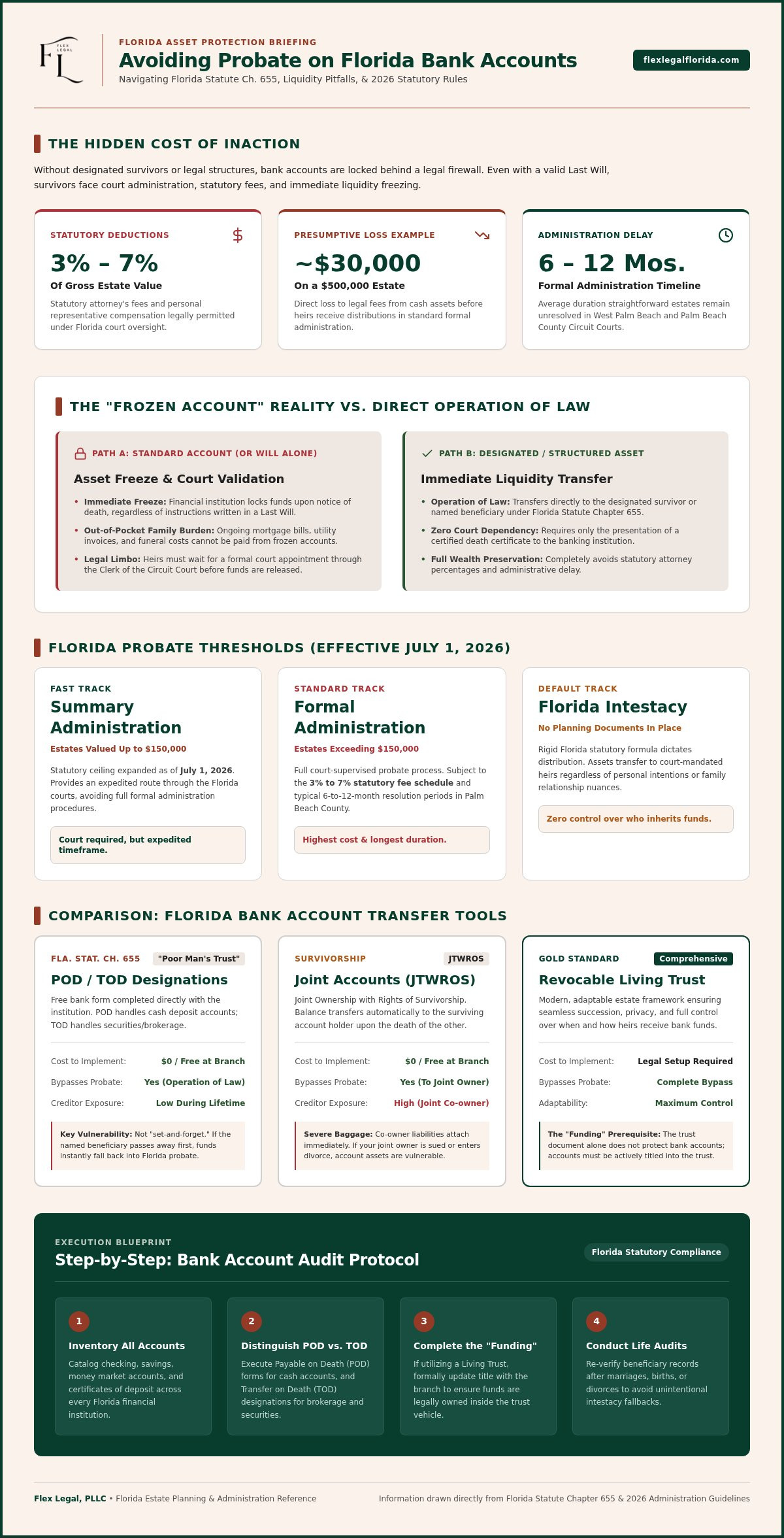
Probate isn't just a legal formality; it's a drain on your family's inheritance. Technically, the probate process is the court-supervised system for identifying and distributing a deceased person's assets. In Florida, this system acts like a "hidden tax" because it pulls significant value away from your heirs. Statutory attorney's fees and personal representative compensation can consume between 3% and 7% of a gross estate's value. For a $500,000 estate, those presumptive fees alone can total around $30,000. Avoiding probate on bank accounts Florida families rely on is the fastest way to stop this wealth leak before it starts.
Time is another major factor. Even a relatively straightforward estate in West Palm Beach can take 6 to 12 months to resolve through formal administration. During this window, your family remains in a state of legal limbo. They can't touch the funds, yet they're responsible for maintaining the estate's obligations. This delay isn't just an inconvenience; it's a barrier to the liquidity survivors need to move forward.
The 'Frozen Account' Nightmare for Survivors
Banks aren't your allies during a crisis. When an account holder dies without a designated survivor or beneficiary, the institution must freeze the assets immediately. This happens regardless of what your Last Will and Testament says. A Will doesn't grant immediate access; it's merely a set of instructions the court must validate first. While your family waits for a probate lawyer in Palm Beach County to be appointed, bills keep coming. Mortgage payments, funeral costs, and utility bills don't stop just because your cash is locked behind a bank's legal firewall. Survivors often find themselves paying out of pocket for these expenses while waiting months for a judge's order.
Florida's Specific Probate Rules for 2026
As of July 1, 2026, Florida law provides two primary paths through the court system. Summary Administration is now available for estates valued up to $150,000. This is a significant increase from previous years that helps many families avoid the full weight of Formal Administration. However, if your total assets exceed this limit, you face a much longer timeline involving the Palm Beach County Clerk of the Circuit Court. If you die without any estate planning documents, you fall into "intestacy," which is a legal state where Florida law dictates exactly who gets your bank accounts regardless of your personal wishes. This rigid structure lacks the adaptability modern families need to protect their legacy.
The Fastest Ways to Avoid Probate: POD Designations and Joint Ownership
Many West Palm Beach residents seek the path of least resistance when planning their legacy. Avoiding probate on bank accounts Florida banks hold often starts with "Payable on Death" (POD) designations or joint ownership. These tools are frequently called the "Poor Man’s Trust" because they're free to set up and bypass the court system entirely. Florida Statute Chapter 655 specifically governs these multi-party accounts, ensuring that funds transfer directly to the survivor or beneficiary by operation of law. This means the bank simply needs a death certificate to release the funds, skipping the months-long wait associated with court-supervised administration.
How to Set Up a POD Account in Florida
Setting up a POD account is a quick win for your estate plan. You simply visit your financial institution and complete a "Beneficiary Designation" form. It's vital to distinguish between a POD account for cash and a "Transfer on Death" (TOD) designation, which applies to securities and brokerage accounts. Both achieve the same goal: keeping the asset out of the probate clerk's hands. However, these forms aren't "set it and forget it" documents. You must audit these records after major life events like marriages or births. If a named beneficiary passes away before you, the account could fall back into the probate system you worked so hard to avoid.
The Risks of Joint Bank Accounts
Joint Ownership with Rights of Survivorship (JTWROS) is another common tactic for married couples and families. It allows the account to transfer automatically to the surviving owner. But this simplicity comes with significant baggage that many people overlook until it's too late. First, there's creditor risk. If your joint owner gets sued or ends up in a messy divorce, your savings could be subject to a legal levy or become an asset in their litigation. Second, you lose total control. A joint owner has the legal right to withdraw 100% of the funds at any time. While these methods offer speed, they don't provide the high-level planning found in a Revocable Trust in Florida.
Florida courts also frequently see disputes over "convenience accounts." This happens when an elderly parent adds a child to an account solely to help pay bills, not intending to gift them the entire balance upon death. Without clear documentation, this can trigger bitter litigation among siblings after the parent passes. If you're looking for a more secure, adaptable way to manage your assets without these risks, exploring Asset Protection Planning can provide the structural clarity joint accounts often lack.
Why a Revocable Living Trust is the Gold Standard for Florida Accounts
While simple designations offer a quick fix, they lack the sophisticated protection required for complex family dynamics. A Revocable Living Trust serves as a comprehensive command center for your financial life. It doesn't just address what happens when you pass away; it provides a roadmap for your care while you're still here. Unlike the public probate process, trust administration is a private matter in Florida. Your account balances and beneficiary lists remain confidential, shielded from the prying eyes of the public record.
Privacy is a significant advantage, but incapacity planning is the real game-changer. If you become ill or unable to manage your finances, your successor trustee steps in immediately. They can pay your bills and manage your bank accounts without seeking a court-ordered guardianship. This agility ensures your life continues without a legal bottleneck. For those focused on avoiding probate on bank accounts Florida law treats trusts as the most adaptable tool available, allowing for seamless transitions during life's most difficult moments.
POD vs. Trust: A Tactical Comparison
POD designations are notoriously fragile. If your named beneficiary passes away before you, or if you both perish in a common accident, the account defaults to probate. Furthermore, if your beneficiary is a minor, Florida law requires a court-supervised guardianship of the property for any amount exceeding $15,000. This adds the exact layers of cost and delay you intended to avoid. A trust bypasses these hurdles by allowing you to name contingent beneficiaries and set specific rules for minor heirs.
The "Special Needs" factor also favors the trust model. If a beneficiary relies on government benefits, a direct POD payout could disqualify them from essential support. A trust allows for specialized distributions that protect those benefits. This level of customization is simply impossible with a standard bank form.
Retitling Your Accounts to Your Trust
Moving your cash into a trust requires a process known as "funding." You must contact your financial institution to change the account title from your individual name to the name of your trust, such as "John Doe, Trustee of the John Doe Revocable Trust." This transition is typically straightforward and doesn't affect your FDIC insurance limits or your daily banking habits. You still use the same debit cards and write checks as you always have. The only difference is the legal ownership structure that protects the assets.
Funding your trust by retitling your accounts is the most frequently overlooked step in Florida estate planning, rendering even the best legal documents ineffective. Without this step, your trust is like a beautiful safe with nothing inside. Ensuring your accounts are correctly titled is the final, vital link in a frictionless estate plan.
Step-by-Step: How to Audit and Update Your Florida Bank Accounts
Taking control of your financial legacy requires more than just signing a few papers. It demands a systematic review of every account you own. Start by creating a comprehensive inventory of your checking, savings, CDs, and money market accounts. Many residents assume their accounts are set up correctly, only to find that old beneficiary designations or outdated titles remain in place. By reviewing current titles for JTWROS or existing beneficiaries, you can identify gaps before they become legal hurdles for your family.
Consulting with a West Palm Beach estate planning attorney is the most efficient way to align these accounts with your broader goals. A professional review ensures that your bank records don't contradict your trust or will. Once you've identified the necessary changes, you must formalize these updates by submitting specific paperwork to each financial institution. Avoiding probate on bank accounts Florida banks manage is only successful if the bank's internal records match your legal intent.
The Bank Account Audit Checklist
A thorough audit goes beyond names. You should verify that the bank has correct Social Security numbers for all beneficiaries to prevent identity confusion later. Ask if the bank supports "per stirpes" designations. This ensures that if a child passes away before you, their share goes to your grandchildren rather than being redistributed among other heirs. Additionally, ensure your durable power of attorney is on file with each institution. This grants your chosen representative the power to manage funds if you're incapacitated, preventing the need for court-supervised guardianship.
Dealing with Florida Banks: What to Bring
Banks are bureaucratic by nature. When you visit a branch to update your records, bring your valid ID, original trust documents, or a Certificate of Trust. If you're removing a deceased joint owner, you'll need a certified death certificate. Be prepared for the fact that some banks insist on their own internal forms even if you provide a valid legal trust. If you have out-of-state accounts, check if that state's laws conflict with your Florida residency status. A modern, agile approach to these updates saves your family from months of friction later. To ensure your records are legally sound, audit your accounts today.
Beyond the Bank: Building a Frictionless Florida Estate Plan
Success in avoiding probate on bank accounts Florida families rely on is a vital first step, but it shouldn't be your last. A bank account is often just one component of a larger financial picture that includes your home, retirement savings, and life insurance policies. If you secure your checking account but leave your real estate or brokerage accounts unaddressed, your family will still face the court system you tried to bypass. A truly frictionless plan treats every asset as a connected piece of your legacy. This holistic approach ensures that no matter what you own, your heirs can access it without a judge's signature.
Coordinating Beneficiaries Across All Assets
Conflicting instructions are a common trap in estate planning. If your bank form names one person but your Revocable Living Trust or Will names another, the bank form generally takes precedence in Florida. This mismatch can accidentally disinherit a loved one or trigger a legal dispute between family members. You must ensure that your beneficiary designations across all platforms are synchronized and updated. For those with high-value accounts or business interests, working with asset protection lawyers near me ensures that your wealth is shielded from creditors while remaining accessible to your heirs. Avoiding probate on bank accounts Florida residents manage is only effective when it aligns with your entire portfolio.
The Flex Legal Advantage: Modern, Agile Estate Planning
Flex Legal, PLLC approaches estate planning with a focus on adaptability and transparency. We understand that traditional legal models can feel rigid and intimidating. That's why we utilize a flat-fee philosophy for document preparation, providing you with price certainty from the start. Our goal is to act as your agile ally, offering modern solutions that prioritize clarity over complexity. We serve West Palm Beach families with the empathy required to handle sensitive transitions and the professional authority to ensure every document is legally sound. We don't just hand you a folder of papers; we partner with you to build a dynamic support system for your family.
Securing your financial future shouldn't be a source of anxiety. By integrating your bank accounts into a holistic plan, you provide your survivors with immediate liquidity and peace of mind. The path to a protected legacy is clear, and it starts with a strategy tailored to your specific needs. Schedule your estate planning consultation with Flex Legal today.
Take the Next Step Toward a Frictionless Legacy
Protecting your wealth shouldn't feel like a chore. You've learned that while POD designations offer a quick fix, they lack the multi-generational protection of a Revocable Living Trust. By auditing your titles and ensuring your funding is complete, you eliminate the risk of the Palm Beach County court system freezing your cash at the worst possible time. Avoiding probate on bank accounts Florida families depend on requires this proactive, modern approach to asset management.
Flex Legal, PLLC provides the agile, solution-oriented support you need to navigate these specific rules. We offer flat-fee estate planning to give you total price certainty from day one. Our deep expertise in Palm Beach County probate procedures ensures your plan is built for the local legal landscape. Don't leave your heirs waiting for months to access what you've worked a lifetime to build. Secure your accounts and avoid Florida probate; contact Flex Legal today. We're here to act as your partner in building a secure, adaptable future.
Frequently Asked Questions
Does a Will avoid probate for bank accounts in Florida?
No. A Will actually requires probate to be effective. It provides instructions to the court, but the bank won't release funds to an executor until the court issues Letters of Administration. To truly succeed in avoiding probate on bank accounts Florida residents should look toward beneficiary designations or trusts. These tools bypass the court entirely, providing survivors with immediate liquidity during a difficult transition.
What happens to a joint bank account when one owner dies in Florida?
In Florida, a joint account with rights of survivorship transfers automatically to the surviving owner. The survivor gains full control of the funds without court intervention. However, this simplicity carries risks, such as exposure to the co-owner's creditors or potential lawsuits. While it avoids probate at the first death, the account will eventually face the court system when the second owner passes unless further planning is in place.
Is a POD account better than a Living Trust for avoiding probate?
Better depends on your specific family needs. A POD account is a simple, free tool for direct transfers to adult beneficiaries. However, a Revocable Living Trust is the gold standard because it handles contingencies, such as a beneficiary passing away before you. Trusts also provide incapacity planning, allowing a successor trustee to manage funds if you become ill, a vital feature that POD accounts lack entirely.
Can a minor be a beneficiary on a Florida bank account?
Yes, but it's often a legal mistake. If a minor is named as a POD beneficiary and the account value exceeds $15,000, Florida law requires a court-supervised guardianship of the property. This process is expensive and time-consuming, defeating the purpose of avoiding probate. Using a trust to hold funds for a minor is a more agile solution that keeps the court out of your family's private financial matters.
How do I claim money from a POD account after someone dies?
The process is relatively straightforward at most West Palm Beach branches. You must present a certified copy of the death certificate along with your valid government-issued identification. The bank will verify your status as the named beneficiary and typically issue a check or transfer the funds to a new account. It's a private transaction that bypasses the Palm Beach County Clerk of the Circuit Court, ensuring fast access to cash.
What is the 'Convenience Account' rule in Florida bank law?
A convenience account is a designation where a person is added to an account solely to help the owner pay bills. Under Florida law, this person has no ownership rights to the funds after the owner's death. However, disputes often arise if the account isn't clearly documented. Without a proper legal audit, heirs might fight over whether the co-signer was intended to inherit the balance or simply act as a temporary agent.
Do I need a lawyer to add a POD beneficiary to my account?
You don't need a lawyer to fill out a bank's beneficiary form. However, a legal consultation ensures your POD designations don't conflict with your overall estate plan. Many West Palm Beach residents accidentally disinherit loved ones because their bank forms don't match their trust instructions. Our flat-fee estate planning services help you synchronize these details, providing price certainty while securing your legacy against unintended legal errors that lead to court disputes.
Will my bank account be frozen if I have a Power of Attorney?
A Power of Attorney expires the moment the account holder passes away. It's a powerful tool for managing funds while you're alive, but it does nothing to prevent an account from being frozen after death. To keep the account active for your survivors, you must have a joint owner, a POD beneficiary, or have the account titled in the name of a Revocable Living Trust to ensure a smooth transition.


Comments