
Annual Estate Plan Review Checklist: What to Revisit in 2026

Updated: 6 days ago
Your estate plan may not need a rewrite, but it may need a closer look. Family, finances, property, and personal wishes can change, leaving older documents or beneficiary choices out of step with your current situation. An annual estate plan review checklist helps you identify what to revisit without assuming every document needs to be replaced.
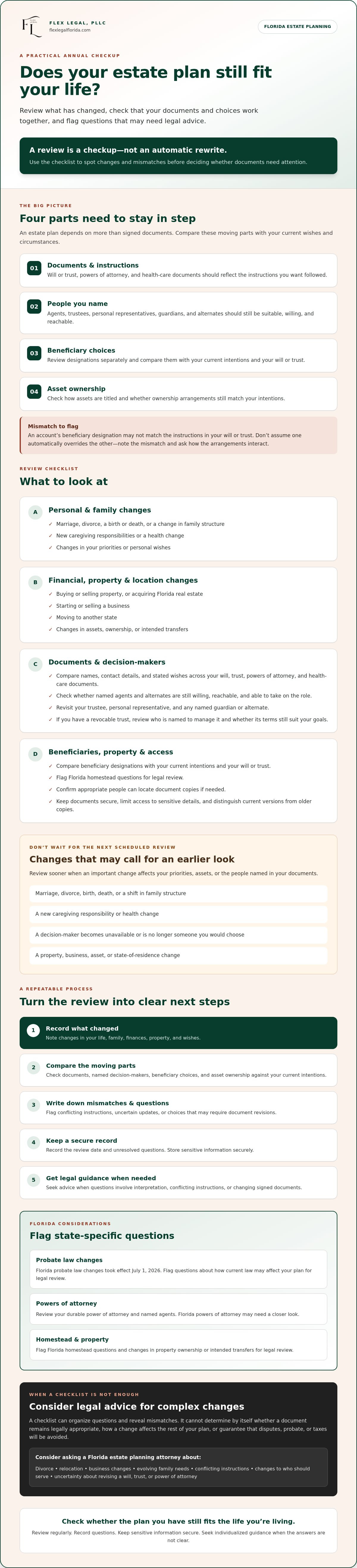
A useful review brings the moving parts together: your will or trust, the people you’ve named to make decisions, beneficiary designations, and the way your assets are titled. Coordination matters. For example, an account’s beneficiary designation may not match the instructions in your will or trust.
This checklist walks you through personal and financial changes, documents and beneficiary choices to revisit, and questions to flag for an attorney. It also highlights Florida-specific considerations, including probate law changes that took effect July 1, 2026, and powers of attorney that may need a closer look. You’ll finish with a repeatable review process and a clearer sense of when legal advice may be appropriate. An annual review is not an automatic rewrite. It’s a practical way to check whether your plan still fits your life.
Table of Contents
Why an Annual Estate Plan Review Checklist Matters
An estate plan is more than a set of signed documents. It also depends on who is named to make decisions, how assets are owned, and whether those arrangements still reflect your wishes. An annual estate plan review checklist gives you a regular way to compare the plan you have with the life you’re living now. For a broader overview of the documents and tools involved, see Estate planning.
The review is a checkup, not an automatic rewrite. It may uncover an old address, a decision-maker whose circumstances have changed, or a beneficiary choice that no longer matches your intentions. Some findings may call for an administrative update. Others may raise legal questions about how your documents, property, or family circumstances fit together.
What an annual estate plan review can and cannot do
A checklist can help you spot mismatches and organize questions. It cannot determine by itself whether a document is still legally appropriate or how a change affects the rest of your plan. Updating contact information is different from changing who inherits property or who can act on your behalf. Those choices may require document revisions and individualized legal guidance. A review also cannot guarantee that disputes, probate, or taxes will be avoided.
Life changes that should prompt an earlier review
Don’t wait for your annual review date if something important changes. Marriage, divorce, a birth or death, a new caregiving responsibility, a health change, or a shift in family structure may affect your priorities or the people named in your documents. Review sooner, too, if a decision-maker becomes unavailable or is no longer someone you would choose.
Changes to your assets matter as well. Buying or selling property, acquiring Florida real estate, starting or selling a business, or moving to another state can raise questions about ownership, intended transfers, and whether your documents still fit your circumstances. The details depend on your situation and current law. Record what changed and what needs attention, then seek legal advice if the issue involves interpretation or document revisions. Addressing a concern while it’s fresh can be more useful than leaving it until your next scheduled review.
Review Your Estate Planning Documents and Decision-Makers
Use this part of your annual estate plan review checklist to compare the documents you have with the instructions you want followed. Check names, contact details, and stated wishes across your will, trust, powers of attorney, and health-care documents. Estate planning can involve several tools working together. Cornell Law School’s legal definition of estate planning offers a useful overview.
Check wills, trusts, and beneficiary instructions
Compare the distributions described in your will or trust with your current intentions. If your plan includes a revocable trust, review who is named to manage it and whether its terms still suit your goals. For more context, see this revocable trust guide.
Review beneficiary designations separately. Some assets, including accounts with named beneficiaries, may transfer according to those designations. If a designation appears inconsistent with your will or trust, don’t assume one automatically overrides the other. Note the mismatch and ask an attorney how the documents and asset arrangements interact.
Revisit incapacity documents and chosen representatives
Check your durable power of attorney and health-care documents for current agents and alternates. Ask whether each person is still willing, reachable, and able to take on the role. Review your trustee, personal representative, and any named guardian or alternate, too. Someone you trusted years ago may no longer be the right choice. For more detail, read this Florida durable power of attorney guide.
Confirm that the appropriate people can locate document copies if needed. Keep the documents in a secure place, and let relevant decision-makers know how to access them without sharing sensitive details more widely than necessary. If you’ve changed a document, make sure you can distinguish the current version from older copies.
Write down questions instead of making informal edits to signed documents. If your review uncovers conflicting instructions, a change in who should serve, or uncertainty about updating a will, trust, or power of attorney, an attorney can assess the documents together. Learn more about Flex Legal’s estate planning services if you’re considering legal guidance in West Palm Beach.
Check Florida Property, Beneficiaries, and Family Needs
Documents are only part of the picture. Your annual estate plan review checklist should also cover how property is owned, who is named to receive certain assets, and whether family members have new or changing support needs. These details can affect whether your arrangements still work together as intended.
Florida homestead and ownership changes to flag
Review any Florida real estate, especially a home you consider your homestead. Note whether you’ve bought or sold property, changed how it is titled, updated a trust arrangement, or now intend for different people to receive it. Consider whether your family circumstances have changed since your last review.
Florida homestead rules can depend on the facts, including the property and family situation. Don’t assume a transfer or ownership change will have a particular legal effect based on a checklist alone. If a home, trust, or family arrangement has changed, flag it for a Florida estate planning attorney to review under current law.
Beneficiaries, dependents, and special circumstances
Then consider whether a beneficiary’s circumstances have changed. A child may have reached adulthood, a dependent may have a new diagnosis or disability, or someone’s support needs may have shifted. These changes can affect the planning questions to ask, particularly if the person receives or may need public benefits. The effect depends on individual circumstances. Don’t assume a particular arrangement will preserve eligibility.
For a dependent with a disability or other ongoing support needs, consider whether your plan still reflects your goals for care and financial support. Special needs planning may warrant a closer look at how a potential inheritance or other resources fit with that person’s situation. Bring relevant documents and questions to an attorney, who can assess the details and explain options without promising a particular benefits outcome.
Use This Annual Estate Plan Review Checklist Step by Step
A repeatable process makes it easier to spot what changed and decide what deserves attention. Set aside time to review your records, then use these steps to turn your observations into a practical follow-up plan.
Prepare a review folder and change log
Gather your current estate documents, beneficiary records, and a list of major assets. Keep originals and digital copies in secure locations, and make access arrangements clear to the trusted people who may need them. Avoid putting account numbers, passwords, or other sensitive details in an unsecured note.
Use the annual estate plan review checklist to record the review date and changes in your family, health, residence, property, or business circumstances. Keep the log factual. It should help you remember what changed, not replace or informally revise a signed document.
Sort checklist findings by urgency and complexity
For each finding, note whether it needs an administrative update, factual confirmation, or legal advice. A changed phone number is different from a change in who should inherit property or serve as a decision-maker. Prioritize questions involving family structure, property, or an unavailable representative, especially when they may affect multiple documents.
Gather: Collect current documents, beneficiary information, and your major-asset list.
Note changes: Record relevant family, health, residence, property, and business updates.
Check alignment: Compare your current wishes with document terms, named decision-makers, ownership records, and beneficiary choices.
List questions: Separate simple record corrections from decisions that could change legal rights or document terms.
Set follow-up: Record the review date, unresolved questions, and a secure next step, such as confirming an account record or arranging legal advice.
Don’t try to resolve legal questions by editing a signed document or assuming one record controls another. If property, family circumstances, or a decision-maker’s availability has changed and you’re unsure what it means for your plan, consider speaking with a Florida estate planning attorney. This guide to finding an estate-planning attorney in West Palm Beach can help you think through what to look for.
For help reviewing estate-planning questions raised by your checklist, contact a West Palm Beach estate planning attorney.
Know When to Ask a Florida Estate Planning Attorney for Help
Your annual estate plan review checklist can surface questions, but it cannot confirm that your documents are legally valid, resolve competing instructions, or determine how current law applies to your circumstances. Consider legal advice when a change affects more than one part of your plan or you’re unsure what a document means in practice.
Signs that a self-review may not be enough
Ask an attorney to review your plan if documents appear to conflict, you’re uncertain who owns an asset, or beneficiary records don’t seem consistent with your intentions. A change to Florida homestead property or a trust arrangement deserves particular attention because the right analysis depends on the specific facts and current Florida law.
Make the next step clear and manageable
Prepare for a conversation by gathering your current documents, the checklist, and notes about what has changed. You don’t need to solve each issue first. A Florida estate planning attorney can review the information with you, explain how the relevant documents and circumstances fit together, and assess whether updates are appropriate or your current plan remains suitable.
Flex Legal, PLLC offers fixed-fee estate-planning packages with predetermined fees for comprehensive document preparation. That does not mean every review has the same scope or that a package necessarily covers every question raised by your checklist. Ask what work is included and whether it fits your needs before deciding on a next step.
A review is a chance to get clarity, not a commitment to replace everything. If you’d like to discuss what your checklist uncovered, talk with Flex Legal about your estate plan.
Keep Your Estate Plan Aligned as Life Changes
An annual estate plan review checklist helps you check whether your documents, assets, beneficiaries, and chosen decision-makers still reflect your wishes. A review doesn’t automatically mean starting over. It helps you identify administrative updates, record questions, and recognize when a change in your family, property, or business may call for legal advice.
Florida-specific issues can depend on your circumstances and current law, so treat the checklist as a starting point, not a legal determination. If you’re unsure whether your documents still work together, bring your current plan and review notes to an attorney. Flex Legal, PLLC is founded and operated by Jennifer L. Flexer, Esq. The firm offers fixed-fee estate-planning packages with predetermined fees for comprehensive document preparation. Ask what scope fits your needs.
Talk with Flex Legal about your estate plan and take a practical next step toward keeping it current. A thoughtful review can help you move forward with greater clarity.
Frequently Asked Questions
How often should I review my estate plan?
Review your estate plan annually, and revisit it sooner after a major life or financial change. A yearly check can catch outdated contact details, unavailable decision-makers, changed beneficiaries, or questions about property. It doesn’t mean you need to rewrite every document each year. If you spot a change, ask a Florida estate-planning attorney whether it calls for a formal update. Record your review date and any unresolved questions.
What life events should trigger an estate plan review?
Review your plan after marriage, divorce, a birth or death, a major health change, a move, or a substantial change in property or business ownership. These events may affect your wishes, the people you’ve named, or how assets are held. Don’t assume a document changes automatically after a life event. The effect depends on your documents and circumstances, so seek legal advice before relying on that assumption.
Can I update my will or trust myself?
Don’t make handwritten edits or informal changes to a will or trust without first confirming the proper process for your document and situation with a Florida attorney. The rules for making a change and the way documents interact can matter. A checklist can help you identify questions, but it doesn’t amend a will, trust, or beneficiary record. Ask an attorney how to make and coordinate any needed updates.
What should I review in my estate plan each year?
Check your will, trust, powers of attorney, health-care documents, named representatives, beneficiary designations, and current asset information. Ask whether your family, health, property, or business circumstances have changed. Confirm that the people you’ve named remain willing and available. An annual estate plan review checklist can help you organize findings, but it can’t make legal changes. If something no longer matches your intentions, record the question and seek advice before acting.
Does owning a home in Florida change what I should review?
Yes. Florida real estate, including a homestead, can raise state-specific planning questions. Review whether the property’s ownership, your family circumstances, or your intended recipients have changed. A general checklist can’t determine how a home will pass because the analysis depends on the facts and current law. If a home, trust, or household arrangement has changed, ask a Florida estate-planning attorney to review the relevant documents together.
Do beneficiary designations override a will in Florida?
It depends on the asset, how it’s owned, the beneficiary record, and the documents involved. Some assets may transfer according to a beneficiary designation rather than instructions in a will, but don’t assume every situation works the same way. Compare account records with your overall plan. If you find a mismatch or aren’t sure which instruction applies, ask a Florida attorney to review the details before relying on either record.
When should I hire an estate planning attorney to review my plan?
Consider legal advice if your family structure, Florida property, business interests, health needs, or chosen representatives have changed, or if documents appear inconsistent. An attorney can assess how the documents work together and whether updates may be appropriate. Bring your current paperwork and a short change log. For West Palm Beach residents, a local Florida estate-planning attorney can review your circumstances under current state law. The goal isn’t necessarily a complete rewrite, but a plan that fits your current wishes.


Comments