
When is Probate Required in Florida? The 2026 Essential Guide

Most people think probate is a government trap designed to drain an estate's value through endless fees and procedural delays. In reality, it is often just a necessary title-clearing event to move assets from a deceased person's name to their rightful heirs. Knowing exactly when is probate required in Florida depends less on the total value of the estate and more on how those assets were titled on the day of passing. If a house or bank account sits solely in the decedent's name, the court usually needs to step in to turn the legal key.
You're likely feeling the weight of Florida's complex homestead protections and worrying if a year-long formal administration is your only path forward. It's natural to feel anxious about high costs and rigid legal jargon. This guide clears the fog by providing a definitive framework to determine if court intervention is mandatory for your situation. We'll explore the 2026 updates to summary administration thresholds, explain why some assets bypass the courtroom entirely, and show you how a modern, flat-fee ally in Palm Beach County can make the process feel like a partnership rather than a burden.
Key Takeaways
A Last Will and Testament provides a roadmap for the court but does not actually allow your family to bypass the probate process.
You can determine when is probate required in Florida by reviewing how assets are titled; anything owned solely by the decedent typically triggers a court filing.
The "Beneficiary Trap" can force life insurance or IRAs into probate if designations are outdated, making proactive asset review essential.
Florida's homestead laws grant primary residences unique protections that often require a specific "Petition to Determine Homestead" before a sale can proceed.
Strategic planning with a revocable living trust offers a modern way to bypass the courtroom and streamline the transfer of your estate.
Table of Contents
What Triggers the Probate Process Under Florida Law?
Understanding when is probate required in Florida begins with defining what the court actually does. Probate isn't a government tax or a debt collection scheme. Instead, it's the formal, court-authorized transfer of legal title from a person who has passed away to their living beneficiaries. This state-level process is strictly governed by the Florida Probate Code. It acts as a legal gatekeeper. If an asset is "locked" in the name of someone who is no longer here to sign a deed or a transfer form, the court provides the legal authority to unlock it and move it forward.
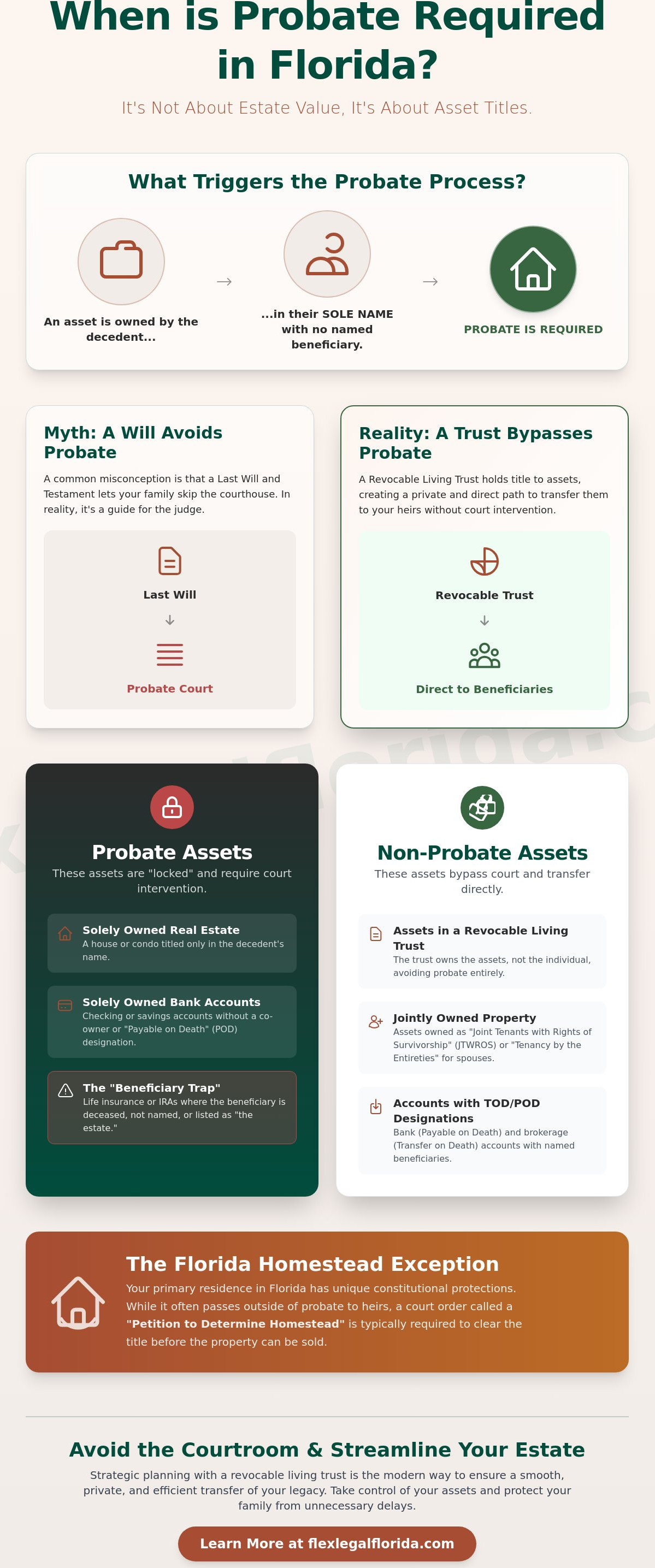
The primary trigger for this process is quite simple. If a decedent owned any asset in their sole name without a designated beneficiary, the Florida court system must intervene. Without a court order, a bank won't release funds, and a title company won't allow the sale of a home. It's a binary situation: either the asset has a built-in transfer mechanism, or it requires a judge's signature to change hands. Determining when is probate required in Florida is essentially an audit of how every piece of property was titled at the moment of death.
The Myth of the 'Magic Will'
A common misconception is that having a Will allows your family to skip the courthouse. In reality, a Last Will and Testament is often a ticket to the courtroom rather than a way to avoid it. The court must first "validate" the document to ensure it meets strict legal standards. This involves a process where the judge confirms the Will is "self-proving," meaning it was signed and witnessed according to specific Florida statutes. While a Will tells the judge who should receive your property, revocable trusts operate on a different logic. Trusts hold title to assets during your lifetime, ensuring there's never a "title gap" that requires court intervention when you pass. A Will is a roadmap for the court; a trust is a vehicle that bypasses the court entirely.
Sole Ownership vs. Joint Ownership
The way you hold title to your property determines whether your heirs face a long wait or a smooth transition. "Sole Name" assets are the most frequent reason for a probate filing. If a bank account or a condo is in your name only, it's likely headed for a judge's desk. However, Florida law provides specific exceptions for joint ownership that can simplify things. Married couples often utilize "Tenancy by the Entireties," a unique form of ownership where the property automatically passes to the surviving spouse. Another common tool is "Joint Tenants with Rights of Survivorship" (JTWROS). This allows the legal process of probate to be bypassed for that specific asset, as the ownership interest simply shifts to the remaining owners. While effective, these joint ownership strategies require precise titling to work as intended under the Florida Probate Code and only act as a temporary bypass until the final owner passes away.
Probate vs. Non-Probate Assets: A 2026 Comparison
Determining when is probate required in Florida is not about the total size of your bank account. It's about the name on the account. Assets that move automatically to a living person or entity bypass the Palm Beach County probate court entirely. These are known as non-probate assets. Conversely, anything stuck in the name of the deceased person is a probate asset. The distinction is vital because non-probate property is usually available to heirs within weeks, while probate property remains locked until a judge signs off.
The "Beneficiary Trap" is a common hurdle that many families encounter during an already difficult time. Life insurance policies, 401ks, and IRAs are designed to stay out of court. However, if you fail to name a beneficiary, or if the named person passed away before you, the money defaults to your estate. This mistake forces a non-probate asset into the very court system you intended to avoid. Using "Payable on Death" (POD) for bank accounts and "Transfer on Death" (TOD) for brokerage accounts creates a clear legal path for your funds to move without friction. If you find yourself managing an estate with complex titles, our team provides streamlined Probate Administration support to keep the process moving efficiently.
For a deeper look at the technical definitions of these asset classes, the Florida Bar's guide to probate provides a helpful baseline for consumers. It's also worth considering how a living trust changes the equation. When you transfer property into a trust, the trust itself becomes the legal owner. Because a trust doesn't "die," the assets held within it never trigger a probate filing. This is often the most effective way to ensure that when is probate required in Florida, the answer for your family is a definitive "no."
Common Non-Probate Assets in Florida
Most non-probate assets share a common trait: they have a contractually designated survivor or a specific legal structure that handles the transfer.
Life insurance proceeds paid directly to a named beneficiary rather than the estate.
Retirement accounts like 401ks or IRAs with valid, living beneficiaries on file.
Bank accounts with established Payable on Death instructions.
Real estate held as "Joint Tenants with Rights of Survivorship" or "Tenancy by the Entireties" for married couples.
The 'Probate-Trigger' Asset List
These items lack an automatic transfer mechanism and usually require a judge's order to move to the next owner.
Real estate owned solely by the decedent. Without a Lady Bird Deed or joint ownership, this is a primary trigger for formal administration.
Bank or brokerage accounts without any designated beneficiaries or POD/TOD instructions.
Personal property including vehicles, jewelry, and art. While these are often lower in value, they still require legal authority to transfer if they aren't specifically addressed in a trust or through simplified administration.
Types of Florida Probate: Formal vs. Summary Administration
Once you've identified that court intervention is necessary, the next step is determining which legal lane the estate will take. Florida law provides different paths based on the value of the assets and the time that has passed since the decedent’s death. For very small estates, a process called "Disposition of Personal Property Without Administration" may be available. As of July 1, 2026, the threshold for personal property that can avoid formal probate entirely in these specific cases has doubled to $20,000. This is designed to help families settle small affairs without the friction of a full court proceeding.
Deciding when is probate required in Florida also involves looking at the 2-year rule. If a person has been deceased for more than two years, the estate automatically qualifies for a simplified process regardless of its total value. This is a significant relief for families who discover "lost" assets long after their loved one has passed. You can find more details on these categories through the Florida Courts official probate information portal, which outlines the foundational rules for each administration type.
Summary Administration: The 'Short' Path
Summary Administration is often the preferred route for simpler estates. Effective July 1, 2026, the threshold for non-exempt assets to qualify for this path increased from $75,000 to $150,000. This legislative change allows many more families to use the expedited process. While state averages suggest a timeline of 2 to 4 months, many simple cases in Palm Beach County can be resolved even faster if there's no outstanding debt. It's an efficient, solution-oriented option for estates where the assets are clear and creditors are non-existent.
Formal Administration: The Standard Process
Formal Administration is the standard, multi-step process required for estates exceeding $150,000 or those involving complex creditor issues. In this scenario, the court appoints a Personal Representative, often called an executor, to manage the estate's affairs. This individual has a fiduciary duty to gather assets, pay valid debts, and distribute the remainder to beneficiaries. A critical component of this path is the mandatory 90-day creditor period. During this time, the estate must remain open to allow potential creditors to file claims. Because this process involves strict deadlines and technical filings, you'll need an experienced probate lawyer in Palm Beach County to ensure everything stays on track. Most formal administrations take between 8 and 12 months to complete, making it the most thorough way to determine when is probate required in Florida for larger legacies.
The Florida Homestead Trap: Why Your House is Different
Florida's homestead laws are among the most protective in the country, but they also create a unique legal maze when a homeowner passes away. Many people believe that because a primary residence is often exempt from creditor claims, it sits outside the court's reach. This is a dangerous misunderstanding. While the house may not be used to pay off credit card debt or medical bills, it is almost always the most complex asset to navigate when determining when is probate required in Florida. You might have the keys to the front door, but without a specific court order, you don't truly have the legal authority to sell or transfer the property.
The core of the "Homestead Trap" lies in the requirement for a Petition to Determine Homestead. Title companies in West Palm Beach and throughout the state are notoriously strict. They won't issue title insurance for a future buyer until a probate judge formally declares the property as the decedent's protected homestead. This means that even if the home is the only asset left behind, you'll still likely find yourself in the probate system just to clear the title for a potential sale.
Title vs. Creditor Protection
The paradox of Florida homestead is that it's simultaneously "non-probate" for debt purposes and "probate" for title transfer. While the West Palm Beach property appraiser tracks the home's tax status, only a judge can issue the Homestead Order that confirms the house passed to the heirs free of creditor claims. Until this order is signed, the legal title remains in limbo. Heirs are often surprised to find they are responsible for property taxes and maintenance, yet they are legally barred from selling the asset until the court validates the transfer. If you're currently facing this "title limbo," our team offers expert Probate Administration services to help you secure the necessary court orders without unnecessary delays.
Restrictions on Devise
Florida's Constitution places heavy restrictions on who can receive your home after you pass. If you have a surviving spouse or a minor child, you cannot simply leave your house to a friend or a sibling in your Will. Any attempt to do so is considered an "invalid devise." The law automatically steps in to grant the spouse a life estate, while the children receive a vested remainder interest. This can lead to messy co-ownership situations that last for decades. Managing these risks starts long before a death occurs. For example, a well-drafted durable power of attorney ensures that if you become incapacitated, a trusted ally can manage the property and potentially move it into a trust to avoid these constitutional traps altogether. Understanding when is probate required in Florida means recognizing that your home is never just a simple piece of real estate; it's a constitutionally protected asset with its own set of rules.
How to Avoid Probate and Streamline Your Florida Estate
The most effective way to handle the complexities of the court system is to ensure your family never has to enter it. Proactive planning transforms the question of when is probate required in Florida from a looming uncertainty into a controlled outcome. By auditing your assets today, you can implement transfer mechanisms that trigger automatically, leaving no "title gaps" for a judge to fill. This isn't just about saving on court costs; it's about providing your heirs with immediate access to the resources they need without a six-month waiting period.
One highly effective tool for homeowners is the "Lady Bird Deed," also known as an Enhanced Life Estate Deed. This allows you to maintain total control over your property during your lifetime while designating a beneficiary who inherits the home automatically upon your passing. Unlike a traditional life estate, you can sell or mortgage the property without the beneficiary’s consent. It’s an agile solution that specifically bypasses the title hurdles discussed in previous sections, ensuring the property transfers without a court order.
The Power of the Revocable Living Trust
A revocable living trust remains the gold standard for comprehensive probate avoidance. A trust is a legal entity that "owns" your assets, managed by you as the trustee. Because the trust doesn't die when you do, the assets held within it stay outside the court's jurisdiction. However, a trust only works if it's properly "funded." This means you must actually retitle your bank accounts, brokerage accounts, and real estate into the name of the trust. An empty trust is a common planning mistake that leaves your family right back in probate court. Trusts are also indispensable for special needs planning, as they allow you to provide for a loved one while protecting their eligibility for vital government benefits.
Modern Solutions for West Palm Beach Families
Traditional legal models often rely on unpredictable hourly billing or a percentage of the estate's value, which can make the process feel like an added financial burden. We believe in a different approach. By offering transparent, flat-fee estate planning packages, Flex Legal, PLLC acts as an agile ally for families who value clarity and speed. Our process focuses on "probate-proofing" your estate through high-level planning and precise asset titling. We don't just hand you a stack of documents; we partner with you to ensure your plan is adaptable to the evolving needs of your family. If you're ready to move past the confusion of when is probate required in Florida and secure a streamlined future, schedule your modern estate planning review with Flex Legal, PLLC today.
Defining a Clear Path for Your Heirs
The complexities of the Florida court system shouldn't define your family's future. By auditing how your assets are titled and addressing the constitutional nuances of your primary residence, you can answer the question of when is probate required in Florida with confidence. Remember that while a Will provides a roadmap, strategic tools like revocable trusts and Lady Bird deeds are the vehicles that actually keep your heirs out of the courtroom. Taking these steps now ensures that your legacy is transferred with speed and precision rather than being stalled by administrative friction.
We specialize in helping families navigate these hurdles with a modern, empathetic approach to probate administration. Whether you're currently settling an estate or looking to probate-proof your own assets, our flat-fee estate planning packages provide the clarity you deserve without the stress of unpredictable costs. Flex Legal, PLLC brings deep expertise in Florida Homestead laws to ensure your home remains a protected asset rather than a legal bottleneck. Secure your legacy and avoid the stress of probate—contact Flex Legal, PLLC today. Your peace of mind is worth the investment in a clear, adaptable path forward.
Frequently Asked Questions
Is probate required in Florida if there is a Will?
Yes, probate is generally required even when a Will exists because the court must formally validate the document before any assets can be distributed. A Will acts as a roadmap for the judge, but it doesn't give heirs the legal authority to transfer titles or access accounts on its own. Without court intervention, the Will remains a private document without the power to move legal ownership.
How much money can you have before probate is required in Florida?
The threshold for determining when is probate required in Florida depends on the type of administration you use. As of July 1, 2026, estates with non-exempt assets valued at $150,000 or less qualify for Summary Administration, which is a faster and less expensive process. If the assets exceed this $150,000 limit, the estate must undergo Formal Administration, regardless of how simple the family situation might seem.
Can I avoid probate in Florida with a small estate?
You can often avoid the full, formal probate process if the estate qualifies as a "small estate" under Florida law. For very limited cases where the decedent's personal property is worth less than $20,000 or only covers preferred funeral expenses, a process called Disposition Without Administration may be available. This allows for the release of assets without any formal court hearings or a Personal Representative.
Does a surviving spouse automatically inherit everything in Florida without probate?
A surviving spouse does not always inherit everything automatically, especially when is probate required in Florida for assets held in the decedent's sole name. While property held as "Tenancy by the Entireties" passes immediately to the spouse, any bank accounts or real estate without a joint owner or "Payable on Death" designation must go through the court. Florida’s intestacy laws provide for the spouse, but they don't bypass the legal requirement to clear title through probate.
How long do you have to file probate after death in Florida?
Florida law requires the person in possession of a Last Will and Testament to deposit it with the Clerk of the Circuit Court within 10 days of learning about the death. While there isn't a rigid deadline to officially open a probate administration, waiting too long can complicate the payment of taxes and the management of real estate. Most families find it best to start the process within 30 to 90 days to avoid issues with creditors or property insurance.
What happens if I don't start the probate process in Florida?
If you don't start the process, the decedent's assets remain legally "locked" in their name indefinitely. You won't be able to sell the family home, transfer a vehicle title, or close out brokerage accounts. Over time, this can lead to significant problems, such as the home facing foreclosure for unpaid taxes or bank accounts being turned over to the state as unclaimed property after years of inactivity.
Is a lawyer required for probate in Florida?
A lawyer is legally required for almost all probate proceedings in Florida, particularly for Formal Administration. Florida Probate Rules generally prohibit a Personal Representative from representing themselves because the process involves the rights of creditors and multiple beneficiaries. Even in Summary Administration, where a lawyer isn't strictly mandated by every county, the technical nature of homestead petitions and creditor bars makes professional guidance a practical necessity.
How do I know if an asset is a 'probate asset'?
You can identify a probate asset by checking the legal title or ownership documents. If an asset was owned solely by the decedent and does not have a designated beneficiary or a "Transfer on Death" instruction, it is a probate asset. Conversely, assets with joint tenants, rights of survivorship, or those held within a revocable living trust are considered non-probate assets and pass directly to the heirs.



Comments