
Avoiding Probate on Real Estate in Florida: The 2026 Homeowner’s Guide

Did you know that a standard Will doesn't actually keep your home out of court? Many homeowners mistakenly believe their final wishes are enough to bypass the legal system, yet a Will often serves as the very document that triggers a lengthy court process. When it comes to avoiding probate on real estate in Florida, the strategy you choose today determines whether your heirs receive their inheritance in weeks or spend a year navigating the Palm Beach County probate court.
It's frustrating to think that after years of mortgage payments, a significant portion of your home's equity could be swallowed by statutory attorney fees, which often start at 3% of the estate's value. You want a clear plan that protects your family from conflict and keeps creditors at bay. This 2026 guide provides the most effective legal strategies to ensure a seamless transfer of your property. We'll break down modern solutions like Lady Bird deeds and Revocable Living Trusts, giving you a straightforward path to securing your legacy without the friction of traditional probate.
Table of Contents
Why Real Estate Triggers Probate in Florida
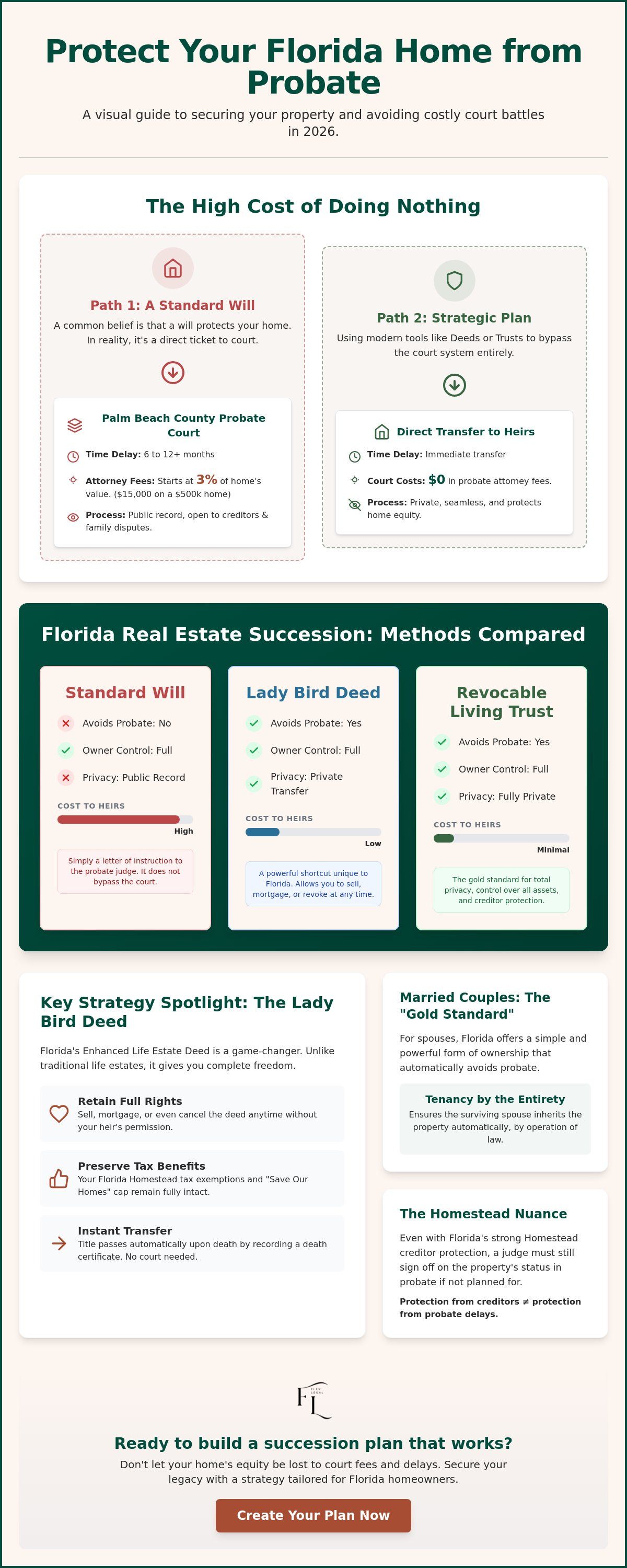
Florida real estate is often a family's most cherished asset. It's also the one most likely to get stuck in the legal system for months or even years. Probate is the court-supervised process of validating a person's Will and officially transferring the title of their property to their heirs. If you own a home in your individual name, the law views that title as locked the moment you pass away. Only a judge has the authority to unlock it and move it to the next owner.
A common trap for many homeowners is the belief that having a Last Will and Testament is the ultimate solution for avoiding probate on real estate in Florida. This isn't the case. In reality, a Will is simply a letter of instruction to a judge. It doesn't bypass the process; it actually requires it. Without additional strategic planning, your family must hire an attorney to present that Will to a court before they can sell the home or even change the locks. This realization often comes too late, leaving families to deal with paperwork when they should be grieving.
In Palm Beach County, the financial burden of this process is steep. Florida law sets a presumptively reasonable fee for probate attorneys at 3% of the first $1 million of the estate's value. For a $500,000 home, that's $15,000 in legal fees alone. When you add the $399 court filing fee for formal administration and other costs, the equity you've built over decades begins to evaporate quickly.
The Role of the Palm Beach County Probate Court
The 15th Judicial Circuit handles a high volume of estate cases every year. If your heirs live out of state, they'll find the local system particularly challenging. Florida requires a local personal representative or a close relative to manage the estate, which often forces distant family members to travel or manage complex logistics from afar. Delays are standard. A typical formal administration can take six to twelve months, during which the property may sit empty while taxes and insurance bills continue to mount.
The Florida Homestead Nuance
Florida's Homestead laws provide world-class protection against creditors, but they don't stop the probate clock. Even if the home is your primary residence, it doesn't automatically jump over the court process. A judge must still sign a Petition to Determine Homestead to confirm its status and officially transfer ownership. This extra legal step is a frequent surprise for families who thought the home's protected status meant it was exempt from court oversight. While the home is eventually safe from most creditors, it's not safe from the delays of the probate calendar.
The Lady Bird Deed: Florida’s Unique Probate Shortcut
Florida is one of the few states that offers a specific legal tool called an Enhanced Life Estate Deed. Most people know it by its more colorful name: the Lady Bird Deed. While many other states use standard "Transfer on Death" deeds, Florida hasn't adopted that specific format. Instead, the Lady Bird Deed serves as our state's specialized solution for avoiding probate on real estate in Florida while maintaining total control over your property during your lifetime.
The "enhanced" part of this deed is what makes it a modern favorite. In a traditional life estate deed, you'd need the permission of your beneficiaries to sell or mortgage the home. You'd essentially be tied to their consent. A Lady Bird Deed removes that friction. It allows you to name a successor who will inherit the home automatically when you pass away, yet you retain the absolute right to sell the property, take out a loan, or even revoke the deed entirely without ever notifying the person you named. It's a dynamic way to plan for the future without giving up your current independence.
When the owner passes away, the title transfers immediately by operation of law. There's no need to wait for a judge's signature or file a case in the Palm Beach County court system. The heir simply records a death certificate in the public records, and the chain of title is complete. It's fast, efficient, and keeps your private family matters out of the public eye.
Pros and Cons of the Lady Bird Deed
One of the biggest advantages is the preservation of your Florida Homestead tax benefits. Because you retain full control, your Save Our Homes cap remains intact. It's also a powerful tool for Medicaid planning. Since the transfer doesn't technically happen until death, it typically isn't counted as a "gift" during the five-year look-back period. However, these deeds must be drafted with precision. If the legal description or the "power to convey" language is even slightly off, title insurance companies may refuse to issue a policy when your heirs eventually try to sell the home. Ensuring your documents meet current standards is a vital part of asset protection planning that stands up to scrutiny.
When a Lady Bird Deed is the Right Choice
This strategy is often the best fit for simple estates where you intend to leave your home to one or two adult children. It's a cost-effective alternative to a trust if your primary goal is protecting a single piece of real estate. For the plan to work, the deed must be recorded correctly with the Palm Beach County Clerk. This creates a clear public record of your intent and ensures the transition is as smooth as possible for your family.
Using a Revocable Living Trust for Real Estate Succession
While a Lady Bird Deed is excellent for single assets, a revocable trust offers a more comprehensive framework for avoiding probate on real estate in Florida. Think of a trust as a private entity you create to hold your assets. You remain in total control as the Trustee during your life, but the property technically belongs to the trust. This legal distinction is what keeps the court out of your family's business later.
When you pass away, your named Successor Trustee steps in immediately. They have the legal authority to transfer the home to your heirs or sell it without waiting for a judge's order. This transition happens behind closed doors. Unlike probate, which is a public record anyone can search, trust administrations are private. This keeps your family's financial details and your home's equity away from prying eyes and aggressive solicitors. It's a streamlined, modern way to handle wealth transfer.
A trust also solves a problem that deeds cannot: incapacity. If you become ill and can't manage your affairs, your Successor Trustee can manage the property for your benefit. This avoids the need for a court-ordered guardianship. Guardianship proceedings are often more expensive and restrictive than probate itself. By using a trust, you're building a dynamic support system that adapts to your health needs while protecting your home's value.
The Critical Step: Funding Your Trust with Real Estate
A trust document is just a stack of paper until you "fund" it. To protect your home, you must execute a specific "Deed to Trust" and record it with the Clerk in West Palm Beach. This document officially moves the title from your individual name into the trust. It's a precise legal step that requires careful drafting. If the deed isn't worded correctly, you could accidentally lose your Florida Homestead tax status or the Save Our Homes valuation cap. The trust must contain specific language that confirms your right to reside in the home to keep these vital tax breaks intact.
Trusts for Multiple Properties or Out-of-State Owners
If you own investment properties or a vacation home in another county, a trust is your best defense. Without it, your heirs might face multiple probate cases in different jurisdictions. This is known as "ancillary probate," and it doubles the legal fees and court delays. A single trust can hold all your real estate holdings, streamlining your entire portfolio into one smooth transfer. It's particularly useful for those moving to Florida from other states who want to ensure their new Florida home doesn't get tangled in the laws of their former residence. This proactive approach allows your heirs to sell a property immediately if needed, rather than waiting months for court permission.
Joint Ownership and Other Titling Strategies
Many homeowners view joint ownership as the path of least resistance. It feels like a simple shortcut. By adding a family member to the deed, the property theoretically passes to them automatically. While Joint Tenancy with Right of Survivorship (JTWROS) is a common method for avoiding probate on real estate in Florida, it often creates more problems than it solves. This strategy is frequently a "quick fix" that ignores long-term tax and legal consequences.
One of the most significant risks is the "Step-Up in Basis" tax trap. When you add a child to your deed as a joint tenant, you're making a lifetime gift. If they sell the house after you pass away, they may owe substantial capital gains taxes because they didn't receive a full step-up in tax basis to the home's 2026 market value. In contrast, using a trust or a Lady Bird deed allows your heirs to inherit the property at its current value, potentially saving them tens of thousands of dollars in taxes.
Creditor risks are equally concerning. If you add a co-owner to your title, their financial problems become your problems. If your child is involved in a car accident, faces a business lawsuit, or goes through a divorce, their interest in your home is a reachable asset. A creditor could place a lien on your primary residence to satisfy your co-owner's debt. You've effectively traded the cost of probate for the much higher risk of losing your home's equity to a stranger's legal battle.
Tenancy by the Entireties for Married Couples
For married couples, Florida offers a specialized form of ownership called Tenancy by the Entireties. This is often considered the gold standard for marital property. It provides automatic survivorship rights and a unique layer of asset protection. If a creditor holds a judgment against only one spouse, they generally cannot attach a lien to the home. However, this only delays the inevitable. Once the first spouse passes away, the survivor becomes the sole owner. Without a follow-up plan, the home is once again headed for the probate court upon the second spouse's death.
The Dangers of "Just Adding a Name" to the Deed
Adding a child or relative to your deed is a permanent decision that strips away your autonomy. You can't sell, mortgage, or even refinance the property without their notarized signature. If your relationship with the co-owner sours, you're stuck in a legal stalemate. Additionally, gifting a portion of your home may trigger IRS reporting requirements. For 2026, the annual gift tax exclusion is $19,000. If the value of the interest you've transferred exceeds this, you must file a gift tax return. A modern asset protection planning strategy prioritizes your control while keeping the property safe from both the court and outside creditors.
Creating Your Florida Real Estate Succession Plan
Your real estate succession plan isn't a static document; it's a dynamic strategy that evolves with your life. After exploring the various tools available, the final step in avoiding probate on real estate in Florida is deciding which path fits your specific goals. While some homeowners prioritize the simplicity of a Lady Bird Deed, others require the robust protection of a Revocable Living Trust to manage multiple properties or protect beneficiaries with special needs. The right choice depends on your family structure and your long-term vision for your home's equity.
Consulting with a probate lawyer in Palm Beach County is the most efficient way to review your current deed and identify potential title gaps. Many residents are surprised to find their properties are still titled in ways that invite court intervention. Working with a dedicated estate planning attorney West Palm Beach ensures that every box on your homeowner's checklist is checked, from preserving tax exemptions to securing asset protection. At Flex Legal, we believe in transparency, which is why we provide flat-fee certainty for our deed and trust preparation services. You'll know exactly what to expect without the stress or unpredictability of hourly billing.
Step-by-Step Action Plan for Homeowners
Taking the first step doesn't have to be overwhelming. You can start the process today by following this straightforward path to secure your property:
Locate your current deed: Find the recorded document and check the exact titling language. Look for specific phrases like "Joint Tenants with Right of Survivorship" or "Tenancy by the Entireties" to understand your current starting point.
Evaluate your heirs: Consider if your beneficiaries are minors or have special needs. If they do, a trust is essential to manage their inheritance without the need for court-ordered guardianship.
Schedule a consultation: Reach out for a modern, streamlined review to update your title. This ensures your plan aligns with 2026 Florida statutes and provides the protection your family deserves.
The Value of an Agile Legal Ally
We've moved beyond the traditional, rigid law firm model. Flex Legal acts as an agile ally, simplifying complex Florida statutes into actionable plans that actually work for your family. We prioritize clarity and comfort, using modern communication methods to keep you informed every step of the way. By focusing on adaptable strategies rather than one-size-fits-all rules, we help you secure your legacy in Palm Beach County with confidence. Your home is likely your most valuable asset, and maintaining its condition—whether through local services or specialized experts like Cabinet refinishing Denver—is a smart way to preserve its value for the future. Ultimately, it deserves a plan that keeps it in your family's hands and out of the courthouse.
Take Control of Your Property's Legacy
You've seen how easily a home can get stuck in the court system and how quickly statutory fees can erode your family's inheritance. Whether you choose the streamlined efficiency of a Lady Bird Deed or the comprehensive protection of a Revocable Living Trust, the goal remains the same: keeping your private affairs private. Mastering the strategies for avoiding probate on real estate in Florida isn't just about paperwork; it's a gift of peace and financial security for your heirs. By acting now, you ensure that your home's equity stays with the people you love rather than being consumed by court costs.
At Flex Legal, we bring specialized expertise in Palm Beach County real estate law to every plan we build. We've replaced the traditional, slow law firm experience with a modern, agile approach that values your time and your goals. Our flat-fee pricing for deed and trust packages means you get high-level planning without any financial surprises. Secure your Florida home today with a flat-fee estate plan from Flex Legal. You've worked hard to build your equity, and we're here to help you protect it with a plan that adapts to your life.
Frequently Asked Questions
Does a Will avoid probate for my house in Florida?
No, a Will doesn't avoid probate for your Florida home. It actually serves as the primary document that guides the court through the probate process. When a property is listed in a Will, a judge must still oversee the validation of the document and the official transfer of the title to your heirs. This process can take months and involves public court records that anyone can search.
What is the cheapest way to avoid probate on real estate in Florida?
A Lady Bird Deed is generally the most cost-effective method for avoiding probate on real estate in Florida. It allows for an automatic title transfer upon death without the higher setup costs associated with a full trust. While joint ownership is also inexpensive, it carries significant risks; it can expose your home's equity to a co-owner's creditors or lead to potential capital gains tax issues for your heirs.
Can I use a Transfer on Death (TOD) deed for my Florida home?
Florida doesn't recognize standard Transfer on Death (TOD) deeds. Instead, our state uses the Enhanced Life Estate Deed, commonly known as a Lady Bird Deed, to achieve the same goal. This unique legal tool provides the same "transfer on death" functionality while allowing you to keep total control over the property during your lifetime. You retain the right to sell or mortgage it without beneficiary consent.
How does a Lady Bird deed affect my Florida Homestead exemption?
A Lady Bird Deed has no negative impact on your Florida Homestead exemption or your Save Our Homes tax cap. Because you retain full control and the right to live in the property, the local property appraiser continues to view you as the primary owner. This allows you to keep your property taxes low while ensuring the home bypasses the court system when the title eventually transfers to your beneficiaries.
What happens if I die with real estate in my name only?
If you die with real estate in your name only, the property must go through the Florida probate court to transfer the title. Effective July 1, 2026, if the non-exempt assets are worth less than $150,000, your family might qualify for a faster Summary Administration. However, if the value exceeds that threshold, they'll face a formal administration, which typically involves higher fees and a timeline of six to twelve months.
Do I need a lawyer to change my deed to avoid probate in Florida?
While you aren't legally required to use an attorney, it's highly recommended to ensure the deed is drafted and recorded correctly. Simple errors in the legal description or the specific "power to convey" language can cause title insurance companies to reject the deed later. This could leave your heirs stuck in court anyway. A professional ensures your strategy for avoiding probate on real estate in Florida stands up to legal scrutiny.
Can a revocable trust protect my home from creditors in Florida?
A revocable trust doesn't provide asset protection from your own creditors during your lifetime because you still maintain control over the assets. However, Florida's Homestead laws offer separate, powerful protections for your primary residence against most judgment creditors. The primary value of the trust is its ability to protect your heirs' inheritance from their own creditors and to ensure the home's equity isn't drained by the high costs of probate.
How long does it take to transfer property through a Lady Bird deed after death?
The transfer of property through a Lady Bird Deed is nearly instantaneous. Your heirs don't have to wait for court approval or a judge's signature to take ownership. They simply need to record a certified copy of your death certificate with the county clerk. Once recorded, the title officially vests in the named beneficiaries, allowing them to sell the property or manage it within days rather than months.


Comments