
Estate Planning for Blended Families in West Palm Beach: A 2026 Guide
- Kelly Mata
- 1 day ago
- 12 min read

What if your "simple" will actually leaves your biological children with nothing while handing your entire legacy to your step-children? It's a harsh reality that many parents overlook until it's too late. When it comes to estate planning for blended families in West Palm Beach, the standard rules often fall short. You likely want to ensure your current spouse is comfortable without accidentally disinheriting the children from your first marriage. It's a delicate balance, and the fear of future family litigation is a weight no one wants to carry.
We understand that your family dynamic is unique, and a one-size-fits-all approach doesn't work here. You'll discover how to protect your spouse and ensure your biological children receive their intended inheritance without the legal traps of Florida probate. We'll walk through a clear roadmap for your assets, including how to handle the complexities of Florida Homestead laws and the new $150,000 threshold for summary administration. By the end, you'll know exactly how to use modern tools like Revocable Living Trusts to create a legacy that's built on clarity, not conflict.
Table of Contents
The Blended Family Estate Planning Dilemma in West Palm Beach
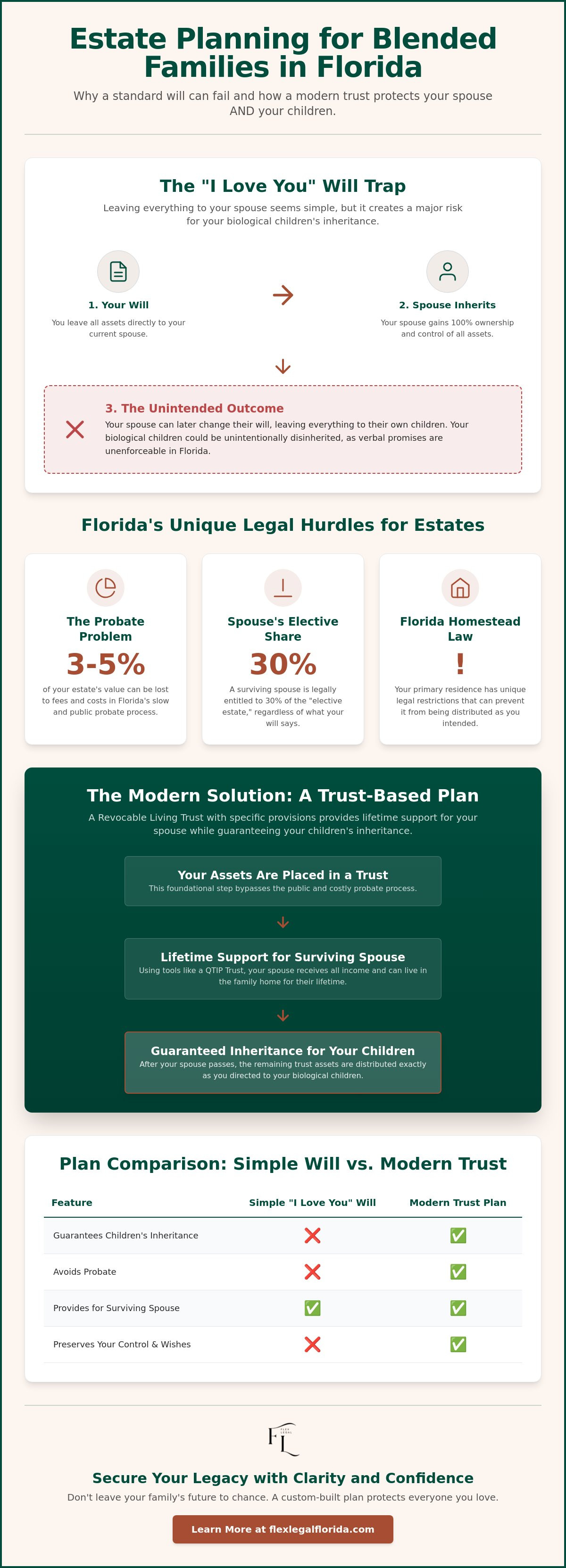
Estate planning for blended families in West Palm Beach isn't just about drafting documents; it's about managing a delicate ecosystem of competing interests. While Estate planning basics often focus on simple asset transfers, remarried couples face a unique emotional weight. You want to provide for your spouse while ensuring your biological children aren't left behind. Standard plans often fail here because they assume a linear family line that doesn't exist in a blended structure. Florida’s elective share laws add another layer of complexity. By law, a surviving spouse is entitled to 30% of the "elective estate" regardless of what your will says. This figure includes not just probate assets, but also certain accounts and property transfers. Without a tailored strategy, these legal minimums can disrupt your specific goals for your children's inheritance, especially when high-value West Palm Beach real estate is involved.
The Conflict of Interest: Spouse vs. Children
The most common mistake is the "all to spouse" will. It feels right at the moment, but it creates a massive risk for your legacy. Once assets pass to a surviving spouse, they have total control over those funds. They can change their own will years later, potentially leaving everything to their own biological children and completely bypassing yours. Under Florida intestacy laws, step-children aren't recognized as heirs. If you pass away without a plan, your step-children receive nothing from your estate. This can create deep resentment and lead to expensive litigation between your children and your spouse. Balancing these needs requires structured legal guardrails rather than just trusting that everyone will "do the right thing" decades from now.
West Palm Beach Legal Landscape in 2026
Palm Beach County courts have seen a steady rise in contested estates as family structures become more complex. Modern families in 2026 don't always fit into the rigid boxes of traditional law. This makes it vital to work with a local estate planning attorney west palm beach who understands the specific tendencies of our local judiciary. Your plan needs to be adaptable. It should reflect the reality of your life today while remaining robust enough to withstand legal challenges tomorrow. Effective estate planning for blended families in West Palm Beach prioritizes transparency. By using specific designations and modern trust structures, you can ensure your intentions are clear and enforceable. This approach keeps your loved ones out of the courtroom and preserves the family harmony you've worked hard to build.
Why a Simple Will Often Fails Florida’s Blended Families
The "I Love You" Will is the most common document in traditional estate planning. It's a straightforward arrangement where each spouse leaves everything to the other, assuming the survivor will eventually provide for all the children. While this works for some, it's a dangerous strategy for remarried couples. Once the first spouse passes away, the survivor gains total ownership of all assets. Your biological children have no legal right to that property. You might have a verbal agreement with your spouse to look after your kids, but in Florida, those promises are legally unenforceable. Without a written, binding structure, your children's inheritance rests entirely on your spouse's future goodwill, which can change over time.
A simple will also offers no protection against the lack of control that follows the first death. The surviving spouse can move assets, spend the principal, or even change their own will to exclude your children entirely. This isn't always done out of malice. Life happens. New relationships form, and financial priorities shift. If you want to ensure your legacy reaches your biological children, you need a plan that doesn't rely on trust alone. For many, exploring modern planning options is the first step toward creating a truly resilient family roadmap.
The Probate Problem in Palm Beach County
Probate in West Palm Beach is often a slow, public, and expensive hurdle. Even with recent legislative updates, the process can drain a significant portion of your estate. As of July 2026, House Bill 1337 has increased the threshold for summary administration to $150,000, but many local estates still exceed this limit. Formal administration typically costs between 3% and 5% of the estate's total value. These fees, combined with court costs and potential litigation, come directly out of the inheritance you intended for your family. If step-children and biological children disagree on the will's terms, probate litigation can drag on for years. You can find a detailed breakdown of these costs in our probate lawyer palm beach county guide.
Unintended Disinheritance and the "Last to Die" Rule
The "Last to Die" rule is a major risk in estate planning for blended families in West Palm Beach. It means the spouse who lives the longest ultimately decides where the combined family wealth goes. If your surviving spouse remarries, their new partner gains immediate legal protections under the Florida Statutes on Elective Share and Homestead. This new spouse could claim a significant portion of your assets, effectively disinheriting your children in favor of a stranger. A simple will provides zero defense against these statutory rights. It hands over full control, leaving your biological heirs vulnerable to the survivor’s future life choices and the legal claims of their new family members.
Essential Legal Tools for Protecting Spouses and Children
Effective estate planning for blended families in West Palm Beach requires a shift from simple documents to strategic tools that manage complex relationships. You don't have to choose between your spouse’s comfort and your children’s security. Modern legal structures allow you to achieve both. A revocable trust acts as the primary engine for this protection. Unlike a will, which only takes effect after a court process, a trust operates immediately and stays private. This is vital for families who want to avoid the delays of the Palm Beach County probate court.
For remarried couples, the Qualified Terminable Interest Property (QTIP) trust is often the gold standard. It allows you to provide your surviving spouse with income from the trust assets for the rest of their life. Once they pass away, the remaining principal is distributed to your biological children. This ensures that a future remarriage by your spouse won't divert your family’s wealth to a new partner or step-children you didn't intend to support. Home ownership also requires a specific strategy. While outright ownership is common, a life estate deed can allow a spouse to live in the home for their lifetime, after which the property automatically passes to your heirs. This avoids the homestead complications we'll discuss in the next section.
The Power of the Revocable Living Trust
A trust provides a level of adaptability that a will simply cannot match. You can appoint a neutral, professional trustee to handle distributions. This removes the emotional burden from family members and prevents potential friction between step-parents and step-children. Privacy is another major benefit. In Florida, probate files are public records. A trust keeps your financial details and your family’s inheritance private. As noted in the University of Florida's Guide to Estate Planning, understanding how assets are divided is the first step toward preventing unintended consequences. By using a trust, you ensure your legacy remains a private family matter.
Prenuptial and Postnuptial Agreements
Prenuptial and postnuptial agreements serve as the foundation of a resilient plan. These documents allow spouses to waive their rights to the elective share, which is the 30% portion of the estate Florida law automatically grants to a surviving spouse. To be valid in Florida, a postnuptial agreement requires full financial disclosure from both parties. Each spouse should have their own attorney to ensure the agreement is fair and enforceable. Introducing this topic shouldn't feel like a lack of trust. Instead, frame it as a gift of clarity. Comprehensive estate planning for blended families in West Palm Beach often starts with these two pillars: marital agreements and trust structures. It’s about creating a clear, conflict-free roadmap for everyone you love.
Florida Homestead Laws and Special Needs Considerations
Your primary residence is likely your most valuable asset, but in Florida, it's also the most legally restricted. While previous sections explored how trusts manage liquid wealth, the family home operates under strict constitutional rules. Many homeowners assume they can leave their house to whoever they choose. In a remarriage, this assumption is often wrong. The "Homestead Trap" refers to the Florida Constitution's restriction on devising a primary residence if you're survived by a spouse or minor child. If your plan doesn't account for this, the law will override your wishes, potentially locking your spouse and children into a shared ownership structure they never wanted.
Effective estate planning for blended families in West Palm Beach requires a proactive approach to real estate. In 2026, the Florida Homestead Exemption has increased to $51,411, providing significant tax benefits and creditor protection. However, these benefits come with strings attached. If you own a home in your name alone and pass away, Florida law typically grants your surviving spouse a life estate, while your biological children receive the "remainder" interest. This means your spouse can live there for life, but your children own the equity. This setup frequently leads to friction over who pays for property taxes, insurance, and major repairs like a new roof. It's a rigid default that rarely serves the best interests of a modern blended family.
Navigating the Florida Homestead Trap
To avoid the default life estate conflict, you need specific legal tools. One effective strategy is using a Lady Bird Deed, which allows you to maintain control of the property during your life while transferring it automatically to your heirs upon death. Another option involves a prenuptial or postnuptial agreement where a spouse waives their homestead rights in exchange for other assets. This allows you to leave the home directly to your biological children if that's your goal. You can also transfer the home into a trust, provided the language is carefully drafted to satisfy Florida’s complex homestead requirements. These methods ensure the equity you've built stays within your biological bloodline without leaving your spouse homeless.
Blended Families and Special Needs Children
The stakes are even higher if your blended family includes a child with a disability. Leaving a direct inheritance to a child from a previous marriage who receives government benefits can be a catastrophic mistake. A sudden influx of assets could disqualify them from essential programs like Medicaid or SSI. Working with a special needs planning attorney is the only way to ensure these vulnerable heirs are protected. A Special Needs Trust (SNT) acts as a legal safeguard, allowing the child to benefit from the inheritance for supplemental needs without losing their government safety net. If you're ready to secure your home and protect your most vulnerable family members, it's time to explore modern estate planning solutions that adapt to your family's unique reality.
Securing Your Legacy with Flex Legal, PLLC’s Modern Planning Model
Flex Legal, PLLC understands that estate planning for blended families in West Palm Beach isn't a static, one-time event. It's a dynamic process that requires a modern, adaptable approach. Traditional law firms often rely on rigid, slow-moving models that can feel cold or intimidating to families in transition. We've replaced that outdated style with a partnership-based model where we act as your agile ally. Our focus is on clarity and comfort, ensuring you feel empowered rather than overwhelmed by legal jargon. We believe that fairness in a blended family is achieved through structured legal guardrails. We're here to help you build them without the friction often associated with traditional professional services.
Predictable Pricing for Complex Families
Complexity shouldn't come with an unpredictable price tag. Many traditional firms use hourly billing, which can create a "lawyer fear" that prevents families from asking the critical questions they need to ask. At Flex Legal, PLLC, we use a flat-fee model for our comprehensive blended family plans. This means you'll know exactly what your investment is from the very start. Whether we're drafting a Revocable Living Trust or coordinating a complex QTIP structure, you won't have to worry about the clock ticking. Our packages are designed to be thorough. They cover everything from asset protection to specific inheritance roadmaps for your biological children, providing the price certainty you deserve.
Your Agile Ally in Palm Beach County
We leverage modern technology to make the planning process as smooth and transparent as possible. You don't have to deal with the slow, paper-heavy methods of the past. Our streamlined approach ensures your documents, including your durable power of attorney and healthcare surrogate designations, are precise and current. We prioritize speed and transparency, moving you from your initial consultation to a fully funded estate plan with efficiency. This allows you to focus on what matters most: your family's harmony and future security. Ready to protect both your spouse and your children? Schedule your consultation with Flex Legal, PLLC today.
Build a Legacy Based on Clarity
Protecting your family shouldn't feel like a legal gamble. You now understand why traditional wills often fall short for remarried couples and how specialized trust structures can bridge the gap. By navigating Florida’s unique homestead restrictions and accounting for the specific needs of every family member, you can prevent the conflict and litigation that often haunt blended households. Estate planning for blended families in West Palm Beach is about creating a roadmap that honors all your relationships without leaving your biological children’s future to chance.
Flex Legal, PLLC is here to act as your agile ally. We offer specialized expertise in Florida Homestead and Special Needs laws to ensure every detail of your plan is robust and enforceable. Our flat-fee pricing model provides total cost certainty, allowing you to focus on results rather than billable hours. We provide modern legal support tailored to the evolving needs of West Palm Beach residents, ensuring your plan stays as adaptable as your life.
Secure your family’s future with a flat-fee estate plan from Flex Legal, PLLC. Your peace of mind is within reach, and we're ready to help you secure it.
Frequently Asked Questions
Can I leave my West Palm Beach home to my children if I am remarried?
You can leave your home to your children, but only if you navigate Florida’s strict homestead laws correctly. If you're married, you can't devise your primary residence to anyone else unless your spouse formally waives their rights. This is usually done through a prenuptial or postnuptial agreement. Without these documents, the law overrides your will, giving your spouse a life estate while your children wait to inherit the equity later.
What happens if I die in Florida without a will and I have a blended family?
Your assets will be divided according to Florida’s intestacy statutes if you die without a valid plan. In a blended family, the surviving spouse typically receives half of the probate estate, while your biological children share the remaining half. This mandatory split often forces family members into shared ownership of property, which can lead to tension and expensive legal disputes that a clear plan would have avoided.
Do stepchildren have any inheritance rights under Florida law?
Stepchildren have zero automatic inheritance rights under Florida law. They aren't considered legal heirs unless you have formally adopted them. If you want your stepchildren to receive a portion of your legacy, you must specifically name them in a trust or a will. Without these proactive steps, they'll be completely excluded from your estate in favor of your biological relatives and surviving spouse.
How does a QTIP trust work for blended families in Florida?
A QTIP trust balances the needs of your current spouse with the long-term security of your children. It provides your spouse with a steady stream of income for the rest of their life while keeping the principal assets protected. Once your spouse passes away, the remaining assets go directly to your biological children. It’s a reliable way to prevent your legacy from being diverted to a spouse's future partner.
Is a prenuptial agreement required for estate planning in a second marriage?
While not a legal requirement, a marital agreement is a foundational tool for estate planning for blended families in West Palm Beach. These agreements allow spouses to waive their rights to the 30% elective share and homestead claims. By removing these statutory hurdles, you gain the freedom to distribute your assets exactly how you want. It's the most effective way to ensure your children receive their intended inheritance without conflict.
How can I prevent my ex-spouse from managing my children’s inheritance?
You can prevent an ex-spouse from controlling your children’s inheritance by using a trust rather than a direct gift. If you name a minor as a beneficiary in a will, the court might grant your ex-spouse control over those assets as the child’s natural guardian. By naming a trusted individual or professional as a successor trustee, you ensure your funds are managed according to your specific instructions and values.
What is the cost of estate planning for a blended family in West Palm Beach?
The investment for a blended family plan depends on your specific goals and the legal tools required to meet them. We believe in transparency, so we offer flat-fee packages that eliminate the uncertainty of hourly billing. This modern approach allows you to focus on building a resilient plan for your family without worrying about unexpected costs. You'll know exactly what your comprehensive estate plan costs before we begin.
Can a revocable living trust be changed after one spouse dies in a blended family?
Whether a trust can be changed after a death depends entirely on its specific terms. Many couples choose to make certain provisions irrevocable after the first spouse passes to ensure biological children aren't disinherited later. If the trust stays fully revocable, the survivor could potentially name new beneficiaries. We help you design adaptable structures that lock in protections for your children while providing necessary flexibility for the survivor.


Comments