
What is a Pre-Need Guardian in Florida? Your 2026 Legal Guide
- Kelly Mata
- Aug 3
- 12 min read

What if the person making your most intimate medical and financial decisions was a total stranger appointed by a judge who doesn't know your story? It's a heavy thought, but for many Floridians, the lack of a clear plan makes this a real possibility. You likely value your independence and want to ensure your future remains in the hands of someone you actually trust. Understanding what is a pre-need guardian in Florida is the first step toward reclaiming that control before a crisis ever hits.
We know that the thought of losing autonomy is stressful, and navigating complex probate laws often feels like a hurdle rather than a help. This guide simplifies the process, showing you how a pre-need guardian designation protects your wishes if you ever become incapacitated. You'll learn the specific 2026 legal requirements under Florida Statute § 744.3045 and how to document your choice properly. We'll walk through the essential steps to ensure your voice is heard, giving you the peace of mind that your future is secure and your legacy is handled on your own terms.
Table of Contents
Understanding the Pre-Need Guardian Designation in Florida
Planning for a time when you might not be able to make your own decisions is an act of empowerment. At its core, a pre-need guardian is a person you choose today to step into your shoes if a court ever finds you incapacitated in the future. This isn't just a casual suggestion; it's a formal written declaration that tells a judge exactly who you trust to manage your life. While most people hope they'll never need it, knowing what is a pre-need guardian in Florida allows you to build a protective shield around your autonomy.
This document is proactive by design. Traditional guardianship is often reactive, triggered by a crisis where family members might scramble or disagree in a courtroom. By designating a legal guardian in advance, you eliminate the guesswork. This person's authority extends to two critical areas of your life: your person and your property. This means they'll handle everything from your medical treatments and living arrangements to your bank accounts and real estate investments. You can file this declaration with the Clerk of the Court or keep it safely with your other estate planning records to be produced when necessary.
The Legal Basis: Florida Statute 744.3045
Florida law provides a clear framework for this process under Florida Statute § 744.3045. This law creates what's known as a rebuttable presumption. Essentially, the court starts with the assumption that the person you named is the one entitled to serve. Unless there's evidence that your chosen individual is disqualified or unfit, the judge will generally honor your wishes. This legal preference is a powerful tool because it significantly limits the court's discretion to appoint a stranger or a professional guardian who doesn't know your values. It ensures that your voice remains the loudest in the room, even when you're no longer able to speak for yourself.
Adult vs. Minor Pre-Need Guardians
The flexibility of Florida law allows you to designate guardians for different scenarios. For adults, the designation focuses on your own potential incapacity. However, parents can also use this tool to name a guardian for their minor children. In Florida, this is often referred to as a Standby Guardian. If both parents become incapacitated or pass away, the standby designation activates to ensure the children are cared for by a trusted family member or friend immediately. The triggers for these roles differ; an adult designation requires a judicial determination of incapacity, while a minor's guardianship often activates upon the parents' inability to provide care. Both serves as a vital safety net for your family's future.
Florida Legal Requirements for a Valid Designation
Creating a plan for the future is a powerful step, but your choice only carries weight if the document meets strict state standards. Understanding what is a pre-need guardian in Florida requires a look at the formal rules that prevent your wishes from being challenged in court. Florida law is precise about how these documents are created, signed, and maintained. If the paperwork doesn't follow the letter of the law, a judge may be forced to overlook your chosen ally in favor of a court-selected alternative.
The core requirement is that the document must be in writing. Oral promises or casual emails aren't enough to satisfy the court. Under Florida Statute 744.3045, the declaration must be signed by the person making the designation in the presence of at least two attesting witnesses. These witnesses must be present at the same time to verify that the signing was a voluntary, competent act. While you aren't required to file this document immediately with the Clerk of the Court in West Palm Beach, doing so creates a permanent public record that is easily accessible during an emergency incapacity hearing.
Formalities of Execution
The signing process for a pre-need guardian designation mirrors the strict formalities of a Last Will and Testament. This high bar exists to prevent fraud and ensure that no one is being pressured into naming a specific person. To make the process even more robust, many professionals include a "self-proving" affidavit. This single-page addition, signed before a notary, allows the court to accept the document as valid without needing to track down the original witnesses years later. Ensuring these formalities are handled correctly is a key part of our flat-fee document preparation services, which focus on making complex legal steps accessible and stress-free.
Who Can Serve? Qualifications and Disqualifications
Not everyone is eligible to serve as a guardian in the eyes of the law. Florida sets specific benchmarks to ensure the person you choose is capable of the responsibility. At a minimum, the designated person must be at least 18 years old and have a clean criminal record. A felony conviction is an automatic disqualifier. Additionally, Palm Beach County judges look closely at the relationship between the guardian and the ward. While family members can live anywhere, non-relatives must typically be Florida residents to serve.
The court always applies the "best interests of the ward" standard. Even if your paperwork is perfect, a judge could potentially disqualify your choice if that person has a conflict of interest or a history of financial instability. The goal is to find a balance between honoring your autonomy and ensuring you are protected from potential exploitation. By selecting a qualified primary and alternate guardian now, you provide the court with a clear, adaptable path forward that respects your values and your safety.
Pre-Need Guardian vs. Court-Appointed Guardian: Why Control Matters
The difference between choosing your own advocate and having one chosen for you is the difference between autonomy and a gamble. When families are in crisis, emotions run high. Without a pre-selected ally, the courtroom can become a battleground where siblings or distant relatives fight over who should manage your affairs. This litigation isn't just emotionally draining; it's expensive. Defining what is a pre-need guardian in Florida for your specific family situation removes this friction. It saves your estate significant resources and spares your loved ones from unnecessary legal conflict. You're effectively providing a roadmap that the court is legally inclined to follow.
There is also a profound emotional benefit to this proactive step. Knowing that your wishes are documented and legally binding provides a sense of security that a reactive process simply can't offer. You avoid the "stranger in the courtroom" scenario, where a judge might appoint a professional guardian who has no personal connection to your life or history. By making this choice now, you ensure that the person managing your most private matters is someone who already understands your heart and your habits.
The Role of the Court in Incapacity Proceedings
Florida's incapacity process involves a three-member Examining Committee. These professionals, usually including a psychiatrist and other medical or social experts, evaluate your ability to manage daily life. Once they submit their findings, the judge reviews your pre-need designation during the hearing. The court's role is to ensure your chosen guardian is qualified. Unless there's a compelling reason, like a recent criminal record or a clear conflict of interest, the judge will honor your choice. This provides a layer of protection against a judge being forced to make a random appointment because the family is deadlocked.
Protecting Your Autonomy and Dignity
Choosing your guardian is about more than just numbers on a balance sheet. It's about dignity. Your guardian is expected to use "substituted judgment." This means they must make decisions based on what they know you would want, reflecting your personal values and lifestyle. Whether it's your preference for certain medical treatments or where you want to live, a trusted ally is more likely to honor those nuances than a court-appointed stranger.
This principle of protection also applies to your children. Naming a pre-need guardian for a minor child ensures that your parenting values continue even if you can't be there. For more on how these roles interact with the court system, our guide for a Probate Lawyer in Palm Beach County offers deeper context on court oversight and estate administration. Taking these steps today ensures that your future remains a reflection of your own choices, not a judge's best guess.
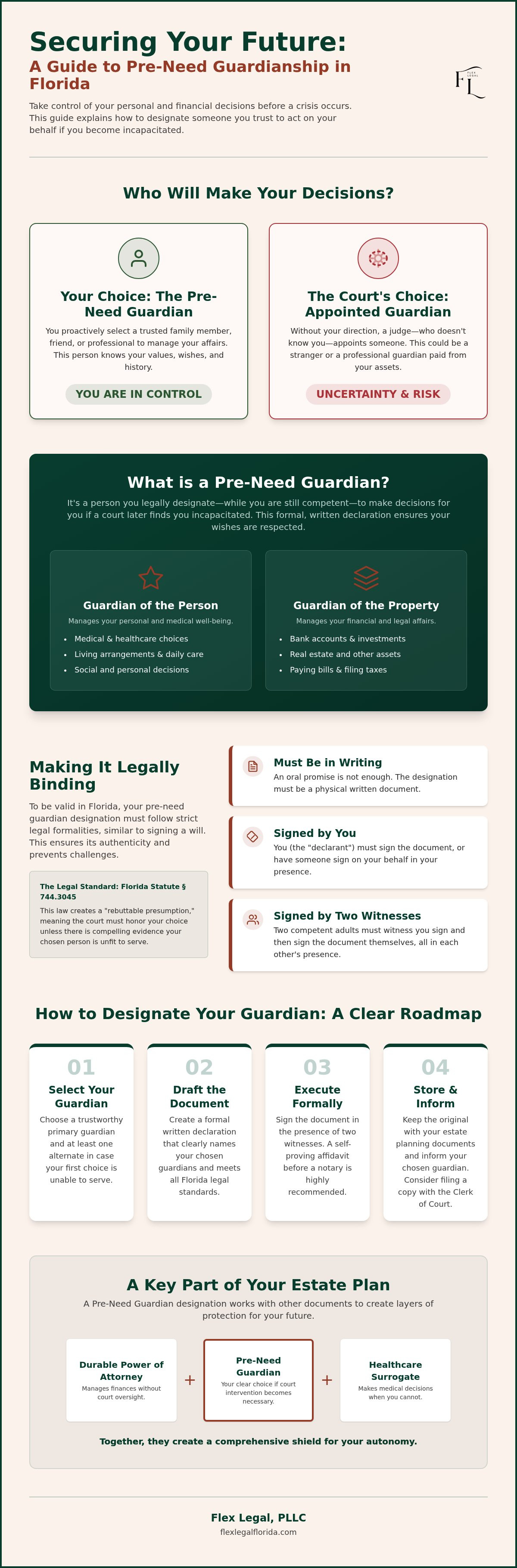
How to Properly Designate a Pre-Need Guardian in West Palm Beach
Moving from theory to action is where your protection becomes real. While the conceptual legal definition of what is a pre-need guardian in Florida is straightforward, the actual execution requires attention to detail to ensure the document stands up to judicial scrutiny. Following a structured process ensures that your intentions are clear and that your designated advocate is ready to act if the need arises. By taking these steps now, you're building a safety net that functions exactly how you intended during a time of crisis.
The process follows five essential steps to secure your future:
Identify a primary guardian and at least one alternate who shares your values and understands your lifestyle.
Draft your declaration to align with the specific statutory requirements of Florida law to avoid technical challenges.
Sign the document in the presence of two attesting witnesses and a notary public to verify the authenticity of your signature.
File the designation with the Clerk of the Court to create a verifiable public record that is easily accessible to a judge.
Communicate your plan with your family and the people you've named to ensure everyone understands their potential roles.
Filing with the Palm Beach County Clerk
While you can keep your declaration with your private estate records, filing it early with the Clerk of the Court provides an extra layer of security. Having the document on file at the Main Courthouse in West Palm Beach ensures it is immediately available to a judge during an emergency incapacity hearing. The fee for filing formal guardianship proceedings in Florida is $395, though recording individual declarations before a case is opened may involve smaller administrative costs. By taking this step today, you remove one more hurdle for your family and ensure the court knows exactly what is a pre-need guardian in Florida for your specific needs before a crisis occurs.
Selecting the Right Person for the Job
Choosing your advocate is a deeply personal decision that requires looking beyond family ties. You should look for someone with financial stability, geographic proximity to your home, and a firm understanding of your healthcare preferences. Naming an alternate is equally vital; it prevents a situation where your first choice is unavailable, leaving the court to appoint a stranger. A family guardian offers a personal bond and shared history, whereas a professional guardian is a compensated neutral party often used when family dynamics are complicated or no relatives are available to serve.
We specialize in making this process seamless through our flat-fee document preparation services, ensuring your designation is legally sound and ready for filing. Taking these steps today turns a complex legal requirement into a simple, effective safety net for your future.
Beyond the Form: Integrating Guardianship into Your Florida Estate Plan
Understanding what is a pre-need guardian in Florida is a vital start, but this designation shouldn't be your only line of defense. A strong estate plan is a dynamic system where different documents work together to cover every possible scenario. While a guardian manages your person and property under court supervision, other tools can keep your affairs private and out of the courthouse entirely. By layering these protections, you create a robust safety net that adapts to your specific needs as they evolve over time. This holistic approach ensures that your autonomy is protected from every angle, not just in the event of a total incapacity hearing.
A comprehensive plan moves beyond a single form to include specialized tools like a Last Will and Testament, health care surrogate designations, and asset protection strategies. When these documents are drafted in harmony, they provide a clear roadmap for your family and the court. This clarity reduces the risk of family disputes and ensures that your chosen representatives have the exact authority they need without overstepping their roles. Relying on a West Palm Beach estate planning attorney helps you navigate these interactions with confidence.
Guardian vs. Power of Attorney: Which Takes Precedence?
Florida law follows the "least restrictive alternative" doctrine. This means a judge won't appoint a guardian if there's a less intrusive way to protect your interests. A Durable Power of Attorney in West Palm Beach is often that alternative. If your agent can handle your financial and legal needs through a power of attorney, the court may find that a full guardianship is unnecessary. However, having a pre-need designation remains essential. It acts as a critical backup in case your power of attorney is ever challenged or if your agent is unable to serve when the time comes.
The Role of Living Trusts in Avoiding Guardianship
For your finances, a Revocable Trust is a powerhouse tool for maintaining privacy. Assets held in a trust are managed by your successor trustee if you become incapacitated, completely bypassing the need for a guardian of the property. This keeps your financial life out of the public record and avoids the ongoing reporting requirements and fees of a court-supervised guardianship. When you pair a trust with a health care surrogate, you've built a comprehensive shield for both your dignity and your wealth.
Finalizing your plan means looking at the big picture and ensuring every piece fits together perfectly. Don't leave your future to chance or a judge's best guess. Schedule a consultation with Flex Legal to build your secure future and ensure your wishes are the final word.
Take Control of Your Future Today
Your future deserves a plan that reflects your values, not a judge's best guess. We've explored how a pre-need designation keeps you in the driver's seat by naming a trusted ally before a crisis occurs. You've also seen how this document works alongside tools like living trusts to provide a seamless transition if incapacity ever becomes a reality. Navigating what is a pre-need guardian in Florida doesn't have to be overwhelming when you have an agile ally by your side.
At Flex Legal, we simplify the process with transparent, flat-fee pricing for our document packages. Attorney Jennifer L. Flexer, Esq. provides the personal attention and specialized expertise in Palm Beach County probate court required to build a secure, adaptable plan. Don't leave your autonomy to chance. Secure your future with a flat-fee incapacity plan from Flex Legal and gain the peace of mind you deserve. Your legacy is safe in your own hands.
Frequently Asked Questions
Does a pre-need guardian have power over me right now?
No, a pre-need guardian has zero authority over you while you're competent. Their role only begins after a judge formally determines you're incapacitated through a legal proceeding. It's a "just in case" document that remains dormant until it's needed, ensuring you keep full control of your life today.
Can I change my mind after I have designated a pre-need guardian?
You can absolutely change your mind at any time as long as you have the mental capacity to do so. To update your choice, you simply execute a new written declaration that meets Florida's legal standards. This new document automatically replaces your previous designation, allowing your plan to stay as agile as your life changes.
What happens if I dont have a pre-need guardian in Florida?
Without this document, a judge will decide who manages your life during a crisis. While Florida law has a priority list for relatives, the court could appoint a professional guardian if your family is deadlocked or in conflict. Understanding what is a pre-need guardian in Florida helps you avoid this "stranger in the courtroom" scenario and keeps you in control.
Is a pre-need guardian the same as a health care surrogate?
They serve different purposes. A health care surrogate makes medical decisions when you're temporarily unable to communicate, often without a court's involvement. A pre-need guardian is a broader role that requires a formal court determination of incapacity. This role involves managing both your personal well-being and your financial assets under ongoing judicial oversight.
Do I need a lawyer to file a pre-need guardian designation in West Palm Beach?
While you aren't legally required to hire an attorney, it's a smart move to ensure your document follows Florida Statute 744.3045 exactly. Small technical errors can make a designation invalid when you need it most. An attorney also ensures your paperwork is correctly filed with the Clerk of the Court in West Palm Beach for immediate access during an emergency.
Can a non-Florida resident serve as my pre-need guardian?
A non-resident can only serve as your guardian if they are a close relative, such as a spouse, sibling, parent, or child. Florida law is strict about non-relatives; they must live in the state to be eligible. This rule ensures that a non-relative guardian is close enough to manage your daily needs and attend local court hearings without friction.
What is the difference between a pre-need guardian and a standby guardian?
A pre-need guardian is generally chosen for yourself or your children in the event of future incapacity. A standby guardian is a specific tool for parents that activates immediately if the parent becomes unable to care for their minor child. Both documents provide essential protection, but they trigger under different circumstances based on the specific needs of the family members involved.
How often should I update my guardianship designation?
It's best to review your guardianship designation every three to five years to ensure it still reflects your wishes. You should also update it immediately after major life changes, like the death of a named guardian, a move to a new state, or a divorce. Keeping your plan current ensures your chosen advocate is still the best fit for your life and shared values.


Comments