
What Assets Should Go Into a Living Trust in Florida? (2026 Guide)

A living trust is essentially an empty vessel. Without the right contents, it offers no protection against the Florida probate courts. Many homeowners believe that simply signing a trust document secures their legacy, but the real work lies in "funding" the trust through strategic asset transfers. Understanding exactly what assets should go into a living trust in Florida is the difference between a seamless transition and a costly, public legal battle for your heirs.
It's natural to feel anxious about retitling your property or worried about losing control over your hard-earned assets. You want to ensure your family avoids the stress of court, especially with the 2026 summary administration threshold now sitting at $150,000. This guide provides a clear, actionable checklist for transferring your real estate, bank accounts, and investments while keeping your tax benefits and privacy intact. You'll discover how to protect your homestead, which accounts to leave alone, and how to maintain total flexibility as your life evolves.
Key Takeaways
Master the concept of "funding" to ensure your trust functions as a complete legal shield rather than just an empty document.
Identify exactly what assets should go into a living trust in Florida to bypass the probate process and keep your family’s financial affairs private.
Learn how to protect your primary residence within a trust while fully preserving your Florida homestead tax exemptions and creditor protections.
Recognize which assets, like IRAs and 401(k)s, should stay outside the trust to avoid immediate tax penalties and unintended legal complications.
Access a step-by-step 2026 roadmap for inventorying your estate and successfully retitling assets with your bank or brokerage.
Table of Contents
Understanding "Funding": Why Your Florida Trust Needs Assets
A Revocable Living Trust is often described as a magic bullet for avoiding probate, but the document itself doesn't actually own anything the moment you sign it. Think of your trust as an empty vessel. It's a sophisticated container designed to hold your wealth, yet it remains powerless until you fill it. Determining what assets should go into a living trust in Florida is the most critical step in active estate management. Without the formal process of transferring ownership from your individual name to the trust, your estate plan is essentially just a stack of paper.
The success of your plan relies on "funding." This is the legal procedure where you retitle your property, accounts, and investments so the trust becomes the official owner. When assets are properly funded, your Successor Trustee gains immediate authority to manage them if you become incapacitated or pass away. For families in Palm Beach County, this creates a seamless transition. It bypasses the need for a judge's signature to pay bills or sell a property, keeping your private business out of the public record.
The Legal Mechanism of Title Transfer
Florida law recognizes a distinction between "legal title" and "equitable title." When you own a house in your own name, you hold both. By Understanding Trusts, you can see how funding shifts these roles. You transfer the legal title to yourself as Trustee, while you retain the equitable title, meaning you still enjoy the full use and benefit of the property. The trust must be the owner of record for the asset to bypass the court system entirely. Trust funding is the critical bridge between document creation and probate avoidance.
The Cost of Failing to Fund
If you forget to move an asset into your trust, your "Pour-Over Will" acts as a safety net. This document "pours" any stray assets into your trust after you die. However, there is a significant catch. A Pour-Over Will must go through the formal probate process to function. This means your family will still face court dates, legal fees, and delays, even though you have a trust.
As of July 2026, Florida has increased the summary administration threshold to $150,000, but many estates still far exceed this limit. Failing to fund your trust can lead to thousands of dollars in avoidable expenses. If you're concerned about assets currently stuck in your individual name, reviewing your plan with a Probate Lawyer in Palm Beach County: A 2026 Guide to Florida Estate Administration can help you identify gaps before they become a burden for your heirs. Deciding what assets should go into a living trust in Florida today prevents a legal headache tomorrow.
Primary Assets to Transfer for Maximum Probate Avoidance
Identifying what assets should go into a living trust in Florida involves looking beyond your primary residence. To achieve maximum probate avoidance, you must consider everything from your financial portfolio to your business legacy. Real estate is often the biggest priority. This includes not just your Florida home, but also secondary vacation properties, rental units, and out-of-state land. Moving these into a trust prevents "ancillary probate," which is a secondary court process required in every state where you own land.
Financial accounts are equally vital. While retirement accounts have their own rules, your non-retirement brokerage accounts, standard savings, and Certificates of Deposit (CDs) should be retitled. Similarly, your business interests, such as LLC memberships or stock in a closely-held corporation, can be transferred to the trust. This ensures that your business continues to operate smoothly without waiting for a judge to appoint a personal representative. For high-value tangible items like jewelry, fine art, or rare collections, a trust provides a private way to pass these treasures to specific heirs without public disclosure.
Modern Assets: Digital and Intellectual Property
Your digital footprint is a modern asset class that many traditional plans overlook. Cryptocurrency wallets and private keys are perhaps the most sensitive. If your heirs don't have the keys or the legal authority to access them through your trust, those funds could be lost forever. Beyond currency, consider your domain names, monetized social media accounts, and digital storefronts. Intellectual property, including copyrights, patents, and royalty-producing contracts, should also be formally assigned to your trust to ensure the income stream continues for your beneficiaries.
Special Considerations for Special Needs Beneficiaries
When your estate plan involves a loved one with a disability, the stakes are much higher. Direct inheritance can disqualify a beneficiary from essential government benefits like SSI or Medicaid. By integrating these assets into a Special Needs Planning framework, you can provide for their quality of life without jeopardizing their support systems. This specialized approach ensures that the trust assets are used for "supplemental" needs that the government doesn't cover. If you're unsure how to categorize your specific holdings, consulting with an estate professional can help you refine your strategy. This checklist clarifies what assets should go into a living trust in Florida to ensure your hard work stays within your family’s control.
The Florida Homestead Nuance: Should Your Primary Home Be in the Trust?
Florida's constitutional homestead protections are unique, making the decision of whether to include your primary residence in your estate plan a delicate one. As you evaluate what assets should go into a living trust in Florida, your main home requires specific attention to avoid a tax disaster. The "Save Our Homes" cap is a vital benefit for West Palm Beach residents, limiting annual property tax assessment increases to 3%. If you transfer your deed without the correct legal language, you could trigger a reassessment that significantly increases your yearly tax bill.
Beyond tax caps, your home is a legal fortress against most judgment creditors. This protection generally remains intact when moving the property into a revocable trust, provided the document is drafted to reflect your intent to reside there permanently. For some in Palm Beach County, an Enhanced Life Estate Deed, often called a "Lady Bird Deed," might be a better fit. This allows the home to bypass probate automatically while you maintain absolute control, serving as a flexible alternative to trust ownership.
Preserving Your Tax Exemptions
To satisfy the Palm Beach County Property Appraiser, the trust must explicitly state that the settlor has the right to reside in the home for life. This verification is essential to keeping your $50,000 exemption and your valuation cap locked in place. At Flex Legal, PLLC, we ensure your revocable trust contains the precise wording required to avoid a "change in ownership" trigger that could reset your tax basis.
Homestead and Creditor Protection
Florida Homestead is widely considered the strongest asset protection tool in the nation. It shields your equity from most creditors, which is why it's a cornerstone of any local estate plan. However, a major risk involves using "irrevocable" trust structures that haven't been customized for Florida law. If the trust isn't tailored to preserve constitutional rights, you might inadvertently lower the shield that protects your home from lawsuits.
This is a critical consideration for West Palm Beach professionals in high-risk fields who are determining what assets should go into a living trust in Florida to balance probate avoidance with long-term security. A properly structured revocable trust maintains this protective barrier while ensuring your most valuable asset stays out of the public probate court system.
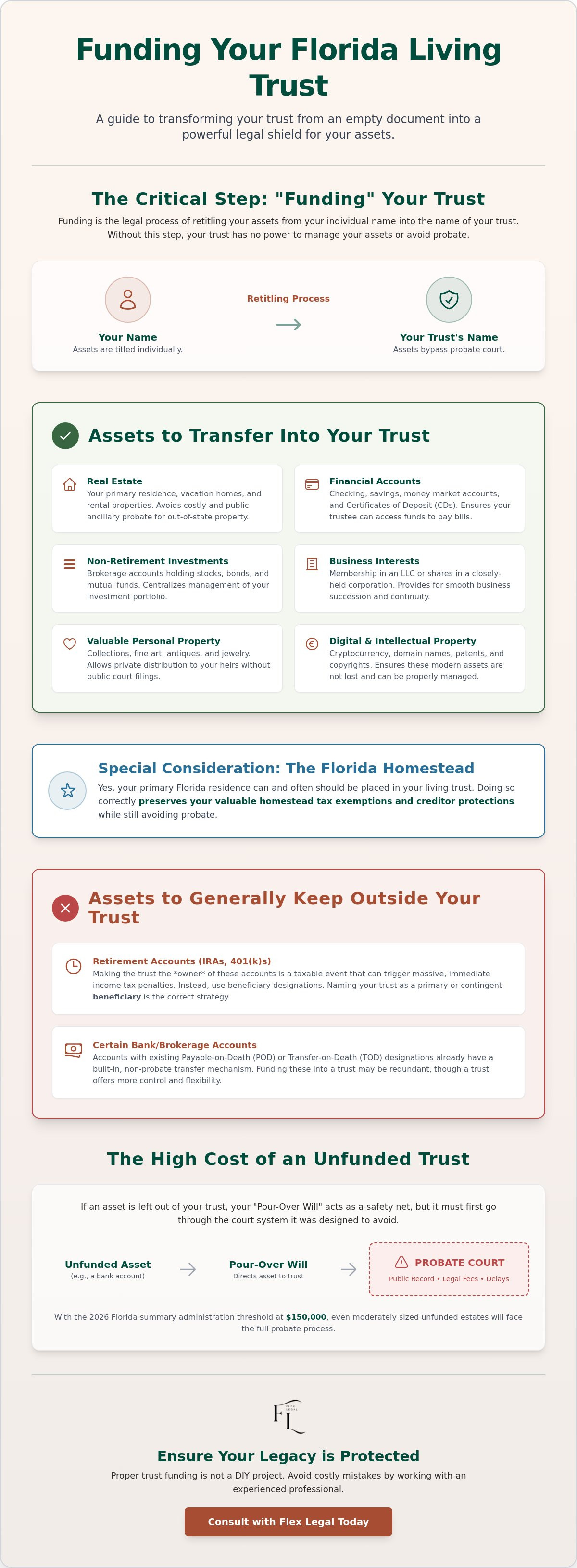
Assets That Should Generally Stay Outside Your Revocable Trust
While we have focused extensively on what assets should go into a living trust in Florida, the strategy is only complete when you identify what to leave out. Certain assets are better off staying in your individual name to avoid immediate tax hits or administrative headaches. Not every piece of property belongs in a trust. Some assets have built-in transfer mechanisms that work perfectly well on their own. Others carry heavy tax penalties if you try to change the owner of record during your lifetime.
For instance, your daily checking account and your primary vehicle don't always need trust ownership. Florida law provides specific shortcuts for these items that are often more efficient than trust retitling. HSAs and Medical Savings Accounts also follow a specific tax logic. Retitling them can result in the loss of their tax-advantaged status. Knowing these boundaries ensures your estate plan remains agile and cost-effective without creating unnecessary paperwork for your Successor Trustee.
The Danger of Retitling Retirement Accounts
Moving an IRA, 401(k), or 403(b) directly into a trust is considered a "taxable distribution" by the IRS. This mistake triggers an immediate income tax bill on the entire balance, potentially wiping out a third of your savings in a single year. To avoid this "tax trap," you should keep the account in your name and use the trust as a primary or contingent beneficiary. This preserves the tax-deferred status while still allowing the trust to control the distribution after you pass away.
The SECURE Act 2.0 updates have significantly changed how these accounts are inherited. Most non-spouse beneficiaries now have to empty the account within ten years of the original owner's death. A well-drafted trust can help manage these distributions. It protects heirs from their own financial inexperience while ensuring the tax burden is managed as efficiently as possible over that ten-year window.
Using "POD" and "TOD" Designations
For smaller bank accounts used for daily expenses, a Payable-on-Death (POD) designation is often sufficient. It allows the money to jump directly to your heir without probate court involvement. In Palm Beach County, the DMV allows for Transfer-on-Death (TOD) designations on vehicle titles. This simplifies the transfer process for your family without the need to retitle the car or boat into the trust today.
While these designations are helpful, they are often called "poor man's trusts" because they lack flexibility. They don't provide for successor beneficiaries if your first choice passes away before you do. When you are deciding what assets should go into a living trust in Florida, these designations should be used as supplements, not replacements, for a comprehensive plan. If you have questions about specific account types, consulting with an estate professional can help you avoid costly tax errors and ensure your plan is truly optimized.
Action Plan: How to Fund Your Florida Living Trust in 2026
You have identified what assets should go into a living trust in Florida. Now it's time to execute. Funding your trust is not a one-time administrative hurdle; it's the final lock on your estate's security. Without this step, your trust remains a hollow shell, and your family will still face the probate process you worked so hard to avoid. Taking action in 2026 requires a methodical approach to ensure every piece of your wealth is correctly aligned with your legal goals.
Start by creating a comprehensive inventory of everything you own. This list should include physical property, digital assets, and business interests. Once your list is complete, the process follows four primary steps:
Contact Financial Institutions: Reach out to your banks and brokerage firms. Request their specific "Certification of Trust" or "Trust Registration" forms. These documents allow you to prove the trust exists without revealing your private distribution details.
Execute New Deeds: For West Palm Beach real estate, a new deed must be drafted and recorded in the Palm Beach County public records. This officially moves the title from your individual name to the trust.
Update Beneficiary Designations: As discussed in the previous section regarding tax traps, retirement accounts and life insurance policies require updated beneficiary forms. You aren't changing the owner, but you are ensuring the trust is the recipient of the funds.
Assign Business Interests: Use a formal "Assignment of Interest" to move your LLC memberships or corporate stock into the trust's name.
The Flex Legal, PLLC Approach to Asset Alignment
We believe that estate planning should be streamlined and transparent. Our flat-fee packages provide more than just documents; they provide a clear roadmap for your specific funding needs. At Flex Legal, PLLC, we prioritize an "Asset Alignment" meeting to confirm every account and property is in its proper place. This focus on adaptability ensures that as your wealth grows or your family dynamics change, your trust remains a dynamic support system rather than a static set of rules. We act as your agile ally, making sure the legal bridge between your assets and your legacy is unbreakable.
Ongoing Maintenance and 2026 Reviews
Your trust is a living document that must evolve with you. If you purchase a new home or open a new investment account, you must fund that asset immediately. Waiting even a few months creates a window where that asset could be subject to probate. We recommend annual "Trust Check-ups" to review your holdings and verify that your funding is still accurate. This modern approach to estate management prevents forgotten assets from triggering court intervention later. To ensure your plan is fully optimized for the current legal landscape, schedule a consultation with Jennifer L. Flexer, Esq. at Flex Legal, PLLC to secure your assets today.
Take the Final Step Toward Total Asset Protection
Building a trust is the first half of the journey; funding it is the completion. By understanding exactly what assets should go into a living trust in Florida, you've already taken a massive step toward protecting your family from the public eye of the probate court. From securing your West Palm Beach home's tax cap to naming your trust as a beneficiary for life insurance, every move you make now ensures a smoother transition for your heirs. A well-executed plan doesn't just manage your property; it preserves your peace of mind.
At Flex Legal, PLLC, we specialize in making this transition as simple and transparent as possible. Founding Attorney Jennifer L. Flexer, Esq. provides the modern, personalized guidance you need to navigate Florida’s specific homestead and special needs laws. With our flat-fee packages, you gain price certainty while receiving a customized roadmap that ensures no asset is left behind. We act as your agile ally, adapting your plan to meet the evolving needs of your family and your wealth.
Your family’s future is too important to leave to chance or outdated legal models. Let's work together to build an estate plan that is as adaptable and resilient as you are. Take action today to ensure your legacy remains exactly where it belongs—in your family's hands.
Frequently Asked Questions
Do I need to put my car in my Florida living trust?
You generally don't need to retitle your daily-use vehicle into your trust. Florida offers a Transfer-on-Death (TOD) designation through the DMV that allows the car to pass directly to a beneficiary without probate. This is often more efficient than trust ownership unless you own a high-value collection or specialized luxury vehicles.
Will putting my house in a trust increase my property taxes in Palm Beach County?
No, your property taxes won't increase if the trust includes the specific language required by the Palm Beach County Property Appraiser. This wording ensures you keep your $50,000 exemption and the "Save Our Homes" assessment cap. It's a common concern when deciding what assets should go into a living trust in Florida, but a well-drafted trust preserves all your tax benefits.
Can I put my Florida LLC or small business in a revocable trust?
Yes, you can and should transfer your Florida LLC or small business interests to your trust. This is done through an assignment of membership interest. It ensures your business keeps running smoothly without a court-ordered pause if something happens to you, allowing your Successor Trustee to step in immediately.
What happens if I forget to put an asset in my trust?
If an asset is left out, your Pour-Over Will serves as a backup, but it requires a trip to probate court. As of July 2026, if the forgotten assets are worth less than $150,000, your family might qualify for a simplified summary administration. However, proper funding avoids this court delay and the associated legal expenses entirely.
Can I still sell my house if it is owned by my living trust?
You retain full control to sell, mortgage, or lease your house at any time. As the Trustee of your revocable trust, you sign all closing documents just as you would if the house were in your individual name. The trust structure doesn't limit your ability to manage your property or take advantage of market opportunities.
Is life insurance usually put into a revocable living trust?
Most people name the trust as the beneficiary of their life insurance rather than the owner. This allows the death benefit to be managed according to the trust's specific instructions without the complexity of transferring the policy itself. It's a key part of determining what assets should go into a living trust in Florida to ensure your heirs are provided for as you intended.
Does a living trust protect my assets from nursing home costs in Florida?
A revocable living trust does not protect your assets from nursing home costs or Medicaid spend-down requirements. Because you still control the assets, the state considers them countable resources when determining your eligibility for government assistance. Asset protection for long-term care usually requires specialized, irrevocable trust planning.
How much does it cost to fund a trust in West Palm Beach?
Funding costs depend on the type and number of assets you need to move into the trust. While some bank accounts only require a simple form, real estate involves deed preparation and county recording fees. We offer flat-fee packages to ensure West Palm Beach families have full price certainty before we begin the asset alignment process.



Comments