
Trust Litigation Attorney in Palm Beach County: Protecting Your Legacy in 2026

What if the legal document designed to secure your family's future has actually become the source of its greatest conflict? It's a painful reality for many beneficiaries who discover that a trust is being mismanaged or, worse, doesn't reflect their loved one's true wishes. You likely feel a mix of frustration and anxiety as you watch assets diminish while a trustee remains silent. It is completely natural to worry that legal fees will consume what's left of your inheritance before you ever see a resolution. Partnering with a trust litigation attorney Palm Beach County families trust means moving past the stagnation of traditional law and into a relationship built for speed and clarity.
We understand that you aren't just looking for a court battle; you want to restore the grantor's intent and protect your legacy. Whether you need to remove an uncooperative trustee, prove a document was altered, or finally gain transparency on asset distribution, there is a clear path forward. This guide explores the modern strategies for resolving disputes, including how the July 1, 2026, updates to the Florida Trust Code affect your rights. We'll walk through the steps to hold fiduciaries accountable and ensure the transition of wealth happens exactly as it was promised.
Key Takeaways
Identify the specific legal grounds required to challenge a trust in Florida and the evidence needed to prove a document's invalidity.
See how a trust litigation attorney Palm Beach County families rely on serves as a strategic ally to uncover hidden financial records and mismanagement.
Gain clarity on the 15th Judicial Circuit’s procedural rules to help your case move smoothly through the local court system.
Learn how modern, agile legal strategies prioritize your family dynamic while working to restore the grantor’s true intent.
Understand the investigative phase of litigation and how subpoenas are used to gain transparency on asset distribution.
Table of Contents
What is Trust Litigation and Why is it Rising in Palm Beach County?
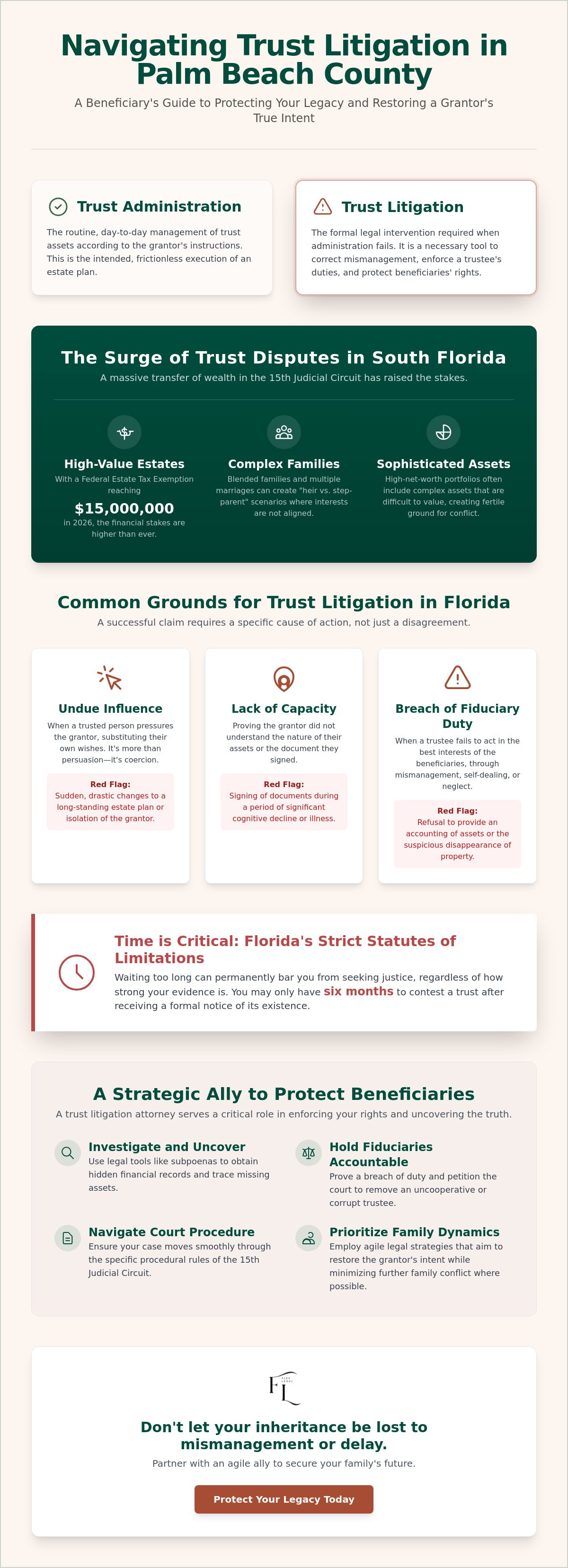
Trust litigation is the formal legal process of resolving disputes that arise during the management or distribution of a trust. While most people hope their estate plans will be executed without friction, the reality is often more complex. Trust litigation acts as a mechanism to enforce the fiduciary duties of a trustee under the Florida Trust Code. It isn't just about family arguments; it's a surgical legal tool used to ensure that a person's life work is handled exactly as they intended. To understand these disputes, one must first understand the fundamental legal structure of a Trust (law), which establishes a tripartite relationship between the grantor, the trustee, and the beneficiaries.
A simple disagreement over a decision doesn't always lead to a courtroom. However, when transparency fails or assets seem to vanish, a formal legal action becomes necessary to protect your rights. In 2026, the demand for a trust litigation attorney Palm Beach County families can rely on has reached new heights. This surge isn't accidental. It's the result of shifting demographics and a massive transfer of wealth within the 15th Judicial Circuit.
The Surge of Trust Disputes in South Florida
Palm Beach County is currently experiencing a historic era of estate transfers. With the federal estate tax exemption reaching $15,000,000 per individual in 2026, the stakes for local families have never been higher. High-net-worth estates often involve sophisticated assets that are difficult to value, creating fertile ground for conflict. Additionally, our local population frequently includes complex family structures, such as blended families and multiple marriages. These dynamics often lead to "heir vs. step-parent" scenarios where interests are naturally unaligned. When these tensions boil over, the 15th Judicial Circuit provides the specific procedural framework required to find a resolution.
Litigation vs. Trust Administration
It's vital to distinguish between routine trust administration and active litigation. Administration is the day-to-day management of the trust, while litigation is the intervention when that management fails. You might need a trust litigation attorney Palm Beach County expert if you notice specific red flags: a trustee who refuses to provide an accounting, sudden changes to trust documents made late in a grantor's life, or the suspicious disappearance of personal property. Early intervention is often the most agile way to handle these issues. By identifying a breach of duty early, we can sometimes secure a settlement or a trustee’s resignation before a full-scale court battle depletes the estate’s resources.
Common Grounds for Trust Litigation in Florida
Florida law doesn't allow for lawsuits based on hurt feelings or general unfairness. To file a successful claim, you must identify a specific cause of action supported by the Florida Statutes on trust proceedings. This legal framework acts as a safeguard for beneficiaries, ensuring that bad actors cannot easily siphon away a family's legacy. Proving a trust is invalid requires meeting a specific evidentiary burden, which often involves medical records, financial trails, or witness testimony. Speed is your greatest ally in these matters. Florida’s statutes of limitations are notoriously strict. For instance, you may only have six months to contest a trust once you receive a formal notice of its existence. Waiting too long can permanently bar you from seeking justice, regardless of how strong your evidence is.
Undue Influence and Lack of Capacity
Many Palm Beach County elder law cases center on the vulnerability of the grantor. Undue influence occurs when someone in a position of trust pressures a grantor into changing their trust terms for the influencer’s benefit. It’s more than just simple persuasion; it's the substitution of the influencer’s mind for the grantor’s. Lack of capacity is a separate but related issue. It involves proving the grantor didn't understand the nature of their assets or the impact of the document they signed at the time of execution. Common red flags include sudden, drastic changes to a long-standing plan or the sudden isolation of the grantor from their long-term friends and family.
Breach of Fiduciary Duty
A trustee has a heavy legal burden. They must act with absolute loyalty, impartiality, and care toward every beneficiary. When a trustee puts their own interests first, they’ve crossed a legal line. A probate lawyer in Palm Beach County often looks for signs of self-dealing, such as a trustee selling trust property to themselves at a discount or commingling trust funds with personal accounts. Failure to provide a mandatory annual accounting is another major red flag. If you aren't receiving clear updates on the trust's value, it's often a sign that transparency has been compromised. Reviewing your current documents with a trust litigation attorney Palm Beach County expert can help identify these breaches before they cause irreparable financial harm.
Trust Reformation and Removal of Trustees
Sometimes, a trust contains technical errors that don't match the grantor’s true intent. In these cases, we petition for trust reformation to correct the language and fix the mistake. Other times, the problem is the person in charge rather than the document itself. If a trustee is unfit, uncooperative, or has breached their duties, the court has the power to remove them. Replacing an ineffective trustee is often the only way to ensure your revocable trust is managed with the integrity it deserves. We focus on these agile solutions to stop the drain on estate assets and restore order to the distribution process.
The Role of a Trust Litigation Attorney: Protecting Beneficiaries
When a beneficiary feels sidelined or ignored, the role of a trust litigation attorney Palm Beach County families hire is to act as both a shield and a sword. It’s about more than just filing paperwork; it’s about taking proactive control of a deteriorating situation. The process starts with an investigative phase where we use subpoenas to uncover hidden financial records that a trustee might be withholding. This phase is critical because it moves the case from suspicion to evidence. While litigation can be intense, our goal is often to negotiate settlements that preserve family relationships while firmly securing your assets. This agile approach focuses on results without unnecessary friction.
Disputes often stem from a lack of transparency, trustees improperly profiting, or simple mismanagement, which are common reasons for trust disputes in South Florida. If the conflict involves a vulnerable beneficiary, such as an adult with a disability, the expertise of a special needs planning attorney becomes vital. They ensure that any recovered funds or restructured trusts don't accidentally disqualify the beneficiary from essential government benefits. We work as a modern team to protect those who cannot protect themselves.
Demanding an Accounting
You have a clear legal right to know exactly what’s happening with the trust’s assets. Under Florida law, a formal trust accounting must include a statement of all receipts and disbursements, a detailed list of assets, and their current market values. If a trustee refuses to provide this information or ignores your requests, we don't just wait for them to change their mind. We use the court's power to compel disclosure. This ensures you aren't left in the dark while your inheritance is being managed behind closed doors.
Asset Recovery and Surcharge Actions
When assets have already been lost due to negligence or intentional theft, we pursue surcharge actions. This is a legal mechanism to force a trustee to pay back money from their own personal funds to compensate the trust for losses. In high-value Palm Beach disputes, we often partner with forensic accountants to trace misappropriated assets that may have been moved through various accounts. This level of planning ensures that every dollar is accounted for and returned to its rightful place. Partnering with a trust litigation attorney Palm Beach County specialist allows you to move from being a passive observer to an active participant in protecting your legacy.
Navigating the Palm Beach County Court Process
Entering the legal system can feel like stepping into a different world, but the process is structured to move toward a logical resolution. In Florida, trust litigation is a non-jury proceeding, meaning a judge, not a jury, will decide the outcome. This often results in a more streamlined and technical environment than what you see in televised trials. Because the 15th Judicial Circuit handles approximately 8,000 probate and trust cases annually, the local courts have developed highly efficient electronic filing and case management procedures. Understanding these local rhythms is vital for an agile legal strategy. While the prospect of a trial is often what brings people to a trust litigation attorney Palm Beach County expert, the reality is that most disputes in West Palm Beach are resolved long before a judge makes a final ruling.
Filing the Initial Petition
The journey begins at the Probate Division of the Palm Beach County Courthouse. To initiate a formal administration or a trust contest, a petition must be filed alongside the required fees, such as the $401.00 filing fee for formal administration. Once filed, we must complete the "service of process," which is the formal notification of all interested parties. This starts a ticking clock for the defense to file a "Responsive Pleading." During this phase, the opposing party will outline their defenses, setting the stage for the legal arguments that will follow. It's a period of high activity where setting the right tone can influence the entire trajectory of the case.
The Discovery and Mediation Phase
Discovery is the investigative heart of the lawsuit. This is where we exchange documents, answer written interrogatories, and conduct depositions to get testimony under oath. It's a transparent process designed to ensure no one is surprised by evidence at a trial. Before a trial date is even considered, Florida courts almost always require the parties to attend mediation. This is a confidential meeting where a neutral third party helps both sides reach a voluntary agreement. For many West Palm Beach families, a mediated settlement is the preferred outcome. It offers a faster resolution, keeps private family matters out of the public record, and allows for creative solutions that a judge might not have the authority to grant. If you are ready to move toward a resolution, you can contact our team today to discuss your specific case needs.
Why Flex Legal is Your Agile Ally in Trust Disputes
Choosing a trust litigation attorney Palm Beach County families can rely on shouldn't feel like a leap into the unknown. Jennifer L. Flexer, Esq. provides a modern perspective that challenges the status quo of traditional, rigid law firms. While legacy institutions often rely on decades-old procedures, we prioritize adaptability. We tailor every legal strategy to your specific family dynamic, acknowledging that a one-size-fits-all approach fails in the face of complex trust disputes. Our focus is on the restoration of the grantor’s true intent, ensuring that the wealth they built is managed exactly as they promised.
Working with a West Palm Beach firm offers a distinct advantage because we understand the specific nuances of the 15th Judicial Circuit’s case management rhythms. We use tech-forward tools to reduce the friction often associated with litigation. This means using streamlined communication and digital platforms that keep you informed without the need for endless phone tags. We move cases forward with purpose. Our goal is to ensure that your time and resources aren't wasted on administrative delays or outdated filing methods. By acting as an agile ally, we help you navigate the high-volume local court system with confidence and speed.
A Reassuring and Solution-Oriented Approach
We've intentionally moved away from the intimidating, overly formal atmosphere that defines many traditional professional services. Instead, we offer a solution-oriented environment where you feel heard and supported. Your emotional well-being is a priority throughout the legal process. We understand that trust disputes are deeply personal and often involve painful family conflict. We act as a dedicated partner in your asset protection journey, providing a steady hand and clear declarations of value at every turn. This partnership-based approach ensures you aren't just another case file; you're a family we're helping to protect.
Get Started with a Modern Legal Partner
The first step toward resolution is a preliminary consultation to assess the merits of your case. With the July 1, 2026, updates to the Florida Trust Code now in effect, it's more important than ever to have a trust litigation attorney Palm Beach County expert who stays ahead of regulatory changes. We provide honest clarity on potential outcomes and realistic timelines, helping you make informed decisions about your inheritance. You deserve to know where your case stands before committing to a long-term battle. If you're ready to protect your legacy with a team that values transparency and modern solutions, Schedule a consultation with Flex Legal, PLLC today.
Secure Your Family's Future Today
Restoring a grantor's true intent requires more than just a deep understanding of the Florida Trust Code; it demands a legal partner who prioritizes your family's unique needs. We've explored how identifying specific legal grounds and navigating the procedural nuances of the local court are essential steps in resolving disputes. By moving from suspicion to evidence through formal accounting and investigative discovery, you can finally gain the transparency you deserve. Choosing a trust litigation attorney Palm Beach County families rely on ensures that your case is handled with both technical precision and modern efficiency.
Flex Legal, PLLC is deeply rooted in the Palm Beach County legal community and led by Jennifer L. Flexer, Esq., a dedicated advocate for West Palm Beach families. We combine sophisticated legal authority with an agile approach that cuts through the friction of traditional litigation. You don't have to face complex family dynamics or uncooperative trustees alone. It's time to move toward a solution that honors your loved one's wishes while securing your financial future. Secure your inheritance and protect your family’s legacy; contact Flex Legal, PLLC for a trust litigation consultation today. We are here to help you turn the page and move forward with clarity.
Frequently Asked Questions
How long does trust litigation typically take in Palm Beach County?
Trust litigation in the 15th Judicial Circuit typically takes between 12 and 24 months to reach a final judgment. This timeline depends heavily on the complexity of the assets and the cooperation of the parties involved during the discovery phase. Many cases resolve much faster if a settlement is reached during court-ordered mediation, which often occurs within the first year.
Can a trustee use trust funds to defend themselves in a lawsuit?
A trustee can generally use trust assets to pay for their legal defense, but they must provide formal notice to all beneficiaries before doing so. If the court later determines that the trustee committed a breach of fiduciary duty, they may be ordered to reimburse the trust from their personal funds. This is why a trust litigation attorney Palm Beach County expert is essential to monitor these expenditures and protect the estate's value.
What is the statute of limitations for contesting a trust in Florida?
You generally have six months to contest a revocable trust after receiving a formal notice of the trust's existence and a copy of the document. If you didn't receive this formal notice, the statute of limitations for claims based on fraud is typically four years under Chapter 95 of the Florida Statutes. Because these deadlines are strict and vary based on the type of claim, acting quickly is vital to preserve your rights.
Is it possible to remove a trustee without going to a full trial?
Yes, it's possible to remove a trustee through a mediated settlement agreement or a court-ordered suspension if there is evidence of immediate risk to the assets. If a trustee's actions are clearly harmful, a judge may appoint a temporary professional fiduciary to manage the trust while the litigation continues. This agile solution stops the drain on assets without waiting for a final trial date.
Do I have to live in Florida to file a trust litigation claim in Palm Beach County?
You don't need to be a Florida resident to file a claim in the Palm Beach County court system. As long as the trust is administered here or the grantor lived in West Palm Beach at the time of their death, our local courts have jurisdiction over the matter. We frequently represent out-of-state beneficiaries who need a trust litigation attorney Palm Beach County specialist to manage their local legal proceedings.
What happens if the trust has a "no-contest" clause?
No-contest clauses are completely unenforceable under Florida law. You can challenge the validity of a trust or the actions of a trustee without the risk of being automatically disinherited by the clause. Florida's legal system prioritizes the right of beneficiaries to ensure a trust is valid and that the trustee is acting in their best interests.
How much does it cost to hire a trust litigation attorney in West Palm Beach?
The cost of hiring an attorney depends on the complexity of the dispute and the time required for investigation and court appearances. Most firms use hourly rates for litigation, though the total investment varies based on whether the case settles early or proceeds to a trial. We focus on clear communication regarding timelines and expectations so you can plan your legal strategy with confidence.
Can a trust be contested after the grantor has passed away?
Yes, the period after a grantor’s death is the most common time for trust contests to begin. This is usually when beneficiaries first gain access to the trust documents and discover potential issues like undue influence or a lack of mental capacity. You have the legal right to challenge the document's validity or the trustee’s administration throughout the distribution process.



Comments