
The Essential Duties of a Successor Trustee in Florida: A 2026 Guide
- Kelly Mata
- Jul 12
- 12 min read

Updated: Jul 20
Stepping into the role of a successor trustee isn't just a family favor; it's a high-stakes legal commitment where a single oversight can put your personal assets at risk. You likely accepted this responsibility out of a sense of duty, but now that you're responsible for the duties of a successor trustee in Florida, the complexity of the law can feel daunting. It's natural to feel a sense of unease about the legal weight on your shoulders, especially when you're also managing family dynamics while grieving a loss.
We understand that you want to do right by your loved one without compromising your own financial security. This guide empowers you to master your legal obligations with clarity and confidence. We provide a straightforward roadmap that helps you fulfill your responsibilities, protect yourself from potential lawsuits, and ensure an efficient distribution of assets. You'll learn exactly what to do in those critical first 30 days, how the Florida Prudent Investor Rule impacts your decisions in 2026, and how to keep beneficiaries informed without the stress of constant conflict.
Table of Contents
When Does a Successor Trustee Step In? Triggering the Transition in Florida
A successor trustee is essentially the backup manager of a trust. Your role remains dormant until a specific event activates your authority. Once a trigger occurs, you transition from a named successor to the active fiduciary responsible for the duties of a successor trustee in Florida. This transition is rarely automatic in a practical sense; it requires specific documentation to prove to banks, title companies, and the court that you're now in charge.
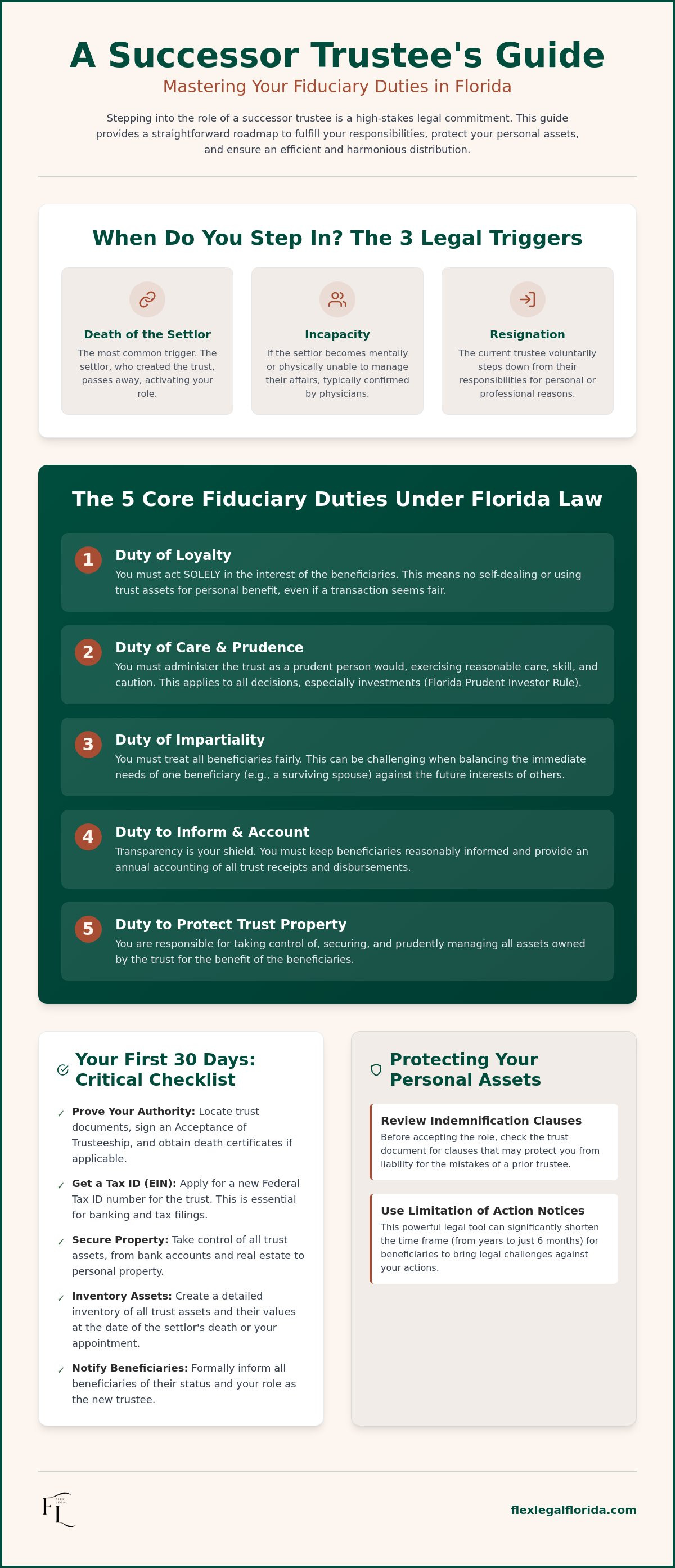
Three primary events typically trigger this change in leadership. The most frequent is the death of the settlor, the person who created the trust. In many cases, the settlor serves as their own trustee until they pass away. The second trigger is incapacity. If the settlor becomes mentally or physically unable to manage their affairs, the trust documents usually require one or two medical certifications from physicians to confirm the shift in power. Finally, a trustee may simply resign. This happens if the current manager decides they no longer want the responsibility for personal or professional reasons.
The Legal Handover: Proving Your Authority
To begin your work, you must first locate the original trust document along with any amendments. These papers are your rulebook. You'll also need to utilize a Certificate of Trust under Florida Statute 736.1017. This modern legal tool allows you to prove your authority to financial institutions without revealing private details like beneficiary names or specific asset values. It's a streamlined way to get things moving. If the transition is due to a death, order at least five to ten certified copies of the death certificate. Banks, insurance companies, and government agencies will each demand their own original copy to recognize your standing.
Accepting or Declining the Role
You aren't forced to serve just because you were named in the document. Before you take action, review the trust for "indemnification" clauses. These provisions can protect you from being held liable for the mistakes of the previous trustee. Once you're ready, you formally accept the position by signing an Acceptance of Trusteeship. This document signals to all parties that you're ready to uphold the duties of a trustee and manage the assets prudently.
If you choose to decline, perhaps because the family dynamics are too volatile or the trust is too complex, you must do so in writing. The role then passes to the next person named in the document. Declining early is often better than starting the process and realizing later that you're in over your head. Taking the time to evaluate the commitment ensures you can fulfill the duties of a successor trustee in Florida with the focus the role requires.
The 5 Core Fiduciary Duties Under Florida Trust Code (Chapter 736)
When you accept the role of successor trustee, you aren't just managing money. You're stepping into a fiduciary role, which is the highest standard of legal obligation. Under the Florida Trust Code (Chapter 736), your primary responsibility is to act solely in the interests of the beneficiaries. This means personal feelings and self-interest must stay at the door. Understanding the duties of a successor trustee in Florida requires a shift in perspective from personal ownership to stewardship.
The Duty of Loyalty is the cornerstone of this role. You cannot use trust assets for your own benefit or engage in self-dealing. Even if a transaction seems fair, if it benefits you personally at the expense of the trust, it's likely a breach. Alongside this is the Duty of Care. Florida Statute 736.0804 requires you to administer the trust as a prudent person would. You don't need to be a financial genius, but you must exercise reasonable care, skill, and caution. Transparency is your best shield. The Duty to Inform and Account means you must keep beneficiaries updated. In Florida, this involves providing an annual accounting of all trust receipts and disbursements to ensure everyone stays on the same page.
Impartiality: Managing Family Dynamics
Trust administration often gets messy when family is involved. The Duty of Impartiality requires you to treat all beneficiaries fairly. This is particularly tough when balancing the needs of a surviving spouse who needs immediate income against children who are remaindermen waiting for their inheritance. If you're both a trustee and a beneficiary, the risk of perceived bias is high. We recommend documenting the logic behind every major decision. Clear records prevent future litigation and keep family tensions from boiling over into a courtroom. If the paperwork feels overwhelming, professional trust administration support can act as a neutral buffer.
Productivity of Assets
You cannot simply let trust funds sit in a zero-interest checking account. You have a duty to make trust property productive. Under Florida Statute 518.11, known as the Prudent Investor Rule, you must manage assets with a strategy that considers the trust's specific purposes and distribution requirements. This requires diversifying investments rather than putting everything into one stock or property. Managing Florida real estate adds another layer of complexity. You must ensure properties are insured, maintained, and, if appropriate, generating rental income until they are sold or distributed. For trust assets located in central Florida, professional management through morganpropertysolutions.com helps keep these properties productive and well-maintained. It's about active management, not just passive holding.
Your First 30 Days: A Successor Trustee Checklist
The first month is the most intense phase of trust administration. It's a period of discovery and organization. While the duties of a successor trustee in Florida officially begin the moment the previous trustee steps down, the practical workload hits its peak in these first thirty days. You aren't just a manager; you're a detective and a protector. Acting quickly ensures you don't miss statutory deadlines that could lead to personal liability later.
Your first administrative priority is securing a new Federal Tax ID (EIN) for the trust. Since the trust is now an independent entity following the settlor's death, it needs its own tax identity for banking and tax filings. You'll also need to send a formal "Notice to Beneficiaries" as required by the Florida Trust Code. Sending this notice within the first 30 days sets a professional tone and keeps everyone informed. This is also the time to assemble your support team. A trust attorney, a CPA, and a financial advisor are essential partners who help you manage the heavy lifting of compliance. The Florida Bar explains revocable trusts as flexible estate planning tools, but they require precise handling to remain effective during this transition.
Inventory and Asset Protection
Start by gathering every relevant document you can find. This includes property deeds, brokerage statements, and current bank balances. Don't forget digital assets; access to email accounts and online portals is crucial for modern administration. Using a secure digital vault like ironcladfamily.com can help you organize and protect these critical documents in one centralized location. Once you identify physical property, take immediate steps to protect it. Change the locks on real estate and update insurance policies to reflect the trust's current status. A Notice of Trust is a legal document filed with the Clerk of the Court in the settlor's county of residence to publicly announce the trust's existence and settle potential creditor claims.
The Paper Trail: Record Keeping for 2026
Open a dedicated trust checking account immediately. Never mix trust funds with your personal money. Every penny that enters or leaves the trust must be tracked with surgical precision. In 2026, many trustees use cloud-based accounting software to simplify this process and provide transparent reports to beneficiaries. Detailed records are your best defense if a beneficiary questions your actions. If you can't account for a specific expense, you might be held personally responsible for it. Clear, digital trails turn a complex job into a manageable one.
Liability and Pitfalls: Protecting Yourself in Palm Beach County
Successfully managing the duties of a successor trustee in Florida requires more than just good intentions; it requires a defensive strategy. Stepping into this role means you're personally on the hook for any "breach of duty." If a beneficiary feels you've mismanaged assets or failed to follow the trust's specific instructions, they can hold you personally liable. One of your strongest defenses is the "Limitation of Action" notice. By sending this formal report to beneficiaries, you can often shorten the window for them to bring a lawsuit from four years down to just six months. It's a vital step for achieving finality and peace of mind.
Commingling funds is perhaps the most common trap for family trustees. Mixing trust money with your personal bank accounts is a major red flag that courts rarely overlook. Even if you intend to pay it back, the act itself is a breach. You also need to stay ahead of the IRS. You're responsible for filing the settlor's final individual 1040 tax return and the trust's fiduciary 1041 returns. If you're feeling overwhelmed by these technical requirements, our trust administration support can handle the heavy lifting and keep you in compliance.
Trustee Compensation in Florida
Florida law allows you to receive "reasonable compensation" for your efforts. What qualifies as reasonable depends on the complexity of the trust and the time you invest. Remember that this compensation is considered taxable income. In Florida, you might face federal income and self-employment taxes that account for 25-35% of your gross pay. Whether you choose to take a fee or waive it to preserve family harmony, you must document every hour spent and every expense incurred. An itemized log is your best protection against accusations of overcharging.
When to Seek Legal Intervention
Sometimes, the duties of a successor trustee in Florida lead you into a stalemate. If you're dealing with hostile beneficiaries who refuse to communicate or ambiguous trust language that's open to interpretation, you may need a "judicial construction." This is a court-ordered clarification of the trust's terms. Modern Florida estate plans also frequently utilize Trust Protectors. These are neutral third parties who can resolve disputes or adjust the trust for tax changes without the need for a lengthy court battle. Recognizing when you need an ally is a sign of a prudent trustee.
Navigating Trust Administration with Flex Legal
Fulfilling the duties of a successor trustee in Florida doesn't have to be a solitary or stressful experience. At Flex Legal, we act as your agile ally, providing the professional support you need to manage complex legal requirements without the typical friction of traditional law firms. We understand that you're likely balancing this role with your own career and family life. Our goal is to streamline the entire process, from that initial first-month checklist through to the final distribution of assets.
One area where local expertise is non-negotiable is the "Homestead Trap." Florida's homestead laws are notoriously complex. If a trust includes the settlor's primary residence, specific rules govern how it can be sold or transferred. Missteps here can lead to title defects or unintended tax consequences. We help you identify these regional nuances early so you can move forward with confidence and avoid personal liability. It's about making the process feel manageable rather than overwhelming.
Fixed-Fee Support for Peace of Mind
We believe in transparency, which is why we offer flat-fee models for our administration services. This provides you with price certainty from day one, allowing you to focus on the task at hand rather than worrying about unpredictable billable hours. We handle the professional document preparation and compliance filings that often feel like the heaviest burden for a trustee. If you're still in the planning stages or need to review the original document, you can learn more about our revocable trust services.
Comprehensive Estate Support in West Palm Beach
Our partnership-based approach is designed specifically for families in West Palm Beach and across Palm Beach County. We stay current with the latest 2026 Florida legislative updates to ensure your administration remains fully compliant. Sometimes, despite the best planning, you might discover that certain assets were never moved into the trust. If a trust isn't fully funded, read our guide on probate lawyer palm beach county to understand how we can help you bridge that gap through probate administration.
Managing the duties of a successor trustee in Florida is a significant commitment, but you don't have to do it alone. Whether you're just starting the 30-day inventory or you're ready to make final distributions, we're here to help. Schedule a consultation today to review your specific trust requirements and discover how a modern legal partner can protect your peace of mind and your family's legacy.
Step Forward with Confidence as a Florida Trustee
Taking on the role of a successor trustee is a significant act of service for your family. By mastering the duties of a successor trustee in Florida, you've already taken the biggest step toward protecting yourself and the assets you manage. Success in this role comes down to two things: acting with total transparency and maintaining a meticulous paper trail. Whether you're navigating the intense first 30 days or preparing for the final distribution, your focus on fiduciary responsibility will shield you from liability and ensure your loved one's legacy is honored exactly as they intended.
You don't have to carry this legal weight alone. Flex Legal provides the modern, flat-fee solutions you need to handle complex administration without the stress of unpredictable billable hours. With dedicated West Palm Beach support and expert guidance from Jennifer L. Flexer, Esq., you have an agile ally ready to handle the heavy lifting of compliance and paperwork. Take the stress out of trust administration; contact Flex Legal today.
You have the tools and the knowledge to lead this transition effectively. Trust your process, stay organized, and know that professional support is always just a conversation away to ensure you reach the finish line with confidence.
Frequently Asked Questions
Can a successor trustee be a beneficiary of the trust in Florida?
Yes, a successor trustee can absolutely be a beneficiary. This is a common arrangement in family estate plans where a child or spouse manages the assets they will eventually inherit. While legal, this dual role requires you to be extra cautious about impartiality. You must document every decision clearly to prove you aren't favoring your own interests over other beneficiaries. This transparency is a core part of the duties of a successor trustee in Florida.
How long does a successor trustee have to distribute assets in Florida?
There isn't a single fixed deadline, but most trust administrations take between six months and one year. The timeline depends on the complexity of the assets and the length of the creditor period. You must wait for the three month statutory window for creditors to close before making final distributions. Acting too quickly can leave you personally liable for unpaid debts, while dragging your feet can lead to beneficiary complaints or legal action.
Does a successor trustee have to show the trust to the beneficiaries?
Yes, you are legally required to provide a complete copy of the trust document to all "qualified beneficiaries" upon request. Florida Statute 736.0813 is very clear about this right to information. Hiding the document or being secretive about its terms is a major red flag that often leads to litigation. Keeping everyone informed from day one is the best way to maintain family harmony and fulfill your legal obligations.
What happens if a successor trustee fails to perform their duties?
If you fail to perform the duties of a successor trustee in Florida, you can be held personally liable for a breach of trust. Beneficiaries have the right to petition the court for your removal and may sue you for any financial losses the trust suffered due to your negligence. In some cases, the court might even order you to pay for the beneficiaries' legal fees out of your own pocket.
Is a successor trustee responsible for the deceased's debts in Florida?
You aren't personally responsible for the debts, but the trust assets are. You must use the trust funds to settle valid claims from creditors before any money goes to the beneficiaries. By filing a Notice of Trust with the Clerk of Court, you start a formal three month clock for creditors to come forward. Once this period ends, you can safely distribute the remaining assets without worrying about old bills resurfacing.
Can a successor trustee sell real estate without all beneficiaries' consent?
Yes, in most cases you can sell real estate without a vote from the beneficiaries. Most modern Florida trust documents grant the trustee a specific "power of sale." As long as you sell the property at a fair market price and the sale is in the best interest of the trust, you have the authority to move forward. It's still a good practice to keep beneficiaries informed about the listing and the final sale price.
How much do successor trustees get paid in Florida?
Successor trustees are entitled to "reasonable compensation" for their time and effort. While the law doesn't set a specific percentage, family members often take between 0% and 1% of the trust's value annually. Professional trustees might charge closer to 1.5%. Whatever amount you choose, you must keep a detailed log of your hours and tasks. This documentation justifies your fee if a beneficiary ever questions the payment in court.
Can a successor trustee be removed by the beneficiaries?
Beneficiaries can remove a trustee, but they usually need a judge's approval to do so. They must prove a serious issue exists, such as a breach of fiduciary duty, a total breakdown in communication, or the mismanagement of assets. Some trust documents include a "trust protector" who can swap trustees more easily. Without that provision, beneficiaries must file a formal petition in probate court to force a change in leadership.


Comments