
Special Needs Trust for Personal Injury Settlements in Florida: A 2026 Guide
- Kelly Mata
- Jun 12
- 12 min read

Winning a personal injury settlement should be a moment of relief, but for many Floridians, it often triggers a new financial crisis. You've fought hard for justice, and the idea of losing your Medicaid or SSI benefits because of a successful legal outcome is both frustrating and unfair. Establishing a special needs trust for personal injury settlement Florida is the most effective way to protect your recovery while maintaining your eligibility for vital state and federal support.
This 2026 guide will show you how to secure your financial future through strategic planning that balances your settlement funds with public benefits. We will clarify the differences between first-party and third-party trusts, explain how the latest ABLE Act age adjustments impact your options, and show you how to find an agile legal partner in West Palm Beach to navigate the probate court system with confidence. This approach ensures your settlement provides the long-term security you deserve without sacrificing the safety net you currently rely on.
Key Takeaways
Understand how to bypass the strict $2,000 asset limit that often disqualifies injury victims from Florida Medicaid and SSI.
Learn why a special needs trust for personal injury settlement Florida is the essential tool for shielding lump-sum recoveries from being counted as disqualifying income.
Compare the advantages of First-Party (d4A) trusts versus Pooled trusts to determine the most cost-effective structure for your specific settlement amount.
Discover how to use your settlement funds for quality of life extras, such as home modifications and specialized vehicles, while the state continues to pay for your medical care.
Navigate the West Palm Beach probate court requirements and the Medicaid payback provision with a streamlined, modern approach to legal planning.
Table of Contents
The Impact of a Personal Injury Settlement on Florida Public Benefits
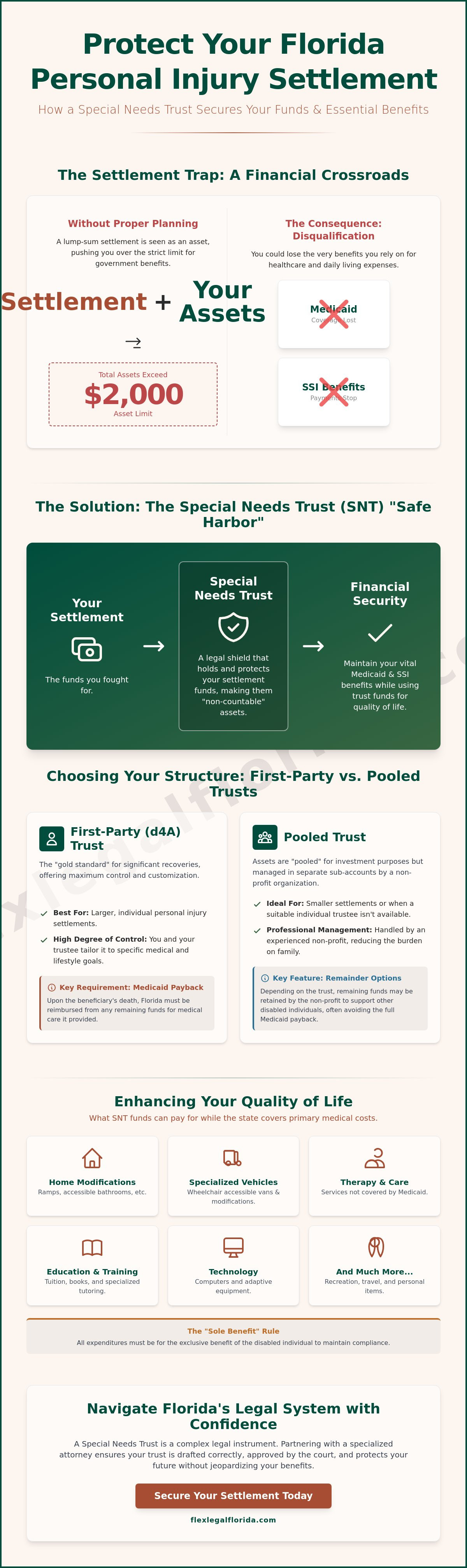
Receiving a settlement check is a hard won victory, but for many Floridians, it can feel like a trap. Most public assistance programs, including Supplemental Security Income (SSI) and Medicaid, rely on a strict "asset test" to determine who stays eligible. If your countable resources exceed $2,000, you risk losing your benefits immediately. Since most litigation recoveries far exceed this amount, the money you won to help you recover could actually leave you without the health insurance you need to survive. This is why a special needs trust for personal injury settlement Florida is a vital tool for anyone navigating a recovery while disabled.
The government views a lump sum settlement as a "windfall." In the month you receive the funds, the money is treated as income. In every subsequent month, any remaining funds are counted as assets. Without a legal "safe harbor," this sudden influx of cash triggers a disqualification notice from the Social Security Administration. A Special Needs Trust (SNT) is the only federally recognized structure that allows you to keep your settlement funds without them counting against these strict limits.
It's important to recognize the different roles your legal team plays during this transition. Your personal injury attorney is an expert at proving liability and maximizing your recovery amount. However, they may not be specialists in the complex web of government benefit preservation. Working with a special needs planning attorney in West Palm Beach ensures that your settlement is structured correctly before the check is even cut, preventing a lapse in care.
SSI vs. Medicaid: What is at Risk?
Losing SSI means losing a monthly cash payment, which in 2026 is capped at $994 for an individual. While that loss is significant, the loss of Florida Medicaid is often catastrophic. Medicaid pays for long term therapies, specialized prescriptions, and home health aides that most private insurance plans don't cover. Some families try a "spend down" strategy, where they quickly buy a car or furniture to get under the $2,000 limit. This isn't an adaptable solution. It leaves the disabled individual with physical items but no liquidity for future medical emergencies or specialized care needs.
The 2026 Florida Landscape for Disabled Litigants
In 2026, the individual asset limit for SSI remains at $2,000, while the Florida Medicaid income cap for long term care has reached $2,982. Florida’s Department of Children and Families (DCF) recognizes properly drafted SNTs as exempt assets, meaning they won't count toward these limits. By using a special needs trust for personal injury settlement Florida, you can ensure your funds are available for "quality of life" expenses while the state continues to cover your primary medical costs.
Choosing Your Structure: First-Party (d4A) vs. Pooled Trusts
Selecting the right vehicle for your recovery funds is one of the most important decisions you'll make after a legal victory. When setting up a special needs trust for personal injury settlement Florida, you generally choose between two primary paths: a private First-Party SNT or a Pooled Trust. Both structures serve as a legal shield, but they offer very different levels of control and adaptability. For many families in West Palm Beach, the goal is to find a balance between professional oversight and the flexibility to meet daily needs.
The First-Party SNT, governed by 42 U.S.C. § 1396p(d)(4)(A), is often considered the gold standard for significant personal injury recoveries. It allows for a high degree of customization, letting you tailor the trust's language to your specific medical and lifestyle goals. Because it's funded with your own settlement money, federal law requires a Medicaid payback provision. This means that when the beneficiary passes away, the state of Florida has the right to be reimbursed from any remaining funds for the cost of medical care provided. Despite this requirement, the autonomy it provides during your lifetime is unmatched.
Every trust must strictly adhere to the "Sole Benefit" rule. This regulation ensures that trust assets are used exclusively for the disabled individual. Whether you are purchasing a specialized vehicle or hiring a private therapist, the expenditure must clearly serve the beneficiary's interests. If you're unsure which path fits your recovery, exploring modern Special Needs Planning options can help clarify your next steps.
The Self-Settled Trust (d4A) Advantage
A First-Party SNT can be established by the individual themselves, a parent, grandparent, legal guardian, or the court. To qualify, the beneficiary must be under age 65 at the time the trust is created and funded. This structure is ideal for those who want a family member or a specific professional trustee to manage the funds. It provides the agility needed to respond to changing health conditions without the rigid oversight of a large, communal organization.
Pooled Trusts: A Communal Alternative
Pooled trusts are managed by non-profit organizations that "pool" the assets of many different individuals for investment purposes while maintaining separate sub-accounts for each person. This is often a practical choice for smaller settlements where the administrative costs of a private trust might be too high. While pooled trusts offer professional management, they typically provide less customization. You are often bound by the non-profit's specific distribution rules, which can feel restrictive if your needs don't fit into their standard categories.
Florida Legal Requirements and the "Payback" Provision
Creating a special needs trust for personal injury settlement Florida involves more than just signing a document. To satisfy the Social Security Administration (SSA) and Florida’s Department of Children and Families, the trust must be irrevocable. This means once the settlement funds are placed inside, you cannot simply dissolve the trust and take the cash back. This permanent structure is what tells the government the money isn't a "countable resource," allowing you to stay eligible for your benefits. Before the trust is even funded, your legal team must handle lien resolution. If Medicaid or Medicare paid for your medical care after your injury, they have a legal right to be reimbursed from your settlement before the remaining balance moves into the trust.
The state's interest doesn't end with the initial lien. Federal law requires that first-party trusts include a very specific provision regarding the remaining funds after the beneficiary's death. This is often the most misunderstood part of the process. However, understanding the rules allows you to plan with clarity and confidence. You aren't just following rules; you're building a compliant foundation that protects your right to care for decades to come.
Navigating the West Palm Beach Probate Court
When a settlement involves a minor or an incapacitated adult, the West Palm Beach probate court usually steps in to oversee the process. The judge may appoint a Guardian ad Litem, an independent person who reviews the trust terms to ensure they're in the beneficiary's best interest. This court oversight adds a layer of protection but also requires precise legal filings. If you're already dealing with a guardianship case, the trust must be carefully coordinated with court records. For those managing complex family estates alongside a settlement, consulting a probate lawyer in Palm Beach County: A 2026 guide to Florida estate administration can provide the necessary context for how these systems overlap.
The Payback Myth vs. Reality
Many families fear that the "payback" provision means the state takes everything. In reality, the state only seeks reimbursement for the specific amount they spent on the beneficiary's medical care. Crucially, the trust can pay for certain final expenses before the state receives a dime. This includes reasonable costs for a funeral, burial, and the final administrative expenses of closing the trust. Under Florida law, the state’s claim for medical assistance is a first-priority debt against the remaining trust assets, but it only applies to funds left over after the beneficiary passes. During your lifetime, the focus remains entirely on What Can SNT Funds Pay For to improve your daily life and independence.
Practical Usage: What Can SNT Funds Pay For?
Establishing a special needs trust for personal injury settlement Florida is only the first step. The true value of the trust lies in how it enhances your daily life. While Medicaid covers essential medical care and SSI provides a basic monthly income, these programs rarely fund the "extras" that lead to true independence. Your trust acts as a specialized financial tool, allowing you to pay for quality of life improvements that government benefits simply don't reach. From advanced medical equipment to recreational travel, the trust ensures your settlement funds work for you without jeopardizing your safety net.
Allowable expenses cover a wide range of needs. You can use trust funds for electronics like computers and specialized software, home modifications to improve accessibility, and even vacations for the beneficiary and a companion. It's also a smart way to pay for professional services. The trust can directly compensate accountants, care managers, and attorneys for their work in maintaining the trust's compliance. If you're ready to see how these tools can be tailored to your specific recovery, it's time to explore your options for Special Needs Planning.
One critical area to watch is the "In-Kind Support and Maintenance" (ISM) rule. As of a significant rule change on September 30, 2024, the Social Security Administration no longer considers food as ISM. This means your trust can pay for groceries and restaurant meals without reducing your monthly SSI payment. However, housing remains a sensitive area. If the trust pays for your rent or mortgage, your SSI payment (which is $994 for an individual in 2026) will likely be reduced. Understanding these nuances is essential for protecting your monthly cash flow.
Lifestyle and Adaptability
In West Palm Beach, trust funds are frequently used to purchase specialized vans or adaptive technology that makes navigating the community easier. Beyond physical tools, the trust can fund "Companion Care." This is a vital service that provides social engagement and assistance with daily activities that goes beyond the basic nursing care Medicaid provides. Vocational training and educational courses are also allowable expenses, giving you the chance to pursue new skills or hobbies funded by your settlement.
The Trustee’s Role in Distribution
The cardinal rule of trust administration is that the trustee should never give cash directly to the beneficiary. Doing so counts as income and will trigger a loss of benefits. Instead, the trustee pays third-party vendors directly or uses a specialized trust credit card. Maintaining a clear paper trail is non-negotiable. Both the SSA and Florida Medicaid have the right to review trust expenditures, so keeping meticulous records of every transaction ensures the trust remains an agile and compliant support system for years to come.
Securing Your Settlement with Flex Legal, PLLC: A Modern West Palm Beach Ally
You've navigated the physical and emotional toll of a personal injury. Now, the final hurdle is protecting the settlement that represents your future. At Flex Legal, PLLC, we view the creation of a special needs trust for personal injury settlement Florida as more than a legal requirement; it's a strategy for long term independence. We move beyond static, one size fits all documents to build a dynamic support system that adapts as your life changes. Our goal is to ensure that your recovery funds empower you rather than complicating your access to essential state and federal support.
Financial certainty is crucial during a stressful recovery. We offer flat fee options for trust creation so you don't have to worry about unpredictable hourly billing while you're focusing on healing. Our team works directly with your personal injury attorney to ensure the transition from litigation to trust funding is seamless. This proactive coordination prevents the "windfall" problem mentioned earlier, keeping your government benefits intact from the moment your case concludes. Local West Palm Beach expertise matters because the probate court system has specific expectations for court approved settlements. We understand the nuances of the local judiciary and the specific reporting requirements that Florida Medicaid and the SSA demand.
The Flex Legal, PLLC Difference
Empathy is the core of our partnership. We act as an agile ally, guiding families through the complexities of Florida probate and trust administration without the intimidating atmosphere of traditional firms. We prioritize clarity and comfort, ensuring you understand every step of the process. If you're looking for a comprehensive look at how to choose the right partner for your long term needs, see our Estate Planning Attorney in West Palm Beach: The 2026 Buying Guide.
Next Steps for Your Personal Injury Recovery
Timing is everything in special needs planning. You must act before the settlement check is cut to avoid triggering an immediate loss of benefits. Scheduling a consultation allows us to review your specific settlement terms and design a special needs trust for personal injury settlement Florida that meets your unique goals. We'll help you evaluate whether a first-party or pooled trust is the most adaptable choice for your situation. Don't let a hard won victory become a financial liability; take the steps today to protect your assets and your future care.
Secure Your Future Independence Today
Protecting your health insurance and monthly income doesn't mean you have to sacrifice the benefits of your legal recovery. By establishing a special needs trust for personal injury settlement Florida, you create a dynamic path forward that balances immediate needs with long term security. You now understand how these trusts shield assets from strict government limits, the specific ways you can use funds to enhance your daily life, and why navigating the West Palm Beach probate system requires a specialized, agile approach.
Jennifer L. Flexer, Esq. and the team at Flex Legal, PLLC specialize in Florida Special Needs Planning, providing the modern solutions you need to move beyond static legal documents. We offer flat-fee pricing for our estate planning packages, ensuring you have total cost certainty during your recovery. Our partnership based approach focuses on clarity and comfort, helping you transition from the stress of litigation to the stability of a well-managed trust.
Protect your benefits and your future; schedule a Special Needs Planning consultation with Flex Legal, PLLC today. You've fought hard for this settlement; let's make sure it provides the lifelong support and peace of mind you deserve.
Frequently Asked Questions
Can I set up a Special Needs Trust after I receive my settlement check?
Ideally, you should establish the trust before you receive any funds. If you have already received the check, you must act quickly to move the assets into a trust within the same calendar month to avoid a lapse in benefits. Once a new month begins, the settlement counts as an asset, which typically triggers an immediate disqualification from Florida Medicaid and SSI.
Does a Special Needs Trust affect my eligibility for Florida Medicaid?
A properly structured special needs trust for personal injury settlement Florida actually protects your eligibility by keeping your countable assets below the $2,000 limit. Because the assets are legally held by the trust rather than the individual, the state does not count them as your personal resources. This allows you to maintain your health coverage while using trust funds for "extra" quality of life expenses.
Who can serve as the trustee of a First-Party SNT in Florida?
You can appoint a family member, a professional trustee, or a trust company to manage the account. While family members offer a personal touch, professional trustees provide valuable expertise in complex government reporting and distribution rules. The right choice often depends on the settlement size and the level of administrative oversight required by the West Palm Beach probate court.
What happens to the money in the trust if the beneficiary passes away?
Upon the beneficiary's death, the state of Florida must be reimbursed for the total amount of Medicaid benefits paid on their behalf. This requirement is known as the "payback provision." Any funds remaining after the state is reimbursed can then be distributed to the heirs or beneficiaries named in the trust document. It is a mandatory requirement for all first-party trusts.
Is there a limit to how much money I can put into a Special Needs Trust?
There is no legal maximum on the amount of settlement funds you can place into a special needs trust for personal injury settlement Florida. Whether your recovery is $50,000 or $5 million, the trust can hold the entire balance to protect your benefits. However, remember that the individual must be under age 65 at the time the trust is established and funded to qualify.
Can an SNT pay for my housing and utilities in West Palm Beach?
Yes, the trust can pay for rent, mortgages, and utilities, but these payments may reduce your monthly SSI check. The SSA considers housing payments as "In-Kind Support and Maintenance," which typically results in a reduction of about one third of your SSI payment. Fortunately, your Medicaid eligibility usually remains unaffected by these specific housing distributions, providing a helpful trade off for many families.
Do I need a lawyer to create an SNT for a personal injury settlement?
Hiring a specialized attorney is essential to ensure the trust complies with the strict, evolving federal and Florida regulations. A single mistake in the trust's language can lead to an immediate loss of benefits and costly legal disputes with the SSA. An agile legal partner helps you navigate the necessary court approvals and coordinates directly with your personal injury litigation team.
How does a d4A trust differ from a Third-Party Special Needs Trust?
A d4A trust is funded with the beneficiary's own money, such as a personal injury settlement, and must include a Medicaid payback provision. In contrast, a third-party trust is funded by someone else, like a parent, and does not require the state to be reimbursed. Both tools protect government benefits, but they are used for different sources of money and have different inheritance rules.


Comments