
Emergency Temporary Guardianship in Florida: A 2026 Legal Guide
- Kelly Mata
- 12 hours ago
- 12 min read

Imagine your aging parent is suddenly hospitalized and unable to communicate, but their bills are mounting and critical medical decisions can't wait for a standard court hearing. When a crisis hits, you don't have weeks to navigate red tape; you need a way to step in immediately. Seeking an emergency temporary guardianship Florida allows you to act as an agile ally for your loved one, securing the legal authority to protect their health and assets before permanent damage occurs.
It's completely natural to feel a sense of urgency and fear when a family member's safety is at risk. You want to do what's right, but the complexity of court procedures can feel like a barrier during an already emotional time. We've designed this guide to replace that confusion with a clear, actionable path forward. You'll learn the exact legal requirements to obtain an appointment within 24 to 72 hours and how to manage the transition once that initial 90-day window begins.
We'll walk through the specifics of Florida Statute 744.3031, the necessary filing fees, and how to present evidence of imminent danger to a judge. By the end of this article, you'll have a streamlined roadmap to gain the control you need to keep your loved one safe and secure.
Table of Contents
What is Emergency Temporary Guardianship (ETG) in Florida?
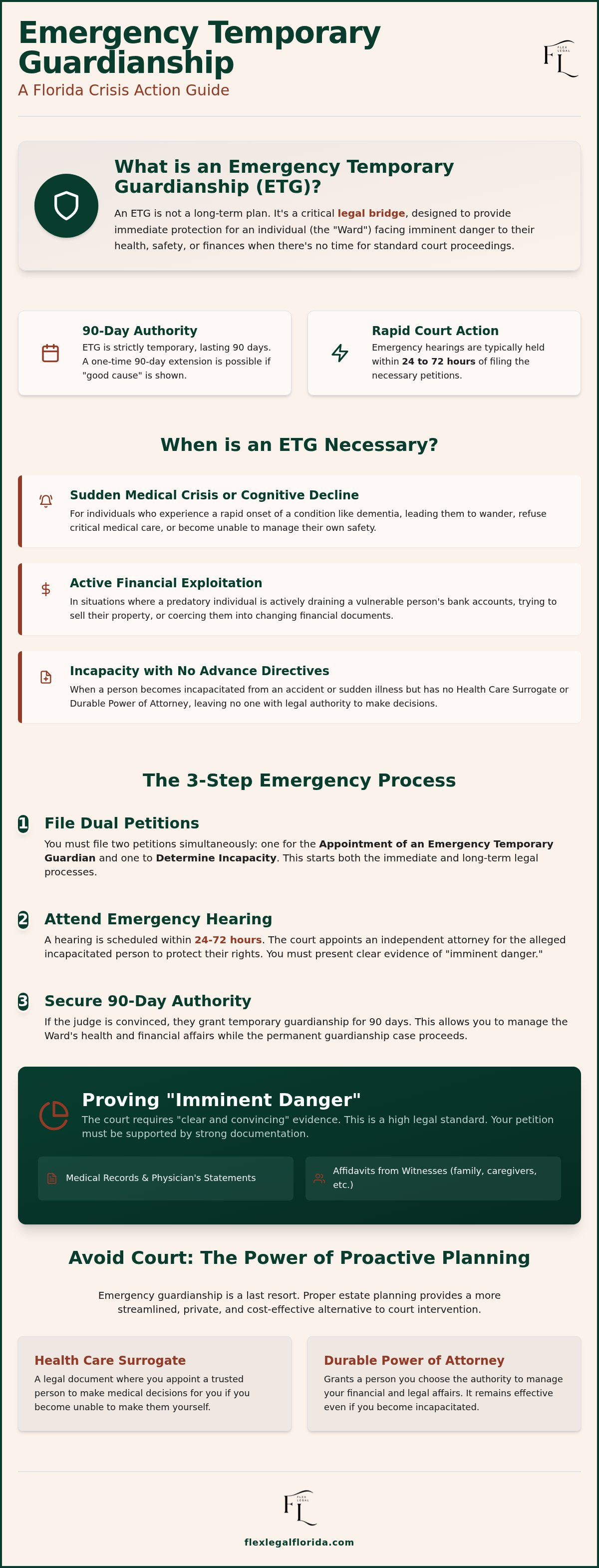
An emergency temporary guardianship Florida isn't a long-term management plan; it's a legal bridge. It exists to protect individuals when time is the enemy and immediate action is the only way to prevent harm. In the eyes of the law, a Legal guardian is typically appointed after a thorough and often lengthy process of evaluation. However, an ETG cuts through the standard timeline to address threats that can't wait for a month-long court calendar.
The legal framework identifies two primary roles in these proceedings. The "Ward" is the individual who is allegedly incapacitated and at risk. The "Petitioner" is the person or entity asking the court for the authority to step in and help. Because an ETG can be granted quickly, sometimes even without the Ward being present at the initial hearing, Florida courts view it as an extraordinary measure. Judges don't grant this power lightly. They require "clear and convincing" evidence that there is an imminent danger to the person's health, safety, or property. This high bar ensures that while protection is available, the individual's civil liberties aren't restricted without a genuine, pressing need.
The 90-Day Rule and Extensions
An ETG is designed to be short-lived. By default, the authority granted by the court lasts for exactly 90 days. It's a placeholder while the court determines if a permanent guardianship is necessary. If the underlying legal case is complex or requires more time for medical evaluations, the court can grant a one-time 90-day extension. You must show "good cause" for this extra time. If a permanent guardian isn't appointed before the ETG or its extension expires, the legal authority simply vanishes. This can leave the Ward vulnerable again, so it's vital to stay ahead of the clock.
When is an ETG Actually Necessary?
Not every family disagreement or health scare requires court intervention. However, specific scenarios demand the speed of an emergency temporary guardianship Florida to prevent a total catastrophe:
Sudden Cognitive Decline: A senior experiencing a rapid onset of dementia who begins wandering or refusing life-saving medical treatment.
Financial Exploitation: A situation where a "new friend" or a predatory relative is actively draining a vulnerable person's bank accounts or attempting to sell their home.
Lack of Advance Planning: A medical crisis where the patient is incapacitated but hasn't signed a Health Care Surrogate or a Durable Power of Attorney, leaving no one with the legal right to speak with doctors or pay hospital bills.
In these moments, the law acts as a shield. It provides a temporary, adaptable solution that keeps the Ward safe while the family works toward a more permanent arrangement.
Filing for an emergency temporary guardianship Florida requires a specific, two-pronged legal strategy. You can't simply ask for temporary control in a vacuum. Instead, you must file a Petition for Appointment of an Emergency Temporary Guardian alongside a Petition to Determine Incapacity. This dual filing ensures the court addresses the immediate crisis while starting the formal process to evaluate the individual's long-term needs. In Palm Beach County, these petitions are typically processed through the Clerk of the Circuit Court & Comptroller at the main courthouse in West Palm Beach.
Once the paperwork is submitted, the court moves with incredible speed. It's common for an emergency hearing to occur within 48 to 72 hours of the initial filing. During this window, the court appoints an independent attorney to represent the alleged incapacitated person. This attorney acts as a safeguard, ensuring the individual's rights are protected even in an urgent situation. If you're managing a crisis, having an agile ally to handle these guardianship proceedings can make the difference between a successful intervention and a rejected petition.
Step 1: Filing the Petitions
Drafting these documents requires precision. The petition must outline the specific facts that justify bypassing the standard notice requirements. You'll need to provide detailed disclosures about your own background, including credit and criminal history, to prove you're qualified to serve. Simultaneous filing is non-negotiable; the court won't grant temporary powers unless there is an active case to determine if a permanent guardian is needed later. Because the court is acting on limited information, any lack of clarity in your filing can lead to delays you simply can't afford.
Step 2: The Emergency Hearing
The hearing itself is often "ex parte," meaning it can happen with very short notice to other parties due to the urgency. This process is strictly governed by Florida Statute 744.3031, which mandates that the petitioner prove imminent danger through clear and convincing evidence. The judge will scrutinize the specific threats to the individual’s welfare or property. If the judge is satisfied, they will issue "Letters of Guardianship." These letters are your primary tool; they are the official court orders that banks, hospitals, and government agencies require before they allow you to take any action on the ward's behalf.
ETG vs. Permanent Guardianship: Key Differences
While the goal of both roles is protection, an emergency temporary guardianship Florida differs significantly from a permanent arrangement in its scope and urgency. Think of an ETG as a tactical intervention. It's designed to stop a specific harm right now. A permanent guardianship, by contrast, is a comprehensive system for long-term care and decision-making. The timeline alone highlights this difference. While a permanent guardian might take months to appoint, an ETG can be established in a matter of days to address a sudden crisis.
The evidentiary standards represent the biggest hurdle. To win an ETG, you must prove "imminent danger" to the ward's welfare or property. This is a higher, more immediate bar than the "incapacity" required for permanent status. Under Florida Statute 744.3031, the court only grants the specific powers needed to resolve the emergency. While a permanent guardian often holds "plenary" or full authority over all aspects of a person's life, a temporary guardian's power is strictly limited to the crisis at hand. You aren't taking over their entire life; you're stepping in to fix a specific, dangerous problem.
Limited Scope of Temporary Power
Judges are cautious about stripping away civil rights without a full trial. Because of this, your temporary authority is usually restricted to specific acts. You might be authorized to freeze a bank account or consent to a specific surgery, but you won't necessarily have the right to sell the ward's home or change their permanent residence. During the 90-day window, you must file a final report detailing every action you took. This transparency ensures the court can verify that you only used your power to address the emergency and nothing more. It keeps the process focused on immediate safety rather than long-term control.
The Transition Process
Every ETG case must eventually move toward a permanent resolution. This transition involves a three-member examining committee. These professionals, usually including a psychiatrist and other medical experts, evaluate the ward to determine their actual level of capacity. This process takes time, which is why the ETG serves as such a critical bridge. If the ward has complex assets or if the situation arises from a death in the family, you may find that probate lawyer Palm Beach County services overlap with your guardianship needs. Efficiently converting temporary letters into permanent authority requires hitting strict deadlines to ensure there's no gap in legal protection for your loved one.
Proving "Imminent Danger" in Florida Courts
To secure an emergency temporary guardianship Florida, you must meet the high legal standard of "clear and convincing evidence." This isn't just a matter of showing that your loved one is struggling or making poor choices. You have to prove that harm is not just possible, but practically inevitable without court intervention. Judges are looking for specific, recent incidents rather than general concerns about aging. If the danger is merely "potential," the court will usually require you to wait for the standard guardianship process to play out over several months.
Petitions are frequently denied when they lack concrete proof of immediacy. A judge won't take your word for it; they need a verifiable paper trail. This is where your role as an advocate becomes critical. You need to gather documentation that speaks louder than a simple testimony. If you're facing a situation where a loved one is rapidly losing their ability to stay safe, it's time to act. You can start by reviewing our services for guardianship proceedings to ensure your evidence meets the court's strict criteria.
Medical and Cognitive Evidence
A statement from the ward's primary physician is often the most persuasive piece of evidence you can provide. Doctors can attest to specific cognitive deficits that prevent the person from understanding the consequences of their actions. Beyond medical notes, you should document specific instances of neglect. This includes missed medications for chronic conditions, significant weight loss from forgetting to eat, or dangerous household incidents like leaving a stove on. Recent hospitalizations are particularly impactful because they provide a neutral, third-party record of a crisis that couldn't be managed at home.
Financial Danger and Exploitation
Financial threats often move faster than medical ones. You should look for "sudden and unusual" transactions, such as large cash withdrawals or new names appearing on bank accounts. These are red flags that a predatory "friend" or a scammer is targeting your loved one. According to Florida Statute 825.103, financial exploitation occurs when a person stands in a position of trust and confidence with an elderly person and knowingly obtains or uses their funds with the intent to deprive them of their property. Presenting bank statements that show a rapid drain of assets can justify an immediate freeze through an ETG to preserve what remains of the ward's estate.
How to Avoid Emergency Guardianship with Proactive Planning
While an emergency temporary guardianship Florida provides a vital safety net, it's essentially a reactive measure for a crisis that might've been avoided. Court intervention is often stressful, public, and expensive. It requires your family to prove incapacity to a judge while navigating strict filing deadlines and background checks. You can bypass this entire ordeal by creating a comprehensive roadmap while you're healthy. Proactive planning isn't just about signing documents; it's about maintaining your autonomy and keeping your private affairs out of a courtroom.
The most effective way to prevent a court-ordered guardianship is through a durable power of attorney. This document grants a trusted person the legal authority to manage your finances and legal matters if you're unable to do so yourself. Without this specific designation, your family has no legal standing to access your bank accounts or pay your mortgage during a medical emergency. In those cases, the court must step in to appoint a guardian, which is exactly the scenario proactive planning is designed to prevent. Flex Legal, PLLC streamlines this incapacity planning process to ensure these protections are in place long before they're needed.
The Essential Incapacity Toolkit
Planning for incapacity requires a multi-layered approach that addresses both your health and your assets. A Designation of Health Care Surrogate allows you to name someone to make medical decisions on your behalf, which is a much faster and less intrusive alternative to a guardianship of the person. To protect your property, a revocable trust offers a private, streamlined way to manage your estate. Your successor trustee can step in immediately without waiting for a judge to issue letters of authority. Finally, a Living Will ensures your medical team understands your end-of-life preferences, removing an immense emotional burden from your family.
Consulting a West Palm Beach Expert
The legal landscape in Palm Beach County is unique. Local court rules and the specific expectations of probate judges can influence how your documents are interpreted during a crisis. Working with a local expert ensures your plan is airtight and compliant with the latest Florida statutes. We focus on modern, adaptable solutions that prioritize your comfort and clarity. Choosing flat-fee estate planning today can save your loved ones from the high costs and emotional toll of an emergency temporary guardianship Florida later. Secure your family’s future with Flex Legal, PLLC estate planning services to turn a potential crisis into a manageable, private transition.
Securing Immediate Protection for Your Loved One
Navigating a sudden family crisis requires more than just legal knowledge; it demands a swift and adaptable strategy. An emergency temporary guardianship Florida serves as a vital 90-day bridge that grants you the authority to freeze assets, authorize medical care, and stop imminent harm. While we've discussed the importance of proactive tools like durable powers of attorney for the long term, some situations simply cannot wait. You need an ally who understands the local nuances of the Palm Beach County court system and can move as quickly as the situation demands.
At Flex Legal, PLLC, we provide modern legal support designed for families in high-stakes environments. Our approach combines local West Palm Beach expertise with compassionate crisis management to ensure your loved one's safety remains the top priority. We focus on clear communication and streamlined procedures to remove the friction from an already emotional process. You don't have to face this uncertainty alone. Protect your loved one today; Schedule a consultation with Flex Legal, PLLC to gain the clarity and legal authority you need. Better days are ahead, and the right legal path is within reach.
Frequently Asked Questions
How long does it take to get an emergency temporary guardianship in Florida?
It typically takes between 24 and 72 hours to obtain an emergency temporary guardianship Florida once the petitions are filed. The court prioritizes these cases when there is evidence of imminent danger to a person's health or property. This rapid timeline allows you to act as an agile ally for a loved one while the standard, longer guardianship process begins in the background.
What is the difference between guardianship and emergency temporary guardianship?
An emergency temporary guardianship is a 90-day bridge designed for immediate crises, whereas permanent guardianship is a long-term solution. The temporary version only grants the specific powers needed to resolve a current emergency, such as freezing a bank account. Permanent guardianship involves a full evaluation of capacity and typically grants broader, ongoing authority over the ward's person and property.
Who can be appointed as an emergency temporary guardian in Florida?
Any qualified adult, including a family member, friend, or professional guardian, can be appointed as an emergency temporary guardian. The court often prioritizes family members who are already familiar with the ward's needs and can step in quickly. However, the proposed guardian must pass a background check and meet Florida's legal requirements for serving in this fiduciary role during the 90-day window.
Can an emergency temporary guardianship be extended beyond 90 days?
Yes, a court can extend an emergency temporary guardianship for an additional 90 days if there is "good cause." This usually happens when the permanent guardianship proceedings are delayed or if the ward's condition requires more time for a thorough medical evaluation. If a permanent guardian isn't appointed by the end of this one-time extension, the temporary legal authority automatically expires.
Do I need a lawyer for emergency temporary guardianship in West Palm Beach?
Yes, Florida law requires any person or entity petitioning for guardianship to be represented by an attorney throughout the proceedings. This is especially critical for emergency filings in West Palm Beach, where the court requires precise documentation and adherence to local probate rules. Having legal representation ensures your petition meets the high evidentiary standards required for immediate judicial approval.
What happens at an ETG hearing in Palm Beach County?
At an ETG hearing, a judge reviews the clear and convincing evidence of imminent danger presented in your petition. These hearings are often "ex parte," meaning they can happen with very short notice to other parties due to the urgency. If the judge agrees that protection is needed, they'll issue Letters of Guardianship that grant you the immediate legal authority to protect the ward.
How much does it cost to file for emergency guardianship in Florida?
The filing fee for a petition to determine incapacity is $231, and the fee for a petition for guardianship of person and property is $400. These are the current court costs as of July 2026. You should also plan for additional costs, such as the fees for the court-appointed attorney and the examining committee, which typically range between $500 and $1,500 per evaluator.
Can an emergency guardianship be contested by the ward or other family members?
Yes, the ward or other family members can contest an emergency temporary guardianship Florida. The ward's court-appointed attorney is specifically tasked with protecting their rights and can argue against the necessity of the appointment. Other family members may also challenge the choice of guardian or the claim that an emergency exists, which may lead to a more formal, contested court hearing.


Comments