
Health Care Surrogate Florida: The 2026 Guide to Protecting Your Medical Decisions
- Kelly Mata
- 11 minutes ago
- 12 min read

What if your family is forced to fight a legal battle in a hospital hallway because you didn't choose who speaks for you? It's a heavy thought, but it's the reality for many who haven't formalized their medical wishes. You likely want the peace of mind that comes with knowing your care is in the right hands. Without a properly designated health care surrogate florida residents often face the risk of court-ordered guardianship or family conflict during an already stressful time.
We understand that thinking about medical emergencies is uncomfortable. However, taking control now is the best way to protect your autonomy and spare your loved ones from making impossible guesses. You deserve legal certainty that your specific medical preferences will be followed, whether that involves life-prolonging procedures or everyday care decisions. This 2026 guide explains exactly how to designate a surrogate, clarifies how this role differs from a living will, and outlines the steps to build a modern, adaptable plan that keeps you in the driver's seat.
Table of Contents
What is a Health Care Surrogate in Florida?
Florida Statutes Chapter 765 provides the legal framework for choosing who manages your medical care when you're unable to do so. A health care surrogate florida designation is a legally binding appointment for medical advocacy that ensures your specific wishes are the final word in any clinical setting. This document is a cornerstone of a modern estate plan because it addresses your physical well-being and bodily autonomy, which are distinct from your financial assets.
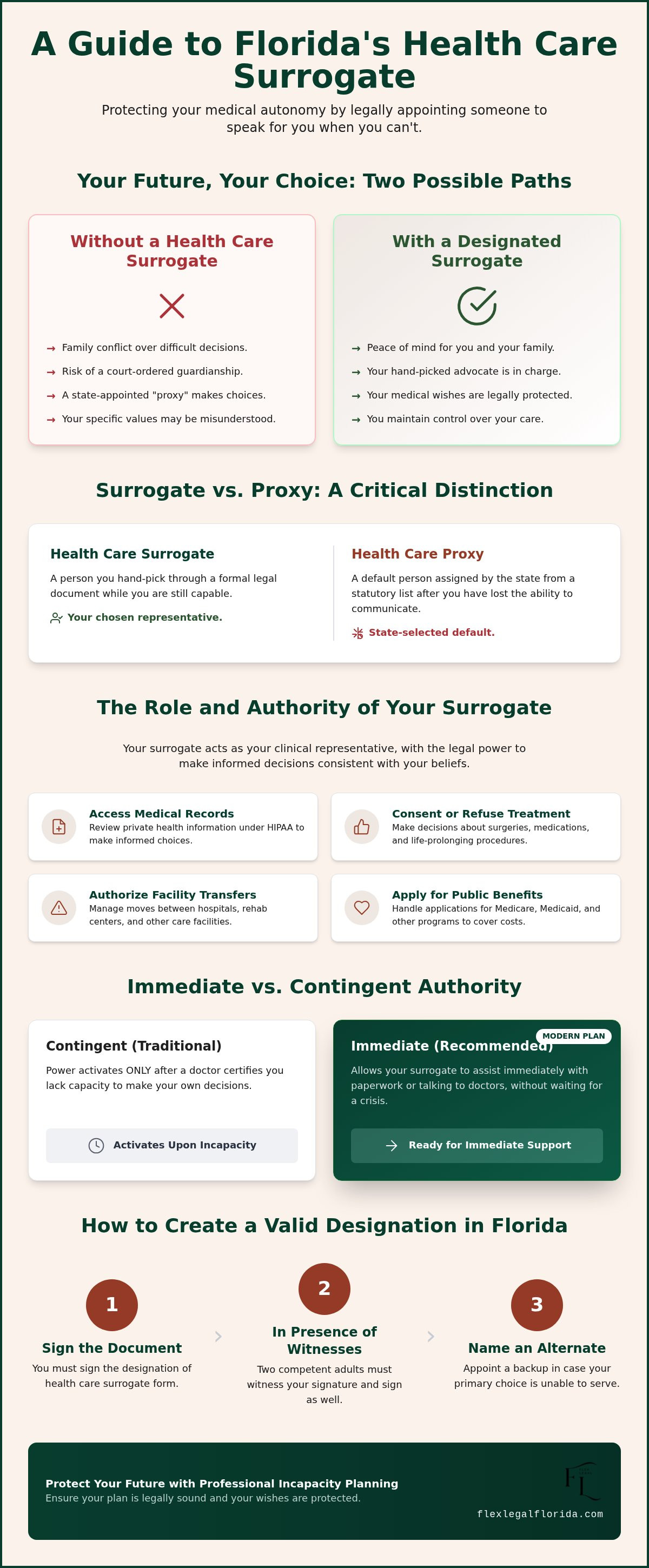
It's vital to distinguish between a surrogate and a "proxy." While both roles involve making decisions for someone else, a surrogate is a person you hand-pick through a formal legal process while you're still capable. A proxy is a default individual assigned by the state from a statutory list only after you've already lost the ability to communicate. Relying on a proxy can lead to family friction or the appointment of someone who doesn't truly understand your values. To better understand the broad legal foundation of this role, you can explore the general concept of What is a Health Care Surrogate as it applies across different jurisdictions.
Florida law treats medical decisions with a unique level of sensitivity. Unlike financial matters, which are often handled by a Durable Power of Attorney, health care decisions require a dedicated document. This ensures that the person managing your bank account isn't automatically the same person making life-or-death surgical choices unless you specifically want them to hold both roles.
The Role and Authority of Your Surrogate
Your surrogate serves as your clinical representative. They have the power to step into your shoes to ensure your care remains consistent with your beliefs. Their authority typically includes:
Accessing and reviewing your private medical records under HIPAA regulations to make informed choices.
Consenting to or refusing specific medical treatments, surgeries, or medications.
Authorizing transfers between different care facilities, such as moving from an acute care hospital to specialized West Palm Beach rehab centers.
Applying for public benefits, such as Medicare or Medicaid, to cover your treatment costs.
Immediate vs. Contingent Authority in 2026
Current Florida law allows for two types of surrogate authority. A "contingent" designation is the traditional route, where your surrogate's power only activates after a doctor formally certifies that you lack the capacity to make decisions. However, modern planning often favors "immediate" authority. This allows your surrogate to assist you right away, even if you're still alert. They can help with complex medical paperwork or talk to specialists on your behalf, providing a layer of support that adapts to your needs without waiting for a medical crisis.
How the Designation of Health Care Surrogate Works in Florida
Formalizing a health care surrogate florida document involves more than just filling out a template; it requires adhering to specific procedural safeguards to ensure your choices are respected in a clinical emergency. The legal backbone of this process is Florida's Health Care Surrogate Law, which dictates how the designation must be signed and managed. If these steps aren't followed precisely, a hospital's legal department might reject your document, leaving your care in the hands of a court-appointed stranger.
Your choice of surrogate is flexible, but there are limits. Any competent adult can serve, but Florida law generally prevents your health care provider from being your surrogate unless they're also a relative. It's also vital to name an "Alternate Surrogate." Life is unpredictable, and if your primary choice is unreachable or unable to act during a crisis, having a secondary advocate prevents your plan from failing. Without this backup, you fall into the default "Health Care Proxy" system, where the state follows a rigid hierarchy to pick a decision-maker for you, regardless of your personal relationship with them.
Modern planning focuses on making these documents as accessible as possible. If you're looking for a streamlined way to get these documents in place, working with an agile ally at flexlegalflorida.com can ensure your paperwork is both legally sound and easy to manage.
Execution Requirements: Witnesses and Notaries
To make your designation valid, you must sign it in the presence of two adult witnesses. The law is specific here: at least one of these witnesses cannot be your spouse or a blood relative. Additionally, your designated surrogate cannot serve as a witness. While Florida law doesn't strictly require a notary for a medical surrogate form to be valid, many modern practitioners recommend it. A notarized document carries more weight when presented to out-of-state facilities or skeptical medical boards. For those who value speed, Florida's 2026 standards continue to support Remote Online Notarization (RON), allowing you to finalize your documents digitally from the comfort of your home.
The HIPAA Release Component
A surrogate's authority is hollow if they can't see the data behind the decisions. Your document must include a built-in HIPAA waiver. This federal privacy law often prevents doctors from sharing sensitive details with anyone but the patient. Without a clear waiver, your surrogate might be barred from reviewing test results or treatment plans at major Florida health systems. A robust designation ensures that your advocate has immediate access to your medical records, allowing them to collaborate effectively with your surgical or rehabilitative teams without bureaucratic delays.
Health Care Surrogate vs. Living Will vs. Power of Attorney
Many people assume that a single legal form covers every aspect of incapacity. In reality, a robust plan relies on a trifecta of documents that handle different crises. While a Living Will provides the "what" by outlining your specific end-of-life instructions, your health care surrogate florida designation provides the "who" by naming a trusted person to interpret those instructions. However, medical advocacy is only half the battle. You also need a Durable Power of Attorney to handle your financial life, such as paying your mortgage or managing insurance claims, while you're recovering.
Failing to coordinate these three tools often leads to a legal vacuum. If you become incapacitated without this clear structure, your family might end up in Palm Beach County probate court seeking an emergency guardianship. This process is expensive, public, and emotionally draining. By aligning your medical and financial directives, you ensure that your representative has the authority to act across all areas of your life without court intervention. This proactive approach acts as a shield, keeping your private matters out of the hands of judges and state-appointed strangers.
Why a Living Will Alone is Often Insufficient
A Living Will is a powerful document, but it has a very narrow scope. Under Florida law, it only activates when you're in a terminal condition, an end-stage condition, or a persistent vegetative state. It doesn't help if you're in a temporary coma following a car accident or if you're experiencing the middle stages of dementia. In these non-terminal situations, your surrogate is the one who makes day-to-day medical choices. For a truly seamless transition of power, many residents choose to integrate these directives into a revocable trust. This ensures your medical advocates and financial trustees work from the same playbook, providing a unified response to any health crisis.
Financial vs. Medical Authority
It's a common misconception that a medical surrogate can pay hospital bills or access your bank accounts to fund your care. They can't. A surrogate's authority is strictly limited to clinical and personal health decisions. To keep your household running and your medical providers paid, you must designate an agent through a separate legal document. Banks and hospitals in Florida generally prefer these roles to remain distinct to avoid confusion and liability. While you can name the same person for both roles, the legal authority must come from the correct source. You can dive deeper into the financial side of this equation in our guide to the Durable Power of Attorney in West Palm Beach. Having both documents ready ensures that when a crisis hits, your surrogate can focus on your health while your financial agent handles the logistics.
How to Choose Your Florida Health Care Surrogate
Selecting the right individual for your health care surrogate florida designation is perhaps the most critical part of the planning process. This isn't an honorary title or a way to show favoritism among your children. It's a job description. You need someone with the emotional strength to witness you in a vulnerable state and the decisiveness to make hard choices under pressure. They must be willing to advocate for your wishes, even if the medical team or other family members disagree with your preferences.
Logistics matter, but they aren't the only factor. Your surrogate doesn't necessarily have to live in Florida, though they should be easily reachable by phone or video call at any hour. In 2026, medical communication is more agile than ever, but having someone who can physically travel to a hospital in West Palm Beach if a situation escalates is a distinct advantage. One of the biggest mistakes is naming "Co-Surrogates" to avoid hurting someone's feelings. While it sounds fair to name two people, it often leads to medical stalemates. If they disagree on a treatment plan, the hospital may be forced to wait for a court order. It's much safer to name one primary advocate and one alternate.
If you're ready to formalize these choices with an expert who understands the local landscape, contact Flex Legal, PLLC today to discuss your custom incapacity documents.
Common Mistakes in Choosing a Surrogate
Many people choose a surrogate out of a sense of obligation. You might feel you must name your spouse or your oldest child, even if they aren't the best fit for a high-stress crisis. If your spouse is your primary surrogate and you're both involved in the same accident, your plan fails unless you've named an alternate. Additionally, keep your documents current. A Florida divorce generally revokes your ex-spouse's authority by law, but relying on a statute alone is risky. Updating your designation ensures there's no confusion at the hospital bedside during a major transition in your personal life.
Special Considerations for Special Needs Families
For families with adult children who have disabilities, the surrogate role is a vital safety net. As children age out of the pediatric system, parents no longer have automatic authority to make medical decisions. This is where a surrogate designation overlaps with special needs planning in West Palm Beach. By establishing these documents early, you protect vulnerable family members from the rigid and intrusive nature of court-ordered guardianship. This ensures their medical advocacy remains a private family matter rather than a public legal proceeding.
Protect Your Future with a West Palm Beach Estate Planning Expert
Relying on a generic, downloadable form for your health care surrogate florida designation is a gamble with your medical autonomy. These templates often lack the precise legal language required to satisfy the legal departments of major Florida health systems. A single missing initial or an improperly qualified witness can render the entire document void at the exact moment you need it most. When every second counts in an emergency room, you need the confidence that your advocate has ironclad authority to speak for you.
Flex Legal, PLLC approaches incapacity planning differently. We act as your agile ally, moving beyond static rules to build a dynamic support system tailored to your life. Our flat-fee packages provide price certainty, so you know exactly what to expect without the stress of unexpected hourly billing. We ensure your documents are not only statutorily compliant but also practically accessible, giving you a clear path forward that protects your family from the confusion of a medical crisis.
The Flex Legal Advantage: Modern, Agile Ally
Professional drafting ensures your documents meet the rigorous 2026 standards of Palm Beach County. Jennifer L. Flexer, Esq. specializes in creating incapacity documents that work in harmony with your entire portfolio. By coordinating your medical directives with a probate lawyer, we minimize the risk of future litigation and family disputes. Our personalized approach treats you as a partner in the planning process, not just another case number. We focus on adaptability, ensuring your plan remains effective as your health needs and family dynamics evolve.
Next Steps: Secure Your Health Care Surrogate Today
Taking the first step is simpler than you might think. When you visit our West Palm Beach office for your initial consultation, bring a list of your preferred advocates and any specific medical instructions you want to formalize. We'll guide you through the "immediate authority" options and help you choose the right alternates to prevent document failure. Our flat-fee model means you can focus on making the best decisions for your future without worrying about the clock. Schedule your consultation with Flex Legal today to secure your medical legacy and give your family the peace of mind they deserve.
Take Control of Your Medical Future
Protecting your medical autonomy is about more than just a piece of paper. It's about ensuring your voice is heard when you're most vulnerable. By formalizing a health care surrogate florida designation, you remove the burden of guesswork from your family. You also avoid the intrusive oversight of court-ordered guardianship. You've seen how this role works alongside your Living Will and Power of Attorney to create a complete shield for your well-being and personal dignity.
Modern estate planning should be transparent and accessible. Flex Legal, PLLC provides the professional authority you need with the modern convenience you want. With expert guidance from Jennifer L. Flexer, Esq. and flat-fee pricing for all incapacity documents, you can build a plan that adapts to your life without financial surprises. We're proud to serve as an agile ally for Palm Beach County families looking for streamlined, effective legal support that prioritizes clarity and comfort.
Secure your medical future with a West Palm Beach estate planning expert at Flex Legal today. Your future self and your loved ones will thank you for the clarity and peace of mind you provide now.
Frequently Asked Questions
Does a Health Care Surrogate in Florida need to be notarized?
No, Florida law doesn't strictly require a notary for a health care surrogate florida document to be legally valid. You must sign the designation in the presence of two adult witnesses, and at least one cannot be a spouse or blood relative. While not a statutory mandate, notarization is often recommended for practical reasons. It provides an extra layer of certainty that can help your surrogate avoid bureaucratic hurdles when dealing with out-of-state hospitals or skeptical insurance providers.
Can I name more than one person to be my health care surrogate?
You can name co-surrogates, but it's usually not a good idea. Naming two people with equal authority can lead to a medical stalemate if they disagree on your treatment. This often forces the hospital to wait for a court order, which wastes precious time. A more agile approach is to name one primary surrogate and a clear alternate. This ensures a streamlined decision-making process while providing a backup if your first choice is unavailable.
What is the difference between a Health Care Surrogate and a Power of Attorney?
A Health Care Surrogate handles medical decisions, while a Durable Power of Attorney manages your financial and legal affairs. These are two separate authorities that cover different aspects of your life. Your surrogate talks to doctors and reviews medical records. Your financial agent pays your mortgage and manages your bank accounts. Most comprehensive plans include both to ensure all your needs are met during a period of incapacity without needing a court-ordered guardian.
How do I change or revoke my Health Care Surrogate in Florida?
You can change or revoke your designation at any time as long as you're competent. The most effective way is to sign a new health care surrogate florida document, which automatically replaces any previous versions. You can also revoke it by providing a written notice to your surrogate and your health care providers. It's vital to destroy old copies and ensure your current doctor has the most recent version on file to prevent conflicting instructions during a crisis.
Does my Florida Health Care Surrogate work in other states?
Most states recognize a validly executed Florida document under reciprocity laws. This means if your designation followed Florida's legal requirements when you signed it, other states will generally honor it. However, if you spend a significant amount of time in another state, you should have a local attorney review your plan. This ensures your documents align with specific regional regulations and will be accepted by local hospital legal departments without any unnecessary friction or delay.
What happens if I don't have a Health Care Surrogate and I become incapacitated?
If you don't have a designated surrogate, Florida's Health Care Proxy statute takes over. The law provides a specific hierarchy of people, starting with a court-appointed guardian, followed by a spouse, adult children, and parents. This default system doesn't account for your personal relationships or preferences. It can lead to family arguments or the appointment of a relative who doesn't understand your values, making a proactive, personalized plan much more reliable for your care.
Can my doctor serve as my health care surrogate?
Generally, your treating physician cannot serve as your health care surrogate. Florida law prevents employees or owners of a health care facility where you're receiving care from acting as your advocate unless they're also a relative. This rule exists to prevent conflicts of interest between your medical treatment and your financial or personal wishes. It's always best to choose a trusted friend or family member who is independent of your medical team and can focus solely on your advocacy.
Is a Florida Health Care Surrogate the same as a Living Will?
No, they serve different purposes. A Living Will is a document that lists your specific instructions for end-of-life care, such as whether you want a feeding tube. A Health Care Surrogate is the person you appoint to make a broad range of medical decisions when you can't. Think of the Living Will as the "what" and the Surrogate as the "who." Using both ensures your advocate has a clear roadmap to follow during any type of medical crisis.


Comments