
Special Needs Trust Administration Florida: A 2026 Legal Guide
- Kelly Mata
- Jul 30
- 12 min read

What if a single distribution for something as simple as a new laptop or a specialized therapy session accidentally triggered a loss of your loved one's Medicaid eligibility? For many families, special needs trust administration Florida feels like walking a tightrope where the rules are constantly shifting. You want to provide the best possible life for your family member, but the fear of a paperwork error or a misunderstood 2025 legal reform can be paralyzing. It is a heavy burden to carry, especially when you are already focused on the daily care and well-being of someone you love.
You deserve an agile ally that turns this complex legal maze into a clear, manageable path. This guide provides the tools you need to master Florida's latest trust requirements and protect your loved one's financial security for the long term. We will explore the nuances of the 2026 Medicaid income caps, the expanded ABLE account eligibility, and the specific reporting frameworks that keep you in total compliance. You'll gain the clarity and confidence necessary to act as an effective advocate for your family's future without the constant stress of legal uncertainty.
Table of Contents
The High Stakes of Special Needs Trust Administration in Florida
At its core, special needs trust administration Florida involves the ongoing management and distribution of assets for an individual living with a disability. It's much more than just holding money in a bank account. It's a precise legal process designed to supplement, not replace, government assistance. To understand the foundation, one must look at What is a Special Needs Trust and how it functions as a protective shield. In Florida, the stakes are exceptionally high because the rules governing Medicaid and Supplemental Security Income (SSI) are rigid. One small misstep can lead to an immediate loss of benefits, leaving a vulnerable individual without essential healthcare or housing support.
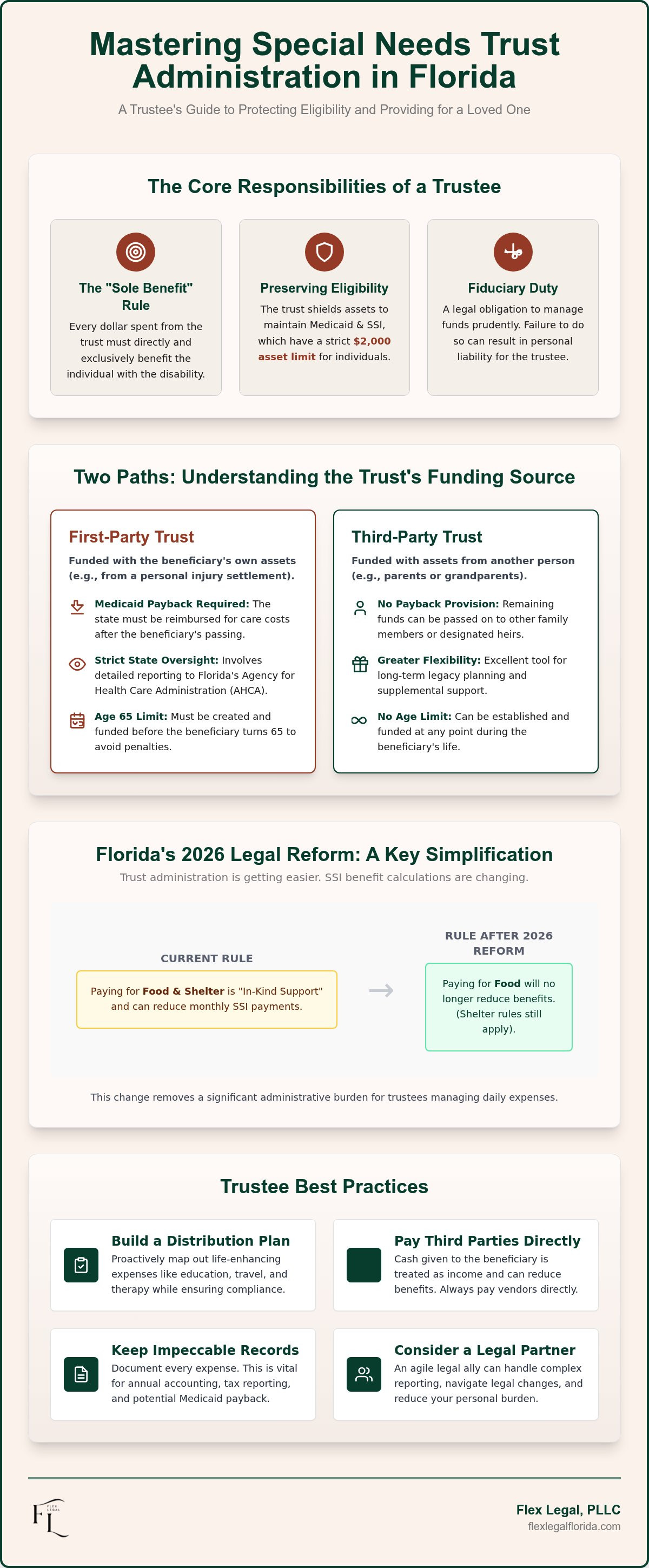
The "Sole Benefit" rule is the cornerstone of every decision a trustee makes. This rule mandates that every dollar spent must directly benefit the person with the disability. You can't use trust funds to buy a gift for a sibling or pay for a family vacation unless it's clearly documented how that expense serves the beneficiary's specific needs. Florida is particularly strict regarding Medicaid payback requirements for first-party trusts. Upon the beneficiary's death, the state must be reimbursed for the cost of medical care provided. This makes the administrative trail of every penny vital for future legal compliance.
Preserving SSI and Medicaid Eligibility
To qualify for means-tested programs in Florida, an individual generally cannot have more than $2,000 in countable assets. The trust acts as a firewall, keeping assets invisible to the government. However, if a trustee makes a distribution directly to the beneficiary in cash, the Social Security Administration treats it as unearned income. Even paying for certain utilities can trigger In-Kind Support and Maintenance (ISM) rules, which might reduce monthly SSI payments by up to one-third. Effective administration requires a deep understanding of which expenses are safe and which will trigger a penalty.
The Trustee's Fiduciary Duty
Under the Florida Trust Code, a trustee has a legal obligation to act in the highest good faith. This fiduciary duty isn't a suggestion; it's a binding requirement. Trustees must follow the "prudent investor" rule, ensuring trust assets are managed with care and diversity to prevent loss. If a trustee mismanages funds or fails to keep accurate records, they can be held personally liable for the loss of value or benefits. This is why many West Palm Beach families seek professional support to handle the complex annual accounting and reporting that the law demands. It’s about more than just numbers. It’s about maintaining a lifeline for your loved one.
First-Party vs. Third-Party Special Needs Trust Management
The rules for special needs trust administration Florida change significantly based on whose money is being managed. It is a common misconception that all special needs trusts are identical. In reality, the source of the funds dictates your reporting obligations and what happens to the money when the trust eventually closes. Most trustees find themselves managing either a first-party trust, funded with the beneficiary's own assets, or a third-party trust, funded by family members. Both are governed by the Florida Trust Code (Chapter 736), but their administrative paths diverge quickly.
First-party trusts, often called (d)(4)(a) trusts, typically hold money from personal injury settlements or direct inheritances. Because this money technically belongs to the beneficiary, the law views it as a "payback" vehicle. Third-party trusts are different. They are established by parents or grandparents using their own assets to provide a lifetime of support. These are often more flexible and serve as a cornerstone of a family's long term legacy planning. Understanding which one you are managing is the first step toward avoiding costly compliance errors.
Administering First-Party 'Payback' Trusts
When you manage a first-party trust, you are under the watchful eye of Florida's Agency for Health Care Administration (AHCA). You must provide detailed documentation to satisfy Medicaid lien requirements and ensure the state is aware of the trust's status. There is also a strict age-65 limit for funding these trusts. If assets aren't moved into the trust before the beneficiary turns 65, you may face severe eligibility penalties. The most critical administrative task here is preparing for the eventual "payback." When the beneficiary passes away, the remaining funds must first reimburse the state for any medical assistance provided before other heirs can receive a dime.
Managing Third-Party SNTs for Family Members
Third-party trusts offer much more breathing room for the trustee. There is no Medicaid payback requirement, meaning any funds left over can stay within the family or go to a designated charity. Your primary focus here is succession planning and ensuring the trust's longevity. It's often helpful to work with a Special Needs Planning Attorney in West Palm Beach to train successor trustees on these specific duties. Since these trusts don't have the same AHCA reporting burdens as first-party versions, you can focus more on the beneficiary’s quality of life and long term financial growth. If you feel overwhelmed by these distinctions, our team can provide the hourly trust administration support you need to stay on track.
Navigating Florida’s 2026 Trust Law Landscape (SB 262)
Florida's legal environment for trusts underwent a significant shift with the implementation of SB 262. This reform, which gained full momentum through 2025 and into 2026, directly impacts how special needs trust administration Florida is handled by families and professionals alike. It represents a move toward greater transparency and flexibility. For trustees, this means the old "set it and forget it" mentality is no longer viable. You must ensure your trust documents and daily practices align with these modernized Florida Statutes to avoid unintended tax consequences or benefit interruptions.
Flex Legal acts as an agile ally for West Palm Beach families navigating these regulatory shifts. We help trustees review existing documents to ensure they aren't using outdated language that could trigger a red flag with state agencies. Since these laws are designed to be more responsive to the needs of the beneficiary, they offer new opportunities to improve a loved one's quality of life. Adapting to these changes doesn't have to be a source of stress. With the right framework, these reforms actually make your job as a trustee more intuitive.
The 2025/2026 ISM Rule Change: Paying for Food
One of the most impactful changes in 2026 is the Social Security Administration's updated policy on In-Kind Support and Maintenance (ISM). Historically, if a trustee paid for a beneficiary's groceries or restaurant meals, it resulted in a mandatory reduction of their SSI check. That is no longer the case. Trustees can now use trust funds to pay for food without any reduction in government benefits. This simplifies the daily reality of trust administration. You can now fund a meal out or a full pantry without fear of a benefit penalty, providing a level of dignity and ease that was previously tied up in red tape.
SB 262 and Trustee Accountability
While SB 262 offers more flexibility, it also demands higher levels of accountability. Florida trustees now face enhanced disclosure requirements, meaning you must keep beneficiaries and relevant state agencies better informed about the trust's status. If you are managing an older, non-compliant SNT, the new law makes it easier to use "decanting" to fix structural issues. Decanting is the process of moving assets from an obsolete trust to a modern one to improve terms or compliance. This tool allows special needs trust administration Florida to remain dynamic, ensuring that a trust created ten years ago can still function effectively in today's legal climate.
Best Practices for Trustees: Allowable Expenses and Record-Keeping
Moving from the legal theory of a trust document to the daily reality of special needs trust administration Florida requires a shift in mindset. You're no longer just a family member or a friend; you're a financial gatekeeper. The most successful trustees don't wait for a crisis to decide how to spend money. Instead, they create a formal "Distribution Plan" that aligns trust spending with the beneficiary's specific lifestyle and medical needs. This proactive approach ensures funds last for the beneficiary's lifetime while providing a clear roadmap for any state agencies that might audit the trust's activities.
Commonly allowed expenses include life-enhancing items that government benefits don't cover. Think of things like specialized therapy, advanced education, travel experiences, and modern electronics. These items improve quality of life without jeopardizing eligibility. However, you must follow the "Golden Rule" of trust management: never give cash or cash equivalents directly to the beneficiary. This includes gift cards, which the Social Security Administration often views as "income." If you provide cash, you're essentially undoing the protective firewall the trust was designed to create.
Handling housing is more nuanced. While some advisors suggest avoiding rent or mortgage payments entirely, it's often a necessary expense. If the trust pays for housing, it may trigger a reduction in SSI payments, but the benefit of a stable, high-quality home often outweighs the small loss in monthly cash assistance. Balancing these trade-offs is a core part of effective special needs trust administration Florida. You must weigh the utility of the expense against the potential impact on means-tested programs.
The SNT Distribution Checklist
Sole Benefit: Verify that the expense is exclusively for the beneficiary's needs and not for the convenience of others.
Direct Payment: Always pay vendors, landlords, or service providers directly from the trust account. You should never reimburse the beneficiary directly.
Digital Records: Keep clear, digital copies of every receipt and invoice for at least seven years to satisfy state and federal auditors.
Annual Accounting and Reporting in Palm Beach County
The Palm Beach County Probate Court maintains specific expectations for annual accounting. You'll need to provide a detailed ledger of all income and disbursements. This process often requires coordination with tax professionals to handle 1041 fiduciary tax returns and K-1 distributions. If you find the local court nuances or tax filings overwhelming, consulting a Probate Lawyer in Palm Beach County: A 2026 Guide to Florida Estate Administration can ensure your reporting is flawless. Our team at Flex Legal provides the hourly support you need to maintain compliance without the stress of going it alone.
Professional Support for Florida SNT Administration
Managing a trust isn't a hobby. It's a legal obligation that requires constant vigilance and a deep understanding of ever-changing regulations. Many family members start with the best intentions but find the reporting and compliance requirements of special needs trust administration Florida overwhelming as the years pass. You don't necessarily need a distant, rigid corporate trustee to take over every aspect of the trust. Instead, you can partner with an expert who acts as a coach and legal safeguard, ensuring you remain in control while staying fully compliant with state and federal laws.
Flex Legal provides a modern alternative to traditional professional services. We offer flat-fee predictability for the initial planning phase and hourly trust administration support for your ongoing needs. This hybrid approach allows West Palm Beach families to access high-level expertise without the intimidating atmosphere or opaque billing cycles of older firms. We act as an agile ally, helping you handle the complex annual accounting and distribution decisions that preserve your loved one's quality of life.
Coordination is the key to a successful long-term plan. It's vital to ensure that your broader estate strategy, including your revocable trust, works in perfect harmony with special needs provisions. If these documents aren't aligned, an accidental inheritance could bypass the protective shell of the SNT and immediately disqualify the beneficiary from essential Medicaid or SSI benefits. We help you bridge these gaps, creating a unified financial fortress for your family.
Why West Palm Beach Families Choose Flex Legal
Attorney Jennifer L. Flexer provides the personalized attention that complex special needs planning demands. She focuses on modern, adaptable legal strategies that account for local nuances, such as the specific filing expectations of the Palm Beach County Probate Court. One critical area we address is the "Florida Homestead Trap." Improperly titling a home within a trust can inadvertently jeopardize property tax exemptions or creditor protections. Our team offers empathetic, professional support to help you avoid these common pitfalls while navigating the emotional and legal complexities of disability law.
Getting Started with Trust Administration Support
The first step toward peace of mind is an initial trust review. We identify existing compliance gaps and look for outdated language that might trigger issues under the 2026 legal standards. From there, we help you set up a streamlined distribution and record-keeping system. This takes the guesswork out of daily spending and makes annual reporting a simple, stress-free process. Schedule a consultation with Flex Legal today to secure your loved one's future.
Securing Your Loved One's Legacy in a Changing Legal Landscape
Mastering special needs trust administration Florida means balancing meticulous legal compliance with a deep commitment to your family's well-being. We've explored how the 2026 legal reforms, particularly the changes to food expense rules and enhanced trustee accountability, offer new opportunities to improve a beneficiary's quality of life. By maintaining clear records and adhering to the "sole benefit" rule, you act as the ultimate safeguard for your loved one's essential government benefits.
You don't have to carry the weight of these complex regulations alone. Flex Legal provides the West Palm Beach local expertise and modern, adaptable legal strategies needed to navigate this journey with confidence. Our comprehensive special needs planning focus ensures that every distribution and report serves your long-term goals. We prioritize clarity and comfort, acting as an agile ally so you can focus on care rather than paperwork.
Protect your family's future with expert special needs trust administration at Flex Legal. Our partnership-based approach is designed to provide the security and peace of mind your family deserves. You have the power to create a stable future, and we're ready to help you protect it.
Frequently Asked Questions
Can a Florida special needs trust pay for the beneficiary's rent?
Yes, a special needs trust can pay for rent, but you should understand the impact on Supplemental Security Income (SSI). Paying for housing is considered In-Kind Support and Maintenance (ISM), which usually reduces the monthly SSI check by a specific amount. Despite this reduction, the trust often provides a much higher standard of living than a beneficiary could afford on SSI alone. It's a strategic trade-off that many Florida families choose to make.
What happens to the money in a special needs trust when the beneficiary dies?
The outcome depends on whether you're managing a first-party or third-party trust. In a first-party trust, Florida law requires that any remaining funds first reimburse the state for Medicaid expenses incurred during the beneficiary's life. Third-party trusts, which are funded by family members, don't have this "payback" requirement. Remaining assets in a third-party trust can pass directly to siblings, other relatives, or charitable organizations as outlined in the original trust document.
Is a trustee allowed to give the beneficiary a credit card from the trust?
No, you shouldn't give a beneficiary a standard credit card or a debit card linked directly to the trust account. The Social Security Administration views access to cash or cash equivalents as unearned income, which can trigger an immediate loss of benefits. Instead, trustees often use specialized cards that allow for controlled spending at specific vendors. This method protects the beneficiary's eligibility while still providing them with some financial independence for approved daily expenses.
How has Florida law SB 262 changed special needs trust administration?
SB 262 modernized special needs trust administration Florida by increasing trustee transparency and simplifying the process for fixing outdated trust documents. One of the most significant shifts involves "decanting," which allows a trustee to move assets into a newer trust with better terms. This law ensures that trusts created years ago can adapt to modern 2026 standards. It also places a higher emphasis on keeping beneficiaries informed about the trust’s financial health and administrative actions.
Do I need a lawyer to help with annual special needs trust accounting?
While Florida law doesn't strictly require an attorney for accounting, partnering with one is a smart move to mitigate personal liability. The Palm Beach County Probate Court has specific filing nuances that can be difficult to navigate without professional guidance. A lawyer ensures your annual reports are accurate and compliant with the Florida Trust Code. This professional oversight provides a necessary safety net, protecting you from claims of mismanagement or accidental benefit disqualification.
Can an SNT beneficiary also have an ABLE account in Florida?
Yes, a beneficiary can absolutely have both a special needs trust and an ABLE account. In fact, using them together is a primary strategy for special needs trust administration Florida in 2026. The trust holds larger assets, while the ABLE account handles smaller, frequent expenses with more flexibility. Since Florida eliminated Medicaid recovery for ABLE accounts in 2019, this combination offers a powerful way to build savings while maintaining full eligibility for state programs.
What is the difference between a supplemental needs trust and a special needs trust?
These terms are often used interchangeably, but they can have distinct legal meanings depending on the context. A "special needs trust" is the broad category for any trust designed for a person with a disability. A "supplemental needs trust" often specifically refers to third-party trusts created by family members to provide for things government benefits don't cover. Regardless of the name, the goal is always to protect means-tested benefits while enhancing the beneficiary's quality of life.
How do the new 2026 SSI rules affect food purchases from an SNT?
The 2026 SSI rules represent a massive victory for trustees because food is no longer counted as part of In-Kind Support and Maintenance (ISM). Previously, if the trust bought groceries or paid for a restaurant meal, the beneficiary's SSI check was reduced. Now, you can use trust funds for food without any penalty to their monthly cash assistance. This change simplifies daily administration and allows the beneficiary to enjoy a better diet without financial repercussions.


Comments