
Protecting My Home from Medicaid Estate Recovery in Florida: 2026 Guide
- Kelly Mata
- Aug 6
- 13 min read

Your Florida home is likely your most valuable asset, yet many families mistakenly believe that homestead status alone will keep it safe from the state. In reality, the state can still seek repayment for long-term care costs once a homeowner passes away. If you are concerned about protecting my home from medicaid estate recovery Florida, you need to understand that the rules for 2026 require more than just living in the property. Without a proactive strategy, your family home could end up in probate, making it vulnerable to government claims.
It is natural to feel anxious about the five-year lookback period or the complexity of asset limits, especially when the 2026 home equity limit is set at $752,000. You shouldn't have to choose between receiving quality care and leaving a legacy for your children. This guide will show you how to use modern legal tools to ensure your property stays in the family while you still qualify for the benefits you've earned. We will explore how Lady Bird deeds and specialized trusts can bypass probate and shield your equity from recovery efforts efficiently.
Table of Contents
What is Medicaid Estate Recovery in Florida?
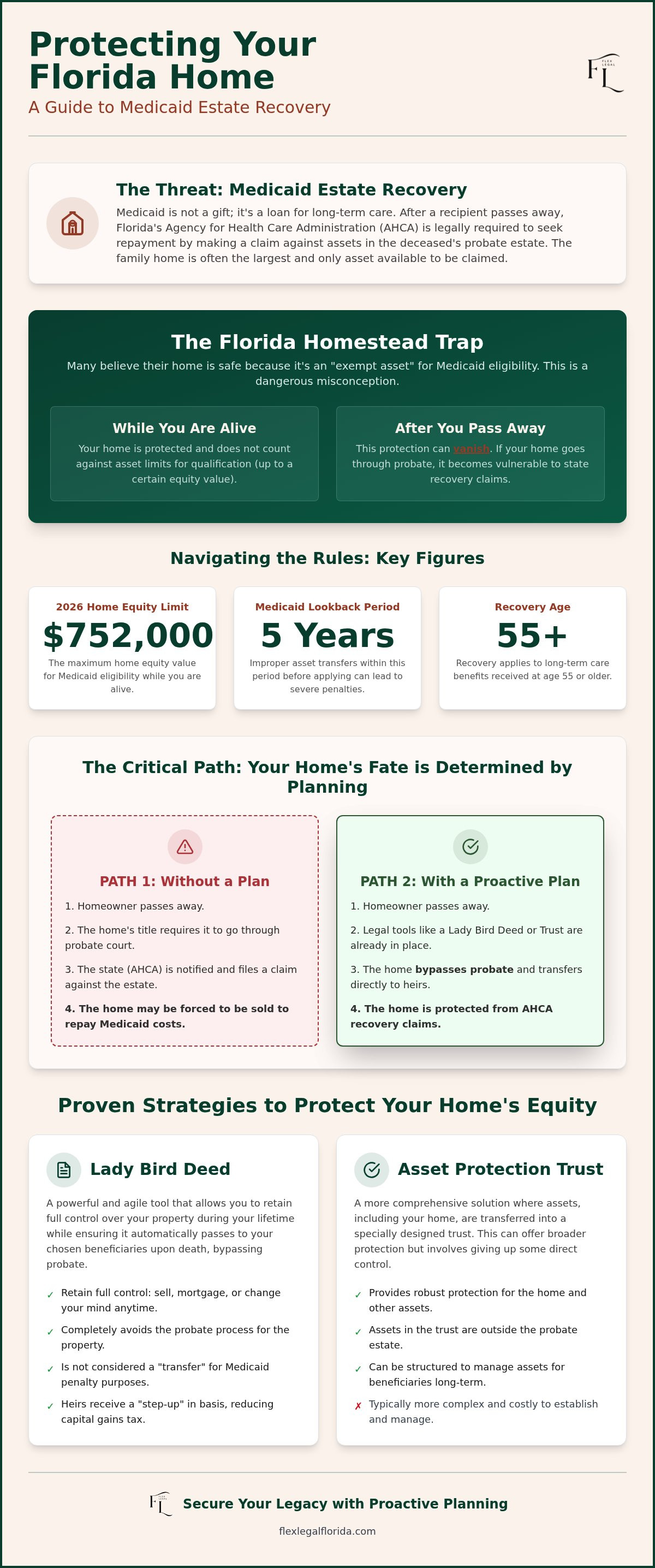
Medicaid isn't a gift; it's more like a loan that comes due after you pass away. In Florida, the state is legally required to seek repayment for the costs of long-term care provided to Medicaid recipients. This process, known as Medicaid Estate Recovery, allows the state to balance its books by collecting from the assets you leave behind. While you may have qualified for benefits with very few liquid assets, your home often remains as the last piece of equity available for the state to claim.
Florida is unique because the Agency for Health Care Administration (AHCA) manages these recovery efforts. They act as a sophisticated creditor, monitoring probate filings across the state to identify potential sources of repayment. However, there is a critical limit to their reach. Under Florida law, recovery is generally restricted to assets that pass through a formal probate estate. This distinction is the foundation for protecting my home from medicaid estate recovery Florida. If an asset bypasses probate, it often stays out of the AHCA's hands. In Palm Beach County, where property values are high, the family home is almost always the primary target for these claims because most other assets were spent down to meet the $2,000 eligibility limit.
How the AHCA Identifies Your Assets
The state doesn't have to go hunting for your property; the legal system brings it to them. When a probate case opens, the personal representative is required by law to notify the state of the death. This notification serves as a formal alert to the AHCA. Once they receive word, they review their records to calculate the total cost of care provided. If they find a balance, they file a "Statement of Claim" against the estate. This claim must be paid before any assets can be distributed to your heirs, often forcing the sale of a home that has been in the family for generations.
Which Medicaid Benefits are Subject to Recovery?
The AHCA doesn't seek repayment for every minor medical bill. Instead, they focus on high-cost long-term care services. This includes nursing facility stays, home and community-based services (HCBS), and any hospital or prescription drug costs incurred while the recipient was receiving long-term care. These costs can easily reach tens of thousands of dollars per year, quickly consuming the equity in a modest home. Federal law mandates that estate recovery applies to any individual who received these specific Medicaid benefits at age 55 or older.
The Florida Homestead Trap: Why Your House is at Risk
Many Florida residents are lulled into a false sense of security by the state's generous homestead protections. They know that while they are alive, their primary residence is considered an "exempt asset" for Medicaid qualification purposes. As long as your home equity doesn't exceed the 2026 limit of $752,000, you can qualify for benefits without being forced to sell your house. However, there is a massive difference between eligibility and recovery. Qualification is about the present; recovery is about the future. The moment a homeowner passes away, that "exempt" status can vanish if the property is not titled correctly.
The real danger lies in the Florida probate process. If your home becomes part of your probate estate, it is no longer shielded from the state's reach. Under Florida Statute 409.9101, the state has the authority to seek recoupment from any assets passing through probate to pay for the long-term care services they provided. This is the "Homestead Trap." People assume that because the home was safe while they were in a nursing home, it remains safe for their heirs. Avoiding this trap requires a strategy for protecting my home from medicaid estate recovery Florida that keeps the property entirely out of the probate court's jurisdiction.
Living in the Home vs. Leaving it to Heirs
Florida law does provide some automatic safety nets, but they are narrow. The state cannot recover against a home if there is a surviving spouse, a child under age 21, or a blind or totally disabled child of any age. These protections are vital, yet they don't cover every family. If you intend to leave your home to adult, non-disabled children, the situation becomes more complex. While the Florida Constitution provides a "Heirs at Law" exception that protects homestead property from general creditors, Medicaid is a unique type of creditor with specific federal mandates. Relying solely on constitutional language without a modern title strategy is a gamble most families can't afford to take.
Common Misconceptions About Florida Homestead Law
The most dangerous myth is that a Last Will and Testament provides protection. In reality, a Will is simply a set of instructions for the probate judge; it does nothing to keep your home out of the courtroom. Because a Will must be validated by a judge to transfer title, it actually guarantees that your house will enter the probate system where the AHCA is waiting to file a claim. If your goal is protecting my home from medicaid estate recovery Florida, you need tools that transfer ownership instantly upon death. Exploring asset protection planning now can prevent your family from facing a forced sale during an already difficult time.
Top Strategies to Protect Your Home: Lady Bird Deeds vs. Trusts
Success in protecting my home from medicaid estate recovery Florida requires choosing a legal instrument that balances your current needs with future security. You have two primary paths: the agile Lady Bird deed or the more comprehensive irrevocable trust. Both tools aim to keep your home out of the probate court, but they function in very different ways. Traditional life estate deeds are often a mistake; they force you to get permission from your children before you can sell or refinance your own home. Modern solutions prioritize your independence while securing your legacy without unnecessary friction.
When comparing these methods, consider your goals for control and cost. A Lady Bird deed is typically simpler to implement and focuses specifically on the real estate. An irrevocable trust is a more robust vehicle that can hold various types of property and accounts. While traditional deeds often trigger "gift" penalties and cause tax headaches that can cost your family more than the care itself, these modern strategies are designed to work within the specific 2026 Florida Medicaid guidelines. Choosing the right one depends on whether you are planning years in advance or facing an immediate need for care.
The Power of the Lady Bird Deed in West Palm Beach
The Lady Bird deed, or Enhanced Life Estate Deed, is a favorite for Florida homeowners because it offers a "best of both worlds" scenario. You retain 100% control over the property during your lifetime. You can sell it, mortgage it, or even change your mind about who inherits it without anyone else's signature. Because you keep these rights, Medicaid does not view the deed as a completed gift. This means there is no transfer penalty under the five-year lookback rule, making it an ideal tool for those who may need care sooner rather than later.
Beyond Medicaid, this deed provides a significant tax advantage. Your heirs receive a "step-up in basis" to the property's fair market value at the time of your death. If they sell the house later, they could save tens of thousands of dollars in capital gains taxes. It's a surgical strike against probate that leaves your daily life unchanged while ensuring the home passes instantly to your loved ones the moment you pass away.
Irrevocable Trusts: A Deep-Level Shield
While a deed protects the home, an Irrevocable Medicaid Asset Protection Trust (MAPT) acts as a comprehensive shield for your entire portfolio. This is often the necessary choice if you have assets beyond just a primary residence that you want to preserve for the next generation. The trade-off is control. To make these assets "invisible" to Medicaid, you cannot be the trustee or have direct access to the principal. You're essentially moving your wealth into a secure vault that you no longer own to ensure it remains available for your family's future.
Trusts require careful timing because they are subject to the five-year lookback period. If you fund a trust today, you must wait sixty months before applying for Medicaid to avoid penalties based on the 2026 divisor of $10,645. For families with complex estates, consulting with Asset Protection Lawyers Near Me: Securing Your West Palm Beach Wealth in 2026 is the best way to ensure your trust is structured to meet both state and federal requirements. This proactive approach turns a complex legal hurdle into a streamlined path toward long-term security.
Navigating the 5-Year Lookback Period and Transfer Penalties
Timing is everything when it comes to Medicaid eligibility. Florida implements a sixty-month "lookback period," which means the state reviews every financial transfer you've made in the five years before your application date. If you've given away assets or sold them for less than they're worth, the state imposes a penalty period during which you're ineligible for benefits. This rule is the most significant hurdle for families focused on protecting my home from medicaid estate recovery Florida. Many people assume they can simply sign a quitclaim deed to put the house in their children's names for one dollar, but this common move is a major red flag for auditors.
The consequences of an improper transfer are calculated using a specific formula. As of January 1, 2026, Florida uses a transfer penalty divisor of $10,645. To find your penalty, the state divides the value of the transferred gift by this divisor. For example, if you gift a home worth $320,000 to your children, you could face approximately thirty months of ineligibility for nursing home care. During this time, your family would have to pay for care out of pocket, often exhausting the very savings you were trying to protect. Understanding these numbers is vital for anyone considering asset protection planning to secure their future.
The Caregiver Child Exception
Florida law recognizes the value of family care through the "Caregiver Child" exception. If one of your adult children lived in your home for at least two years immediately before you entered a nursing facility, and their care allowed you to remain at home longer, you may be able to transfer the house to them without any penalty. This exception bypasses the five-year lookback entirely. However, the AHCA requires rigorous documentation, including medical affidavits and proof of residency, to prove that the child's presence was a medical necessity rather than just a living arrangement. When executed correctly, this is one of the most powerful tools for keeping a home in the family.
Crisis Planning: Is it Ever Too Late?
If you're already facing a health crisis or a pending nursing home stay, you might think your options have vanished. This is rarely the case. Even within the lookback period, Florida allows for specific "crisis planning" strategies that can mitigate or eliminate penalties. One common tool is the Personal Service Contract, where a senior pays a family member a lump sum for future care services. This turns a "gift" into a legitimate business expense in the eyes of the state. Transferring the title of a primary residence to a spouse is always considered a penalty-free transfer under Florida Medicaid rules. These adaptable solutions ensure that even a late start doesn't have to result in the loss of your family's most cherished asset.
Secure Your Florida Legacy with Flex Legal
Protecting your home is about more than just a piece of paper; it's about precision. Many people try to save money by downloading generic deeds from the internet, but this is a high-stakes gamble. These templates often fail to meet the strict 2026 Florida recording requirements or lack the specific "enhanced" language necessary for a Lady Bird deed to function correctly. If the deed isn't perfect, it won't keep the property out of probate. This simple mistake can undo all your hard work in protecting my home from medicaid estate recovery Florida, leaving your heirs to face the Agency for Health Care Administration alone.
At Flex Legal, we believe in a different approach. We don't just provide documents; we provide a dynamic support system designed to adapt as your needs change. Our asset protection planning is built on the idea that your legal strategy should be as agile as your life. By using modern, flat-fee solutions, we provide the price certainty you need during a potentially stressful health transition. You'll know exactly what you're paying upfront. This transparency allows you to focus on your family's well-being instead of worrying about unpredictable billable hours.
Why West Palm Beach Families Trust Flex Legal
Families in Palm Beach County turn to us because we act as a partnership-based ally rather than a distant or rigid institution. Jennifer L. Flexer, Esq. brings deep experience in complex probate and estate matters, ensuring that every deed and trust we draft is built to withstand state scrutiny. We understand the emotional weight of these decisions. Whether you're focused on your primary residence or need a Special Needs Planning Attorney in West Palm Beach: A 2026 Guide for Families, we prioritize clarity and comfort in every interaction. Our goal is to make complex legal concepts accessible so you feel confident in your choices.
Start Your Protection Plan Today
Our process is designed to be streamlined and effective. We don't work in a vacuum; we coordinate closely with your financial and tax advisors to ensure your plan is seamless across every area of your life. This high-level planning ensures that your Lady Bird deed or Medicaid Asset Protection Trust fits perfectly into your overall wealth strategy. We handle the technical details of recording and compliance, removing the friction from the planning process. This ensures your home stays in the family and passes outside of the probate court's reach.
Don't wait for a crisis to force your hand. The best time to secure your property is while you have the flexibility to choose the most efficient path forward. You can protect your home and your family's future with Flex Legal by scheduling a consultation to review your current title and deed today. Let us help you navigate the 2026 rules with a plan that is as modern and adaptable as your family deserves.
Take the Next Step Toward Lasting Security
Your home represents a lifetime of hard work and memories. Protecting my home from medicaid estate recovery Florida is about ensuring those assets stay within your family rather than being claimed by the state. As we've explored, the key is avoiding the probate process through modern title strategies like Lady Bird deeds or irrevocable trusts. These proactive moves shield your equity while keeping you in control of your care options.
At Flex Legal, we act as your agile ally in Palm Beach County. We provide expertise in Florida Homestead and Medicaid law through a personalized, modern approach. With our flat-fee pricing for standard estate documents, you get the price certainty you need without the stress of hidden costs. It's time to move from uncertainty to a clear, adaptable path forward for your estate.
Secure your Florida home today with a professional estate plan and protect what matters most. Your family's legacy is worth the investment in professional planning, and we're here to help you every step of the way.
Frequently Asked Questions
Does Florida Medicaid automatically take your house when you die?
No, the state does not simply seize your property. Instead, the Agency for Health Care Administration files a claim against your probate estate to recover the costs of long-term care paid for recipients aged 55 or older. If you've structured your property title to bypass the probate process, the state generally cannot reach the home to satisfy its claim.
What is a Lady Bird deed and how does it protect my home in Florida?
A Lady Bird deed is a specialized legal document that transfers your property to your chosen beneficiaries automatically upon your death. It is a primary tool for protecting my home from medicaid estate recovery Florida because it keeps the asset out of the probate court. By ensuring the home passes directly to your heirs, you prevent the state from ever having the opportunity to file a recovery claim against it.
Can I sell my house if I have a Lady Bird deed?
Yes, you retain absolute power to sell, mortgage, or lease your home with this deed in place. Unlike traditional life estates, you don't need permission or signatures from your heirs to make changes to the property. This flexibility makes it an agile choice for homeowners who want to protect their legacy without losing their independence during their lifetime.
Will my children have to pay taxes on the house if I use a Lady Bird deed?
Your children will typically benefit from a "step-up in basis" to the property's fair market value at the time of your death. This is a significant tax advantage that can save your family thousands of dollars. If they decide to sell the home after inheriting it, they'll likely owe little to no capital gains tax on the appreciation that occurred while you owned the property.
What is the difference between a Life Estate and an Enhanced Life Estate (Lady Bird) deed?
The main difference is control. A standard life estate is rigid; you cannot sell or mortgage the home without the consent of the beneficiaries named on the deed. An Enhanced Life Estate deed allows you to maintain total authority over the property. You can change your mind, name different heirs, or sell the house unilaterally at any time without involving your children or other beneficiaries.
Can the state take my home if my spouse is still living in it?
The state is legally barred from recovering against your homestead if your spouse is still living in the property. This essential protection also applies if you have a minor child or a blind or disabled child of any age. Recovery efforts are deferred as long as these protected individuals reside in the home, though proactive planning is still necessary to protect the equity for the next generation.
How much does it cost to set up a Medicaid protection trust in Florida?
The investment for a trust depends on the complexity of your specific assets and the level of planning required to secure your estate. Every family's situation is different, so it's best to consult with a specialist to discuss a plan tailored to your goals. Professional guidance ensures that your trust is compliant with current 2026 regulations while providing the highest level of asset protection.
What happens if I transfer my home to my kids less than 5 years before needing Medicaid?
Transferring your home within the sixty-month lookback period triggers a transfer penalty that can delay your eligibility for benefits. The state uses the 2026 divisor of $10,645 to calculate how many months you must pay for care out of pocket. This makes protecting my home from medicaid estate recovery Florida a challenge during a crisis, though legal exceptions like the caregiver child rule may still be available.


Comments