
Planning for a Child with Autism in Florida: The Complete 2026 Legal & Financial Guide

Updated: Jun 27
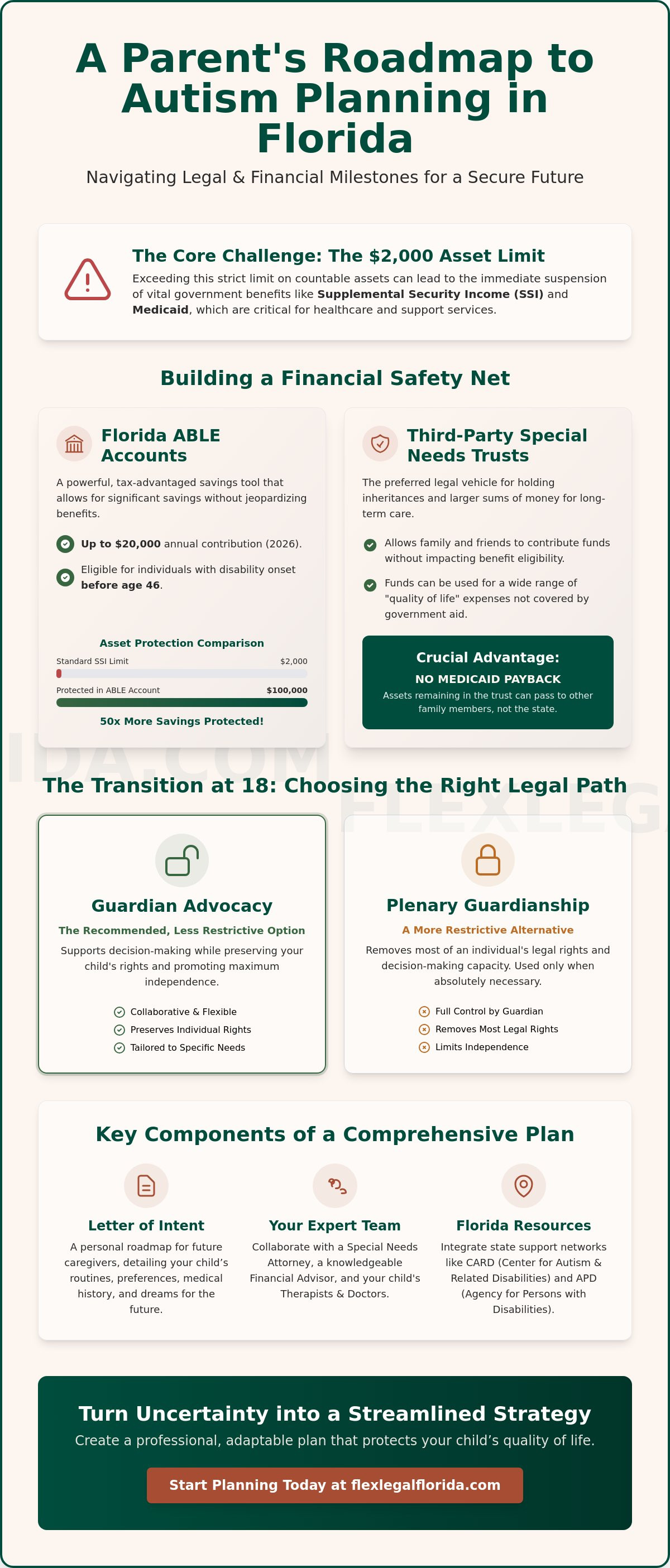
What if the "cliff" at age 18 wasn't a drop-off, but a carefully constructed bridge to your child's independence? For many families, planning for a child with autism in Florida feels like solving a complex puzzle where the pieces are constantly shifting. You've likely felt the weight of confusion over the $2,000 Medicaid asset limit or the fear that a simple inheritance might accidentally disqualify your child from vital Supplemental Security Income. These concerns are valid, but they don't have to define your family's future.
We're here to help you turn that uncertainty into a streamlined strategy that protects your child's quality of life. By integrating modern legal tools with the latest 2026 financial regulations, you can create a safety net that adapts as your child grows. This guide provides a clear path through the maze of special needs planning. We will explore how to maximize the $20,000 ABLE account contribution limits, the strategic use of Third-Party Special Needs Trusts, and why a Guardian Advocate might be a better fit than traditional guardianship. You'll gain the peace of mind that comes from having a professional, adaptable plan in place long before the 18th birthday transition arrives.
Table of Contents
The 2026 Roadmap for Autism Planning in Florida
Special needs planning is the strategic process of ensuring your child has a high quality of life while maintaining their access to essential government aid. In 2026, planning for a child with autism in Florida requires a dynamic approach. The state's legal and financial landscape is shifting, offering more flexibility but also requiring sharper precision. Many families fear the "18-year-old cliff," the moment when a child legally becomes an adult and benefits could vanish. This cliff is a myth for those who prepare early. By establishing a framework years in advance, you ensure the transition is a smooth handoff rather than a frantic scramble.
You don't have to do this alone. A successful plan involves a dedicated team of allies. This usually includes:
A legal expert specializing in Special Needs Planning and Trust Administration.
A financial advisor who understands Florida's specific asset limits.
Your child's therapists and doctors who help document functional needs.
This collaborative effort ensures every legal document reflects the reality of your child's daily life. It's about building a system that is as agile as your family needs it to be.
Florida-Specific Resources to Know
Florida offers specific networks that are vital to your strategy. The Center for Autism and Related Disabilities (CARD) provides essential support and training across the state. Additionally, the Agency for Persons with Disabilities (APD) manages the iBudget waiver, which provides funding for home and community-based services. For families in West Palm Beach, integrating these local resources into your legal plan is critical. It ensures that when you utilize Individuals with Disabilities Education Act (IDEA) services in school, your home-based legal protections are already in sync.
The Emotional vs. Legal Planning Balance
Many parents start in "crisis mode," reacting to immediate school or medical needs. We help you move into "legacy mode." This means looking beyond next month and planning for your child's entire lifespan. A standard Last Will and Testament is often dangerous for autism families if it's just a "Simple Will." If you leave assets directly to your child, you might accidentally disqualify them from Medicaid or SSI due to strict resource limits. Instead, you need a plan that accounts for their unique longevity. You want to ensure they are cared for even when you're no longer there to advocate for them. This requires a shift from short-term fixes to a long-term, sustainable legal foundation.
Protecting Government Benefits: SSI, Medicaid, and Florida ABLE
The $2,000 asset limit is often the first wall parents hit. If your child's bank account crosses this threshold, their Supplemental Security Income (SSI) and Medicaid benefits could be suspended immediately. In 2026, the SSI federal benefit rate is $994 per month. While this provides a basic floor for living expenses, the strict resource limits can penalize families who try to save for their child's future. Planning for a child with autism in Florida requires a deep understanding of these "means-tested" rules to ensure your child isn't left without a safety net.
It's also vital to distinguish between SSI and Social Security Disability Insurance (SSDI). SSI is based strictly on financial need. SSDI is based on a work history, either the individual's or a parent's. Most children with autism will rely on SSI until they qualify for SSDI through a parent's retirement, disability, or death. In Florida, staying eligible for SSI is often the key to maintaining Medicaid. This health coverage is essential for accessing the iBudget waiver, which helps pay for home and community-based services. However, these waivers often have long waitlists, making it even more important to maintain eligibility once you finally reach the top.
Florida ABLE Accounts: A Modern Planning Tool
The 2026 implementation of the ABLE Age Adjustment Act has expanded eligibility significantly. Individuals with a disability onset before age 46 can now open these tax-advantaged accounts. Through the Florida ABLE United program, you can contribute up to $20,000 annually as of 2026. The first $100,000 in an ABLE account is completely disregarded for SSI resource calculations. This allows your child to save for disability-related expenses, like housing or transportation, without losing their monthly benefits. While ABLE accounts are powerful, they have annual caps. This is why they usually supplement rather than replace a comprehensive trust strategy.
The Impact of Inheritance on Benefits
A well-meaning grandparent leaving $10,000 directly to your child can create an immediate legal crisis. This windfall would exceed the $2,000 limit, forcing a "spend down." This process requires you to spend the money quickly on approved items just to restore benefit eligibility. It's a stressful and inefficient way to manage family wealth. By working with a special needs planning attorney, you can ensure that inheritances are directed into a trust instead. This keeps the money available for your child's quality of life while keeping their government safety net fully intact. If you're feeling overwhelmed by these rules, reaching out for a professional review of your current assets can offer immediate clarity.
The Florida Special Needs Trust: The Financial Foundation
Choosing the right Trustee is a pivotal decision. You're selecting the person or entity who will manage the money and make distributions. A family member brings personal knowledge and emotional connection, but they may feel overwhelmed by complex tax filings and reporting requirements. A professional Trustee, such as a bank or specialized trust company, offers objective expertise and continuity. They don't get sick or retire in the same way a person does. Many families choose a hybrid approach, appointing a professional as the Trustee and a family member as a "Trust Protector" to oversee the personal side of the child's care.
Third-Party vs. First-Party Trusts
The most important distinction is whose money is funding the trust. A First-Party SNT is funded with the individual's own assets, such as a legal settlement. Under Florida law, these trusts must include a "Medicaid Payback" provision, meaning the state is reimbursed for care expenses upon the beneficiary's death. In contrast, a Third-Party SNT is funded by parents or grandparents. These do not require a Medicaid payback, allowing you to pass remaining assets to other heirs or siblings. The "sole benefit" rule requires that every dollar spent from the trust must directly support the beneficiary's unique needs or lifestyle, ensuring the funds are never diverted for other purposes.
Funding Your Special Needs Trust
Funding the trust doesn't always require an immediate cash windfall. Life insurance is a common tool used to create an instant legacy, providing a lump sum to the trust upon a parent's passing. You can also direct real estate, brokerage accounts, or retirement assets into the SNT. Many families integrate this into a broader revocable trust, which serves as the master document for the entire estate. This ensures that every piece of your financial puzzle works together to support your child's long-term stability and happiness.
Guardianship and Alternatives in Florida: Transitioning at 18
Turning 18 is a major milestone, but in the eyes of Florida law, it's also a total transfer of power. Regardless of a diagnosis, every individual becomes their own legal guardian the moment they reach adulthood. This means you may suddenly lose the right to make medical decisions, access school records, or manage finances for your child. Effective planning for a child with autism in Florida must address this transition long before the candles are blown out on the 18th birthday. Without a legal plan in place, you could find yourself locked out of your child's care during a crisis.
Florida courts are bound by the "Least Restrictive Alternative" requirement. Judges won't grant a full guardianship if a more narrow solution protects the individual effectively. Plenary guardianship is the most significant step. It removes nearly all legal rights, including the right to vote, marry, or sign contracts. Limited guardianship offers a more surgical approach. It delegates only the specific rights the person cannot exercise alone, such as managing large sums of money or consenting to surgery. In Palm Beach County, the court schedule is often full. Starting the process at least six months before the 18th birthday prevents a legal vacuum where no one has the authority to act in an emergency.
Supported Decision-Making (SDM) and Power of Attorney
For many high-functioning individuals, full guardianship is unnecessary and overly restrictive. Supported Decision-Making (SDM) is a modern trend that allows an adult with autism to keep their legal rights while working with a designated support team. By using a durable power of attorney and designating healthcare surrogates, you ensure that you can still talk to doctors and banks without removing your child's autonomy. It's a partnership that respects their independence while providing a safety net for complex life decisions. This approach is highly adaptable and can be scaled back or increased as your child's skills evolve.
Guardian Advocacy: A Streamlined Florida Option
Guardian Advocacy is a streamlined alternative designed specifically for families navigating developmental disabilities. Under Florida Statute 393.12, this process allows parents to become "Guardian Advocates" without the invasive and costly process of a full incapacity hearing. It's a faster route that respects the dignity of the individual while providing the legal authority parents need. When planning for a child with autism in Florida, this is often the preferred choice for maintaining support without over-litigating. An attorney plays a vital role here by ensuring that the petition is tailored to your child's specific functional levels. This keeps the process moving through the Palm Beach County courts efficiently. If you're ready to secure these legal protections, you can explore our guardianship services to find the right fit for your family.
Creating a Letter of Intent: The Final Piece of the Puzzle
Legal structures like trusts and guardianship provide the necessary framework, but they don't capture the essence of your child's daily life. A Letter of Intent (LOI) is the "love letter" you leave for future caregivers. It's a non-legal document that translates your deep parental knowledge into actionable instructions. While planning for a child with autism in Florida, this document serves as the bridge between formal legal mandates and the personal care your child deserves. It's a living document, meaning you should update it at least once a year as your child's preferences and skills evolve. Store your LOI in a digital folder accessible to your "Planning Team" and keep a physical copy with your original trust documents.
Because it isn't a court-filed document, you have the freedom to be as detailed and informal as necessary to communicate your child's unique personality. It acts as a set of operating instructions for the legal tools you've already built. While your trust handles the money, the LOI handles the human element. It ensures that the person stepping into your shoes doesn't have to guess what makes your child feel safe and happy.
What to Include in Your Child's LOI
Sensory triggers are often invisible to outsiders. Your LOI should detail sensory preferences, such as a child's reaction to specific textures, loud environments, or certain lighting. Include a breakdown of daily routines, preferred communication methods like AAC devices, and a list of doctors who have already established a rapport with your child. List "do not" triggers to prevent unnecessary meltdowns and identify social circles or favorite activities that bring them joy. This personal roadmap ensures that if you aren't there, the transition for your child is as stable as possible. This information helps a successor trustee or guardian advocate maintain the child's quality of life beyond just meeting their basic medical needs.
The Flex Legal Approach: Modern, Agile Planning
Integrating this personal document with a formal strategy from an estate planning attorney West Palm Beach ensures your legacy is protected from every angle. We prioritize price certainty through flat-fee packages, so you can focus on your child instead of a ticking clock. Our philosophy centers on adaptability. We build plans that grow alongside your child's needs, whether they require more or less support as they enter adulthood. The final step in planning for a child with autism in Florida is moving from research to action. You deserve a partner who acts as an agile ally in this journey. Schedule a consultation today to build a roadmap that offers both legal protection and personal peace of mind.
Securing Your Child’s Future Today
Building a safety net for your family requires more than just filling out forms. It involves a strategic combination of financial tools and legal protections that adapt as your child grows. By mastering the 2026 rules for ABLE accounts, Special Needs Trusts, and guardianship alternatives, you ensure that your child’s quality of life remains high without sacrificing their essential government benefits. Effective planning for a child with autism in Florida is a journey that moves from initial confusion to long-term peace of mind.
At Flex Legal, we believe professional planning should be accessible and transparent. Founded by Jennifer L. Flexer, Esq., our firm specializes in Special Needs Planning with a focus on modern, agile solutions. We offer flat-fee pricing for our estate packages, giving you cost certainty while we build your family’s roadmap together. You don't have to navigate these complex state regulations alone. Our team acts as your ally, ensuring every legal detail is handled with empathy and precision.
Ready to take the first step? Schedule a Consultation with Flex Legal to Protect Your Child's Future. You have the power to create a lasting legacy that provides security and comfort for your child for years to come.
Frequently Asked Questions
Does my child with autism automatically get SSI in Florida at age 18?
No, eligibility for Supplemental Security Income (SSI) is not automatic when your child turns 18. Your child must apply as an adult and meet the Social Security Administration's specific definition of disability. The good news is that parental income is no longer "deemed" to the child after age 18. This change often allows many young adults to qualify for the first time for the $994 monthly benefit, provided their personal assets stay below the $2,000 limit.
What is the difference between a Special Needs Trust and an ABLE account?
A Special Needs Trust (SNT) is designed to hold large assets like life insurance or real estate, while an ABLE account is a tax-advantaged savings tool for daily expenses. In 2026, Florida ABLE accounts have a $20,000 annual contribution limit. SNTs have no such cap. Both tools are essential for comprehensive planning for a child with autism in Florida, as they serve different financial purposes and provide overlapping layers of protection.
Can I name my other children as trustees for their sibling with autism?
Yes, you can name a sibling as a trustee, but it's a significant responsibility that requires careful thought. Managing a trust involves strict adherence to Florida's fiduciary laws and complex SSI reporting rules. Many families choose to pair a sibling with a professional trustee or appoint a trust protector. This allows the sibling to focus on their personal relationship with their brother or sister while the professional handles the technical administration.
How much does it cost to set up a Special Needs Trust in Florida?
The cost of establishing a Special Needs Trust varies based on your family's unique needs and the complexity of your assets. Because every child's situation is different, we prioritize price certainty through flat-fee estate planning packages. This approach ensures you know the total investment before the work begins. It's best to discuss your specific goals during a consultation to get an accurate estimate tailored to your family's roadmap.
What is 'Guardian Advocacy' and is it right for my family in West Palm Beach?
Guardian Advocacy is a streamlined legal process under Florida Statute 393.12 that allows you to maintain support for your child without a full incapacity hearing. It's specifically designed for individuals with developmental disabilities. For families in West Palm Beach, this is often the fastest and least restrictive way to stay legally involved in medical and educational decisions. It provides the authority you need while respecting your child’s dignity and independence.
Can a Special Needs Trust pay for my child's housing in Florida?
Yes, a Special Needs Trust can pay for housing, though you must be careful about how it impacts monthly government checks. While a trust can cover rent or mortgage payments, these distributions may result in a reduction of the SSI benefit. However, recent rule changes allow trusts to pay for food and groceries without any benefit reduction. A professional can help you balance these payments to ensure your child receives the maximum support available from all sources.
What happens to the Special Needs Trust if the laws change in 2026?
Modern legal documents are built with adaptability as a core value to protect against future regulatory shifts. If laws change in 2026 or beyond, a well-drafted trust often includes provisions that allow a trustee or trust protector to make necessary technical adjustments. This ensures your child’s protections remain valid even as federal or state regulations evolve. We focus on building dynamic systems that stay responsive to the changing landscape of planning for a child with autism in Florida.
Do I need a lawyer for a Florida ABLE account?
You don't legally need a lawyer to open a Florida ABLE account through the state's official program. However, consulting with a professional is highly recommended to ensure the account works in harmony with your other legal tools. Without proper coordination, an ABLE account might conflict with your Special Needs Trust or lead to accidental benefit disqualification. Integrating all your financial tools into a single, cohesive strategy is the safest way to protect your child's future.



Comments