
Irrevocable Trust for Asset Protection in Florida: The 2026 Strategic Guide
- Kelly Mata
- Jun 13
- 13 min read

What if the very thing you fear most, the loss of control over your hard earned assets, was actually the key to making them legally untouchable? You've spent years building a legacy in the Sunshine State, yet the anxiety of a single predatory lawsuit or the rising costs of nursing home care can feel like a constant shadow. It's common to feel hesitant about the word "irrevocable" because it sounds so final; nobody wants to feel trapped by their own financial planning.
This 2026 guide reveals how to leverage an irrevocable trust for asset protection Florida to shield your wealth from creditors and long term care costs without sacrificing your lifestyle. With the federal estate tax exemption reaching $15 million per individual this year, the stakes for your inheritance have never been higher. We will explore how modern strategies like Spousal Lifetime Access Trusts and the expanded powers of authorized trustees under Florida law provide the adaptability you need. You'll gain a clear path to securing your family home and business while keeping your legacy lawsuit proof for generations to come.
Key Takeaways
Learn why transferring legal ownership is the essential "secret sauce" for creating a legal fortress around your family wealth.
Avoid the common "self-settled" trap by understanding how Florida courts view trusts where the grantor remains the primary beneficiary.
Master the use of an irrevocable trust for asset protection Florida to implement spendthrift clauses that block creditor access to your legacy.
Navigate the synergy between Florida's powerful homestead laws and your trust to ensure your home remains secure without losing tax benefits.
Discover how modern features like trust protectors and decanting allow your estate plan to stay agile as laws and family needs evolve.
Table of Contents
What is an Irrevocable Trust for Asset Protection in Florida?
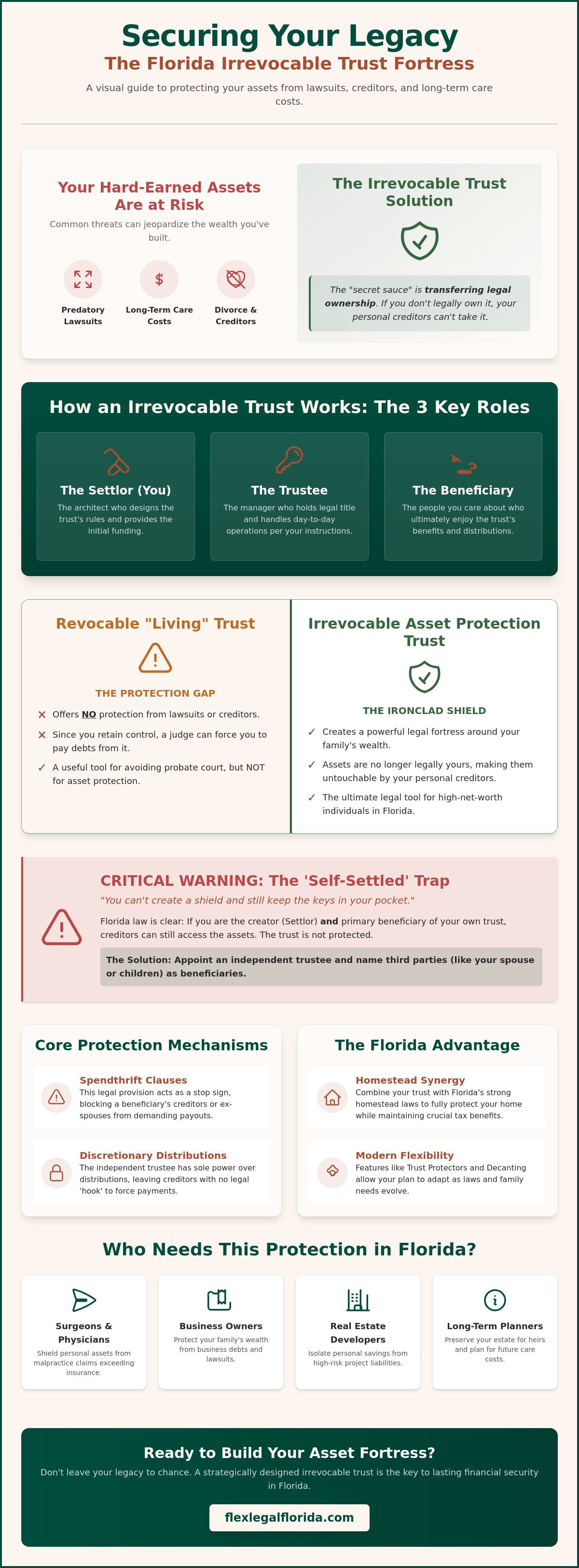
An irrevocable trust for asset protection Florida is a distinct legal entity governed by Florida Statute Chapter 736 that exists independently of its creator once the transfer of assets is finalized. This structure is more than just a document; it's a strategic shift in how you hold wealth. By moving assets into this entity, you're creating a legal boundary that separates your personal liabilities from your family's future security.
Transferring ownership is the secret sauce of this strategy. Most people think of wealth as something they must hold tightly to keep it safe. In the eyes of the law, however, holding onto an asset means a creditor can grab it. When you move an account or a deed into an Asset-protection trust, you no longer legally own those items. You aren't hiding the money; you're changing the legal title. If a creditor sues you personally, they'll find your legal pockets are empty, even though the wealth is being managed according to your specific vision.
A successful trust relies on three specific roles working in harmony:
Settlor: This is you. You act as the architect, designing the rules and providing the initial funding.
Trustee: This is your manager. They hold legal title and handle the day-to-day operations based on your original instructions.
Beneficiary: These are the people you care about. They are the ones who will ultimately enjoy the trust's benefits and distributions.
Irrevocable vs. Revocable Trusts: The Protection Gap
Many Florida residents start with a revocable living trust. These are excellent tools for keeping your affairs out of probate court, but they offer no protection against a lawsuit. If you have the power to pull money out of a trust at any time, a judge has the power to order you to do exactly that to satisfy a debt. The protection gap is wide. Transitioning to an irrevocable trust for asset protection Florida is a strategic move for those whose growing net worth makes them a target for litigation. You trade a degree of direct control for a nearly impenetrable legal shield.
Common Use Cases for West Palm Beach Professionals
In West Palm Beach, professionals often face unique risks. Surgeons, developers, and business owners use these trusts to shield their savings from professional malpractice claims that might exceed their insurance limits. It's also a primary tool for long-term care planning. By planning ahead, you can protect your estate from being entirely consumed by nursing home costs. These trusts also act as a safeguard for your children, ensuring their inheritance isn't lost to a future ex-spouse or a sudden business failure.
The 'Self-Settled' Trap: Why Florida Law is Strict on Grantors
Florida law is clear: you can't create a shield and still keep the keys in your pocket. If you set up an irrevocable trust for asset protection Florida but remain the sole beneficiary, creditors can simply walk through the front door. Under the Florida Trust Code (Chapter 736), assets in a self-settled trust remain reachable by the settlor's creditors because the state refuses to let individuals hide assets from their own debts while still enjoying them.
Florida courts prioritize creditor rights in self-settled scenarios because allowing a debtor to shield assets while maintaining full access to them is viewed as inherently inequitable and contrary to public policy. To avoid this trap, you need an independent trustee. This is a person or entity that isn't you, making the actual decisions on distributions. If you have too much control, a judge may "pierce" the trust, treating the assets as if they still belong to you personally. Maintaining the integrity of the trust requires a clean break from direct ownership.
The Role of Third-Party Beneficiaries
The real strength of an irrevocable trust for asset protection Florida lies in who it's for. By naming your spouse or children as beneficiaries, you move the assets into a different legal orbit. We use spendthrift clauses to ensure that a beneficiary's future creditor or ex-spouse can't force a payout. Because distributions are discretionary, the trustee decides when to pay, leaving creditors with no legal way to step into a beneficiary's shoes.
Navigating Fraudulent Transfer Laws
Timing is everything. Under the Florida Uniform Fraudulent Transfer Act (FUFTA), transfers made with the intent to hinder or delay creditors can be undone. You can't wait until a process server is at your door to fund your trust. We recommend solvency testing before any transfer to prove that you aren't leaving yourself broke just to hide money. Proactive planning is the only way to ensure your asset protection planning stands up to legal scrutiny.
Core Protections: Spendthrift Clauses and Discretionary Distributions
If the transfer of ownership is the foundation, then spendthrift provisions and discretionary powers are the high tech security system. An irrevocable trust for asset protection Florida relies on these specific mechanisms to keep assets out of the hands of anyone you didn't specifically name. Under Florida Statute § 736.0502, a spendthrift provision is only valid if it restrains both voluntary and involuntary transfers of a beneficiary's interest. This means a beneficiary can't hand over their future inheritance to a creditor, even if they wanted to. It's a vital layer of protection that ensures the trust's purpose remains intact regardless of a beneficiary's personal financial situation.
It's important to be realistic about the limits of any legal structure. While these tools are incredibly robust, Florida law recognizes certain "exception creditors." This group typically includes the IRS for tax debts and claims for child support or alimony. Outside of these specific government and family obligations, the shield remains firmly in place for most civil judgments, professional malpractice claims, and business liabilities. For West Palm Beach residents, using precise language that aligns with state statutes is the difference between a secure plan and one that fails under pressure.
Spendthrift Provisions: Blocking Creditor Access
Think of a spendthrift clause as a legal force field. It prevents a beneficiary from "pledging" their trust interest as collateral for a private loan or a risky business deal. This is especially vital for families looking to protect a legacy from a child's potential financial missteps or unforeseen lawsuits. By working with Asset Protection Lawyers Near Me: Securing Your West Palm Beach Wealth in 2026, you can ensure your trust language is modern and precise enough to withstand aggressive legal challenges. It's about building a defense that works automatically so you don't have to worry about the "what ifs."
The Trustee’s Discretion as a Shield
The real power of an irrevocable trust for asset protection Florida lies in the trustee's discretion. Mandatory distributions act as a magnet for creditors; if a beneficiary has a legal right to a check on the first of every month, a creditor can often step in to grab that check. However, if the trustee has the sole power to decide when, if, and how much to distribute, the creditor is stuck. They can't force the trustee to pay out. Understanding Your Asset Protection Trust structure helps you realize that a "floating" distribution schedule is often your strongest defense. Selecting a trustee who understands how to balance family support with asset security ensures the principal stays protected while needs are still met.
The Florida Homestead and Irrevocable Trust Synergy
Florida’s homestead laws provide a legendary level of protection against most creditors, but they aren't a universal solution for every risk. While your primary residence is generally safe from a standard lawsuit judgment, it remains vulnerable to the rising costs of long term care. Integrating an irrevocable trust for asset protection Florida into your strategy allows you to address the gaps where homestead protection ends. This is particularly relevant in 2026, as the Florida homestead exemption now reduces taxable value by up to $51,411 for eligible properties. You don't have to choose between tax benefits and asset security if the structure is designed correctly.
Moving your home into an irrevocable structure requires a delicate balance. If done incorrectly, you risk losing your "Save Our Homes" tax cap, which limits annual assessment increases to 3%. We often see homeowners rush into these transfers without ensuring the trust language preserves their right to the homestead tax exemption. A Medicaid Asset Protection Trust (MAPT) is the primary tool used here. It allows you to start the clock on eligibility while ensuring the property passes to your heirs without being consumed by a state lien or estate recovery efforts.
Protecting Your Home from Long-Term Care Costs
The five year Medicaid look back period is a critical factor for Florida seniors. If you transfer your home into an irrevocable trust today, you must wait sixty months before applying for benefits to avoid penalties. For those who need more immediate flexibility, a "Lady Bird Deed" might offer a simpler alternative by keeping the property out of probate while maintaining your control. However, an irrevocable trust provides a more comprehensive shield against a wider variety of legal threats. Here is how the two strategies compare:
Lady Bird Deeds: Maintain your right to sell or mortgage the property but offer limited protection against non-probate creditors.
Irrevocable Trusts: Create a robust barrier against professional liability and long term care liens, though they require giving up some direct control.
You can secure your home today by starting your asset protection planning with a focus on long term stability and legacy preservation.
Special Needs Planning Integration
Standard trusts often fall short when a loved one with a disability is involved. If an irrevocable trust isn't drafted with specific "third party" special needs language, the assets could accidentally disqualify the beneficiary from essential government programs like SSI or Medicaid. We prioritize creating structures that provide for a loved one's quality of life without jeopardizing their safety net. You can find more detail on these strategies in our guide to Special Needs Planning Attorney in West Palm Beach: A 2026 Guide for Families. This level of customization ensures that your legacy supports your family exactly as you intended.
Modern Trust Design: Adaptability with Flex Legal, PLLC
The biggest misconception about an irrevocable trust for asset protection Florida is that it's a financial dead end. In the past, irrevocable meant permanent and unchangeable, regardless of how your life or the law evolved. Today, modern trust design prioritizes agility. By using a "Trust Protector," you can appoint an independent third party with the power to update trust provisions as tax laws or family circumstances change. This ensures your plan remains effective even as we navigate the 2026 shifts in federal estate tax exemptions.
Another powerful tool in our arsenal is the "decanting" process. Just as you might pour wine from an old bottle into a new decanter to let it breathe, Florida law allows us to pour assets from an old, rigid trust into a brand new structure with more flexible terms. This is particularly useful if your existing trust was written years ago and no longer serves your current goals. Our approach at Flex Legal, PLLC focuses on these dynamic solutions, providing West Palm Beach families with a flat fee model that offers total cost certainty from the start. We guide you through a streamlined four step process:
Asset Audit: We identify which properties, accounts, and business interests need protection.
Threat Profiling: We analyze your specific risks, from professional liability to long term care concerns.
Custom Design: We draft the trust language to include modern flexibility features.
Strategic Funding: We ensure the legal title of your assets is correctly transferred to the trust.
Flexibility in an 'Irrevocable' World
You don't have to lose all influence when you set up an irrevocable trust for asset protection Florida. Through a "Power of Appointment," you can retain the ability to change how assets are eventually distributed among your beneficiaries. You can also reserve the right to replace a trustee if they aren't meeting your expectations. These features allow your estate plan to breathe and adapt. It's about maintaining a partnership with your legal structure rather than being restricted by it. This is especially vital as we prepare for the 2026 sunset of current tax provisions, which may require quick adjustments to your gifting strategies.
Getting Started with Flex Legal, PLLC
Our discovery phase is designed to be straightforward and empathetic. We don't use intimidating jargon; we focus on identifying your specific "threat profile" to build a defense that fits your life. Every trust we design is customized to reflect the values and needs of West Palm Beach professionals and families. If you're ready to move away from rigid, old school planning, we are here to help. Schedule a consultation for an agile asset protection plan and take the first step toward a legacy that is both secure and adaptable.
Build Your Fortress for 2026 and Beyond
Strategic wealth preservation isn't about static rules; it's about building a defense that adapts as quickly as the legal landscape. We have explored how shifting ownership creates an impenetrable shield and how modern features like trust protectors keep your plan agile. By integrating an irrevocable trust for asset protection Florida, you ensure that your family home, business, and savings remain secure from predatory lawsuits and the rising costs of long term care.
Founded by Jennifer L. Flexer, Esq., Flex Legal, PLLC is specialized in these Florida-specific asset protection strategies. We prioritize clarity and partnership, offering transparent flat-fee pricing models so you always know where you stand. You don't have to navigate these complex decisions alone when you have an expert ally in your corner. Secure your legacy with a modern Florida asset protection plan from Flex Legal, PLLC.
Your hard work deserves a future that is certain. Let's design a plan that gives you the peace of mind to focus on what matters most.
Frequently Asked Questions
Can I be my own trustee for an irrevocable asset protection trust in Florida?
You shouldn't serve as your own trustee if you want the trust to actually protect your assets. While Florida law allows you to be a trustee, doing so creates an "alter ego" situation that creditors can exploit. If you have the power to distribute funds to yourself at will, a judge can order you to distribute those funds to a creditor. Using an independent trustee is the only way to ensure the trust remains a separate legal entity that courts will respect.
What assets should I never put in an irrevocable trust?
Avoid placing qualified retirement accounts like 401(k)s or IRAs into an irrevocable trust. Transferring these accounts is generally treated as a full distribution by the IRS, which triggers immediate income taxes and potential early withdrawal penalties. You should also keep enough cash in your personal name to cover your daily living expenses. Assets that you plan to sell or mortgage frequently for personal use are also poor candidates for these long term structures.
How much does it cost to set up an irrevocable trust in West Palm Beach?
The investment required to establish an irrevocable trust for asset protection Florida varies based on the complexity of your asset audit and your specific threat profile. Flex Legal, PLLC utilizes a transparent flat-fee model to provide West Palm Beach families with total cost certainty from the start. This approach avoids the unpredictability of traditional hourly billing. Your custom strategy is designed to reflect your unique goals rather than a one size fits all template.
Can an irrevocable trust be broken by a creditor in Florida?
A creditor can only reach trust assets if they prove a fraudulent transfer occurred under the Florida Uniform Fraudulent Transfer Act. This typically happens if you fund the trust while a lawsuit is already pending or if the transfer leaves you insolvent. Additionally, "exception creditors" like the IRS or those seeking child support have special legal powers to bypass trust protections. Outside of these specific legal scenarios, a properly funded and timely trust remains a nearly impenetrable barrier.
Does an irrevocable trust protect against divorce in Florida?
Assets held in a properly drafted irrevocable trust are typically shielded from divorce settlements if they were moved into the trust before the marriage or before a divorce filing. Because the trust owns the assets, they aren't considered marital property subject to equitable distribution. This is a common strategy for families who want to ensure an inheritance stays with their child rather than a future ex-spouse. It's an effective way to protect a family legacy across generations.
How is an irrevocable trust taxed compared to a revocable one?
Revocable trusts are "grantor trusts" where all income is reported on your personal tax return. Irrevocable trusts are more complex and can be either grantor or non-grantor trusts depending on how they're drafted. Non-grantor trusts are separate tax-paying entities with their own tax identification numbers and compressed tax brackets. We design these structures to balance your asset protection needs with the most efficient tax outcome for your specific income level.
What is the difference between a domestic and an offshore irrevocable trust?
Domestic trusts operate under U.S. law in states like Florida or South Dakota and are subject to American court orders. Offshore trusts are established in foreign jurisdictions like the Cook Islands that don't recognize U.S. judgments. While offshore trusts offer a higher level of protection, they're significantly more expensive and complex to maintain. For most Florida residents, a domestic irrevocable trust for asset protection Florida provides a sophisticated level of security without the international regulatory burden.
Can I sell a house that is owned by an irrevocable trust?
The trustee has the legal authority to sell a house owned by the trust at any time. You don't lose the ability to manage your real estate portfolio; you simply change who signs the closing documents. The proceeds from the sale remain inside the trust, maintaining their protected status from your personal creditors. This allows you to stay agile and move your wealth between different asset classes without ever lowering your legal shield.


Comments