
How to Minimize Federal Estate Tax in Florida: A 2026 Strategic Guide

Florida's lack of a state estate tax is a powerful shield, but it won't stop the IRS from claiming up to 40% of your legacy if your strategy remains static. While many residents feel secure in our tax-friendly climate, the 2026 post-sunset environment brings a specific set of federal challenges that require a proactive approach. Understanding how to minimize federal estate tax in Florida is a vital step for anyone looking to protect their family's wealth from high federal tax rates.
You've likely spent years building your assets with the hope of a smooth transition to the next generation, so the thought of losing a significant portion to federal obligations is unsettling. We're here to provide clarity through modern, adaptable solutions that prioritize your comfort. This guide explores the most effective legal strategies for Florida residents to protect their wealth under the $15 million federal exemption. We'll walk through strategic gifting, the use of irrevocable trusts, and how to maintain control over your assets while ensuring your family's future remains secure and predictable.
Table of Contents
The 2026 Federal Estate Tax Reality for Florida Residents
The Federal Estate Tax Reality has shifted significantly for families across the Sunshine State. At its core, this is a tax on your right to transfer property at the time of your death. While Florida residents enjoy a distinct advantage because our state doesn't impose its own estate or inheritance taxes, the federal government remains a silent partner in your legacy. For years, many residents felt safe under historically high exemption levels. However, the 2026 "post-sunset" environment has arrived, and the rules have changed. Doing nothing is no longer a viable strategy for West Palm Beach families who want to maintain control over their hard-earned assets.
The 2026 Exemption Thresholds
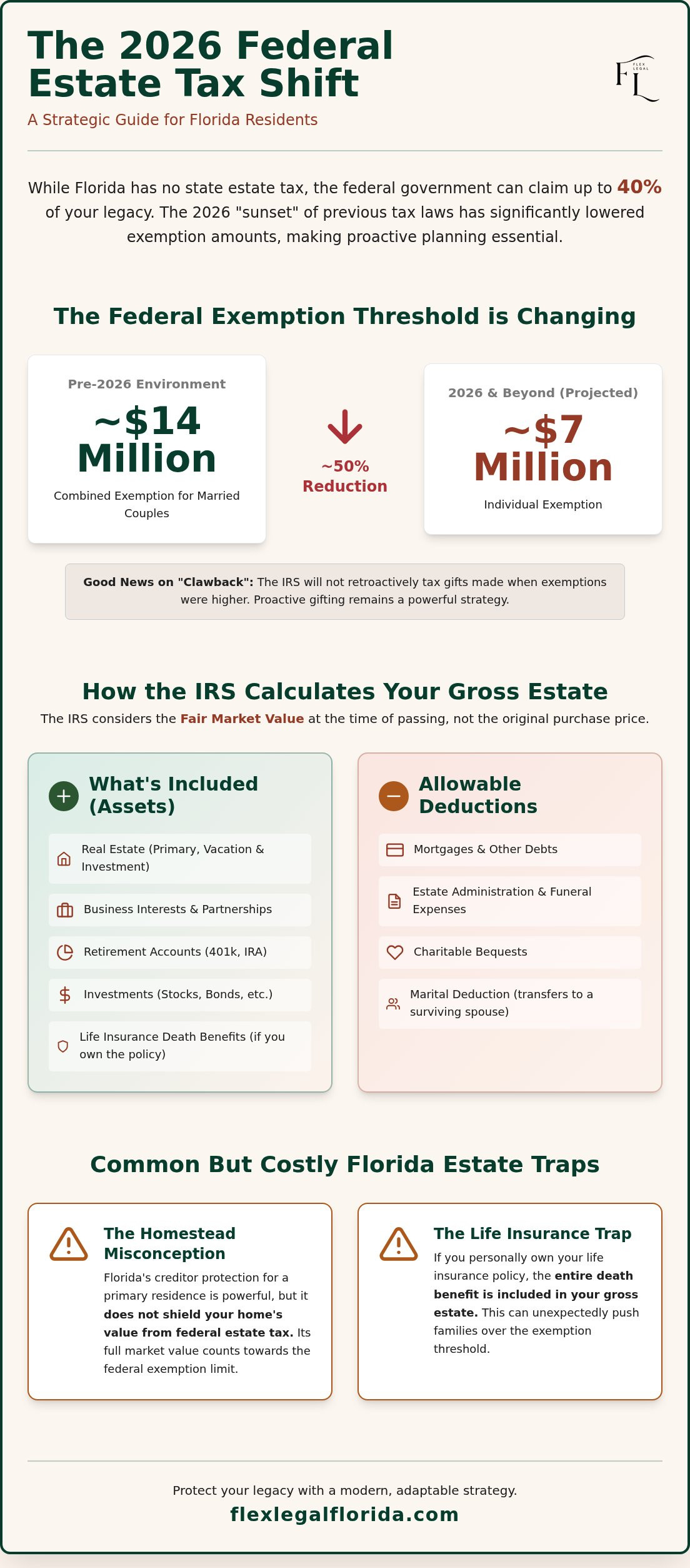
The 2026 sunset refers to the expiration of temporary tax provisions that previously doubled the exemption amounts. We're now operating in a landscape where the individual exemption is projected at approximately $7 million. For married couples, this creates a combined shield of roughly $14 million. While these numbers sound high, they represent a nearly 50% drop from previous years. It's also vital to address the "clawback" myth. Many people fear the IRS will retroactively tax gifts made when exemptions were higher. Rest assured, the IRS has confirmed they won't penalize you for past generosity, but they will apply the new, lower limits to any future transfers.
Who is at Risk in the New Tax Landscape?
The new tax reality captures many "unintentional millionaires" who never expected to face a federal tax bill. In Palm Beach County, property values have surged, often pushing long-term homeowners toward the exemption limit without them realizing it. When you add up real estate, business interests, and life insurance proceeds, it's easy to see why learning how to minimize federal estate tax in Florida is now a priority for a broader range of families.
If your total assets approach the $7 million mark, the IRS could claim a projected 40% of everything above that threshold. This isn't just a concern for the ultra-wealthy; it's a concern for anyone who wants to ensure a smooth transition of assets to their children. A baseline revocable trust is an excellent tool for probate avoidance, but it's only the beginning of a modern tax strategy. Strategic planning today prevents a massive, unnecessary tax bill for your heirs tomorrow.
Calculating Your Gross Estate: What the IRS Sees
To effectively plan, you first need to see what the IRS sees. Many families assume their estate only includes liquid cash or stocks. In reality, the IRS uses a comprehensive lens for Calculating Your Gross Estate, encompassing everything you own or have a financial interest in at the time of your death. This includes real estate, business interests, and even your retirement accounts. Crucially, the IRS looks at the fair market value of these assets on the date of your passing, not the original purchase price. This distinction is vital in a high-growth market like Florida, where property values have surged over the last decade.
The good news is that your taxable estate isn't just a raw sum of your assets. You can deduct certain obligations to lower the final number. Valid deductions that help reduce your liability include:
Mortgages and other personal debts
Funeral expenses and final medical bills
Administrative costs for settling the estate
Charitable bequests made in your will or trust
Florida Real Estate and Homestead Considerations
Florida's Homestead laws are famous for creditor protection, but they don't shield your home from federal tax collectors. While your primary residence in West Palm Beach might be safe from a lawsuit, its full market value still counts toward that projected $7 million federal exemption. Secondary residences and vacation homes are also included at their current market value. However, inherited property often receives a "step-up in basis." This means your heirs' capital gains tax is calculated based on the value at the time of your death, not what you originally paid. It's a powerful tool for building multi-generational wealth without an immediate tax penalty for your children.
The Life Insurance Trap
One of the most common mistakes involves life insurance. If you own your policy, the full death benefit is included in your gross estate. For a family in Palm Beach County with a $2 million home and a $5 million policy, you've already hit the 2026 individual limit. Learning how to minimize federal estate tax in Florida often starts with re-titling these policies. By working with an asset protection lawyer, you can move insurance proceeds into specific trust structures. This removes the value from your taxable estate while still providing for your beneficiaries. If you're unsure where your current valuation stands, connecting with a modern legal ally can help clarify your path forward.
Revocable vs. Irrevocable Trusts: Choosing Your Shield
Choosing the right legal vehicle is the core of any Revocable vs. Irrevocable Trusts strategy. It's often a trade-off between control and tax mitigation. A Revocable Living Trust is a fantastic tool for avoiding probate in Florida. It keeps your affairs private and ensures your assets are managed if you become incapacitated. However, for tax purposes, it's neutral. Since you maintain total control and can change the trust at any time, the IRS still considers those assets part of your gross estate. It won't help you with how to minimize federal estate tax in Florida on its own.
To move the needle on your tax bill, you need a strategy that actually removes assets from your taxable estate. This is where "Portability" becomes a vital concept for married couples. By filing a federal estate tax return (Form 706) when the first spouse passes, the survivor can "port" or claim any unused portion of the deceased spouse's exemption. In the 2026 post-sunset environment, this allows a couple to protect a combined total of approximately $14 million. It's a simple yet powerful way to double your shield without complex restructuring.
The Power of Irrevocable Trusts
For estates that exceed the combined $14 million threshold, irrevocable trusts become the primary tool for tax removal. These structures are designed to be permanent, which is why the IRS respects them as separate entities. An Irrevocable Life Insurance Trust (ILIT) is a classic choice. It owns your life insurance policy so the death benefit doesn't bloat your taxable estate. If you want to gift assets while still allowing your spouse to access the income, a Spousal Lifetime Access Trust (SLAT) offers a sophisticated middle ground. For families with rapidly appreciating assets, like tech stocks or West Palm Beach real estate, a Grantor Retained Annuity Trust (GRAT) allows you to pass the future growth to heirs with minimal tax impact.
Managing Trusts in Palm Beach County
Drafting the document is only half the battle. Administering these complex vehicles requires a local probate lawyer who understands the nuances of Florida trust administration. The most common mistake we see is a failure to "fund" the trust. A trust is just a stack of paper until you actually re-title your bank accounts, deeds, and business interests into the name of the trust. Modern planning also requires adaptability. We don't view trusts as static rules from the past; they should be dynamic systems that can respond to changing family needs or future shifts in federal law. This agile approach ensures your legacy remains protected, no matter how the political or economic climate evolves.
5 Proven Methods to Reduce Your Federal Tax Liability
Reducing the size of your taxable estate doesn't always require complex litigation or massive structural changes. Often, the most effective ways to address how to minimize federal estate tax in Florida involve consistent, strategic actions taken during your lifetime. By moving assets out of your name now, you ensure they aren't subject to that projected 40% tax rate later. These methods focus on shrinking your "gross estate" while your wealth continues to work for your family's benefit.
Beyond simple gifts, you can leverage "unlimited" gifting. The IRS allows you to pay for someone else's tuition or medical expenses without these payments counting toward your annual or lifetime limits. The key is that the payment must go directly to the institution. For business owners, a Family Limited Partnership (FLP) offers a way to transfer interests to heirs while retaining management control. This structure often allows for "valuation discounts," effectively letting you move more wealth out of your estate than the face value of the business interests might suggest.
The 2026 Gifting Strategy
The annual gift tax exclusion is your simplest tool for wealth transfer. In 2026, this amount is projected at $19,000 per recipient. For a married couple in West Palm Beach, "gift splitting" allows you to double this impact, moving $38,000 per child or grandchild every year. Over a decade, a couple with three children could remove over $1 million from their taxable estate without ever touching their lifetime exemption. Be careful with what you give, though. Gifting highly appreciative assets, like stocks with a low cost basis, is often a strategic mistake. Your heirs lose the "step-up in basis" benefit mentioned earlier, potentially trading an estate tax bill for a massive capital gains tax bill.
Charitable Planning in Florida
Philanthropy is a powerful way to align your values with your tax goals. Establishing a donor-advised fund or a private foundation allows you to support Florida-based 501(c)(3) organizations while receiving an immediate deduction. For those seeking income, a Charitable Remainder Trust (CRT) provides you with payments for life, with the remainder going to charity. Conversely, a Charitable Lead Trust (CLT) pays the charity first, often significantly reducing the estate tax value of the assets eventually passing to your heirs. These vehicles turn a potential tax liability into a lasting community impact.
If you're ready to build a gifting plan that fits your family's unique needs, our team can help you design a customized tax minimization strategy that protects your legacy.
Why Professional Estate Planning is Essential in West Palm Beach
The 2026 tax landscape is complex. Using a generic online form might seem cost-effective, but the IRS loves the mistakes found in DIY plans. These errors often lead to expensive audits or legal disputes that drain the very wealth you're trying to protect. A professional West Palm Beach estate planning attorney understands how to bridge the gap between specific Florida property nuances and federal tax obligations. At Flex Legal, PLLC, we reject the stuffy, intimidating atmosphere of traditional firms. We offer flat-fee packages and clear, direct communication, ensuring you have an agile ally in your corner.
Navigating how to minimize federal estate tax in Florida requires more than just filling out templates. It's about creating a dynamic system that adapts as your life and the laws change. Our approach focuses on streamlined support that prioritizes your comfort while delivering sophisticated results. We believe that high-level planning should be accessible and transparent, not buried under layers of dense jargon.
Avoiding Probate Litigation
Properly structured tax planning does more than save money; it preserves family harmony. When a plan is vague or improperly funded, it invites probate litigation. We integrate essential tools like a durable power of attorney to ensure your affairs are managed smoothly if you're ever unable to do so yourself. Additionally, our expertise in Special Needs Planning allows us to include specialized trust language. This protects vulnerable heirs without jeopardizing their essential government benefits, ensuring how to minimize federal estate tax in Florida remains a goal that benefits every member of your family.
Starting Your 2026 Estate Plan
Choosing a local firm gives you a distinct advantage over national platforms that don't understand the Palm Beach County real estate market. Before your first strategy session, gather a general list of your assets, including real estate deeds and life insurance policies. We promise a process that is transparent and free of unnecessary friction. The Flex Legal, PLLC promise is a plan that is both reliable and forward-thinking. This gives you the confidence that your family's future is secure and your legacy is protected from the 2026 sunset provisions.
Protecting Your Florida Legacy in a New Tax Era
The 2026 federal exemption sunset isn't a distant possibility; it's a structural shift that requires immediate, agile action. We've explored how the projected $7 million individual threshold can catch many Florida families off guard, especially with rising property values in West Palm Beach. By understanding the difference between revocable and irrevocable trusts and leveraging strategic gifting, you gain the power to decide how your wealth is preserved. Strategic planning ensures that your hard-earned assets stay within your family rather than going to the IRS.
Knowing how to minimize federal estate tax in Florida is about more than just numbers on a spreadsheet. It's about ensuring your family remains secure and your transition of assets is seamless. Flex Legal, PLLC offers a modern approach to these complex challenges. We provide specialized expertise in Asset Protection and Special Needs Planning through a transparent flat-fee model that eliminates the guesswork. This focus on price certainty and clear communication makes high-level planning accessible and stress-free.
Don't let a static plan from the past leave your heirs vulnerable to high federal tax rates. Secure your family legacy with a strategic estate plan from Flex Legal, PLLC. Our local expertise and solution-oriented strategies are designed to act as your long-term ally. You've worked hard to build your wealth; let's work together to keep it in your family.
Frequently Asked Questions
Does Florida have an estate or inheritance tax in 2026?
No, Florida does not have a state-level estate or inheritance tax in 2026. This remains a significant advantage for West Palm Beach residents compared to those in other states. While you don't have to worry about a local "death tax," you are still subject to federal estate taxes if your assets exceed the exemption threshold. Proactive planning ensures your local tax advantage isn't overshadowed by high federal obligations.
What is the federal estate tax exemption for 2026?
The federal estate tax exemption for 2026 is projected to be approximately $7 million per individual. This change marks the official "post-sunset" environment following the expiration of previous tax provisions. Because this threshold is significantly lower than in past years, many more families in Palm Beach County will find themselves subject to federal taxes. Staying informed about these shifting numbers is the first step in effective wealth protection.
How can a married couple double their estate tax exemption?
A married couple can effectively double their shield to a projected $14 million. This is possible through a concept called "portability," which allows the surviving spouse to utilize any portion of the exemption that the first spouse didn't use. By working with a modern legal ally, couples can ensure they file the necessary paperwork with the IRS to lock in this combined protection for their heirs and avoid unnecessary taxes.
Will my Florida Homestead property be taxed by the federal government?
Yes, your Florida Homestead property is included in your gross estate for federal tax purposes. Many residents mistakenly believe that because their home is protected from creditors under state law, it's also exempt from the IRS. In reality, the fair market value of your West Palm Beach home counts toward your $7 million limit. Rising real estate prices mean your home could be a major factor in your tax liability.
What is the difference between a revocable and irrevocable trust for tax purposes?
The main difference is control. A revocable trust allows you to change terms at any time, but the IRS still considers the assets yours. An irrevocable trust is the most effective vehicle for those asking how to minimize federal estate tax in Florida. By moving assets into an irrevocable structure, you remove them from your taxable estate. This trade-off of control for tax mitigation is a cornerstone of advanced planning.
Can I give away my money to avoid estate taxes?
Gifting is one of the simplest ways to shrink your estate. In 2026, you can give a projected $19,000 per recipient annually without reporting it to the IRS. For a West Palm Beach couple with several grandchildren, this can remove hundreds of thousands of dollars from the taxable estate over time. Larger "lifetime" gifts are also possible, though they reduce your remaining $7 million exemption and require a gift tax return.
What happens if I die without an estate plan in Florida?
If you die without a plan, your estate will likely go through a public probate process in Palm Beach County. Florida's intestacy laws will decide who inherits your property, which may not align with your actual wishes. You also lose the opportunity to use tax-reduction strategies. This can result in your family losing a projected 40% of their inheritance to federal taxes that could have been legally avoided.
How does portability work for Florida residents?
Portability allows a surviving spouse to claim the unused federal exemption of their deceased partner. This is a critical tool for West Palm Beach families exploring how to minimize federal estate tax in Florida. To secure this benefit, the executor of the estate must file a federal estate tax return shortly after the first death. Even if no tax is currently owed, filing ensures the survivor keeps the doubled $14 million protection.


Comments