
How to Protect Assets from Nursing Home Costs in Florida: 2026 Guide

What if the five-figure monthly bill for a Florida skilled nursing facility didn't have to come out of your family's inheritance? Many seniors believe they must spend every last dime before qualifying for help, but that's a costly misconception. Learning how to protect assets from nursing home in Florida is not about hiding funds; it's about using modern legal strategies to secure your legacy while accessing high-quality care. You've worked hard for your home and savings, and the fear of losing them to Medicaid estate recovery is a heavy burden to carry.
We understand the anxiety surrounding the five-year look-back rule and the complexity of state regulations. This 2026 guide reveals the exact legal paths Florida families use to qualify for Medicaid while keeping their property and life savings intact. We'll move past the confusion of traditional, rigid planning to explore agile, fixed-price solutions that provide a clear roadmap for your future. From strategic asset conversion to protective trusts, you'll discover how to navigate the system with confidence and ensure your heirs are protected from rising long-term care costs.
Table of Contents
The Reality of Florida Nursing Home Costs and the 'Spend-Down' Trap
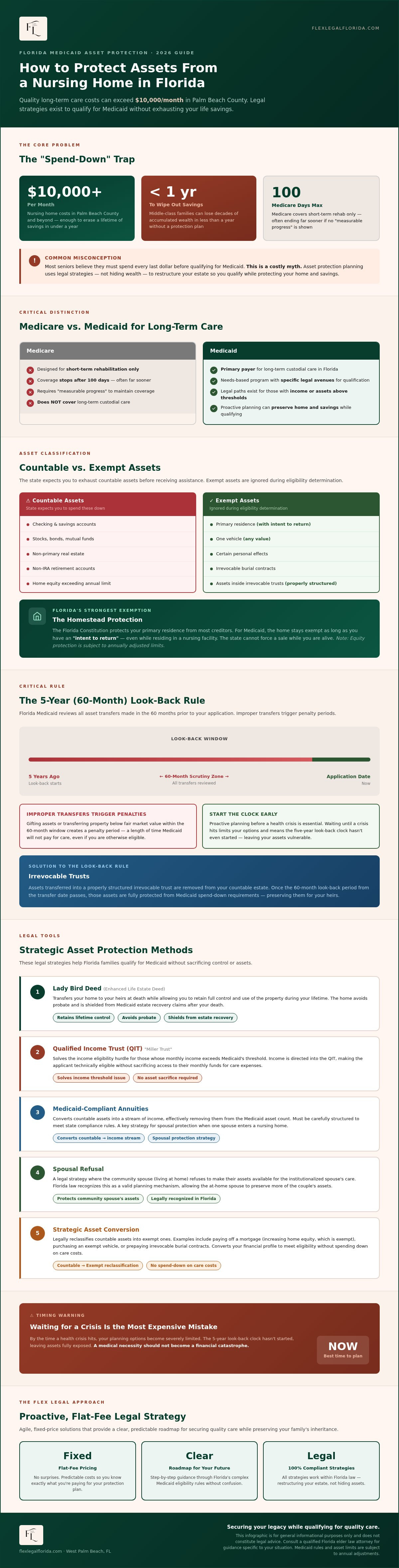
Florida nursing homes aren't just expensive; they're a financial cliff for the unprepared. In 2026, the cost of quality care continues to climb, often exceeding $10,000 per month in Palm Beach County and beyond. For a middle-class family, these bills can evaporate a lifetime of savings in less than a year. This is where the "spend-down" trap begins. The state essentially requires Medicaid applicants to exhaust their countable assets until they reach a specific threshold, often leaving them with almost nothing to their name.
The "spend-down" process is the state's way of ensuring you are financially "poor" enough to qualify for public assistance. While the intent is to reserve funds for those in need, the reality is that it punishes families who saved diligently. Many people believe they must literally spend every dollar on nursing home bills until they meet the [verify current limits] asset mark. This isn't just a financial loss; it's the total destruction of a family legacy that took decades to build.
Why Florida's 'Spend-Down' is Not Your Only Option
Spending your hard-earned assets on care is often unnecessary if you have a strategic plan in place. Learning how to protect assets from nursing home in Florida involves a clear distinction between what the state counts and what it ignores. Asset protection planning isn't about "hiding" wealth or skirting the law. It's about restructuring your estate so you meet legal eligibility requirements while keeping your home and savings safe for your spouse and children. By converting countable assets into exempt ones, you can qualify for help without going broke.
Medicaid vs. Medicare: Clearing the Confusion
A common mistake is assuming Medicare will cover long-term care. It won't. Medicare is designed for short-term rehabilitation, and coverage typically stops after 100 days; it often ends much sooner if the patient isn't showing "measurable progress." Once Medicare stops paying, you're on your own unless you have long-term care insurance or qualify for Medicaid. Medicaid is the primary payer for long-term custodial care in Florida, acting as a needs-based program that features specific legal avenues for those who initially appear to have too much income or too many assets.
Waiting for a health crisis to address these costs is the most expensive mistake you can make. By the time a crisis hits, your options are limited, and the five-year look-back clock hasn't even started. Proactive planning allows you to act as an agile protector of your family's future, ensuring that a medical necessity doesn't become a financial catastrophe.
Countable vs. Exempt Assets: Knowing What the State Can Touch
To understand how to protect assets from nursing home in Florida, you must first separate your property into two distinct categories: countable and exempt. Countable assets are those the state expects you to exhaust before they provide financial assistance. This list typically includes checking and savings accounts, stocks, bonds, mutual funds, and any real estate that isn't your primary residence. Non-IRA retirement accounts are also usually viewed as available resources. If your total countable assets exceed the [verify current limits] threshold, you'll likely face a denial unless you take corrective legal action.
Exempt assets, by contrast, are ignored during the initial eligibility determination. Florida is known for its generous exemptions, which include one vehicle of any value, certain personal effects, and irrevocable burial contracts. You can find the most current list of these items through the official Florida Medicaid eligibility and asset rules. However, the most significant protection available to Florida residents remains the homestead exemption.
The Power of the Florida Homestead
The Florida Constitution provides an incredibly strong shield for your primary residence. As long as you own the home and it serves as your principal place of living, it's generally protected from most creditors. For Medicaid purposes, the home remains exempt as long as you have an "intent to return" to it, even if you're currently residing in a nursing facility. This vital rule prevents the state from forcing a sale while you're alive.
There is a significant caveat to consider. In 2026, the equity in your home is only protected up to a specific limit, which is adjusted annually. If your home's equity exceeds the [verify current limits] threshold, the excess could be considered a countable asset. Additionally, while the home is exempt during your lifetime, the Medicaid Estate Recovery program may attempt to place a lien on the property after you pass away to recoup care costs. This makes proactive asset protection planning essential to ensure the home actually reaches your heirs rather than the state.
What Happens to Retirement Accounts and Life Insurance?
Retirement accounts like IRAs and 401(k)s receive unique treatment in Florida. If the account is in "payout status," meaning you're receiving regular distributions, the state often treats it as a stream of income rather than a countable asset. This is a vital distinction that can save hundreds of thousands of dollars for a family. Life insurance is more complex; policies with no cash value, such as term life, are usually exempt. However, whole life policies with a cash value exceeding small state-mandated limits are often counted against you.
For families with disabled children or relatives, the stakes are even higher. A standard inheritance could disqualify a loved one from their own essential benefits, which is why Special Needs Planning is often integrated into a robust asset protection strategy. By using specific trust structures, you can protect assets for the next generation without compromising their future care or your current eligibility.
The 5-Year Look-Back Rule and the Power of Irrevocable Trusts
Knowing how to protect assets from nursing home in Florida involves mastering the calendar as much as the law. Florida Medicaid implements a 60-month "look-back" period for every long-term care application. During this window, the state scrutinizes every financial transfer, gift, or asset sale you've made. If you transferred property for less than its fair market value, Medicaid triggers a transfer penalty. This penalty isn't a fine; it's a period of time where you're ineligible for benefits, forcing you to pay for care out of pocket when you're most vulnerable.
A common misconception is that a Revocable Living Trust will shield your savings from these costs. It won't. Because you maintain total control over a revocable trust and can withdraw funds at any time, the state views those assets as "available" to pay for your care. To achieve true protection, families often turn to a Medicaid Asset Protection Trust (MAPT). This irrevocable structure effectively "starts the clock" on the five-year look-back period, moving assets out of your countable estate while still allowing them to benefit your heirs.
Revocable vs. Irrevocable: The Protection Divide
The distinction is simple: if you can take the money back, Medicaid can take it too. An irrevocable trust requires you to give up the power to dissolve the trust or spend the principal. However, many Florida residents find a middle ground with "Income-Only" Irrevocable Trusts. These allow you to receive the interest or dividends generated by the assets while the principal remains shielded from nursing home bills. For a deeper look at which structure fits your family, see our Revocable vs. Irrevocable comparison.
Starting the 5-Year Clock Proactively
Planning between the ages of 65 and 70 is significantly safer than waiting until a health crisis at 80. Proactive planning allows you to move assets into a MAPT and wait out the 60-month window while you're still healthy. If you wait until you need care, "gifting" assets to children often backfires by creating a massive penalty. Florida Medicaid calculates this delay using a Penalty Divisor, which represents the state's average monthly cost of nursing home care, to determine the exact length of ineligibility based on the amount transferred. By acting early, you ensure the clock hits zero long before you ever need to file an application.
Strategic Protections: Lady Bird Deeds, Annuities, and Spousal Refusal
While proactive trust planning is the gold standard, Florida law offers several agile tools for families who need to act quickly. These strategies provide immediate answers for how to protect assets from nursing home in Florida without the five-year wait required by traditional trusts. From securing the family home to managing monthly income, these methods allow you to adapt to a sudden health crisis while maintaining financial stability. These aren't "one size fits all" rules; they're dynamic options that we customize to your family's specific needs.
The Lady Bird Deed: Florida's Secret Weapon
The Lady Bird Deed, formally known as an Enhanced Life Estate Deed, is a uniquely powerful tool in our state. Unlike a standard life estate deed, which can create immediate Medicaid eligibility issues and strip you of control, a Lady Bird Deed allows you to retain the right to sell, mortgage, or even revoke the deed at any time. The magic happens at the moment of death; the property passes automatically to your heirs, bypassing the probate process entirely. This is essential because Florida's Medicaid Estate Recovery program generally only pursues assets that pass through probate. By keeping the home out of the court's hands, you ensure it stays in your family's hands.
Protecting the 'Well Spouse' from Poverty
When one spouse enters a nursing home, the "community spouse" staying at home shouldn't be left destitute. Florida implements the Community Spouse Resource Allowance (CSRA) to define exactly how much the well spouse is allowed to keep in their name. In 2026, these limits [verify current limits] are designed to prevent spousal impoverishment. If your joint assets exceed this mark, we often use a Medicaid-compliant annuity. This tool transforms a countable lump sum of cash into a protected, monthly income stream for the spouse at home, effectively "disappearing" the asset for eligibility purposes.
For more complex situations, we may utilize "Spousal Refusal" or Personal Service Contracts. A Personal Service Contract allows you to pay a family member for caregiving services at a fair market rate, which legally reduces your countable assets while keeping that wealth within the family. Additionally, if your income exceeds Florida's strict limits, a Qualified Income Trust (QIT) is the only way to solve the "income gap" and maintain eligibility. These strategies require precise legal drafting to avoid triggering a transfer penalty. If you're navigating a current health crisis, let us help you build a clear, fixed-price asset protection planning strategy that secures your future today.
Securing Your Legacy with Flex Legal in West Palm Beach
Trying to handle Medicaid eligibility alone is often a recipe for financial disaster. The rules are dense, and a single misstep in a deed transfer or a gift can lead to months or even years of permanent ineligibility. At Flex Legal, we believe that understanding how to protect assets from nursing home in Florida shouldn't feel like a battle against a rigid, distant institution. We act as your agile ally, replacing traditional, slow legal models with streamlined support that prioritizes your family's comfort and clarity.
Our approach to West Palm Beach Estate Planning is built on transparency and modern solutions. Unlike traditional firms that bill by the hour, creating an atmosphere of uncertainty, we offer flat-fee pricing for our estate plans. This means you'll know exactly what your investment is before we ever begin. You get high-level planning and custom strategies without the friction of hidden costs, allowing you to focus on what matters: your family's peace of mind.
Proactive vs. Crisis Planning: We Meet You Where You Are
Whether you're planning years in advance or facing an immediate medical emergency, we provide a clear path forward. If a loved one is already in a nursing home, it isn't too late to protect a significant portion of their estate. We specialize in crisis planning that stops the financial bleed and secures eligibility as quickly as the law allows. Our fixed-price legal packages are designed to be adaptable, ensuring that our support moves as fast as your situation requires. This responsive approach is vital when navigating the high costs of care in Palm Beach County.
Next Steps for Palm Beach County Families
Securing your life savings starts with a conversation at our West Palm Beach office. We make the process straightforward and accessible, removing the intimidation factor often found in professional services. Before our first meeting, it's helpful to gather your recent bank statements, property deeds, and any existing trust documents. Having these on hand allows us to identify specific challenges and build an adaptable plan right away. Don't let the high cost of care dictate your family's future. Protect your assets and secure your family's future with Flex Legal today.
Your Path to Protected Care and a Secure Inheritance
Securing your life savings against the rising costs of long-term care doesn't have to be an intimidating or rigid process. By distinguishing between countable and exempt assets and utilizing tools like the Medicaid Asset Protection Trust, you can navigate Florida's complex regulations with confidence. Understanding how to protect assets from nursing home in Florida is about more than just paperwork; it's about ensuring your home and legacy remain in your family's hands for generations to come.
At Flex Legal, we combine professional authority with a modern, empathetic approach to elder law. We replace the uncertainty of hourly billing with flat-fee pricing transparency, acting as your agile ally in Palm Beach County. Whether you're planning for the future or facing an immediate health crisis, we provide the clear, adaptable path you need to protect what you've worked so hard to build. You don't have to face these challenges alone.
Schedule your flat-fee asset protection consultation with Flex Legal today. We're here to provide the clarity and support your family needs to move forward with certainty.
Frequently Asked Questions
Can the nursing home take my house in Florida if I go on Medicaid?
No, the nursing home itself cannot take your house, but the state may seek reimbursement after you pass away. Florida's homestead laws offer some of the strongest protections in the country, and your primary residence is typically an exempt asset during your lifetime. To prevent a lien later, we use specific deeds or trusts to ensure the property passes to your heirs outside of the probate process, effectively shielding it from estate recovery.
What is the Florida Medicaid 5-year look-back rule?
The look-back rule is a 60-month window where Florida Medicaid reviews all your financial transactions. If you've given away money or property for less than its fair market value, the state calculates a penalty period. This delay means you'll have to pay for care out of pocket before benefits begin. Learning how to protect assets from nursing home in Florida requires acting before this window closes or using specific legal exemptions to minimize the impact.
Does a Revocable Living Trust protect my assets from nursing home costs?
A Revocable Living Trust does not shield assets from nursing home costs because you retain full control over the funds. Since you can withdraw the money at any time, Medicaid considers these assets "available" to pay for your care. To achieve true protection, you need an irrevocable structure, such as a Medicaid Asset Protection Trust. This removes the assets from your countable estate while still allowing them to benefit your family members.
What is a Lady Bird Deed and how does it help with Medicaid?
A Lady Bird Deed is an enhanced life estate deed that allows your home to transfer automatically to your heirs upon your death. It is a vital tool because it avoids probate, which is the only place the state can usually seek Medicaid estate recovery. You maintain the right to sell or mortgage the home during your life. This strategy provides a modern, flexible way to keep your house in the family without losing control.
Is it too late to protect assets if my spouse is already in a nursing home?
It's never too late to start planning, even if a loved one is already receiving care. While proactive planning is ideal, "crisis planning" strategies allow us to protect a significant portion of your estate immediately. We use tools like Medicaid-compliant annuities and spousal refusal to help families qualify for assistance without losing everything. Our West Palm Beach team acts as an agile ally to stop the financial drain as quickly as possible.
How much does an asset protection lawyer cost in West Palm Beach?
At Flex Legal, we believe in total transparency, which is why we offer flat-fee pricing for our asset protection and estate planning packages. You won't have to worry about unpredictable hourly bills or hidden costs while navigating a stressful health crisis. This fixed-price model ensures you know your exact investment upfront. We provide clear, professional guidance that prioritizes your family's financial certainty over the traditional, rigid billing structures used by other firms.
What assets are exempt from Medicaid in Florida for 2026?
In 2026, Florida Medicaid allows several key exemptions, including your primary homestead and one vehicle of any value. Other exempt items include household goods, personal effects, and specific burial funds or life insurance policies with small face values. While these items are safe, most other cash, stocks, and secondary properties are countable. We help you restructure these countable assets into exempt ones to achieve eligibility while preserving your wealth for the next generation.
What is a Miller Trust (Qualified Income Trust) and do I need one?
A Qualified Income Trust, often called a Miller Trust, is required if your monthly income exceeds the [verify current limits] gross income cap. Florida is an "income cap" state, meaning you're technically ineligible if you earn even one dollar over the limit. By placing the excess income into this specific trust each month, you legally bypass the cap and maintain your eligibility for care. It's a technical but essential solution for many Florida seniors.


Comments