
Last Will and Testament in Florida: A 2026 Guide to Protecting Your Legacy

If you passed away tomorrow, would your family spend the next eighteen months in a Florida courtroom fighting over assets you intended for their protection? It's a heavy question, but one that many West Palm Beach families avoid until it's too late. You might feel that a basic online template is enough to cover your bases. However, Florida's unique legal landscape means that a single technical error in your Last Will and Testament can trigger an exhaustive probate process that drains your estate.
We understand the anxiety that comes with planning for the unthinkable. You want to ensure your minor children are cared for by people you trust and that your hard-earned assets don't vanish into avoidable legal fees. This guide explains how a professionally drafted Will secures your legacy while meeting Florida's specific 2026 requirements. We'll break down why modern, adaptable planning beats a one-size-fits-all kit, helping you move forward with the clarity and confidence you deserve.
Table of Contents
What is a Last Will and Testament in Florida?
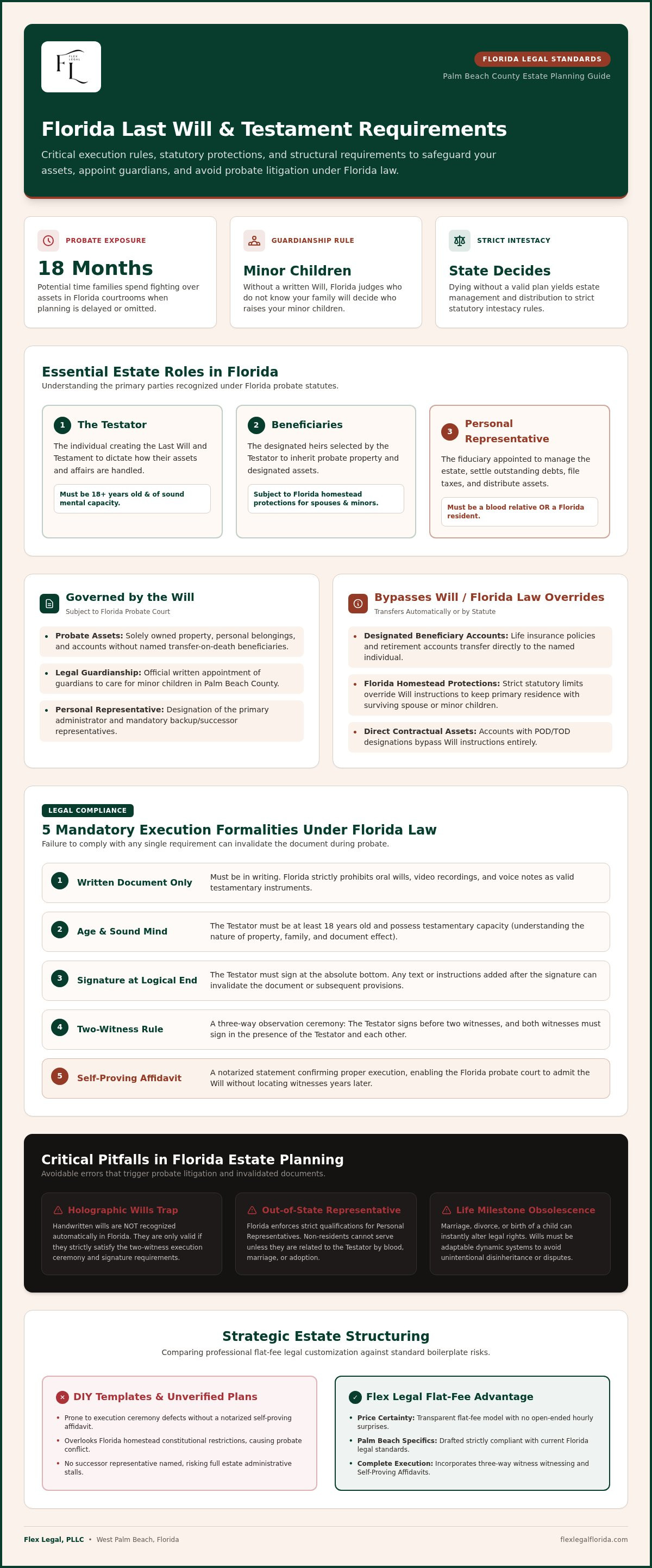
At its core, a last will and testament is a legally binding declaration that dictates how your Florida assets are handled after you pass away. It isn't just a list of belongings; it's the foundation of your legacy. For families in Palm Beach County, this document serves as the primary instrument for naming legal guardians for minor children. If you don't make this choice in writing, a judge who doesn't know your family will decide who raises your kids.
Understanding the terminology is the first step toward a solid plan. You are the Testator, the person creating the Will. Your heirs who receive assets are Beneficiaries. Finally, the individual you appoint to manage the estate's affairs is known as the Personal Representative. It's vital to recognize that a Last Will and Testament only governs "probate assets." This means items like life insurance policies or retirement accounts with named beneficiaries usually bypass the Will and go directly to the person listed on those specific accounts.
Florida law includes unique protections that you won't find in other states, specifically regarding your primary residence. Florida Homestead laws place strict restrictions on how you can distribute your home if you have a surviving spouse or minor children. Even if your Will says otherwise, the law may override your wishes to ensure your family remains housed. We help you align your Will with these complex statutes to avoid surprises during probate.
The Role of the Personal Representative in Florida
Choosing the right person to lead your estate is a major decision. Florida maintains strict residency requirements for this role. Your Personal Representative must either be a blood relative or a Florida resident. This person carries the heavy responsibility of settling your outstanding debts, filing final tax returns, and distributing assets to your heirs. Because life is unpredictable, naming a successor representative is a critical safety net. This backup ensures your estate doesn't stall if your first choice is unable or unwilling to serve when the time comes.
Why Your Florida Will Must Be Adaptable
Life moves fast, and your estate plan should keep up. Major milestones like marriage, the birth of a child, or a divorce can instantly make an old Will obsolete or even lead to unintended consequences in court. We view estate planning as a dynamic support system rather than a static set of rules. Flex Legal focuses on modern, adaptable solutions that evolve alongside your family's changing needs. To speed up the legal process, we include a Self-Proving Affidavit, which is a specific notarized statement that confirms the Will's validity and allows the probate court to accept the document without requiring the original witnesses to testify.
Legal Requirements for a Valid Will in Palm Beach County
Florida law is unforgiving when it comes to the legal formalities of a valid will. You cannot simply record a video or leave a voice note to convey your final wishes; the state strictly requires a written document. To start, the Testator must be at least 18 years old and possess a "sound mind" at the moment of signing. This mental capacity means you understand the nature of your property, the identity of your family members, and the practical effect of the document you are creating.
A unique trap for many is the requirement that the signature must appear at the "logical end" of the document. In Florida, you must sign your Last Will and Testament at the very bottom. If you add text or instructions after your signature, the court might invalidate the entire document or at least the portions that follow the signature. Strict adherence to these execution formalities is the most effective way to prevent future probate litigation and ensure your family remains protected.
The Two-Witness Rule and Notarization
Execution is a precise ceremony rather than a casual task. You must sign the document in the presence of two witnesses, and those witnesses must sign in your presence and in the presence of each other. It is a three-way observation. While a notary is not strictly required to make the Will valid, they are essential for the self-proving process. The notary verifies the identities of everyone involved and signs an affidavit that allows the probate court to accept the document without searching for witnesses decades later. DIY signing ceremonies often fail because they lack this professional oversight, leaving the document vulnerable to challenges.
Avoiding the Pitfalls of Holographic Wills
Many people believe a handwritten note is enough to secure their assets. In some states, these "holographic" wills are legal. Florida is different. A handwritten document is only valid here if it meets every single witness and signature formality required of a typed Last Will and Testament. Relying on an informal letter or a "fill-in-the-blank" kit often leads to expensive probate lawyer Palm Beach County disputes. These disputes can drain the very assets you intended to leave behind. If you want to ensure your documents are bulletproof, consulting an estate planning attorney in West Palm Beach provides the modern, professional authority needed to safeguard your legacy.
Will vs. Revocable Living Trust: Which is Best for You?
Deciding between a Last Will and Testament and a trust is one of the most significant choices you'll make for your family's future. While both documents outline how your assets should be distributed, they function very differently under Florida law. A Will is essentially a set of instructions for the probate court. Once you pass away, the document becomes a public record that anyone can access. In contrast, a revocable trust operates privately, allowing your family to settle your affairs without the prying eyes of the public or the oversight of a judge.
Think of the financial aspect as a choice between "pay now" or "pay later." A Will typically involves lower upfront legal fees. It's a straightforward starting point for many West Palm Beach residents. However, the long-term savings of a trust often outweigh the initial investment. Florida probate can easily consume months of time and a significant percentage of your estate's value in statutory fees. By using a trust, you effectively invest in a smoother, faster transition that protects your legacy from these court-mandated costs.
When a Will is the Right Choice
A Will is often the ideal solution for smaller estates or individuals who prioritize a simple, cost-effective initial plan. It's particularly vital for parents of young children. In Palm Beach County, your Last Will and Testament is the only legal document where you can nominate a guardian for your minors. Even if you choose a trust-based plan for your assets, you still need a "Pour-Over Will." This document acts as a safety net. It catches any assets you might have forgotten to title in the name of your trust and moves them into that trust after you pass away.
The Limitations of a Will in Florida
Wills have clear boundaries that you need to understand. They only take effect after your death. This means they offer zero protection if you become incapacitated due to a sudden illness or injury. To ensure someone can manage your finances while you're alive but unable to speak for yourself, you must have a durable power of attorney. Additionally, the probate process required by a Will is notoriously slow. Assets can be frozen for months while the court verifies the document's validity. For those with complex business interests or unique asset protection needs, the agile nature of a trust provides a more responsive way to manage property without the friction of the court system.
Intestacy: What Happens if You Die Without a Will in Florida?
When you die without a valid Last Will and Testament, you're essentially handing the keys to your estate over to the Florida government. This state of "intestacy" triggers a default distribution plan found in Florida Statutes 732.101-732.111. These laws dictate a strict order of succession that determines exactly who receives your property. The problem? This rigid hierarchy doesn't care about your personal relationships or your family's unique needs. It's a cold, mathematical formula that often results in assets going to people you haven't spoken to in years while leaving others with nothing.
Beyond the distribution of assets, the court also takes over the management of your estate. Without your input, a judge decides who serves as your Personal Representative. This individual will have access to your bank accounts, property, and sensitive records. In West Palm Beach, dying intestate frequently leads to increased legal fees and bitter family conflict as relatives argue over who should lead. You also risk falling into the "Florida Homestead Trap." Under these rules, your primary residence might pass to heirs in ways that make it impossible for your surviving spouse to sell or manage the property without the consent of every child, creating a logistical nightmare.
Protection for Spouses and Children
Florida law provides specific safety nets for immediate family members, even when a plan is missing. The Florida Elective Share ensures a surviving spouse cannot be entirely disinherited; they're generally entitled to at least 30% of the elective estate. Similarly, "Pretermitted" children, those born or adopted after a Will was signed, are protected from being accidentally left out. However, these rules get incredibly complex for blended families. If you have children from a previous marriage, the intestate laws split assets between your current spouse and your children in a way that often forces them to share ownership of property, which is a recipe for litigation.
The Risk to Minor Children
The most heartbreaking consequence of dying without a Last Will and Testament is the loss of control over your children's future. If both parents pass away without naming a guardian, the court determines who will raise them. This often leads to a public and expensive "Guardianship Proceeding." These proceedings are not just costly; they're emotionally draining for the children who are already grieving. You can avoid this uncertainty by taking a proactive step today. Secure your family's future and choose the right guardians for your children by scheduling a consultation to draft your Will.
Creating Your Will with Flex Legal: The Flat-Fee Advantage
Traditional law firms often hide behind hourly billing that leaves clients guessing about the final cost of their protection. We do things differently because we believe transparency is the foundation of a good partnership. Flex Legal provides absolute price certainty through flat-fee estate planning packages. This model allows us to focus entirely on your goals rather than a ticking clock. Every plan we create is customized by an experienced estate planning attorney in West Palm Beach who understands the local court system and Florida's specific statutes. We prioritize your clarity and comfort, ensuring you understand every clause of your legacy before you ever sign on the dotted line.
Our streamlined process is built for the modern world. We've removed the friction traditionally associated with legal services, replacing it with a responsive and agile approach. You won't find dense, multi-clausal jargon here. Instead, we use straightforward language to explain complex concepts. This ensures your Last Will and Testament is a dynamic tool that actually works when your family needs it most. By choosing a partner-based approach, you gain an ally who's committed to your family's long-term success rather than just a one-time transaction.
The Dangers of DIY Wills in Florida
Online templates often promise a quick fix, but they rarely account for the strict execution formalities required in Florida. A common error in these generic forms leads to "partial intestacy." This happens when a DIY document fails to address specific assets or future changes, leaving a portion of your estate to be distributed by state law instead of your personal choice. Having a legal ally is essential for spotting issues with asset titling that a software program will overlook. For example, if your home isn't titled correctly, your Will might not have the power to transfer it as you intended. It's a sobering reality that a "cheap" Will can quickly become a multi-thousand dollar probate disaster for your grieving family. Professional drafting ensures your documents stand up to the scrutiny of a Florida judge.
Next Steps: Securing Your Future
Securing your legacy shouldn't feel like an intimidating hurdle. Our consultation process is designed to be efficient and thorough, moving from your specific challenges to a clear path forward without unnecessary delays. We take the time to coordinate your Last Will and Testament with other essential documents, such as Special Needs Planning or business succession strategies. This holistic view ensures that every piece of your estate plan works in harmony. We invite you to experience an innovative and responsive approach to the law. By focusing on modern solutions and adaptable planning, we help you build a foundation that protects what matters most. Reach out today to start a conversation about your family's future.
Take Control of Your Family's Future Today
Protecting your legacy in Florida requires more than just good intentions; it demands a strategy that respects the state's rigid legal formalities. You now understand that a properly executed Last Will and Testament is your strongest defense against the delays of probate and the uncertainty of court-mandated guardianship. Whether you're choosing between a Will and a trust or simply looking to update an existing plan, the right professional support makes all the difference.
At Flex Legal, we act as your agile ally in West Palm Beach. We provide comprehensive asset protection strategies through a modern, streamlined process that prioritizes your family's comfort. You'll benefit from expert legal counsel and the total price certainty of our fixed-price packages. This approach removes the friction of traditional law firms, giving you a clear path forward without the stress of hourly billing.
Secure your legacy with a flat-fee Florida Will from Flex Legal today. Your future is too important to leave to chance, and taking this proactive step is the best gift you can give your loved ones.
Frequently Asked Questions
Does a Last Will and Testament avoid probate in Florida?
No, a Last Will and Testament does not avoid probate; it serves as the instructional guide for the court during that process. If your goal is to bypass the courtroom entirely, you would typically use a Revocable Living Trust. Assets governed by a Will must still be validated by a judge in Palm Beach County before they can be distributed to your heirs.
Who can be a witness to a Will in Florida?
Any individual who is competent to testify can serve as a witness in Florida. You must have at least two witnesses who sign the document in your presence and in the presence of each other. While Florida law allows beneficiaries to serve as witnesses, we strongly advise using disinterested parties. This choice helps prevent future claims of undue influence during the probate process.
Can I change my Will after it is signed?
You have the right to change or revoke your Will as long as you possess the mental capacity to do so. Minor updates can be handled through a legal amendment called a Codicil. For more significant changes, it's often cleaner to draft a new document that explicitly revokes all previous versions. This ensures there's no confusion about your final wishes in a Florida courtroom.
What is the difference between a Will and a Living Will in Florida?
These documents serve entirely different purposes despite their similar names. A Last Will and Testament dictates how your assets are distributed after you pass away. In contrast, a Living Will is a healthcare directive. It outlines your preferences for end-of-life medical treatment if you become incapacitated. Both are vital components of an adaptable and comprehensive estate plan for West Palm Beach families.
Does a Will need to be notarized in West Palm Beach?
A notary isn't required for the Will to be legally valid, but they're essential for creating a self-proving affidavit. This notarized statement allows the court to admit the Will to probate without tracking down your witnesses years later. Without this step, your family might face long delays and higher legal fees while the court verifies the signatures on your document.
What happens if I move to Florida with a Will from another state?
Florida generally recognizes Wills that were validly executed in another state. However, our state has specific requirements for who can serve as a Personal Representative and how Homestead property is handled. An out-of-state document might not utilize Florida's unique tax and asset protection benefits. We recommend a quick review by a local expert to ensure your plan remains fully effective here.
Can a Will be challenged in Florida probate court?
Yes, a Will can be contested in Florida on several grounds. Common challenges include claims that the testator lacked mental capacity or was under undue influence at the time of signing. Challenges also arise if the strict execution formalities weren't followed. Using a professional drafting service in West Palm Beach is the most reliable way to minimize the risk of these expensive disputes.
How often should I update my Last Will and Testament?
We recommend reviewing your estate plan every three to five years. You should also update your Last Will and Testament immediately after major life milestones like marriage, divorce, or the birth of a child. Changes in Florida's tax laws or a move to a new home also necessitate a check-in. This proactive approach ensures your plan stays agile and responsive to your current life.


Comments