
How to Fund a Special Needs Trust in Florida: A 2026 Strategic Guide

Updated: Aug 22
A signed trust document sitting in a drawer provides zero protection for a loved one with disabilities. Real security only begins when you actually move the money, but many Florida families hesitate because they fear a single administrative error will trigger a benefit cutoff. With the 2026 SSI resource limit remaining at a strict $2,000, even a small, well-intentioned inheritance can jeopardize essential Medicaid coverage.
We know that the legal requirements feel overwhelming and the stakes are incredibly high. You deserve a plan that protects your family for life without the constant stress of disqualification. This guide provides a clear roadmap on how to fund a special needs trust in Florida, ensuring every asset transfer aligns with current legal standards. We will walk through the specific steps to move property, coordinate with 2026 ABLE account updates, and maintain the precise balance needed to keep your peace of mind and your benefits secure.
Table of Contents
Understanding the Critical Role of Funding in Florida Special Needs Planning
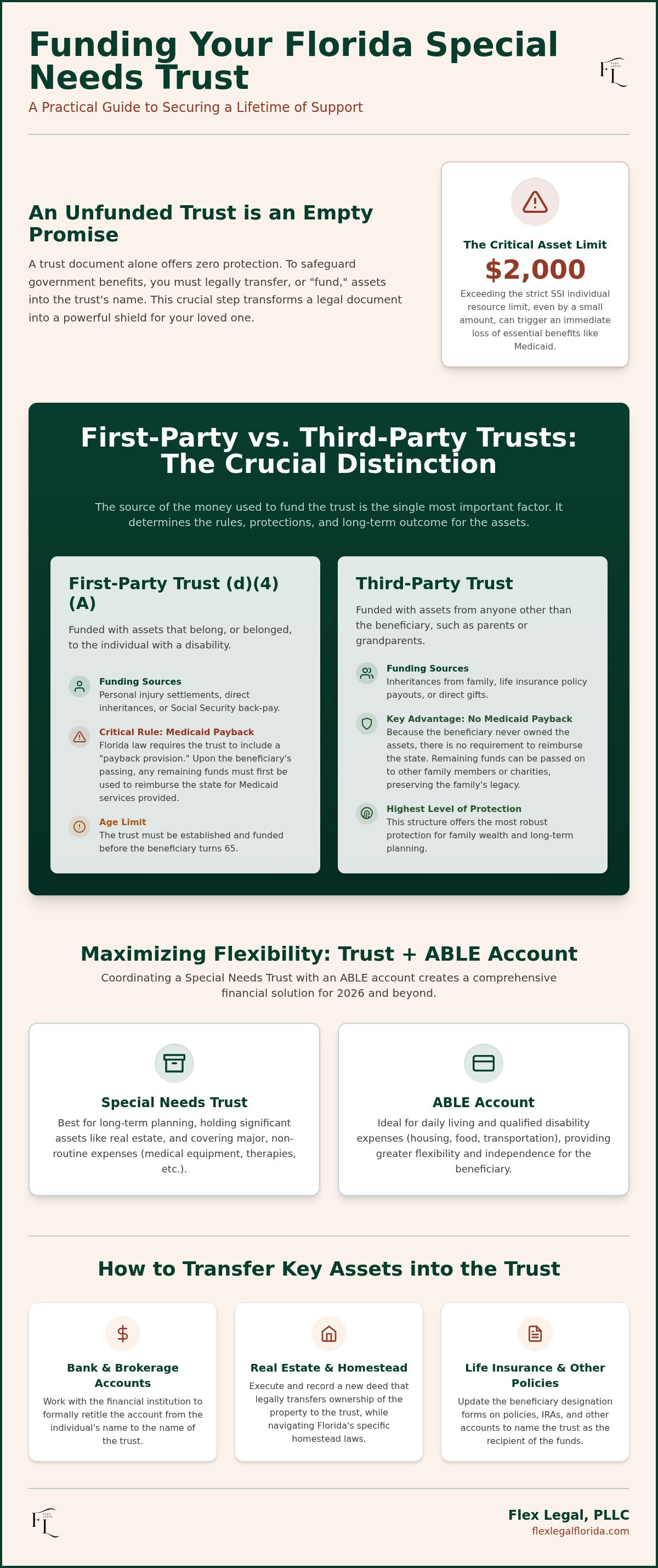
A trust document is essentially a set of instructions. Until you move assets into it, those instructions have nothing to act upon. In legal terms, this is called "funding" the trust. It involves the formal process of retitling assets from an individual's name into the name of the trust itself. Many families spend weeks perfecting the language of a Supplemental needs trust but fail at this final step. Without proper funding, the trust remains an empty shell that offers zero protection against Florida’s strict asset limits.
Understanding how to fund a special needs trust in Florida is vital because the state's regulatory environment is unforgiving. For 2026, the individual SSI resource limit remains at $2,000. If an inheritance or gift lands in the beneficiary's personal bank account instead of the trust, they face immediate disqualification from Medicaid and SSI. The funding process usually begins during specific trigger events. These include receiving a legal settlement, a life insurance payout, a direct gift from a relative, or the death of a parent who named the trust as a beneficiary in their own estate plan.
The Consequences of Improper Funding
Direct gifts are the most common pitfall. When a well-meaning family member leaves money to a child with disabilities in a standard will, that gift counts toward the $2,000 asset limit. This leads to an immediate suspension of benefits. Titling errors also rank as a top reason special needs plans fail. If an account is titled incorrectly, even by one word, the Florida Department of Children and Families (DCF) may count those funds as an available resource. This error can also expose assets to Medicaid estate recovery after the beneficiary passes away, defeating the long-term goal of the plan.
Florida-Specific Regulatory Oversight
Funding isn't a private affair. The Social Security Administration (SSA) and the Florida DCF both have the authority to review trust documents and financial statements. They examine how to fund a special needs trust in Florida and when assets were transferred to ensure the trust meets federal and state guidelines. For residents in West Palm Beach, reporting requirements are strict. You must notify these agencies when the trust is funded or when asset values change significantly. Our approach at Flex Legal focuses on these administrative details, providing the technical support needed to ensure your 2026 reporting is accurate and timely.
First-Party vs. Third-Party Funding: Choosing Your Strategy
Choosing between a first-party or third-party trust depends entirely on whose money is used to fund the account. This distinction is the most critical decision you'll make in the planning process. It dictates the specific legal language required in the trust document and determines whether the state of Florida can claim remaining funds after the beneficiary passes away. Identifying the origin of the assets is the first step in creating a functional plan. Knowing how to fund a special needs trust in Florida effectively starts with this distinction. Resources from Autism Speaks on how to fund a special needs trust highlight that coordinating these assets correctly prevents accidental benefit loss and ensures long-term stability.
Funding a First-Party (d)(4)(A) Trust
First-party trusts are funded with assets that already belong to the person with a disability. Common sources include personal injury settlements, inheritances left directly to the individual, or retroactive Social Security payments. Florida law requires these trusts to include a Medicaid payback provision. This means that when the beneficiary passes away, the trust must reimburse the state for any Medicaid expenses paid on their behalf. You must also be aware of the age 65 cutoff rule. In most cases, a first-party trust must be established and funded before the beneficiary reaches age 65 to maintain eligibility for certain programs. If you are unsure which path fits your family's situation, our team specializes in Special Needs Planning to help you decide.
Funding a Third-Party Special Needs Trust
Third-party trusts offer the highest level of protection for family wealth because they are funded with money that never belonged to the beneficiary. Typical sources include parental inheritances, life insurance policies, and gifts from extended family members. Because the beneficiary never owned these assets, Florida law does not require a Medicaid payback clause. This allows families to avoid the payback trap entirely and ensure that any remaining funds stay within the family or go to a chosen charity. Proactive planning is key here. By titling life insurance or retirement accounts directly to the trust rather than the individual, you bypass the risk of benefit disqualification.
Regardless of the funding source, Florida regulatory bodies look for adherence to the "Sole Benefit" rule. This means the trust must be structured so that every dollar spent is for the exclusive benefit of the person with the disability. This rule is a cornerstone of how to fund a special needs trust in Florida while staying compliant with the Social Security Administration and the Department of Children and Families. Clear recordkeeping and precise titling are your best defenses against future legal challenges.
Step-by-Step: How to Transfer Different Asset Types
Execution is where many well-designed plans stall. Knowing how to fund a special needs trust in Florida requires more than just a signature; it demands a systematic approach to retitling every asset you own. Financial institutions have their own internal protocols, and Florida’s unique property laws add layers of complexity that don't exist in other states. By breaking this down into specific asset classes, you can move forward with confidence and clarity.
The Mechanics of Asset Transfer
The first step is obtaining a Tax ID (EIN) from the IRS. Even if the trust is revocable for tax purposes, many banks require a separate EIN to open a new account in the trust's name. You don't usually need to provide the entire trust document to your bank. Instead, a "Certificate of Trust" acts as a condensed summary that proves the trust exists and identifies the Trustee's powers. Working closely with your financial advisor ensures that brokerage accounts are moved without triggering unnecessary tax events or liquidating investments prematurely.
Special Considerations for Florida Real Estate
Transferring a home into a trust is a delicate process in the Sunshine State. If you don't handle the transfer correctly, you risk losing the Florida Homestead tax exemption, which can lead to a massive spike in property taxes. One effective strategy is using a Lady Bird Deed. This allows you to maintain control of the property during your lifetime while automatically transferring it to the special needs trust upon your death. This method bypasses probate and protects the home from Medicaid estate recovery while keeping the homestead status intact.
Life insurance and retirement accounts require a different tactic. For life insurance, you typically name the trust as either the primary or contingent beneficiary. Retirement accounts like IRAs or 401ks are significantly more complex due to the SECURE Act. Under current rules, most non-spouse beneficiaries must withdraw all funds within 10 years. However, a properly structured special needs trust may allow for "Eligible Designated Beneficiary" status, which stretches those distributions over the beneficiary’s lifetime. This nuance is a vital part of how to fund a special needs trust in Florida when high-value retirement assets are involved. Managing property taxes and insurance for trust-owned homes also requires the Trustee to update the insurance carrier to list the trust as an "additional insured" to prevent coverage gaps.
Coordinating Funding with ABLE Accounts in 2026
The most effective Florida special needs plans in 2026 don't choose between a trust and an ABLE account. Instead, they use both in a coordinated strike. While an SNT provides long-term security for large assets, the Florida ABLE United account offers a level of spending flexibility that a trust simply cannot match. Understanding how to fund a special needs trust in Florida alongside an ABLE account allows you to bypass the restrictive "In-Kind Support and Maintenance" (ISM) rules that often slash SSI benefits.
As of 2026, the annual contribution limit for an ABLE account has risen to $19,000. This amount is tied to the federal gift tax exclusion. For Florida residents, these accounts grow tax-free and are not subject to Medicaid recovery upon the beneficiary's death if the funds were deposited after 2019. This makes the ABLE account the ideal destination for funds intended for "Food and Shelter" expenses. While the SSA no longer counts food as ISM as of late 2024, housing payments made directly from a trust still trigger a one-third reduction in monthly SSI checks. By transferring money from the trust into an ABLE account first, the beneficiary can pay for rent or utilities without any benefit reduction.
The Synergy of SNTs and ABLE Accounts
Think of the Special Needs Trust as the "feeder" for the ABLE account. The trust holds the bulk of the family's wealth, property, and life insurance proceeds. Every year, the Trustee can transfer up to $19,000 into the ABLE account to cover daily living costs. This strategy keeps the ABLE account balance below the $100,000 threshold where it would begin to count against SSI resource limits. It also simplifies record-keeping. The Trustee doesn't need to track every small transaction; they only need to document the annual transfer to the ABLE account, while the beneficiary uses an ABLE debit card for personal needs.
2026 Update: The ABLE Age Adjustment Act
A massive shift occurred on January 1, 2026. The age of disability onset for ABLE eligibility was officially raised from 26 to 46. This change opens the door for thousands of Floridians who acquired a disability later in life, such as through an accident or chronic illness. If you are integrating late-onset disability planning into your Florida estate, this expanded eligibility changes the timeline for funding. You can now use these accounts for beneficiaries who were previously excluded from the program. If you need help building this dynamic framework, our team at Flex Legal offers expert Special Needs Planning to ensure your strategy is modern and compliant.
Secure Your Legacy with Flex Legal Special Needs Planning
Legal planning shouldn't feel like a cold, rigid transaction. At Flex Legal, we’ve built a practice that values agility and transparency over traditional, intimidating formalities. Our flat-fee pricing model removes the financial guesswork often associated with estate law, allowing you to focus on your family's future instead of worrying about billable hours. We act as your modern ally, guiding you through the technicalities of 2026 regulations with a compassionate, solution-oriented approach that prioritizes your comfort.
Understanding the mechanics of how to fund a special needs trust in Florida is a vital first step, but the actual execution requires precision. Titling errors or missed reporting deadlines can have life-altering consequences for a beneficiary. We provide the steady hand you need to bridge the gap between a signed legal document and a fully protected life. By treating each plan as a dynamic support system rather than a static set of rules, we ensure your loved one's benefits remain secure as laws and life circumstances evolve.
Why a Local West Palm Beach Attorney Matters
Palm Beach County has its own specific procedural quirks in the probate and guardianship courts. Working with a local expert like Jennifer L. Flexer, Esq. ensures your plan isn't just a generic template. She understands the local landscape and the latest 2026 Florida legal standards that affect residents from Jupiter to Boca Raton. This localized knowledge helps you avoid common pitfalls like the "Florida Homestead Trap" and ensures your trust administration remains seamless within our regional market.
Starting Your Journey Today
Your path to peace of mind begins with a comprehensive assessment of your family's needs. We start by reviewing your current asset structure, from real estate to retirement accounts, to identify potential eligibility risks. This initial step is crucial for determining how to fund a special needs trust in Florida without triggering a benefit suspension. From there, we move into the drafting and execution phase, creating an adaptable legal framework tailored to your specific goals.
Our support doesn't end when the papers are signed. We stay by your side to help you navigate the funding process step-by-step, ensuring every bank account, brokerage fund, and deed is titled correctly. This partnership-based approach is designed for families who value speed, transparency, and modern communication. Schedule your consultation today to review your funding strategy and secure your legacy for the long haul.
Protecting Your Loved One’s Financial Future
A well-drafted trust is only the beginning. True security comes from the active process of retitling assets and coordinating your strategy with modern tools like ABLE accounts. By distinguishing between first-party and third-party funds, you ensure that 2026 benefit limits don't jeopardize your family's stability. Learning how to fund a special needs trust in Florida correctly is what transforms a legal document into a lifelong safety net.
At Flex Legal, we believe that high-quality special needs planning should be accessible and transparent. Our flat-fee estate planning packages provide the cost certainty your family needs; meanwhile, our deep West Palm Beach local expertise ensures your plan meets every Florida-specific requirement. We act as your agile ally, offering compassionate, modern legal support that adapts to your unique circumstances as they evolve.
Don't leave your beneficiary's eligibility to chance. Take the next step toward permanent peace of mind by working with a team that understands the high stakes of Florida trust administration. Schedule a Consultation with a Special Needs Planning Attorney today to review your funding strategy and safeguard your family's legacy for years to come.
Frequently Asked Questions
Can I fund a special needs trust with my own money for my child?
Yes, you can fund a third-party special needs trust with your own assets, such as cash, life insurance, or property. This is a primary strategy for parents who want to provide for a child without triggering the $2,000 SSI resource limit. When you are planning how to fund a special needs trust in Florida, remember that third-party funds don't require a Medicaid payback. This allows any remaining money to stay with your other heirs.
What happens if I accidentally put too much money into a Florida SNT?
There isn't a maximum legal limit on how much a third-party trust can hold. However, you should be mindful of the tax implications for undistributed income. In 2026, trust income over approximately $16,000 is taxed at the highest federal rate of 37%. While the trust can hold millions, the main concern is usually managing the tax burden rather than hitting a specific regulatory ceiling on the principal amount.
Do I need a new bank account once the trust is funded?
Yes, you must open a dedicated bank or brokerage account specifically in the name of the trust. You'll need an Employer Identification Number (EIN) from the IRS to complete this process. Co-mingling trust assets with your personal funds or the beneficiary's personal money is a major red flag for the Social Security Administration. Keeping a separate account ensures clean record-keeping and proves the assets are legally owned by the trust entity.
How does funding a trust affect my child’s Florida Medicaid eligibility?
Funding a trust correctly protects your child's Medicaid eligibility by keeping their countable assets below the $2,000 limit. When assets are retitled into the trust, they're no longer considered "available" to the beneficiary. However, the Trustee must follow strict distribution rules. If the trust pays for something Medicaid already covers, or if funds are given directly to the child, it could still result in a temporary loss or reduction of essential government benefits.
Can a special needs trust own a house in West Palm Beach?
Yes, a special needs trust can own a house in West Palm Beach or anywhere in Florida. This is often a smart move to ensure the beneficiary has a permanent, stable place to live. You must be careful to handle the transfer correctly to preserve the Florida Homestead tax exemption. A properly managed trust can pay for property taxes, insurance, and maintenance, though you should coordinate these payments to avoid reducing the beneficiary's SSI check.
Is there a limit on how much I can put into a third-party special needs trust?
Does the trust have to pay taxes on the income generated by its assets?
The Medicaid payback rule requires that any funds remaining in a first-party trust at the beneficiary's death must first go to the state of Florida. This reimburses the state for the total cost of Medicaid services provided during the person's lifetime. This rule applies specifically to trusts funded with the beneficiary's own money. In 2026, this remains a mandatory requirement for how to fund a special needs trust in Florida when using the individual's own assets.


Comments