
Special Needs Trust for Mental Illness: Florida Legal Guide

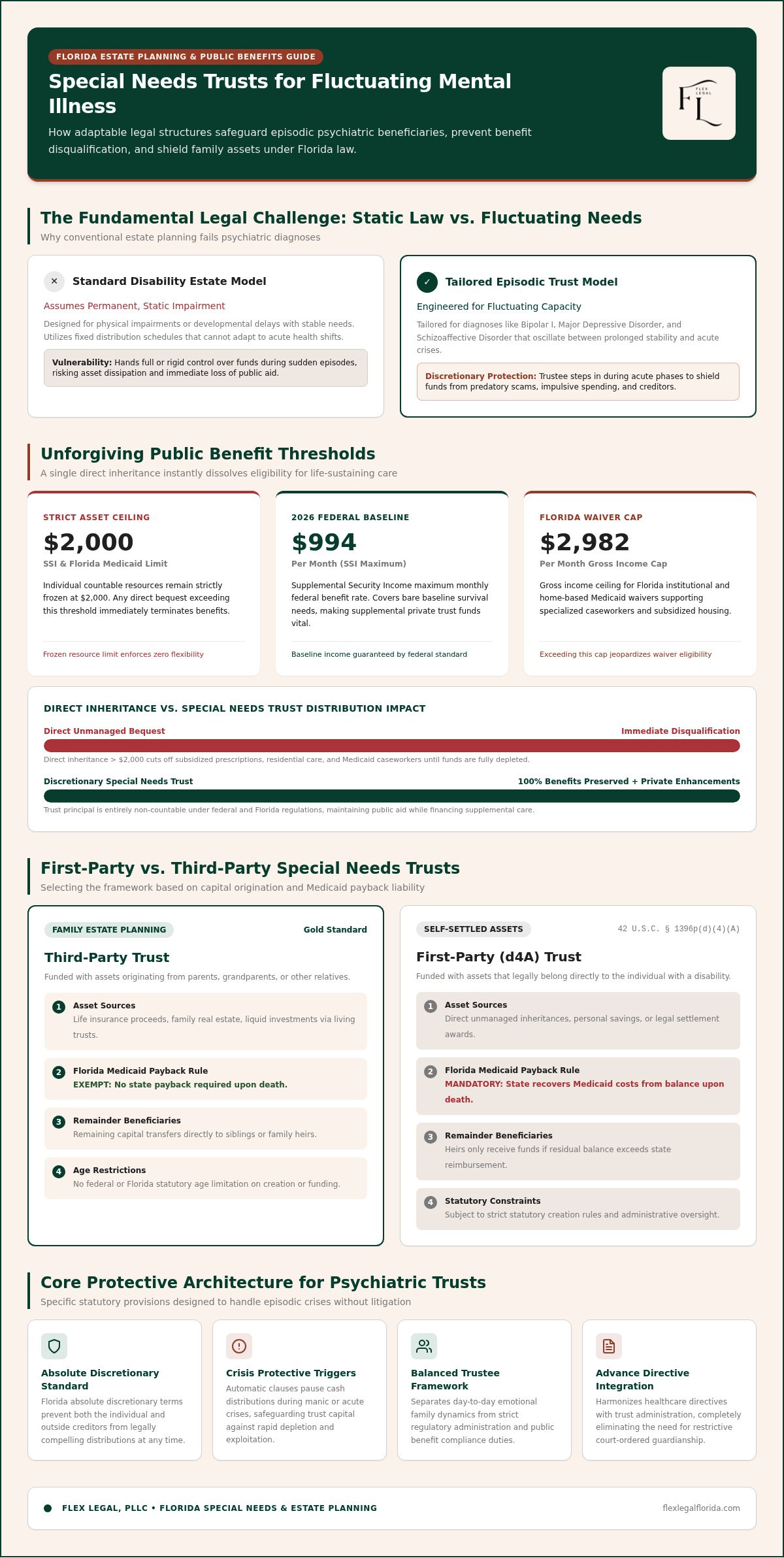
Traditional estate planning assumes a disability is static, but psychiatric conditions fluctuate between years of lucidity and sudden, acute crises. Leaving funds directly to a family member facing bipolar disorder or schizophrenia can instantly disqualify them from Medicaid or Supplemental Security Income (SSI), where individual asset limits remain frozen at just $2,000. Establishing a tailored special needs trust for mental illness provides the legal flexibility required to support their daily stability without jeopardizing critical public assistance.
You probably worry about how to handle unpredictable spending during episodes, or feel guilty about saddling healthy siblings with complex trustee duties. You aren't alone in wanting both safety and dignity for your family. In this Florida legal guide, you'll discover how to design an adaptable trust that enhances your loved one's quality of life, protects against financial exploitation, and preserves essential government benefits. We explore the specific trustee arrangements, Florida statutory safeguards, and discretionary distribution standards that turn long-term security into a practical reality.
Table of Contents
Why Mental Illness Demands a Specialized Special Needs Trust
A special needs trust for mental illness is a fiduciary framework engineered for conditions that fluctuate rather than remain constant. Most traditional estate tools assume a disability is static, such as a permanent physical impairment or an intellectual developmental delay. Psychiatric diagnoses like bipolar I disorder, major depressive disorder, and schizoaffective disorder operate along an unpredictable timeline. A beneficiary might live independently and thrive professionally for years, only to experience an acute crisis that temporarily compromises executive functioning.
Standard estate planning relies on fixed distribution schedules, but families navigating psychiatric disorders need an agile alternative. For foundational background on these legal instruments, reviewing a special needs trust overview highlights how dedicated trusts bridge private resources with public safety nets. Under Florida law, an absolute discretionary trust shields an episodic beneficiary by preventing both the individual and outside creditors from compelling distributions during vulnerable periods.
The Challenge of Episodic Capacity and Financial Vulnerability
Fluctuating cognitive capacity makes personal money management uniquely precarious. During manic, depressive, or psychotic episodes, rational risk assessment often deteriorates rapidly. Beneficiaries become prime targets for predatory scams, high-interest debt, or impulsive spending sprees that can dissolve a lifetime of savings in weeks. Leaving an outright bequest through a standard will hands total financial control to someone during an unpredictable health season. A specialized trust introduces a protective boundary, allowing a trustee to step in and steward funds securely until stability returns.
Protecting Public Benefits: Supplemental Security Income and Medicaid
Public assistance programs provide vital lifelines for psychiatric care, but their financial thresholds are unforgiving. In 2026, the Social Security Administration caps countable resources at just $2,000 for an individual receiving Supplemental Security Income (SSI), which delivers a maximum federal benefit rate of $994 per month. Florida Medicaid enforces this same $2,000 countable asset ceiling, alongside an institutional and home-based waiver gross income cap of $2,982 per month.
A direct, unmanaged inheritance immediately disqualifies your relative from these safety nets, abruptly cutting off specialized caseworkers, subsidized residential placements, and costly psychiatric prescriptions. Structuring an adaptable special needs trust for mental illness keeps trust principal entirely non-countable under federal and Florida regulations. This preserves baseline public aid while supplying private funds for uncovered medical therapies, personal comfort, and crisis intervention.
First-Party vs. Third-Party Special Needs Trusts for Mental Health
Choosing the correct framework depends on whose money funds the trust. The legal distinction between first-party and third-party trusts determines tax treatment, remainder beneficiary rights, and exposure to state recovery claims. Before committing to a structure, evaluate whether the capital originates from your own estate or already belongs to the individual.
Third-Party Special Needs Trusts for Family Estate Planning
A third-party special needs trust serves as the gold standard for parents, grandparents, and relatives planning ahead. Because the money never legally belonged to the person with psychiatric challenges, federal and state statutes do not impose an age cap or a state reimbursement requirement. Parents routinely fund these trusts through life insurance policies, real estate, or liquid investments poured over from a revocable living trust.
When the primary beneficiary passes away, remaining trust principal transfers directly to siblings or other designated heirs rather than the state. Partnering with an experienced special needs planning attorney helps families coordinate these tools with their wider goals, preserving family capital across generations.
First-Party (d4A) Trusts for Personal Assets and Direct Inheritances
A first-party trust, established under 42 U.S.C. § 1396p(d)(4)(A), holds assets that legally belong to the individual with a disability. These vehicles become necessary when a person with a diagnosis receives an uncoordinated direct inheritance, accumulates personal savings prior to a disabling episode, or secures a structured settlement from a personal injury claim.
Under federal rules outlined in the Social Security Administration POMS trust guidelines, the beneficiary must be under age 65 when the trust is established and funded. The defining tradeoff of a first-party trust is the mandatory Medicaid payback provision. Upon the beneficiary's death, Florida's Agency for Health Care Administration (AHCA) holds a first-priority claim against any remaining funds to reimburse the state for lifetime Medicaid expenses. Only residual funds left after repaying AHCA pass to family members.
Here is how the two structures compare for long-term planning:
Funding Source: Third-party trusts use outside family assets; first-party trusts hold the individual's own funds.
Medicaid Payback: Third-party trusts have zero state payback requirements; first-party trusts require total Medicaid reimbursement at death.
Remainder Control: Third-party grantors name secondary heirs freely; first-party residuals are subject to state recovery claims.
Selecting the right structure ensures your special needs trust for mental illness operates smoothly without forfeiting hard-earned wealth. If you need clarity on your family's options, connecting with Flex Legal can help you design an adaptable strategy with clear flat-fee certainty.
Essential Protective Clauses for Psychiatric and Mental Health Trusts
Drafting a special needs trust for mental illness requires precision terms that standard boilerplate templates overlook. Because psychiatric diagnoses involve fluid decision-making capabilities, the trust instrument must balance immediate protection with ongoing quality of life. Incorporating explicit drafting mechanisms shields assets from outside exploitation while empowering the trustee to respond constructively when mental health status shifts.
Absolute Discretionary Distributions and Direct Vendor Payments
Traditional trust drafting frequently relies on support formulas like health, education, maintenance, and support (HEMS). For psychiatric conditions, this language creates severe risks because it grants the beneficiary an enforceable legal right to demand funds. The Legal Information Institute's guide to special needs trusts demonstrates why absolute discretion is essential for insulating trust funds from creditor attachment and preserving eligibility.
Direct cash distributions to a beneficiary reduce their SSI dollar-for-dollar as unearned income. Trustees protect these public resources by making direct vendor payments instead. Permitted trust disbursements include:
Specialized outpatient psychiatric therapies and holistic wellness services
Direct payments to landlords, utility providers, and educational programs
Personal technology, computers, and home internet connectivity
Recreational activities, hobby supplies, and supervised travel
Navigating Relapse, Hospitalization, and Crisis Intervention Clauses
Acute psychiatric decompensation and co-occurring substance dependency require clear emergency protocols. Without specific language, a trustee might feel legally pressured to release cash during active mania, psychosis, or substance misuse. Protective screening provisions authorize the trustee to suspend discretionary non-essential distributions if a beneficiary endangers themselves or faces active addiction.
These clauses redirect trust capital toward immediate medical intervention rather than unmonitored spending. The trustee retains explicit authority to fund private residential treatment programs, hire private mental health caseworkers, or secure specialized legal counsel during involuntary commitment proceedings under Florida's Baker Act (Fla. Stat. §§ 394.451–394.4789). This structure safeguards personal safety while preserving the underlying principal.
Integrating Florida ABLE Accounts for Financial Independence
Complete financial restriction can feel demoralizing for an individual during prolonged periods of psychiatric stability. Modern estate planning solves this by pairing the master trust with a Florida ABLE United account. Under the ABLE Age Adjustment Act, individuals whose disability onset occurred before age 46 now qualify for these accounts, opening access to millions of adults managing psychiatric disorders.
Trustees can deposit funds into the beneficiary's ABLE account up to the 2026 annual limit of $20,000. Up to $100,000 retained inside an ABLE account remains completely excluded from SSI resource tests. This setup grants your loved one personal debit-card autonomy for qualified disability expenses without compromising their essential safety net.
How to Choose the Right Trustee for a Beneficiary with Mental Illness
Selecting the right fiduciary to oversee a special needs trust for mental illness is often the most emotionally charged decision in the entire process. While conventional estate administration focuses primarily on investment management, directing funds for someone with episodic psychiatric challenges requires continuous boundary setting, diplomacy, and strict adherence to benefit rules. Rushing this decision risks rupturing family bonds and jeopardizing asset protection.
The Hidden Strain of Naming Siblings or Family Members
Parents often reflexively nominate a responsible adult sibling to serve as trustee. While well-intentioned, putting a brother or sister in charge of the purse strings creates immediate interpersonal friction. When a trustee must deny unmanaged distribution requests during a manic or depressive phase, the beneficiary often interprets prudent stewardship as personal betrayal. Beyond relational fallout, family trustees shoulder personal liability under the Florida Trust Code, facing dense annual accounting obligations and strict tax reporting that easily trigger caregiver burnout.
Utilizing Professional Trustees, Co-Trustees, and Trust Protectors
A hybrid governance framework offers a modern, balanced solution. Many families in Palm Beach County select an independent corporate trust company or licensed professional fiduciary to manage technical accounting, tax compliance, and benefit rules. A family member can then serve as co-trustee or personal adviser, offering intimate insight into the individual's recovery journey without acting as the financial gatekeeper.
Florida law also permits the designation of an independent Trust Protector. This neutral third party monitors administrative performance, resolves conflicts, and holds the legal authority to replace a trustee if communication breaks down or institutional fees escalate.
When structuring your fiduciary team, work through this practical framework:
Assess emotional boundaries: Can the candidate enforce distribution limits without compromising their personal relationship with the beneficiary?
Verify compliance capability: Does the prospective trustee understand the rigid reporting standards required by SSI and Florida Medicaid?
Ensure long-term continuity: Does your succession plan account for the fact that a beneficiary may outlive individual family trustees?
Install structural checks: Does the trust document empower a Trust Protector to intervene if management falters?
When you establish a special needs trust for mental illness, separating daily family compassion from strict financial administration protects everyone involved. If you want to build a sustainable trustee framework backed by flat-fee pricing certainty, partner with Flex Legal to structure a plan that preserves family harmony.
Creating an Adaptable Florida Estate Plan with Flex Legal
Standalone wills cannot accommodate the fluid reality of psychiatric conditions. A simple last will and testament forces assets through Florida probate, causing public exposure and lengthy administrative delays before funds ever reach your family. A well-crafted special needs trust for mental illness functions best when woven into a comprehensive estate plan, ensuring immediate, private wealth transfers that protect benefits without disruption.
Integrating Companion Documents for Complete Incapacity Planning
A supplemental trust cannot operate in total isolation. Many parents establish a broader revocable trust to hold primary real estate and investments, with instructions to fund the special needs trust upon death. Parents must also protect their own decision-making capacity. Executing a comprehensive Florida durable power of attorney ensures a trusted fiduciary can manage critical financial affairs if parental health declines.
Pairing these instruments with a designation of healthcare surrogate, a living will, and a designation of pre-need guardian establishes clear decision-making authority. When these documents work in unison, families can handle mental health emergencies swiftly, avoiding the costly and intrusive oversight of formal court guardianship proceedings.
Modern, Flat-Fee Legal Guidance for West Palm Beach Families
Planning for a relative with complex psychiatric challenges involves deeply personal considerations. Flex Legal delivers an empathetic, modern alternative to stuffy, rigid legal environments. Founded by Jennifer L. Flexer, Esq., this boutique West Palm Beach firm serves families throughout Palm Beach County and across Florida with responsive, personalized counsel.
Flex Legal operates on transparent flat-fee pricing for estate planning and special needs packages, completely eliminating the uncertainty of unpredictable hourly billing. You gain an agile legal ally dedicated to designing dynamic legal safeguards tailored to your family's unique story. Scheduling an estate planning strategy session lets you put an adaptable framework in place, giving your relative lifelong protection and your family complete confidence.
Securing the future with a customized special needs trust for mental illness ensures your loved one receives consistent, compassionate support through every stage of their mental health journey.
Build a Resilient Future for Your Loved One
Navigating psychiatric conditions requires an estate plan that adapts rather than breaks under pressure. Structuring a custom special needs trust for mental illness shields vital SSI and Medicaid coverage, guards against impulsive financial decisions during acute episodes, and protects family relationships from the friction of direct money management.
You don't have to carry the weight of these complex decisions alone. At Flex Legal, founding attorney Jennifer L. Flexer, Esq., provides modern, client-focused estate planning tailored specifically to Palm Beach County families. Through transparent flat-fee packages, we deliver custom trust solutions and complete pricing certainty without the stress of unpredictable hourly billing. Take the first step toward lasting security today: Schedule a consultation with Flex Legal to build a dependable safeguard that honors your loved one's dignity and protects their future.
Frequently Asked Questions
Can a person with mental illness qualify as a beneficiary of a special needs trust?
Yes. Any individual with a diagnosed psychiatric condition that meets the Social Security Administration's definition of disability qualifies. This includes severe conditions like bipolar disorder, schizophrenia, major clinical depression, or PTSD. A formal SSI or SSDI determination is common, but even without existing benefits, families in West Palm Beach can create a third-party special needs trust for mental illness to prepare for future care needs and provide asset protection.
What happens to a special needs trust if the beneficiary recovers or improves?
The trust remains active and continues to manage disbursements according to its terms unless an explicit termination clause applies. Well-drafted trusts include adaptable conditional provisions. If your loved one achieves sustained recovery and no longer relies on means-tested assistance, the trustee can either continue managing the funds for their quality of life or, if permitted by the trust agreement, distribute the remaining principal directly to them.
Can trust funds be used to pay for psychiatric treatment or private therapy in Florida?
Yes, funding private medical and psychological care is one of the primary purposes of these trusts. Trustees can pay out-of-network psychiatrists, specialized counselors, private inpatient facilities, and alternative wellness therapies directly. Because the trustee pays providers directly rather than distributing cash to the beneficiary, these payments won't reduce SSI cash benefits or violate Florida Medicaid rules, allowing families to secure higher quality care than state programs provide.
Is a special needs trust for mental illness revocable or irrevocable?
Most third-party trusts are created as irrevocable trusts or become irrevocable immediately upon the grantor's death. First-party trusts must always be irrevocable from the start to satisfy Medicaid and SSI non-countable asset tests. If the grantor retained the power to revoke a special needs trust for mental illness and reclaim the funds at will, government agencies would treat the assets as accessible resources, immediately disqualifying the beneficiary from assistance.
How much money can you put into a special needs trust without losing SSI?
There is no legal limit on the total amount of money you can place into a properly drafted special needs trust. Whether funded with $10,000 or millions of dollars, the assets held inside the trust do not count against the strict $2,000 SSI individual resource ceiling. As long as distributions remain strictly within the trustee's sole discretion and avoid direct cash handouts, benefits remain protected.
Can a parent serve as trustee of a special needs trust for their adult child?
Yes, a parent can legally serve as the initial trustee while they remain capable. However, managing distributions for an adult child with fluctuating psychiatric symptoms can cause severe interpersonal stress. Many West Palm Beach families appoint a professional corporate fiduciary or create a co-trustee structure instead. This lets parents focus purely on their loving parental role, while an objective professional handles tax filings, government reporting, and expenditure denials.
What is the difference between an ABLE account and a special needs trust for mental health?
A special needs trust holds unlimited assets managed by a trustee, whereas an ABLE account permits the individual to control their own funds up to strict statutory limits. For 2026, standard ABLE annual contributions cap at $20,000, with balances over $100,000 counting toward SSI limits. Combining both tools gives individuals practical financial autonomy through an ABLE debit card while the trust preserves the family's broader wealth.


Comments