
Florida Living Will vs. Healthcare Surrogate: Do You Need Both in 2026?
- Kelly Mata
- Jun 7
- 12 min read

Only one in three Americans has an advance directive for health care, a statistic that often leads to avoidable family conflict and costly court-ordered guardianship. When you're facing a medical crisis, the last thing you want is for your loved ones to be guessing about your preferences or fighting over life-support decisions. It's understandable to feel confused by the specific legal terminology surrounding a Florida living will vs healthcare surrogate, especially with the 2026 introduction of new patient-directed medical orders.
We're here to help you clear up that confusion and build a plan that adapts to your life. You'll discover the critical differences between these two documents and why having both is the most effective way to secure your protection. We'll break down how a living will speaks for you in end-of-life scenarios while a surrogate acts as your advocate for broader medical choices. This guide provides a clear path to maintaining control over your care, ensuring your medical autonomy stays intact without the friction of a courtroom. It's about providing your family with clarity and yourself with the peace of mind you deserve.
Key Takeaways
Learn how a Living Will acts as your voice for specific end-of-life treatments while a Healthcare Surrogate serves as your designated advocate for broader medical decisions.
Understand the three specific medical triggers that activate a Florida Living Will and why precise legal language is vital for enforceability in 2026.
Discover the critical distinctions between a Florida living will vs healthcare surrogate and how a surrogate's authority can be structured to begin either immediately or upon incapacity.
Find out how combining these documents creates a comprehensive safety net that helps you avoid expensive court-ordered guardianship and family disputes.
Explore how a modern, flat-fee approach to planning provides a streamlined path to securing your medical autonomy without the complexity of traditional legal models.
Table of Contents
Understanding the Core Difference: The Voice vs. The Advocate
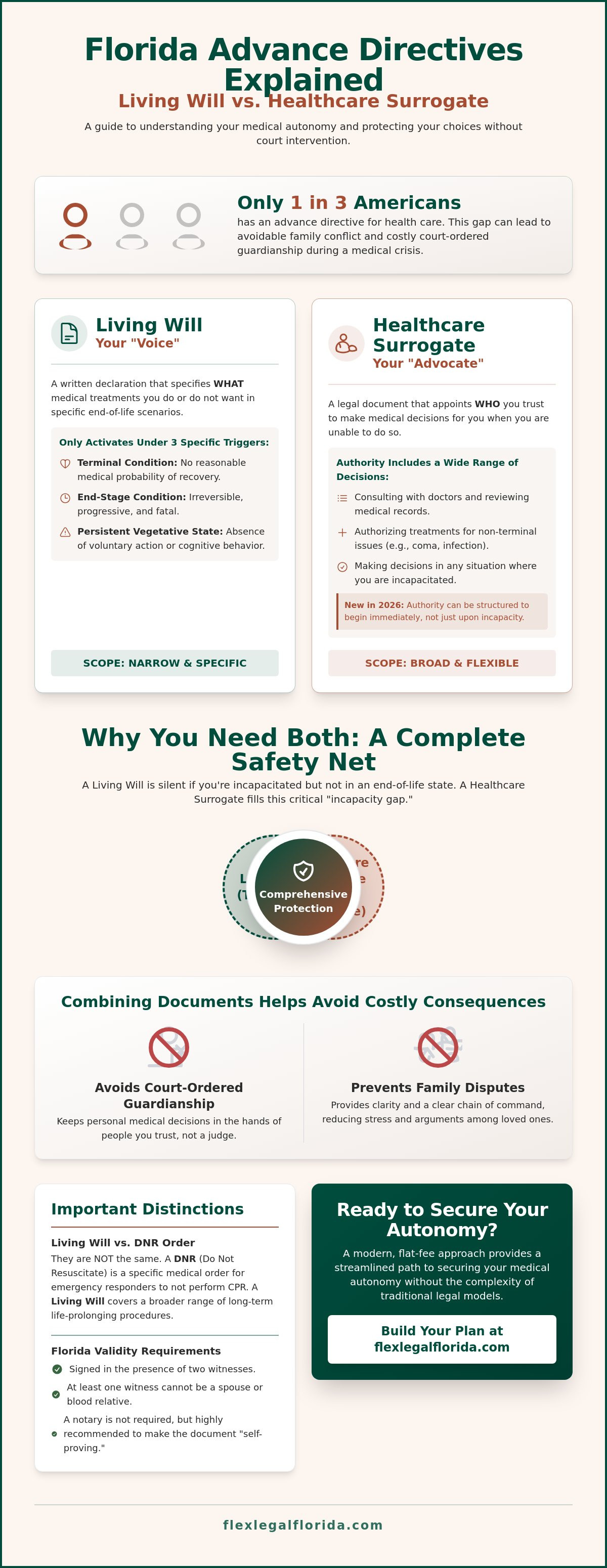
When you begin planning for the future, it's easy to assume one medical document covers everything. However, Florida law, specifically Chapter 765 of the Florida Statutes, treats these as two distinct legal instruments. Understanding the distinction is the first step toward true protection. Think of it this way: a living will is your "voice" for specific medical treatments, while a healthcare surrogate is your "advocate" for the person making the decisions. To get a foundational look at how these roles fit into broader planning, Understanding the Core Difference involves looking at how advance directives function as a whole to protect your autonomy.
The primary reason for the Florida living will vs healthcare surrogate debate is the "incapacity gap." A living will is powerful, but its scope is intentionally narrow. It only activates during specific end-of-life scenarios. If you're incapacitated but not in a terminal state, your living will remains silent. This is where the surrogate steps in. Without a designated advocate, your medical care could stall or end up in the hands of a court-appointed guardian. By having both, you ensure that your wishes are followed and that someone you trust has the legal authority to act on your behalf in any medical situation.
What is a Florida Living Will?
A Florida living will is a written declaration that focuses on "what" happens during specific medical crises. It outlines your instructions regarding life-prolonging procedures like feeding tubes, ventilators, or blood transfusions. This document only takes effect under three specific triggers: a terminal condition, an end-stage illness, or a persistent vegetative state. It acts as your direct set of orders to physicians. It ensures that your preferences regarding life support are honored even when you can't communicate them yourself. It's a proactive way to prevent being kept on life support against your wishes.
What is a Florida Healthcare Surrogate?
A Designation of Healthcare Surrogate focuses on "who" manages your care. This document identifies a trusted individual to make medical decisions for you when you're unable to do so. Unlike a living will, a surrogate's authority is broad. They can consult with doctors at hospitals in West Palm Beach, access your private medical records, and authorize treatments for non-terminal issues, such as a temporary coma or a severe infection. In 2026, you can even choose to make this authority effective immediately, allowing your surrogate to help you navigate complex medical systems even while you're still competent.
Deep Dive into the Florida Living Will: End-of-Life Specifics
A Florida living will isn't a general medical document. It's a precise tool designed for specific, high-stakes moments. In the ongoing discussion of a Florida living will vs healthcare surrogate, this document serves as your definitive instruction manual for physicians. It only activates when your attending physician and one other consulting doctor certify that you are in a terminal condition, an end-stage condition, or a persistent vegetative state. Understanding these Florida Living Will: End-of-Life Specifics ensures your intent isn't lost in medical jargon when you can no longer speak for yourself.
The role of the attending physician is critical here. They act as the gatekeeper who determines if the clinical triggers mentioned in your document have been met. This safeguard prevents the document from being used prematurely during treatable illnesses. Many people also confuse a living will with a Do Not Resuscitate (DNR) order. They aren't the same. A DNR is a specific medical order, typically on yellow paper, that tells emergency responders not to perform CPR. A living will covers a much broader range of long-term life-prolonging procedures, such as ventilators and dialysis, focusing on how you want to be treated over days or weeks.
Legal Requirements for Validity in Florida
To be valid in Florida, your document must be signed in the presence of two witnesses. At least one of these witnesses cannot be your spouse or a blood relative. While you don't legally need a notary, having one makes the document "self-proving," which can significantly speed up the process in a hospital setting. It's also vital to keep your Living Will updated as medical technology evolves and your personal values change. If you're looking for a streamlined way to handle these documents, we can help you create a plan that fits your current life.
Common Instructions Included in a Living Will
Most people use this document to address artificial nutrition and hydration, commonly known as feeding tubes. You can choose whether you want these interventions if they are only delaying an inevitable death. You can also specify your desire for palliative care. This ensures doctors prioritize your comfort and pain management above all else, even if they stop curative treatments. Finally, you may include organ donation wishes to provide a complete picture of your end-of-life plan to your medical team and family.
The Healthcare Surrogate: Empowering Your Medical Advocate
A Designation of Healthcare Surrogate is your proactive choice of a medical advocate. Unlike the living will, which acts as a static set of instructions, your surrogate is a dynamic representative who can react to changing medical circumstances. In the context of a Florida living will vs healthcare surrogate, the surrogate provides the human element necessary to navigate complex hospital systems. Since 2015, Florida law has allowed you to grant this authority immediately. This means your surrogate can help you right now, rather than waiting for a doctor to declare you incapacitated. For a deeper look at how these roles function, Florida's official guide to advance directives provides a clear framework for these designations.
Your surrogate's primary duty is to exercise "substituted judgment." This isn't about what the surrogate thinks is best. Instead, they must make the decision they believe you would make based on your known values and religious beliefs. It's a high standard of care that requires deep trust. It's also distinct from a Durable Power of Attorney, which primarily focuses on managing your financial and legal affairs. While a DPOA can sometimes include medical powers, having a separate, dedicated healthcare surrogate ensures your medical advocate has a clear, undisputed mandate in a hospital setting.
Choosing the Right Surrogate
Selecting your advocate requires more than just picking a close relative. You need someone with emotional stability who can handle high-pressure environments. Proximity to West Palm Beach is also a major factor. If a crisis occurs at a local facility, you want a surrogate who can be physically present to consult with doctors. We often advise against naming co-surrogates. While it sounds fair to name two children, it often leads to medical gridlock if they disagree. It's much safer to name one primary surrogate and a successor as a backup safety net.
The Surrogate's Legal Powers in 2026
Your surrogate holds significant power under Florida law. They provide informed consent for surgeries, psychiatric treatments, and even experimental medical trials. They also have the right to transfer you between facilities or move you into hospice care if that aligns with your wishes. For families involved in Special Needs Planning, the surrogate plays an even more vital role. They ensure that medical decisions remain consistent with long-term care goals and government benefit eligibility. This level of coordination is why we treat these documents as part of an adaptable, modern support system.
Why You Need Both: Avoiding the Florida Guardianship Trap
If you don't choose your medical representatives, the state of Florida will do it for you. Under the "default" surrogate law, a specific hierarchy of family members is granted decision-making power. This might sound convenient, but it often triggers the very family friction you want to avoid. When multiple relatives have equal standing, disagreements can quickly escalate into Probate Litigation or a formal guardianship proceeding. By proactively addressing the Florida living will vs healthcare surrogate distinction, you keep these personal decisions within your inner circle.
In Palm Beach County, guardianship is a public, restrictive, and often expensive court process. A judge decides who manages your life, and the costs are typically paid out of your own assets. According to national estimates, over 1.3 million adults are currently under guardianship, managing more than $50 billion in assets. Florida reports some of the highest guardianship caseloads in the nation. Having both documents creates a synergy that protects you: the living will provides the instructions, while the surrogate provides the authority to execute them. This combination is your best defense against court intervention.
Preventing Family Conflict
Conflict often arises from "verbal" wishes that family members remember differently. These discrepancies can tear families apart during an emotional crisis. By documenting your preferences, you remove the "decisional burden" from your loved ones. They don't have to wonder if they're doing the right thing; they simply have to follow your written lead. This is especially critical for non-traditional families or domestic partners who may not have legal standing under Florida's default laws without these specific designations.
Integrating Incapacity Planning into Your Estate Plan
Effective planning isn't just about who gets your house. It's about who protects you while you're still here. These medical documents work in tandem with a Revocable Living Trust to provide a seamless transition of care. We also recommend including a Designation of Pre-Need Guardian. This acts as a final backstop, telling the court exactly who you'd want as a guardian if a proceeding ever became necessary. If you're ready to secure your future, schedule a consultation with our West Palm Beach team.
Implementing Your Plan with Flex Legal in West Palm Beach
Securing your future shouldn't feel like a burden. At Flex Legal, we've reimagined the legal experience to be as streamlined and responsive as the lives our clients lead in Palm Beach County. Deciding between a Florida living will vs healthcare surrogate is a vital first step, but the real value lies in how those documents are integrated into your specific life story. We move away from the rigid, intimidating atmosphere of traditional firms, offering a partnership based on clarity and modern solutions.
Our approach is built on transparency. We utilize a flat-fee model for our incapacity documents, ensuring you know exactly what to expect without the stress of hidden costs or billable-hour surprises. We reject "cookie-cutter" forms that fail to account for the nuances of your family dynamics or specific medical preferences. Instead, we provide customized planning that evolves with you. Whether you're focused on protecting a partner or ensuring your medical advocate has immediate authority, our process is designed to be efficient and effective.
The Flex Legal Advantage: Professionalism Meets Accessibility
When you work with us, you get direct access to Jennifer L. Flexer, Esq. This isn't a distant institution where you're just another file number. You'll receive a personalized strategy that translates complex Florida statutes into plain English. We prioritize adaptability because we know your needs in 2026 might look different than they did a few years ago. Our goal is to act as your agile ally, providing the confidence that your plan is legally robust and easy for your family to follow during a crisis.
Next Steps for Your Peace of Mind
Getting started is simple. Before your consultation, take a moment to gather your thoughts on who you trust most to speak for you. Ask yourself if your current representatives still align with your values. If you already have documents, it's time for a professional review. A document that is five years old might be outdated by 2026 standards, especially given the recent shifts in how Florida handles immediate surrogate authority. We invite you to book your flat-fee consultation today to ensure your medical autonomy is fully protected by a plan that works as hard as you do.
Secure Your Medical Autonomy
Choosing between a Florida living will vs healthcare surrogate isn't a matter of "either/or." It's about building a layered defense for your medical autonomy. You now understand how the living will provides direct instructions for end-of-life care, while the surrogate acts as your trusted advocate for all other medical decisions. Together, these documents serve as a vital safeguard against the restrictive and public guardianship process that often follows a lack of clear planning. This proactive approach keeps your most personal decisions out of the courtroom and in the hands of those you trust.
Your peace of mind shouldn't be stalled by legal jargon or unpredictable costs. With expert guidance from Jennifer L. Flexer, Esq., you can navigate these choices with confidence. We offer local West Palm Beach expertise and transparent flat-fee pricing to ensure your plan is both professional and accessible. Our focus is on providing a streamlined experience that respects your time and your values.
Secure your future with a flat-fee incapacity plan from Flex Legal today.
Taking this step now means your family won't have to face impossible questions later. It's a gift of clarity for them and a guarantee of dignity for you. We look forward to helping you build a plan that adapts to your life.
Frequently Asked Questions
Is a Florida living will legally binding?
Yes, a Florida living will is a legally binding document when it's signed in the presence of two witnesses. Under Chapter 765 of the Florida Statutes, physicians are required to follow these instructions or transfer your care to a provider who will. This legal weight ensures that your medical team honors your choices regarding life-prolonging procedures without requiring a court order or family consensus.
Can my healthcare surrogate override my living will?
No, your surrogate cannot override the specific instructions you've outlined in your living will. When evaluating a Florida living will vs healthcare surrogate, it's important to remember that the living will is your final word on end-of-life treatments. Your surrogate's role is to advocate for those specific wishes and make decisions for other medical situations that don't meet the living will's narrow clinical triggers.
What is the difference between a healthcare power of attorney and a healthcare surrogate in Florida?
Florida law uses the term "Designation of Health Care Surrogate" instead of "Healthcare Power of Attorney," though they serve similar purposes. While some other states combine medical and financial powers into a single power of attorney, Florida provides a specific statutory framework for medical surrogates. This distinction ensures your advocate has clear, recognized authority in local medical facilities without the ambiguity that generic out-of-state forms might create.
Do I need a lawyer to create these documents in West Palm Beach?
You aren't legally required to hire a lawyer, but professional guidance ensures your documents are enforceable and tailored to your unique family situation. Self-help forms often lack the specific language needed to address immediate surrogate authority or the latest 2026 medical order updates. We provide a streamlined, flat-fee approach that replaces "cookie-cutter" templates with a plan that actually works when your family needs it most.
What happens if I move out of Florida after signing these documents?
Most states have reciprocity laws that recognize out-of-state advance directives if they were validly executed where you lived. However, medical providers in a new state might not be familiar with Florida's specific legal terminology. If you relocate, you should have a local attorney review your plan to ensure it meets the new state's specific requirements for witnesses or notarization to avoid delays in an emergency.
Can I change or revoke my healthcare surrogate at any time?
Yes, you can change or revoke your surrogate designation at any time as long as you are of sound mind. You can do this by executing a new document, providing a written revocation, or even through a clear oral statement to your physician. We recommend reviewing your documents every few years or after major life events to ensure your designated advocate is still the person best suited for the role.
Does a living will apply if I am in a coma but not terminal?
A living will only applies if your coma is medically diagnosed as a persistent vegetative state or is part of a terminal condition. If you are in a temporary coma with a chance of recovery, the living will remains inactive. In this scenario, your healthcare surrogate takes the lead, making decisions about your treatment and care until you regain consciousness and can speak for yourself again.
Who should keep copies of my Florida health care documents?
You should provide copies to your designated surrogate, your primary care physician, and any specialists you see regularly. It's also wise to ensure your local West Palm Beach hospital has a copy on file in their digital records. Keep your original documents in an accessible place at home, and tell your loved ones exactly where to find them. Avoid hiding them in a safe deposit box where they might be unreachable during a weekend crisis.


Comments