
Florida Guardianship Attorney Guide: Navigating Court Processes in 2026

Florida guardianship is a legal measure of absolute last resort, not a standard family solution. If you're facing a sudden medical crisis or cognitive decline in your family, you might wonder whether court intervention is legally mandatory or if existing estate documents are enough. Under Florida law, every petitioner seeking appointment as a guardian must be represented by counsel. Partnering with an agile guardianship attorney ensures that your loved one's constitutional rights remain guarded while you seek the appropriate level of protective care.
It's completely natural to feel overwhelmed by the prospect of examining committees, courtroom hearings, and the heavy fear of stripping away someone's autonomy. You want security for your loved one without compromising their dignity. In this guide, you'll discover how Florida legal guardianship works in 2026, when court action is strictly required, and how a dedicated attorney protects your family through each phase. We'll examine statutory incapacity standards, explore less restrictive planning alternatives, and review mandatory compliance filings so you can move forward with absolute clarity.
Table of Contents
What Is Florida Legal Guardianship and When Is It Needed?
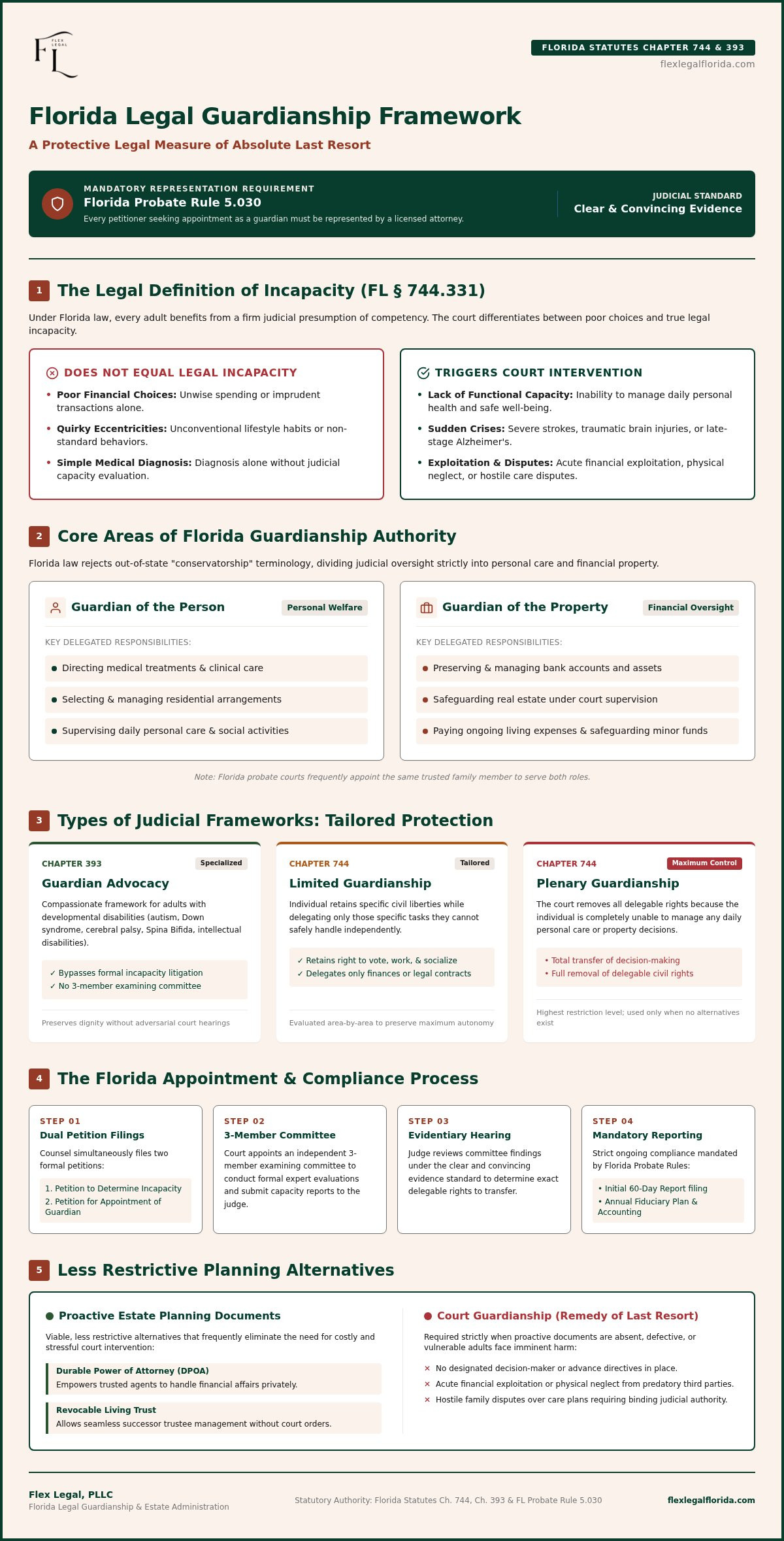
Under Chapter 744 of the Florida Statutes, legal guardianship is a court-supervised process where a judge transfers specific decision-making rights from an adult who lacks cognitive capacity to an appointed surrogate. Unlike routine caregiving, establishing legal guardianship strips away fundamental constitutional rights, such as voting, managing real estate, or directing medical treatments. Sudden crises frequently trigger these filings, including severe strokes, traumatic brain injuries, or late-stage Alzheimer's disease. Because the removal of personal liberty is so profound, Florida law strictly establishes guardianship as a protective remedy of last resort. Partnering with a responsive guardianship attorney gives families clear direction on whether this comprehensive court framework is genuinely required.
The Legal Definition of Incapacity Under Florida Law
Florida Statute Section 744.331 defines incapacity through a formal judicial proceeding rather than a simple medical diagnosis. Crucially, the court differentiates between poor financial choices, quirky eccentricities, and true legal incapacity. Every adult in Florida benefits from a firm judicial presumption of competency. To overturn that presumption, clear and convincing evidence must demonstrate that the person lacks the functional capacity to manage their property, attend to their personal health, or make safe decisions for their daily well-being.
Why Florida Requires Court-Appointed Guardians
The court steps in when an incapacitated individual lacks existing estate documents or has no designated decision-maker to manage urgent affairs. In other instances, formal intervention becomes non-negotiable when a vulnerable adult faces acute financial exploitation or physical neglect from predatory third parties. Guardianship also provides a legally binding mechanism to break hostile family disputes over care plans or living arrangements. In these tense moments, an experienced guardianship attorney helps you balance urgent family protection with rigorous respect for your loved one's remaining autonomy.
Types of Guardianship in Florida: Person, Property, and Guardian Advocacy
Florida law rejects the out-of-state concept of conservatorships, dividing protective court authority strictly into two core areas: person and property. When you evaluate official Florida Courts guardianship information, you will see that judicial authority is carefully compartmentalized to ensure vulnerable residents retain as much personal freedom as possible. The system also handles minors who receive lawsuit settlements or inherit assets over statutory limits, requiring a guardian of the property to safeguard the funds until adulthood. Working with an adaptable guardianship attorney helps your family identify the precise category that provides safety without overreaching.
Guardian of the Person vs. Guardian of the Property
A guardian of the person oversees daily personal welfare, making decisions regarding residential care, medical treatments, and social activities. Conversely, a guardian of the property manages financial affairs, including paying living expenses, managing bank accounts, and preserving real estate under court supervision. While they are distinct legal roles, Florida probate courts frequently appoint the same trusted family member to handle both functions for cohesive administration.
Limited Guardianship vs. Plenary Guardianship
Florida requires judges to evaluate capacity area by area, creating tailored structures instead of blanket rulings:
Limited Guardianship: The individual retains specific civil liberties, such as the right to vote, work, or decide who visits them, while delegating only those tasks they cannot safely handle alone, like managing finances or entering legal contracts.
Plenary Guardianship: The court removes all delegable rights because the individual cannot manage any daily personal care or property decisions.
Florida Guardian Advocacy for Adults with Developmental Disabilities
Florida Statute Chapter 393 offers a compassionate framework for young adults with developmental conditions like autism, intellectual disabilities, cerebral palsy, Spina Bifida, or Down syndrome. Guardian Advocacy bypasses formal incapacity litigation and examining committee evaluations entirely. This streamlined process allows parents to maintain essential decision-making authority as their child turns 18. Aligning this setup alongside a special needs planning attorney ensures public benefits remain secure. If you want to clarify the right path for your loved one, you can explore modern options with Flex Legal for responsive guidance.
The Florida Guardianship Appointment Process: What Families Must Expect
Initiating formal legal guardianship involves a rigorous dual-track procedure designed to protect personal liberties. Your attorney begins by submitting two distinct filings simultaneously in probate court: a Petition to Determine Incapacity and a Petition for Appointment of Guardian under Florida Statutes Chapter 744. The moment these documents reach the docket, the court appoints an independent attorney to represent the alleged incapacitated person. This court-appointed counsel acts as a zealous advocate, ensuring the individual's voice is heard and their civil rights remain defended throughout the entire process. Partnering with a responsive guardianship attorney keeps this multi-step pathway organized, efficient, and transparent for your family.
The Role of the Court-Appointed Examining Committee
Unlike many states that rely on a single doctor's note, Florida requires a comprehensive evaluation by an independent three-member examining committee. State law mandates that at least one member is a licensed physician, while the other two are typically psychologists, gerontologists, or registered nurses. Each clinician performs independent physical, mental, and functional evaluations to assess daily cognitive tasks, such as managing money or directing medical care. Each expert then submits a detailed written report directly to the presiding probate judge, recommending whether specific rights should be retained, partially limited, or delegated.
Court Hearings, Letters of Guardianship, and Fiduciary Bonding
The evaluations culminate in a formal adjudicatory hearing before a circuit judge in the probate division. The court reviews the committee's clinical findings to determine whether incapacity is established by clear and convincing evidence. If that high evidentiary threshold is satisfied, the judge designates the guardian and issues Letters of Guardianship, the official court orders granting legal power to act on the person's behalf.
Before managing any finances, a guardian of the property must obtain a fiduciary surety bond. The judge sets this bond amount based on the total value of the ward's liquid cash and personal assets to safeguard against loss. Working alongside an adaptable guardianship attorney ensures every background filing, hearing preparation, and bond application satisfies statutory standards without delay.
Exploring Less Restrictive Alternatives to Florida Guardianship
Florida probate courts are legally required to deny a guardianship petition if an adequate, less restrictive alternative exists. Judicial intervention strips personal liberties and exposes sensitive medical records and financial affairs to public scrutiny. Private lifetime management preserves a loved one's dignity while avoiding annual court accountings, mandatory bonding fees, and routine status filings. An agile guardianship attorney always reviews existing legal instruments first to determine whether a family can resolve a crisis without initiating a full courtroom proceeding.
Comprehensive Advance Directives and Powers of Attorney
Executing a valid durable power of attorney in Florida authorizes a chosen agent to manage real estate, pay recurring bills, and handle banking transactions without court oversight. To handle medical emergencies, a designation of health care surrogate and a living will empower trusted advocates to direct medical treatments and end-of-life choices. Florida statutes require state financial institutions to accept properly drafted powers of attorney, providing reliable operational security while enforcing statutory fiduciary duties to protect vulnerable seniors against financial abuse.
Revocable Living Trusts and Designated Pre-Need Guardians
A well-funded Florida revocable living trust provides seamless asset administration if an individual experiences cognitive decline. Successor trustees step in immediately to manage trust-owned property under private fiduciary terms, entirely bypassing formal incapacity adjudications and contested probate petitions.
To prepare for unforeseen situations where court involvement is unavoidable, individuals can file a designation of pre-need guardian. This document formally names your preferred guardian before mental incapacity develops, creating a strong legal presumption that the court must follow. If you want to put proactive safeguards in place or evaluate existing documents, contact Flex Legal to discuss adaptable estate planning options.
Why You Must Hire a Guardianship Attorney in Florida
Florida law takes fiduciary accountability seriously, making legal representation mandatory for court-appointed guardians. Under Florida Probate Rule 5.030, every guardian must be represented by an attorney admitted to practice in Florida unless the guardian is an attorney themselves. This mandate exists because a guardian acts as an officer of the court, managing someone else's personal autonomy and financial estate. Engaging an agile guardianship attorney isn't merely practical advice; it's a non-negotiable statutory requirement from the initial filing through final discharge.
Florida Probate Rule 5.030 and Fiduciary Mandates
Under Rule 5.030, individuals cannot represent themselves pro se when petitioning for or serving as a guardian. Your attorney represents you in your official fiduciary capacity, keeping you compliant with rigid statutory deadlines. Within 60 days after the letters of guardianship are signed, the guardian must file an initial verified inventory of property or an initial guardianship plan detailing personal care arrangements.
Courts enforce these requirements strictly. Missing deadlines, spending funds without prior judicial approval, or submitting inaccurate reports can trigger fiduciary surcharge actions, personal financial liability, or immediate removal by the judge. Ongoing duties include filing detailed annual accountings for property and annual plans for personal care, requiring precise tracking throughout the year.
How Flex Legal Guides Palm Beach County Families
Flex Legal, PLLC delivers an approachable, forward-thinking approach for families facing sensitive court proceedings across South Florida. Founded by West Palm Beach attorney Jennifer L. Flexer, Esq., the firm combines local Palm Beach County probate court experience with clear, transparent counsel designed to reduce emotional strain. As an agile guardianship attorney, Jennifer L. Flexer provides steady direction through every stage of court supervision.
Incidents requiring court intervention rarely happen in isolation. Flex Legal seamlessly connects guardianship proceedings with broader estate solutions, including trust management and Palm Beach County probate administration. Instead of treating your situation as a rigid transaction, we act as a trusted legal partner, shielding your family from procedural pitfalls and keeping you fully protected under Florida law.
Protecting Your Loved One's Rights and Well-Being
Facing a family incapacity crisis brings immense emotional weight, but you don't have to navigate Florida's complex legal system alone. While guardianship offers vital protections for vulnerable adults, it remains a measure of last resort. Proactive planning alternatives often provide the security your family needs while preserving personal independence. When court proceedings are unavoidable, adhering to statutory deadlines and fiduciary duties is critical to protecting your loved one's assets and constitutional dignity.
Partnering with a responsive guardianship attorney transforms an intimidating judicial process into a clear, manageable path forward. At Flex Legal, PLLC, founding attorney Jennifer L. Flexer, Esq. delivers a modern, client-centered approach tailored to Palm Beach County courts. Whether you need immediate advocacy in an incapacity proceeding or wish to explore comprehensive trust and special needs planning, our firm serves as an agile ally for your family. Take the next step toward lasting peace of mind and schedule a confidential consultation with Flex Legal today.
Frequently Asked Questions
Can you file for guardianship in Florida without an attorney?
No, you cannot file for or serve as a guardian without legal counsel under Florida Probate Rule 5.030. Florida courts strictly prohibit non-attorneys from representing wards pro se because guardians act as fiduciaries managing another person's rights and property. In West Palm Beach probate court, judges require a licensed guardianship attorney to prepare the petitions, manage examining committee coordination, and ensure every statutory filing complies with state law from day one.
What is the difference between a guardian of the person and a guardian of the property in Florida?
A guardian of the person oversees personal and medical care, while a guardian of the property manages financial assets. The guardian of the person decides living arrangements, healthcare treatments, and daily social needs. The guardian of the property collects income, pays debts, safeguards real estate, and maintains strict judicial accounting. Palm Beach County judges often appoint the same relative to both roles, though they remain distinct legal offices under Florida law.
What does the Florida guardianship examining committee do during an incapacity proceeding?
The three-member committee assesses whether an individual can safely manage their personal care and financial affairs. Appointed by the circuit court, the team includes one physician and two qualified medical or psychological experts. Each clinician conducts an independent functional examination of the alleged incapacitated person. They submit individual written evaluations directly to the presiding judge, detailing which specific civil rights should be retained, delegated to a guardian, or partially limited.
Can a durable power of attorney prevent the need for court guardianship in Florida?
Yes, a valid durable power of attorney frequently eliminates the need for court guardianship by establishing trusted decision-makers in advance. Florida probate courts must dismiss guardianship petitions if a suitable, less restrictive alternative exists. When paired with a healthcare surrogate designation, a properly drafted power of attorney empowers your chosen agent to manage finances and medical care seamlessly, completely bypassing costly public incapacity litigation in West Palm Beach.
What is Florida Guardian Advocacy and who qualifies for it?
Florida Guardian Advocacy is a streamlined alternative under Chapter 393 designed for adults with specific developmental disabilities. Qualifying individuals must have a diagnosis of autism, intellectual disability, cerebral palsy, Spina Bifida, or Down syndrome manifest before age 18. This framework allows parents to maintain legal authority without declaring their child legally incapacitated. It avoids stressful medical committee examinations while providing essential judicial backing to direct medical and personal care.
Who pays the legal fees for a Florida guardianship proceeding?
In Florida, attorney fees and court costs are typically paid from the ward's assets, provided the petition was filed in good faith. The court must review and approve all legal fee applications before any disbursements occur from the ward's accounts. If the ward has insufficient funds or if an individual petitions in bad faith, the court may order the petitioner to pay those expenses personally.
What are the annual reporting duties required of a Florida legal guardian?
Florida legal guardians must file comprehensive annual reports with the clerk of court to maintain accountability. A guardian of the person files an annual plan updating the ward's physical, medical, and residential status. A guardian of the property files a detailed annual accounting documenting every dollar received and spent with supporting receipts. Working with a West Palm Beach guardianship attorney ensures these filings meet strict probate deadlines and avoid fiduciary liabilities.


Comments