
Florida DIY Will Mistakes: Why Online Forms Fail in 2026
- Kelly Mata
- Aug 7
- 13 min read

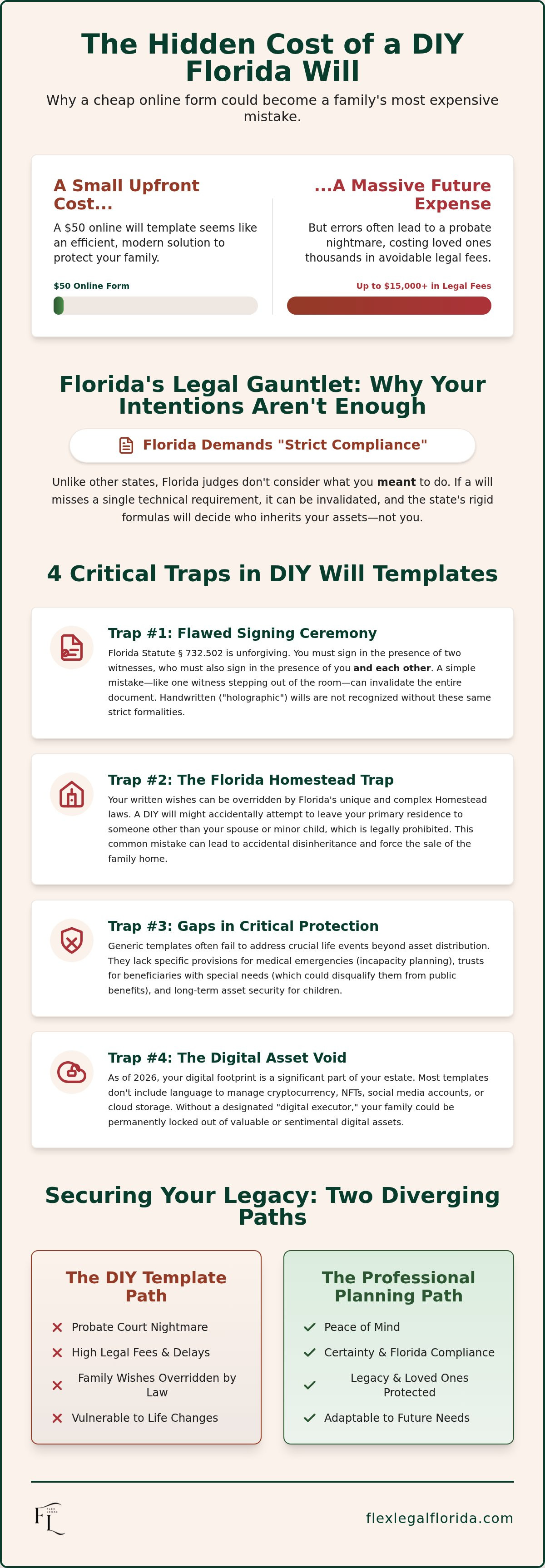
What if the $50 online form you bought to protect your family actually ends up costing them $15,000 in avoidable legal fees? It’s completely understandable why you’d want to skip the traditional law firm experience. Between the intimidating jargon and the fear of high costs, clicking "download" on a template feels like an efficient, modern solution for a simple estate. You want to do right by your spouse and children without getting tangled in red tape.
However, Florida’s unique legal landscape means that common mistakes in DIY wills Florida often turn a quick fix into a probate nightmare. The state’s strict execution rules and complex Homestead laws do not care about your intentions; they only care about the letter of the law. This article reveals the critical traps hidden in one-size-fits-all forms and explains how to ensure your legacy actually reaches your loved ones. We will preview why 2026's new probate thresholds change your planning strategy and how a professional ally provides the adaptability a static form simply cannot match.
Table of Contents
The High Stakes of DIY Wills in Florida’s Legal Landscape
A Florida Last Will and Testament is far more than a simple list of wishes. It's a sophisticated legal document that must align perfectly with the Florida Probate Code to be enforceable. Many people think they can just jot down who gets what, but without specific legal phrasing, a judge may be forced to ignore those intentions entirely. When a document fails to meet state standards, the court treats the estate as if no will existed at all, distributing assets based on rigid state formulas rather than your personal choices.
There's a persistent "simple estate" myth among residents in Palm Beach County. You might believe that because you don't own a massive portfolio, a basic online form is sufficient. However, Florida’s laws are notoriously complex. Even a modest home and a few savings accounts can trigger a formal probate process if the will isn't drafted correctly. When you use generic templates, you're often using language that doesn't account for Florida’s unique statutes. These common mistakes in DIY wills Florida can lead to months of delays and high legal fees that far outweigh the initial cost of a professional plan. The emotional toll on your family during this process is often the heaviest price of all.
Why Florida is Different from Other States
Florida judges apply a "strict compliance" standard. This means if you miss a single technical requirement, the entire document could be declared void. Local judges in the 15th Judicial Circuit aren't looking at what you meant to do; they're looking at what you actually did. If you moved here from another state, your old will might not meet Florida’s execution standards. The Palm Beach County Clerk of the Circuit Court & Comptroller will only accept documents for probate that meet these rigid state benchmarks, leaving no room for the errors often found in generic DIY forms.
The 2026 Digital Asset Challenge
As we move through 2026, estate planning has evolved beyond physical property. Most DIY forms from just a few years ago don't address your digital footprint. This includes everything from cryptocurrency and NFTs to monetized social media accounts and sentimental cloud storage. Digital assets are defined in Florida law as any electronic record in which an individual has a right or interest, ranging from financial accounts to private data stored on a server.
Without specific language granting a digital executor access, your family might be locked out of your accounts forever. Modern planning requires an adaptable approach that accounts for these shifting technologies. A static form won't give your loved ones the legal authority they need to manage your digital legacy, which is why a partnership with a forward-thinking expert is so vital.
Technical Execution Errors: Why Your Signature Isn't Enough
Florida law doesn't offer "participation trophies" for effort. Under Florida Statute § 732.502, the state follows a "strict compliance" rule. This means if you miss even a minor technicality during the signing process, a judge can throw out the entire document. One of the most common mistakes in DIY wills Florida is assuming that a clear statement of intent is enough. In reality, the ceremony of signing is just as important as the words on the page. If the execution is flawed, your estate enters Florida’s probate process as if you never wrote a will at all.
Many people mistakenly believe that handwriting a will—known as a holographic will—is a valid way to save on legal fees. In the Sunshine State, this is a dangerous gamble. Florida does not recognize holographic wills unless they strictly meet the same witness requirements as any other will. Similarly, getting a document "notarized" doesn't automatically make it legally binding. While a notary is important, they don't replace the specific witness requirements mandated by state law. If you're unsure if your current document meets these high standards, a quick review of your Last Will and Testament with a modern legal ally can provide the certainty you need.
The Proper Signing Ceremony
The "presence" requirement is a frequent stumbling block for DIY planners. Florida requires the testator to sign the will in the presence of at least two witnesses. Crucially, those witnesses must also sign in the presence of the testator and in the presence of each other. If one witness leaves the room to take a phone call while the other signs, the will is technically invalid. In West Palm Beach, choosing the right witnesses is also vital; they should be "disinterested" parties who don't stand to inherit under the will to avoid future claims of undue influence.
To streamline things, professional plans include a Self-Proving Affidavit. This is a specific document, signed by a notary and the witnesses, that proves the will was executed correctly. Without it, your family may have to track down those witnesses years later to provide testimony in court before the probate process can even begin.
The Personal Representative Residency Rule
Appointing an executor, or "Personal Representative," is another area where online forms fail. Florida has a very specific residency rule: your Personal Representative must either be a resident of Florida or a close blood relative. If you name your best friend from New York or an out-of-state business partner who isn't related to you, the court will likely reject them. This creates a logistical nightmare, forcing the court to appoint someone you may not have chosen to manage your most private affairs.
The Florida Homestead Trap and Asset Distribution Blunders
Florida’s homestead laws are a double-edged sword. While they offer incredible tax benefits and creditor protection, they also place strict constitutional limits on how you can leave your primary residence to others. One of the most common mistakes in DIY wills Florida involves attempting to leave the family home to a friend or a specific adult child while a spouse or minor children are still living. Florida law simply doesn't allow this. If your will violates these rules, the devise fails, and the property passes according to state law, which often results in a life estate for a surviving spouse and a vested remainder for the children. This legal tangle can paralyze a family’s ability to sell or manage the home for years.
Titling of assets is another area where online templates fall short. A will only controls assets that go through probate. If your bank account or home is held in "Joint Tenancy with Rights of Survivorship," that asset passes directly to the co-owner the moment you pass away. It doesn't matter if your will says someone else should get it. Conversely, property held as "Tenants in Common" does go through probate. Many DIYers fail to check their deeds or account titles, leading to a distribution of wealth that looks nothing like what they intended. Avoiding these common mistakes in DIY wills Florida requires more than just filling in blanks; it requires a strategic understanding of how different laws interact to protect your legacy.
Understanding Florida Homestead Restrictions
The restrictions found in the Florida Statutes and the state constitution are designed to protect families from being displaced. However, for a homeowner in West Palm Beach, these rules can feel like a trap if they aren't navigated carefully. If you have a spouse, they are legally entitled to at least a 30% elective share of your estate, and your homestead property is a major part of that calculation. If your document ignores these rights, your family will likely need a probate lawyer palm beach county to sort out the resulting litigation and title issues during administration.
The 'Residual Estate' Oversight
A "Specific Bequest" is when you leave a certain item or dollar amount to a person. A "Residuary Clause" covers everything else. DIY forms often focus so much on specific items that they forget the "everything else." This is a problem when you acquire new assets after the will is signed. Without a proper residuary clause, those new assets are treated as if you died without a will, triggering intestate succession. You also need to choose the right distribution method for your heirs:
Per Stirpes: This ensures that if a child passes away before you, their share goes to their own children (your grandkids).
Per Capita: This distributes assets equally among living members of a group, which could accidentally disinherit your grandchildren if their parent isn't alive.
Choosing the wrong term in a template can change your family's financial future for generations. Adaptable planning isn't just about the assets you have today; it’s about creating a dynamic system that evolves as your family grows and your portfolio changes.
What DIY Templates Miss: Special Needs and Incapacity
A will is essentially a static set of instructions for after you’re gone. One of the most dangerous common mistakes in DIY wills Florida is treating estate planning as a "one-and-done" task focused solely on the end of life. This narrow focus leaves a massive gap during your "living years," particularly if you face a medical crisis or an extended period of incapacity. Online templates often neglect the vital documents that protect your autonomy while you’re still here, such as a durable power of attorney. Without these, your family might be forced into expensive and public guardianship proceedings just to pay your bills or make medical decisions on your behalf.
For West Palm Beach business owners, this lack of foresight is especially risky. A standard DIY will doesn't provide a roadmap for business succession. If you're suddenly unable to manage operations, a template won't empower a successor to step in and keep the lights on. This lack of adaptability can lead to the rapid devaluation of the very legacy you've worked so hard to build.
Protecting Loved Ones with Special Needs
The "Inheritance Disaster" is a tragic reality for families who use generic forms. If you have a loved one with a disability who relies on Supplemental Security Income (SSI) or Medicaid, a direct bequest from a simple will can be catastrophic. Receiving even a modest inheritance can immediately disqualify them from these essential government benefits. A special needs planning attorney understands how to use a third-party Special Needs Trust to provide for your loved one’s quality of life without jeopardizing their eligibility for support. Online forms simply aren't sophisticated enough to handle these nuances, nor do they help you navigate the complexities of naming a successor guardian for an adult child with disabilities.
Planning for the 'Living' Years
Incapacity planning is the most frequently overlooked component of DIY kits. While a will only triggers at death, a comprehensive plan includes Health Care Surrogates and Living Wills to outline your medical preferences. Many families find that a revocable trust offers far superior protection compared to a will alone. A trust allows for a seamless transition of management if you become incapacitated, avoiding the "probate for the living" known as guardianship. This proactive approach ensures that your care and your finances remain in the hands of people you trust, rather than a court-appointed stranger.
If you want to ensure your plan protects you today and your family tomorrow, schedule a consultation for a modern estate plan that covers every stage of life.
Securing Your Legacy: The Case for Professional Florida Planning
The biggest difference between an online form and a professional estate plan is the human element. A template is a static snapshot of a moment in time. A true legacy plan is a living strategy. When you work with a professional, you're not just buying a stack of papers; you're hiring a counselor who understands the nuances of Florida law. Avoiding common mistakes in DIY wills Florida requires more than just correct spelling. It requires a deep dive into your family dynamics, your asset structure, and your long-term goals.
Many people shy away from law firms because they fear the "billable hour." They worry that every phone call or question will result in a surprise invoice. At Flex Legal, we prioritize price certainty. By offering a flat-fee model, we remove the friction from the planning process. You know exactly what your investment is from the start, allowing us to focus on the strategy rather than the clock. This transparency builds a partnership where you feel comfortable asking the questions that actually matter.
The Benefits of Flat-Fee Estate Planning
Flat-fee pricing provides a clear path forward for those seeking a Last Will and Testament, Revocable Living Trust, or comprehensive power of attorney packages. This model ensures that the value you receive is tied to the quality of the advice and the finality of the protection, not just the time spent typing. Professional planning pays for itself by preventing the very probate litigation that drains estates. When a plan is built correctly the first time, your family avoids the thousands of dollars in court costs and attorney fees associated with fixing common mistakes in DIY wills Florida.
Your Agile Ally in West Palm Beach
The legal landscape in Florida is constantly shifting. As we've seen in 2026, changes to probate thresholds and digital asset regulations mean that what worked five years ago may not work today. Flex Legal acts as your agile ally in West Palm Beach, providing the local expertise needed to navigate the 15th Judicial Circuit courts. We don't just hand you a document and walk away. We help you adapt your plan as your children grow, your business evolves, and state laws change.
This modern approach treats estate planning as a dynamic support system rather than a rigid set of rules. It’s about moving from a "simple will" to a resilient legacy that survives the complexities of the modern world. Don't leave your family's future to a generic algorithm. Schedule a consultation with Flex Legal today to build a plan that truly fits your life.
Building a Legacy That Stands the Test of Time
Your estate plan is the final gift you leave your family. Relying on a generic online form often leads to the very common mistakes in DIY wills Florida that trigger expensive probate litigation and unintended asset distribution. We've explored how strict execution standards, complex homestead laws, and the unique needs of special needs beneficiaries require a more sophisticated touch than a static template can provide. Professional planning ensures your documents are legally binding and adaptable to the shifting landscape of 2026.
At Flex Legal, we act as your agile ally in Palm Beach County. We offer modern, accessible support with flat-fee pricing for full transparency. Whether you need specialized expertise in Special Needs Planning or a resilient trust structure, our goal is to provide clarity and comfort. You deserve a partner who focuses on your strategy rather than the billable hour. This partnership-based approach ensures your wishes are respected without the friction of traditional law firms.
Don't leave your family's future to chance. Protect your family with a professional West Palm Beach estate plan today and gain the peace of mind that comes from a truly secure legacy.
Frequently Asked Questions
Can I write my own will in Florida without a lawyer?
Yes, you can legally draft your own will in Florida, but the state holds you to the same rigorous standards as a licensed attorney. Florida statutes don't allow for "near misses" or good intentions. If your self-made document fails to meet every specific statutory requirement, the court will treat it as void. This often leaves your family in a difficult legal position during an already emotional time.
What makes a DIY will invalid in Florida?
A DIY will typically becomes invalid due to improper execution rather than the actual words on the page. Florida requires you to sign your will in the presence of two witnesses who must also sign in your presence and in the presence of each other. Skipping this specific ceremony or using "interested" witnesses are common mistakes in DIY wills Florida that often go unnoticed until probate begins.
Does a Florida will need to be notarized to be legal?
A will is technically legal without a notary if it's signed by you and two witnesses correctly. However, a notary is essential for creating a "self-proving affidavit." This additional document allows the court to accept the will without tracking down witnesses years later to testify. Without this notarized attachment, your family may face significant delays and higher administrative costs during the probate process.
Can my out-of-state relative be the executor of my Florida will?
Yes, out-of-state relatives can serve as your personal representative if they are related to you by blood, marriage, or adoption. Florida law is very strict about this residency requirement. If you choose a non-relative who lives outside of Florida, the court will disqualify them. This is one of the common mistakes in DIY wills Florida found in generic templates that don't account for state-specific rules.
What is the 'Homestead Trap' in Florida estate planning?
The "Homestead Trap" refers to Florida's constitutional restrictions on how you can leave your primary home to heirs. If you have a surviving spouse or minor children, you cannot simply leave your house to whoever you want. Any attempt to do so in a DIY will is legally void. This often results in a complex shared ownership situation that requires expensive court intervention to resolve.
How much does it cost to have a lawyer draft a will in West Palm Beach?
Costs vary depending on the complexity of your assets and your specific family goals. Many modern firms in West Palm Beach have moved away from traditional hourly billing in favor of a flat-fee model. This approach provides you with price certainty and ensures you aren't charged for every quick question or phone call. You should look for a firm that offers transparent packages tailored to your lifestyle.
What happens if I die in Florida without a will?
If you die without a will, your assets pass through a process called "intestate succession." Florida law decides who gets your property based on a rigid hierarchy, starting with your spouse and children. This process ignores your personal wishes and can lead to family disputes. It also misses vital opportunities for asset protection or providing for loved ones who have special needs.
Is an online will better than no will at all?
Not necessarily. A poorly drafted or improperly executed online will can be more damaging than having no will at all. An invalid document often triggers litigation, as family members may argue over your actual intentions or the document's validity. This creates a legal "mess" that is far more expensive to fix in probate court than the cost of creating a professional plan from the start.


Comments