
Florida Blended Family Estate Planning: 2026 Guide
- Kelly Mata
- 3 days ago
- 12 min read

Updated: 8 hours ago
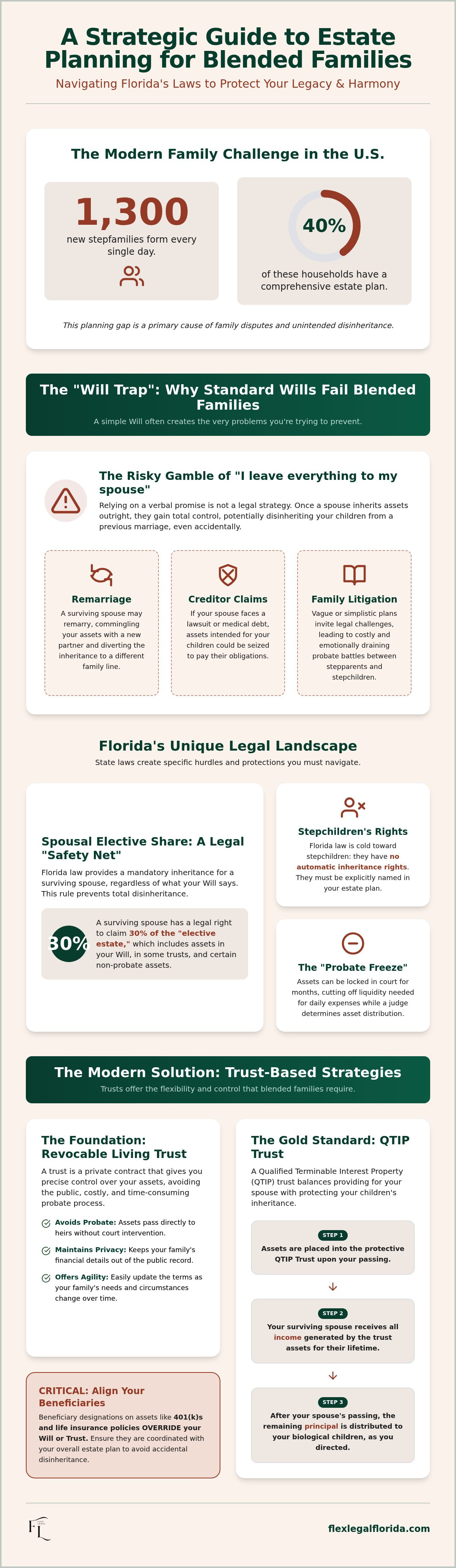
Every single day, 1,300 new stepfamilies form across the United States, yet only 40% of these households have a comprehensive plan for their future. This gap often leads to the exact family disputes you're likely trying to avoid. Effective estate planning for blended families Florida requires a delicate balancing act to ensure your current spouse is supported without accidentally disinheriting children from a previous marriage. It's a challenge that demands more than a standard Will; it requires a strategy built for the complexities of a modern family.
We understand that managing the intersection of love and legacy can feel overwhelming. This guide will show you how to balance mandatory spousal rights with your biological children's inheritance using modern legal tools that prevent family conflict. You'll learn how to protect your assets from unnecessary litigation while maintaining family harmony. We'll walk through the 2026 updates to Florida probate limits, the mechanics of the 30% spousal elective share, and how trust-based planning acts as an agile ally for your family's unique needs.
Table of Contents
The Complexity of Blended Family Estate Planning in Florida
The Complexity of Blended Family Estate Planning in Florida involves a strategic balancing act of "his, hers, and ours" assets. When you combine two households, the legal default settings rarely align with your personal intentions for your children's future. Modern families need a plan that recognizes these nuances rather than ignoring them. Effective planning ensures your current spouse is cared for while guaranteeing that your biological children aren't accidentally left behind.
Many parents fall into the "Will Trap." They leave their entire estate to their surviving spouse with the verbal understanding that the spouse will eventually provide for all the children. This is a risky gamble. Once a spouse inherits assets outright, they have total control. They can change their own Will, remarry, or lose the inheritance to creditors. In these scenarios, your biological children have no legal standing to claim their share. If you die without any plan at all, Florida intestacy laws dictate a 50/50 split between your spouse and your children. While this sounds fair, it often creates immediate conflict over the family home and liquid assets.
There are three primary risks that threaten a blended family legacy:
Remarriage: A surviving spouse may remarry and commingle your assets with a new partner, potentially diverting the inheritance to a different family line.
Creditor Claims: If your surviving spouse faces a lawsuit or medical debt, the assets intended for your children could be seized to pay those debts.
Family Litigation: Vague plans invite legal challenges. Without clear, binding documents, siblings and stepparents often end up in costly probate battles.
Why Florida Law is Unique for Blended Families
Florida law provides a "safety net" for surviving spouses known as the Elective Share. This rule allows a spouse to claim 30% of the elective estate, even if you tried to leave them less in your Will. However, the law is much colder toward stepchildren; they have no automatic inheritance rights in Florida. Additionally, the "Probate Freeze" can be devastating for Palm Beach County families. This occurs when assets are locked in court for months, cutting off the liquidity needed to run a family business or pay daily expenses while the judge decides who gets what.
Common Misconceptions in Palm Beach County
A common myth is that "my spouse will do the right thing." Even with the best intentions, life is unpredictable. Your spouse might face cognitive decline or outside influence in their later years. Another misconception is that joint tenancy with right of survivorship is a complete solution. While it avoids probate temporarily, it grants the survivor total ownership, once again creating the risk of disinheriting your children. Traditional, rigid planning fails because it doesn't account for these shifting dynamics. An agile approach, often utilizing a Revocable Living Trust, allows for a more customized and protected distribution of assets for estate planning for blended families Florida.
Trust-Based Strategies: The Key to Fair Distribution
While a Will is a public document subject to probate, a trust functions as a private contract that bypasses public court oversight. This privacy is essential for families who want to keep their financial details and distribution choices away from prying eyes. Trust-Based Strategies: The Key to Fair Distribution often center around a Revocable Living Trust. This tool gives you the agility to change terms as your family grows or shifts. For those worried about a spouse's future remarriage, the "QTIP" (Qualified Terminable Interest Property) trust is a gold standard. It provides an income stream for your surviving spouse while locking in the principal for your biological children. It ensures your assets don't wander into a new family line if your spouse remarries.
Asset distribution isn't just about what's in your trust. Many assets pass directly to named individuals outside of a Will or Trust. You must align your beneficiary designations on life insurance policies and 401(k) accounts with your overall strategy. If these designations are outdated, they can override even the most sophisticated legal documents. Coordinating these moving parts is a core component of effective estate planning for blended families Florida.
Structuring Inheritance for Multiple Sets of Children
Managing "his, hers, and ours" requires precision. You can create separate sub-trusts within your main plan to treat each group of children fairly based on their specific needs. Choosing an independent trustee, such as a professional fiduciary or a neutral third party, is often the best way to prevent "wicked step-parent" disputes. You also have the choice between "Pot Trusts," which keep funds together for a group of siblings until the youngest reaches a certain age, and "Individual Trusts" that provide immediate separate accounting for each child.
Funding Your Strategy: Life Insurance and Assets
Life insurance acts as a powerful "inheritance equalizer." If you want to leave the family home to your current spouse, you can use a life insurance policy to provide an equivalent cash inheritance for your children. For business owners, transferring interests into a trust is vital for business continuity. In the 2026 West Palm Beach market, where property and business valuations are shifting rapidly, regular updates to these funding levels are necessary to ensure your distribution remains fair. If you're ready to modernize your plan, our team can act as your agile ally in creating these custom structures.
The Florida Homestead Trap and Spousal Rights
Florida’s constitution provides some of the strongest protections in the country for a primary residence, known as the "Homestead." While these laws protect families from creditors, they often create a "Homestead Trap" during estate planning for blended families Florida. If you're married, you can't simply leave your home to your children from a previous marriage through a Will. If your spouse hasn't waived their rights, Florida law automatically grants them a "Life Estate" in the property. This means they have the right to live there for the rest of their life, while your children hold the "remainder" interest.
This split ownership is a frequent source of family friction. The surviving spouse is usually responsible for property taxes and ordinary maintenance, but the children own the long-term equity. Disagreements over major repairs or the eventual sale of the home can lead to years of litigation. To bypass this, many families use pre-nuptial or post-nuptial agreements. These legal tools allow a spouse to waive their homestead rights, giving you the freedom to ensure your children inherit the family home outright without the complications of a life estate.
Navigating the Elective Share
In Florida, you can't completely disinherit a spouse. The law guarantees them an "Elective Share," which is a minimum of 30% of your total elective estate. This includes almost everything you own, from bank accounts to real estate. If your estate plan doesn't meet this 30% threshold, the court will intervene to make up the difference. Proactive trust planning is the best way to satisfy this requirement. By earmarking specific assets to reach that 30% mark, you protect the rest of your estate from being liquidated to satisfy a court order. It's about being an agile planner rather than a reactive one.
Homestead Protection for Business Owners
Business owners in West Palm Beach often look for ways to shield their personal assets from professional liability. However, you should never put your primary residence into a business entity like an LLC. Doing so can cause you to lose your constitutional homestead protections and valuable property tax exemptions. Collaborating with asset protection lawyers near me helps you navigate these boundaries. We help you build a strategy that keeps your home safe from creditors while ensuring it passes smoothly to the next generation without triggering a legal battle between your spouse and children.
Advanced Planning: Special Needs and Digital Legacies
Modern family life extends far beyond physical assets and bank accounts. For those navigating estate planning for blended families Florida, advanced strategies must account for the unique needs of vulnerable heirs and the vast digital footprints we leave behind. When a child has a disability, the stakes are even higher. You aren't just balancing inheritance; you're ensuring that your support doesn't accidentally disqualify them from essential government benefits. Integrating special needs planning into your broader estate strategy allows you to provide for a spouse while securing a lifelong safety net for your child.
Incapacity planning is another area where blended families face friction. If you become unable to make decisions, who takes the lead? A standard document might default to your current spouse, but this can alienate adult children from a previous marriage. A customized durable power of attorney clarifies these roles before a crisis occurs. We also recommend a "Letter of Intent." This isn't a formal legal document, but it acts as a vital guide for future guardians and trustees. It captures your specific wishes for a child's care, education, and daily routines, providing the context that legal forms often miss.
Special Needs Trusts in a Blended Context
Protecting a child's eligibility for programs like SSI or Medicaid requires a specific trust structure. In a blended family, a third-party special needs trust is often the best choice. It allows you to fund the trust with your own assets, ensuring the money is used for the child's supplemental needs without counting as their personal income. You'll also need to carefully select a successor guardian. This person should be someone who understands the child's unique challenges and can maintain a positive relationship with both the surviving spouse and biological siblings.
Securing the Digital Footprint
Digital succession is a major gap in traditional planning. Who gets access to the family cloud storage, social media accounts, or your crypto wallet? Florida's 2026 digital asset legislation provides a framework for fiduciaries, but you must grant explicit permission first. Without a Digital Asset Memo, a stepparent might be locked out of years of family photos or intellectual property. This is especially critical for business owners managing an online brand reputation. If you want to ensure your digital legacy passes to the right hands without a court battle, contact our team to build a modern, adaptable plan.
A Modern Partner for West Palm Beach Families
Traditional law firms often feel like rigid institutions, but your family is dynamic. At Flex Legal, PLLC, we’ve built our practice around the "Agile Ally" philosophy. This means your plan isn't a one-time transaction; it’s a living strategy that evolves alongside your life’s changes. When it comes to estate planning for blended families Florida residents deserve a partner who understands that "fair" doesn't always mean "equal." We focus on creating custom solutions that reflect your specific values and family goals.
One of the biggest barriers to effective planning is the fear of the unknown cost. We’ve eliminated the "billable hour" barrier by offering transparent, flat-fee packages. You’ll know exactly what your investment is before we start. This transparency allows us to focus entirely on the quality of your plan rather than the clock. Our 30-day roadmap provides a clear path from your initial strategy session to a fully funded and secure legacy. We start with a Comprehensive Family Audit to identify hidden gaps in your current documents, ensuring no detail is left to chance.
Why Flex Legal, PLLC is Different
We bring a unique blend of clarity and empathy to complex family dynamics. Founded in 2021, our firm was built to be a modern alternative to traditional, slower legal models. Jennifer L. Flexer, Esq., leads our team with a results-oriented approach that prioritizes your family’s comfort. We also have deep expertise as a probate lawyer palm beach county specialist. This litigation experience allows us to build "battle-tested" plans that are designed to stand up in court and prevent the very disputes we’ve seen tear other families apart.
Your Next Steps to Peace of Mind
Getting started is a streamlined process. For your initial strategy session, gather your current financial statements and any existing estate documents. We act as the hub of your professional team, coordinating directly with your financial advisors and CPAs to ensure your legal and financial strategies are perfectly aligned. Once we finalize your plan, we don't just hand you a binder; we help you fund your trust and update your beneficiary designations. This final step is what transforms a stack of papers into a functional shield for your family’s future.
Once your legal foundation is secure, you can focus on what truly matters—making the most of your time with family, whether that involves local activities or a special trip with Florida Yacht Life.
Securing Your Family’s Modern Legacy
Your family's story is unique, and your legal strategy should reflect that complexity. We've explored how trust-based planning prevents the accidental disinheritance of your children and why navigating Florida’s strict homestead laws is vital for maintaining harmony. By addressing everything from the 30% spousal elective share to your digital footprint, you move from a place of anxiety to one of absolute confidence. Effective estate planning for blended families Florida isn't just about documents; it's about building a dynamic system that protects everyone you love.
At Flex Legal, we act as your agile ally in West Palm Beach. We combine local probate expertise with flat-fee predictability to ensure your planning process is as smooth as it is thorough. Whether you need specialized special needs planning or a comprehensive trust audit, we're here to provide the clarity you deserve. Protect your family's future with a modern, flat-fee estate plan from Flex Legal. You've worked hard to build your life together. Now, take the final step to ensure your legacy remains exactly as you intended.
Frequently Asked Questions
Can I disinherit my spouse in Florida if I have children from a previous marriage?
No, you cannot completely disinherit a spouse without their written consent. Florida law protects surviving spouses through the elective share and homestead rights. Unless your spouse waives these rights in a pre-nuptial or post-nuptial agreement, they're legally entitled to 30% of your elective estate. Attempting to leave them nothing in your Will usually results in a court intervention that can disrupt your intended legacy for your children.
Do stepchildren have any automatic inheritance rights in Florida?
Stepchildren don't have automatic inheritance rights under Florida's intestacy laws. If you die without a valid Will or Trust, only your biological or legally adopted children are recognized as heirs. To include stepchildren in your estate planning for blended families Florida, you must explicitly name them in your legal documents. Without specific designations, they're legally excluded from receiving any part of your estate regardless of your relationship.
What is a QTIP trust and why is it used for blended families?
A Qualified Terminable Interest Property (QTIP) trust is a strategic tool that balances spousal support with child inheritance. It provides your surviving spouse with income from the trust assets for the rest of their life. However, it locks in the eventual distribution of the remaining principal to your children. This ensures your spouse is cared for while preventing the assets from being diverted to a new partner or different family line.
How does the Florida Elective Share affect my estate plan?
The Florida Elective Share guarantees your spouse at least 30% of your total elective estate, regardless of what your Will says. This includes bank accounts, real estate, and certain trust assets. If your plan doesn't provide this minimum, your spouse can file a claim in probate court to take their share. We help you proactively structure your assets to satisfy this requirement without liquidating the inheritance meant for your children.
Can my spouse change our joint trust after I pass away?
It depends on how the trust is drafted. In many traditional joint trusts, the surviving spouse gains full control and can change beneficiaries, potentially disinheriting your children. To prevent this, we often recommend irrevocable provisions that trigger upon the first spouse's death. It's a critical step for anyone navigating estate planning for blended families Florida who wants to ensure their biological children are protected from future changes.
What happens to my Florida home if I die without a will in a blended family?
Your primary residence is subject to strict constitutional protections. If you die without a Will, your surviving spouse receives a life estate in the home, meaning they can live there until they pass away. Your biological children receive the vested remainder, becoming the owners only after the spouse dies. This split ownership often creates conflict over maintenance costs and property taxes. A clear plan helps avoid this shared ownership trap.
Is a pre-nuptial agreement required for effective blended family planning?
While not strictly required, a pre-nuptial or post-nuptial agreement is the most effective way to waive statutory spousal rights. These agreements allow spouses to legally opt out of the 30% elective share and homestead life estate claims. Without one, your ability to leave specific assets entirely to your children is limited by Florida law. These documents act as a foundation for a more flexible and predictable estate strategy.
How can I ensure my special needs child is protected in a second marriage?
You should use a Third-Party Special Needs Trust to hold the child's inheritance. This structure allows you to provide for your child's supplemental needs without jeopardizing their eligibility for government benefits like SSI or Medicaid. By naming a neutral successor trustee, you ensure the funds are managed professionally. This prevents potential friction between your surviving spouse and the child's caregivers while securing the child's long-term financial stability.


Comments