
Duties of a Personal Representative in Florida Probate: A 2026 Guide

Updated: Jun 27
Stepping into the role of a personal representative is less about "honoring a legacy" and more about managing a high-stakes fiduciary business for the Florida court system. It's a position of significant trust, but it also carries heavy legal weight. If you're feeling overwhelmed by the pressure of court deadlines or the friction of managing difficult beneficiaries, you aren't alone. Understanding the duties of a personal representative in Florida probate is the first step toward protecting yourself and the estate you've been entrusted to manage.
You likely want to settle the estate efficiently without making a costly legal mistake that could lead to personal liability. This 2026 guide provides the clear roadmap you need to navigate the process with confidence and clarity. We'll walk through the essential timelines, such as the 60-day inventory deadline and the updated $150,000 summary administration threshold, while showing you how to handle creditors and final distributions properly. This article outlines the entire administration process, giving you the tools to act as a reliable and effective fiduciary from the initial filing to the final discharge.
Table of Contents
What is a Personal Representative in Florida Probate?
In Florida, the person responsible for managing a deceased person's estate is called a Personal Representative. While you might be familiar with the term "executor" from television or other states, Florida law uses this specific title to define your role. It's a position that combines administrative precision with a deep legal responsibility. When you take on the duties of a personal representative in Florida probate, you're essentially stepping into the shoes of the decedent to wrap up their financial life and distribute what remains to the rightful heirs.
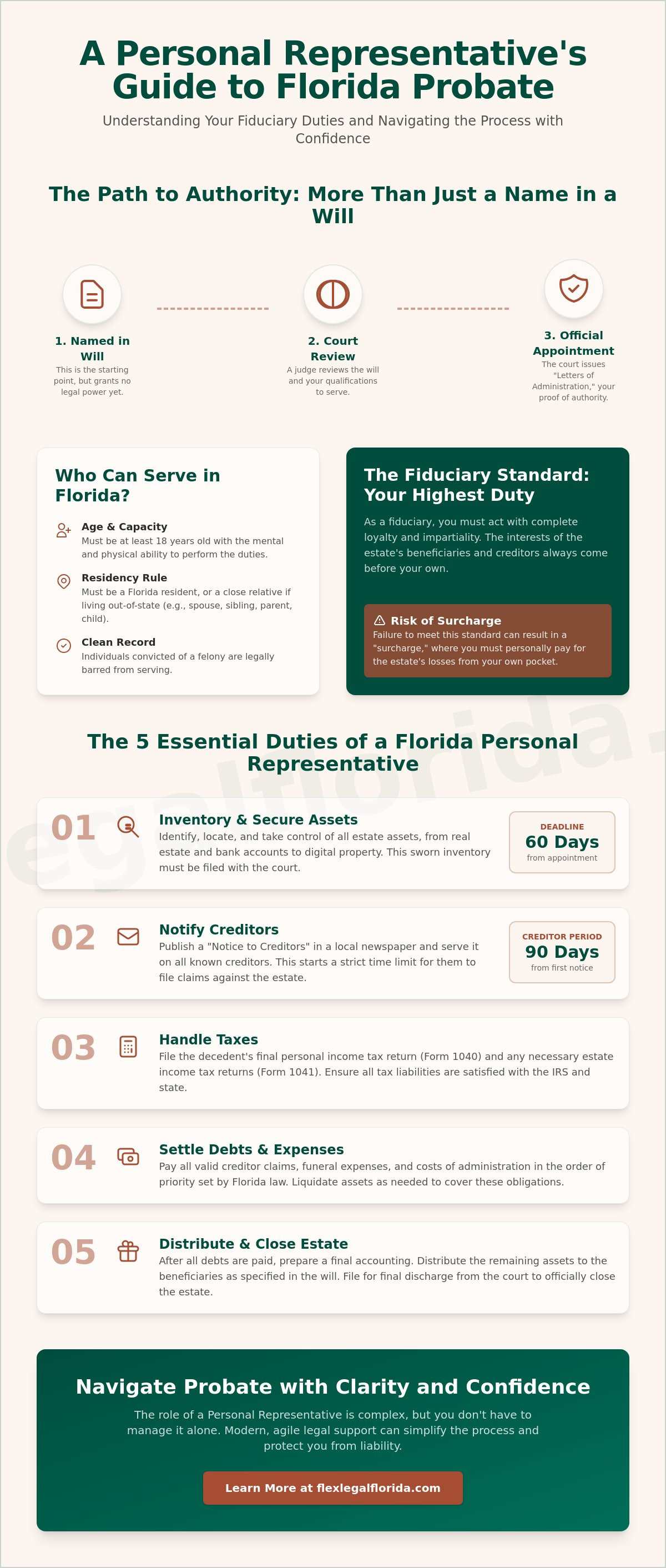
One of the most common misconceptions involves how you actually get the job. Simply being named in a Last Will and Testament doesn't give you the legal power to act. In fact, until the court officially appoints you, you have no authority to move money or sell property. The probate process requires a judge to review the will and your qualifications before issuing "Letters of Administration." These letters are your official credentials. They prove to banks, title companies, and the IRS that you are the authorized representative of the estate.
Who Can Serve as a Personal Representative in Florida?
Florida has specific guardrails to ensure that only qualified individuals manage an estate. The requirements are designed to ensure the person in charge is both accessible and reliable. To qualify, you must meet the following criteria:
Age and Capacity: You must be at least 18 years old and possess the mental and physical capacity to perform the work.
The Residency Rule: Generally, a personal representative must be a Florida resident. If you live out of state, you can only serve if you're a close relative, such as a spouse, sibling, parent, or child.
Clean Record: Anyone convicted of a felony is legally barred from serving in this capacity.
These rules prevent distant, unrelated parties from managing local assets without easy access to the Florida court system. If you aren't a resident and aren't related, the court will likely appoint a professional or a local family member instead.
The Fiduciary Standard: Why It Matters
The core of your role is the "fiduciary duty." This is the highest legal standard of care recognized by law. As a fiduciary, you must act with total loyalty and impartiality. Your own interests always come second to the beneficiaries and creditors of the estate. This means you can't use estate funds for personal expenses, and you can't "self-deal" by buying estate assets for less than fair market value.
If you fail to meet this standard, you risk being "surcharged" by the court. This means you might have to pay for estate losses out of your own pocket. It's a serious commitment, but with the right guidance, it's a manageable one. The law provides this framework to ensure a fair outcome for everyone involved while protecting the integrity of the decedent's final wishes. Understanding the duties of a personal representative in Florida probate is your best defense against these risks.
The 5 Essential Duties of a Florida Personal Representative
Once the court issues your Letters of Administration, you must begin executing the primary duties of a personal representative in Florida probate. The Florida Statutes Chapter 733 provides the legal framework for these actions, but the day-to-day reality involves a high level of organization. You're transitioning from a nominee to an active manager of a legal entity. This requires balancing administrative tasks with strict court-mandated deadlines.
Inventory Assets: Identifying and securing everything from real estate to digital accounts.
Notify Creditors: Alerting those the decedent owed money to and managing their claims.
Handle Taxes: Filing final federal and state returns to satisfy the IRS.
Settle Debts: Paying valid claims and administrative costs in the correct legal order.
Distribute and Close: Handing over the remaining inheritance and filing the final discharge with the court.
Asset Management and the Estate Inventory
Managing Creditors and Potential Claims
One of the most time-consuming duties of a personal representative in Florida probate is managing the "Notice to Creditors." You'll publish this in a local West Palm Beach newspaper to alert the public of the ongoing probate. This triggers a 90-day window for creditors to file claims. It's your job to identify "reasonably ascertainable" creditors and serve them notice directly. Additionally, you must serve a "Notice of Administration" to all interested parties within 20 days of your appointment. If a claim is suspicious or inflated, you have the right to object. This protects the estate's value for the beneficiaries. Managing these timelines can feel like a balancing act, which is why many representatives choose to partner with experts in Probate Administration to ensure no deadline is missed.
Fiduciary Risk: Protecting Your Personal Assets
While you manage the estate's checkbook, the court watches yours. One of the most misunderstood aspects of the duties of a personal representative in Florida probate is the thin line between estate liability and personal liability. If you follow the legal roadmap, the estate's debts aren't your own. But if you deviate from the process, the court can issue a "surcharge." This is a formal order requiring you to reimburse the estate from your personal bank account for losses caused by your mismanagement or neglect. It's a high-stakes role that demands precision from day one.
Heirs are often eager to receive their inheritance, but distributing assets too early is a dangerous gamble. If you pay out funds before the mandatory three-month creditor period expires, and a valid debt later appears, you might be held personally responsible for that bill. The law recognizes this pressure. To help you manage it, Florida Statutes classify hiring a probate attorney as an administrative expense of the estate. This means the estate, not you, pays for the professional guidance needed to satisfy the duties of a personal representative in Florida probate correctly. It's a built-in safety net designed to protect your personal finances from procedural errors.
Personal Liability vs. Estate Liability
Acting in "good faith" is a strong starting point, but it isn't always a complete defense. Even honest mistakes, like failing to notify a reasonably ascertainable creditor or ignoring IRS tax obligations, can lead to personal lawsuits. According to Florida Bar statistics, will contests and probate litigation can cost between $15,000 and $50,000 in legal fees alone. As a fiduciary, you're responsible for ensuring the decedent's final income taxes are filed and any federal estate taxes are addressed. If you distribute the estate's value and leave the IRS unpaid, the government can look to your personal assets for satisfaction.
The Importance of Accurate Accounting
Transparency is your most effective tool for preventing conflict. You must maintain a dedicated estate bank account to ensure you never commingle personal funds with estate assets. This separation makes the "Final Accounting" process much smoother. Before the court discharges you from your role, you must present a clear, line-item record of every dollar that entered and left the estate. For a deeper look at these requirements, The Florida Bar's guide to probate provides an excellent breakdown of these standards. Professional record-keeping doesn't just satisfy the judge; it provides the clarity needed to prevent costly disputes with beneficiaries and ensures a clean exit from your responsibilities.
Probate Timeline in Palm Beach County: What to Expect
The probate process in West Palm Beach isn't just a legal requirement; it's a structured timeline that demands steady progress. While every estate is unique, the average formal administration in Palm Beach County typically takes between 12 and 18 months to conclude. If there's no will, that timeline can easily extend to 24 months. For those acting in a best-case scenario with no disputes, you might see a resolution in as little as five to seven months. However, your duties of a personal representative in Florida probate begin almost immediately. You have exactly 10 days to deposit the decedent's will with the Clerk of the Circuit Court once you learn of the passing.
The initial phase focuses on the Petition for Administration. In Palm Beach County, the filing fee for this petition is currently $401. Once the judge reviews the filing, they issue the Letters of Administration. These documents are essentially your keys to the estate. They grant you the authority to access bank accounts, manage real estate, and speak with federal agencies. Without these letters, you're effectively locked out of the financial assets you've been tasked with protecting. This phase sets the tone for the entire administration.
Starting the Process in West Palm Beach
Filing occurs at the Palm Beach County Clerk of the Circuit Court and Comptroller. Once you have your Letters, you must serve a Notice of Administration to all interested parties within 20 days. This is also the time to notify the surviving spouse of their elective share rights. Under Florida law, a surviving spouse may be entitled to 30% of the elective estate. Managing these notifications is a critical part of the duties of a personal representative in Florida probate, as missing a deadline here can lead to litigation later. Accuracy in these early stages prevents delays that can last for months.
Closing the Estate and Discharge
The longest waiting phase is the 90-day creditor period. Once this window closes and all valid debts are paid, you move toward the final distribution. This involves creating a Plan of Distribution for complex estates, ensuring every heir receives exactly what they're owed. The final step is filing a Petition for Discharge. When the judge signs the Order of Discharge, you're legally released from your role and protected from further liability regarding the estate's administration. If you're ready to streamline this process and avoid unnecessary friction, our team at Flex Legal, PLLC offers expert Probate Administration to keep your timeline on track and your liability low.
How Flex Legal, PLLC Simplifies Your Role as Personal Representative
Managing the duties of a personal representative in Florida probate doesn't have to be a solitary or stressful experience. Traditional legal models often feel rigid and slow, leaving you to wonder if you've missed a critical filing or exposed yourself to personal risk. At Flex Legal, PLLC, we replace that uncertainty with an agile, forward-thinking partnership. We prioritize clarity and speed, ensuring you can fulfill your legal obligations without letting the process consume your life or your peace of mind.
We understand that the administrative side of probate is only half the battle. Dealing with grief while managing court-mandated deadlines is a heavy burden for any family. Our approach focuses on streamlining the complex requirements of Florida law. Whether it's drafting the initial Petition for Administration or providing expert representation in high-stakes probate litigation, we provide the professional authority needed to resolve disputes quickly. We act as a buffer between you and the technical demands of the court system, allowing you to focus on your family.
Transparency is a cornerstone of our service. As discussed earlier, Florida law provides a tiered fee schedule for personal representatives and their attorneys. We ensure you understand these costs from the very first meeting, offering transparent fee structures that align with the complexity of the estate. Flex Legal, PLLC provides clarity that helps you manage expectations with beneficiaries and keeps the focus on a smooth, efficient transition of wealth without hidden financial surprises.
A Partnership-Based Approach
We act as your agile ally, managing the friction of court filings and creditor communications so you don't have to. Our team at Flex Legal, PLLC ensures every detail of the duties of a personal representative in Florida probate is executed with precision. From serving the Notice of Administration to filing the Final Accounting, we handle the technical heavy lifting. This proactive management significantly reduces your personal risk, protecting your own assets from the threat of court surcharges or beneficiary disputes. You'll always know where the estate stands and what comes next.
Beyond Probate: Total Estate Security
Closing an estate is often the beginning of a new chapter for heirs. We help beneficiaries transition their inheritance into a secure future by integrating comprehensive asset protection strategies. This ensures that the wealth you've worked so hard to distribute remains within the family for generations. Our team also provides modern estate planning services, allowing you to create a legacy that avoids the very probate hurdles you've just navigated. If you're ready for a more efficient way to close the estate, Schedule a consultation with Flex Legal, PLLC today and let us simplify your path forward.
Confidently Mastering Your Role as a Personal Representative
Managing an estate is a high-stakes administrative task that requires both precision and a deep understanding of fiduciary responsibility. By now, you recognize that the duties of a personal representative in Florida probate involve much more than just following a will; they require navigating strict 60-day inventory deadlines and managing complex creditor periods. Protecting your personal assets from surcharges starts with having a clear, actionable plan for every court filing and distribution.
You deserve a partnership that prioritizes clarity over confusion. Led by Jennifer L. Flexer, Esq., Flex Legal, PLLC provides modern, agile legal support specifically designed for West Palm Beach families. We believe in fee transparency, utilizing statutory fee schedules and fixed-fee options to eliminate financial uncertainty. Our team acts as your dedicated ally, handling the technical heavy lifting so you can focus on what matters most. Protect yourself and the estate—schedule a probate consultation with Flex Legal, PLLC today. You've been entrusted with a significant responsibility, and with the right support, you can fulfill it with absolute confidence.
Frequently Asked Questions
Can a personal representative be paid for their work in Florida?
Yes, Florida law allows you to be paid for your services. The standard fee is generally 3% on the first $1 million of the estate's value. For larger estates, the percentage decreases on a tiered scale. This compensation is taxable income, so some family members choose to waive the fee if they're already receiving a significant inheritance. It's a way to recognize the time and effort you put into the role.
What happens if a personal representative is unable or unwilling to serve?
If you can't serve, the court looks to the successor named in the will. If the will doesn't name an alternate, or if there is no will, Florida law provides a priority list for who the judge can appoint. This usually starts with the surviving spouse or someone chosen by a majority of the heirs. The process ensures the estate administration stays on track even if the first choice is unavailable.
Does a personal representative have to live in Florida?
You can live out of state only if you're a close relative of the decedent. Close relatives include spouses, parents, siblings, children, and other blood relatives. If you aren't related, Florida law requires you to be a resident of the state to qualify. This rule ensures that the person performing the duties of a personal representative in Florida probate is easily accessible to the local court system and the beneficiaries.
Who pays for the probate attorney in Florida?
The estate pays for the attorney's services. Hiring a lawyer is classified as an administrative expense under Florida law, so the costs come directly from the estate's assets rather than your personal funds. This arrangement allows you to secure professional guidance to protect yourself and the beneficiaries without a personal financial burden. Fees are typically settled during the final stages of the probate process before the estate closes.
Can a personal representative sell real estate without all beneficiaries' consent?
Yes, if the will contains a "power of sale" clause. This specific wording gives you the authority to sell estate property without seeking permission from the judge or the heirs. If that clause is missing, you'll generally need a court order to finalize a sale. While you don't strictly need beneficiary consent in many cases, keeping them informed is a smart way to avoid potential disputes or legal delays during the sale.
How long does a personal representative have to settle an estate in Florida?
A typical formal administration in Palm Beach County lasts 12 to 18 months. The process can be shorter if the estate is simple, or longer if there are disputes or complex tax issues. You're required to manage the 90-day creditor claim window and meet the 60-day inventory deadline. Consistently performing the duties of a personal representative in Florida probate ensures the case moves toward a final discharge as quickly as possible.
Is a personal representative the same as a trustee?
No, the two roles involve different assets and levels of court oversight. A personal representative manages assets that must pass through probate, working under a judge's supervision. A trustee manages assets already placed in a trust, usually operating privately without court intervention. While you might hold both positions simultaneously, you must follow different legal rules and reporting requirements for each to satisfy your fiduciary obligations to the estate and heirs.
What if the decedent didn't leave a will in Florida?
Florida's "intestate succession" laws determine how the estate is handled. In these cases, the law dictates exactly which relatives receive a share of the assets based on their relationship to the decedent. The court will also appoint a personal representative based on a statutory order of preference. This process often takes longer than a standard probate because the court must verify heirs and follow rigid state formulas for asset distribution.



Comments