
Contesting a Will in Florida: A 2026 Legal Guide to Your Rights and Deadlines
- Kelly Mata
- Jul 31
- 12 min read

You've just discovered a will that looks nothing like the promises made to you, but in Florida, being right isn't enough to change the outcome. If you're considering contesting a will in Florida, you're facing one of the strictest legal clocks in the country. The 90-day deadline to file an objection is unforgiving, and missing it by even a single day can permanently bar your claim. It's natural to feel overwhelmed by complex probate statutes or the fear of high legal costs when you've already been blindsided by a suspicious change in an estate plan.
We understand that this process feels like a high-stakes race against time, especially when you're grieving a loss. This guide provides the clarity you need to move forward with confidence. You'll learn exactly who qualifies as an "interested person" and which legal grounds, such as undue influence or lack of capacity, actually hold up in court. We'll break down the 2026 legal requirements and the specific steps to challenge an invalid will so you can find a clear, streamlined path to the resolution you deserve.
Table of Contents
Understanding Your Standing: Who Can Legally Challenge a Florida Will?
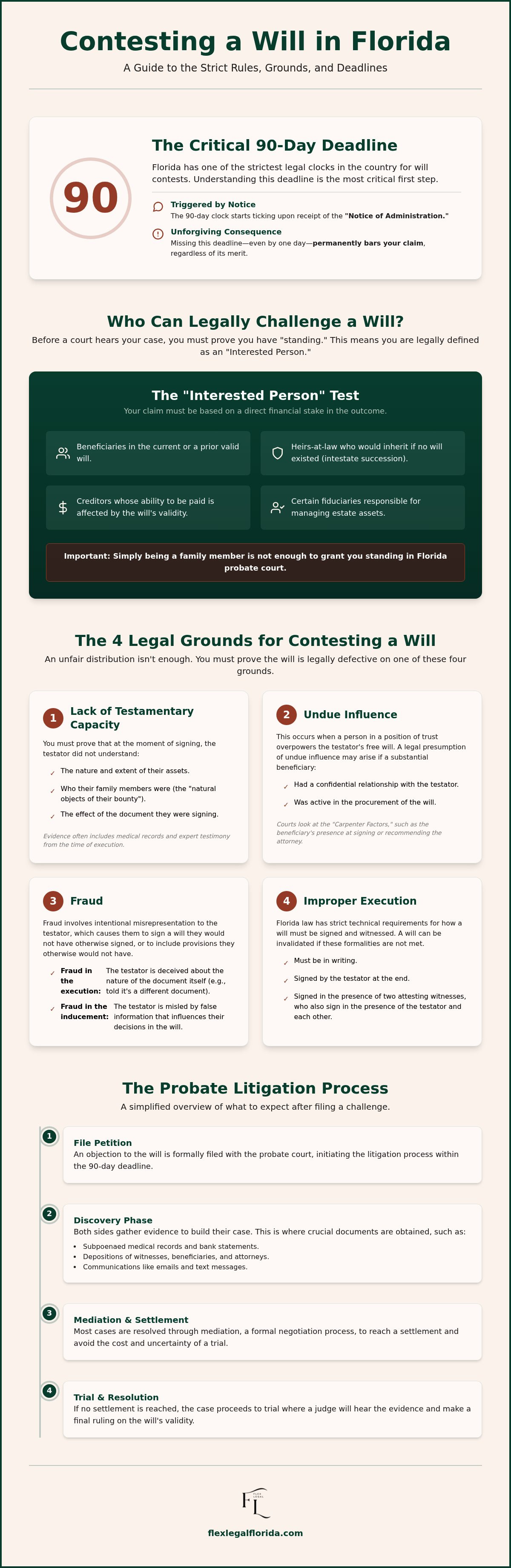
Before you can argue that a signature was forged or a loved one was coerced, you must prove you have the right to be in the courtroom. This legal right is known as "standing." In the context of contesting a will in Florida, standing isn't a participation trophy given to every grieving relative. It's a specific legal status that requires you to have a direct financial stake in the outcome of the probate proceedings. Without it, the court will dismiss your case before it even begins.
Florida Statute 731.201 provides the framework for this requirement by defining an "interested person." This term covers anyone who may reasonably be expected to be affected by the outcome of the particular proceeding involved. While this includes the obvious choices like a surviving spouse or children, it also extends to certain creditors and fiduciaries. However, being a "family member" doesn't automatically grant you standing if the decedent’s previous estate plans or Florida’s intestacy laws wouldn't actually provide you with an inheritance if the current will were invalidated.
The 'Interested Person' Test
The core of the interested person test is the financial impact. If the court tosses out the contested will, does your bank account or property ownership change? If the answer is yes, you likely have standing. Standing is a jurisdictional requirement in Florida probate courts; it's the very foundation that allows a judge to hear your dispute. Typical examples of those who pass this test include named beneficiaries in the current will, beneficiaries named in a previous version of the will, and heirs at law who would inherit under Florida’s default rules if no will existed. Creditors also fit into this equation if the validity of the will affects the estate's ability to settle its debts.
Disinherited Heirs and Prior Wills
A common scenario involves a suspicious, last-minute change that removes a long-time beneficiary. If a 2026 will suddenly disinherits you in favor of a neighbor or a new "friend," your standing often comes from a prior version of the document. Under Florida law, if a court finds valid grounds for contesting a will and invalidates the current document, the estate doesn't necessarily become a free-for-all. Instead, the court may look to the most recent valid prior will. If no prior will exists, the estate follows the rules of "intestate succession." This means the state’s default hierarchy determines who gets what, usually starting with the spouse and children. Understanding your place in this hierarchy is the first step in contesting a will in Florida effectively.
The 4 Legal Grounds for Contesting a Will in Florida
Winning a challenge against an estate requires more than a feeling that the distribution is unfair. Florida courts strongly prefer to honor the written intent of the deceased. To overcome this preference, you must prove that the document is legally defective. When evaluating your case with an agile legal partner, we focus on four specific pillars of litigation. These grounds are the only ways to successfully set aside a will during the probate process.
The first ground is a lack of testamentary capacity. This doesn't mean the person was simply forgetful or elderly. Instead, you must show they didn't understand the nature of their assets, who their family members were, or the effect of the document they were signing. Testamentary capacity is defined as the testator's mental state at the exact moment of signing the document. Proving a lack of capacity often requires a deep dive into medical records and expert testimony from the time the will was executed.
Proving Undue Influence (The Carpenter Factors)
Undue influence is perhaps the most common reason for contesting a will in Florida. It occurs when a person in a position of trust uses their power to overcome the testator's free will, essentially substituting their own desires for those of the deceased. Under the Florida Probate Code on standing and case law, a presumption of undue influence arises if a substantial beneficiary occupied a confidential relationship with the testator and was active in procuring the will.
To identify this, courts look at the "Carpenter Factors," which include signs like:
The beneficiary's presence at the execution of the will.
The beneficiary recommending the attorney who drafted the document.
The beneficiary keeping the will in their possession after it was signed.
The testator being isolated from other family members.
Formal Execution Requirements (Fla. Stat. 732.502)
Florida law is incredibly strict about how a will must be signed. If the technicalities aren't met, the will is void. According to Florida Statute 732.502, the testator must sign at the end of the document in the presence of at least two attesting witnesses. These witnesses must also sign in the presence of the testator and each other. A failure in this "ceremony" is a frequent point of failure in DIY estate planning or deathbed signings. While many modern wills include a self-proving affidavit to speed up probate, these can still be challenged if the underlying signing process was flawed. Fraud and forgery also fall under this umbrella, where a signature is faked or the testator is tricked into signing a document they didn't know was a will.
The 90-Day Deadline: Why Timing is Everything in Florida Probate
Florida's probate system moves with a speed that can catch grieving families off guard. When it comes to contesting a will in Florida, the law prioritizes the finality of estate administration over almost everything else. This means your window for taking action is remarkably narrow. For most people, the standard deadline is exactly 90 days from the moment they receive a specific legal document. This isn't a flexible target; it's a hard statute of limitations that Florida judges enforce with surgical precision.
There is a critical exception that makes the timeline even tighter. If a petitioner serves you with "Formal Notice" before the will is even admitted to probate, your response window shrinks to just 20 days. This tactic is often used to flush out objections early and clear the path for the Personal Representative. Whether you have 90 days or 20, the consequence of missing the deadline is the same. Your claims are permanently barred. You lose the right to challenge the will's validity regardless of how strong your evidence of undue influence or lack of capacity might be.
The Trigger: Receiving a Notice of Administration
The 90-day clock officially starts when you are served with a Notice of Administration. This document is the starter pistol for the probate process. The Personal Representative sends this notice to the surviving spouse, beneficiaries, and anyone who might have an interest in the estate. Its primary purpose is to "quiet" potential claims by forcing them into the open immediately. You cannot afford to ignore this paperwork or set it aside for later. Understanding the distinction between formal notice and informal notice is vital; a Probate Lawyer in Palm Beach County can help you decode these documents and determine exactly how much time you have left to act.
Tolling and Extensions (The Rarity)
Many people make the mistake of waiting to gather "perfect" evidence before they file a petition. In Florida, this delay is often fatal to a case. Florida courts rarely grant extensions or "toll" the deadline for will contests. Even if you discover new evidence of fraud on day 91, the court will likely dismiss your challenge. The law expects you to file your objection first and use the subsequent discovery phase to prove your claims. Speed is a strategy in itself. Waiting for a more convenient time or hoping for a family settlement without legal filing usually results in the permanent loss of your inheritance rights.
The Probate Litigation Process: From Filing to Resolution
Initiating a formal challenge begins with filing a Petition for Revocation of Probate in the circuit court where the estate is being settled. This document officially outlines your legal grounds and asks the judge to set aside the suspicious will. While filing the petition gets you through the door, the actual strength of your case is built during the discovery phase of contesting a will in Florida. This is the period where your legal team works as an agile ally to uncover the facts that aren't visible on the surface of the document.
Discovery is the engine room of any estate dispute. It involves subpoenaing years of bank statements, cell phone records, and internal communications to paint a picture of the testator's life. Depositions are also a vital tool; they allow your attorney to question witnesses, family members, and the alleged "influencer" under oath. These recorded statements often reveal inconsistencies that can't be explained away in court. If you're concerned about how a previous plan was altered, consulting an Estate Planning Attorney in West Palm Beach can help you understand what a valid document should have looked like.
Gathering Evidence in the Discovery Phase
Success in contesting a will in Florida often hinges on what happened behind closed doors. We focus on obtaining the testator’s medical records from West Palm Beach providers to determine their mental state at the time of signing. Beyond medical data, "disinterested witnesses" are your most valuable assets. Neighbors, long-term doctors, or even a local mail carrier can provide unbiased testimony about a sudden change in the testator's behavior or the presence of a new, controlling person in their life. Florida is a "no-jury" state for probate contests; a judge decides the final outcome based on the evidence presented.
The Role of Mediation in Estate Disputes
Most Florida will contests never reach a final trial. Instead, they reach a resolution through mediation. This is a structured negotiation where a neutral third party helps both sides find a middle ground. Mediation is a powerful tool because it saves significant time and preserves what's left of family relationships that a "burn-it-down" trial would destroy. It allows for creative solutions that a judge might not have the authority to order. If you're ready to explore a clear path forward, you can partner with our team to evaluate your litigation options and protect your inheritance rights.
Protecting Your Inheritance with Flex Legal: Strategy and Prevention
Navigating the complexities of contesting a will in Florida requires more than just legal knowledge; it demands a partnership with a firm that understands the emotional and financial stakes involved. At Flex Legal, we serve as your agile ally in Palm Beach County, providing the sophisticated support needed to handle high-stakes probate disputes. We prioritize clarity over confusion, ensuring you always know where your case stands without the traditional friction of rigid, old-school legal models. Our approach is designed to be as dynamic as the modern professional landscape we operate in.
Our team brings deep familiarity with the West Palm Beach legal landscape, from local court procedures to the specific evidentiary standards required by Florida judges. We focus on alleviating the heavy burden of estate litigation through transparent processes and modern communication methods. You won't find yourself lost in a sea of multi-clausal jargon here. Instead, we offer direct, purposeful declarations of value and a commitment to finding the most efficient path to resolution, whether that involves a negotiated settlement or a formal court ruling.
Why Choose Flex Legal for Probate Disputes?
We believe that professional legal support should feel accessible and solution-oriented. Litigation is often stressful, but having a partner who prioritizes your comfort and clarity makes a significant difference. We don't just follow a static set of rules. We adapt our strategy to the unique facts of your case, ensuring that your rights are protected with the precision and speed that modern estate disputes require. This forward-thinking persona allows us to act as a peer to our clients while maintaining the authority needed to win in the courtroom.
Preventing Future Contests with a Revocable Living Trust
Once you've seen the chaos that a contested estate causes, it's natural to want to protect your own legacy from similar disputes. One of the most effective ways to do this is by utilizing a Revocable Living Trust instead of a simple Last Will and Testament. Trusts provide a level of privacy and control that wills simply cannot match. Because a trust is managed during your lifetime and often bypasses the public probate process, it's significantly harder for a disgruntled heir to challenge. Check out our Revocable Trust Guide for a deeper look at how this tool safeguards your assets.
Moving from the stress of litigation to the peace of a professional estate plan is a transformative step. DIY documents often lead to the very litigation we've discussed in this guide. By investing in a customized, high-level plan now, you ensure your wishes are respected and your family is spared the pain of contesting a will in Florida in the future. We're here to help you navigate the present dispute and build a more secure foundation for the years ahead.
Your Path to a Fair Resolution
You now understand that contesting a will in Florida isn't just about righting a wrong; it's a precise legal maneuver involving strict standing requirements and an unforgiving 90-day clock. Success depends on moving quickly to gather evidence during the discovery phase and identifying the specific grounds, like undue influence or lack of capacity, that will hold up before a probate judge. Whether you're dealing with a suspicious last-minute change or a total disinheritance, the path forward requires both speed and a sophisticated strategy.
You don't have to navigate this complex litigation alone. Flex Legal, led by Jennifer L. Flexer, Esq., acts as your modern, agile ally in West Palm Beach. We specialize in Florida probate litigation, offering the clarity and partnership you need to resolve estate disputes without unnecessary friction. Our solution-oriented approach prioritizes your peace of mind while we work to protect your interests and your future.
Secure Your Inheritance: Schedule a Consultation with Flex Legal
Your journey toward a fair resolution starts with a single, decisive step. We're ready to help you take it.
Frequently Asked Questions
How long do I have to contest a will in Florida?
You generally have 90 days to file a formal objection after receiving a document called the Notice of Administration. This deadline is strictly enforced by Florida courts and rarely allows for extensions. If you're served with "Formal Notice" before the will is even admitted to probate, your window to respond shrinks to just 20 days.
Can I contest a will if I was left out entirely?
Yes, you can challenge the document if you qualify as an "interested person" with legal standing. This usually means you were either named in a previous version of the will or you're a legal heir who would inherit under Florida’s intestacy laws. You must prove that you'd have a direct financial stake in the estate if the current will were thrown out.
How much does it cost to contest a will in Florida?
The initial cost includes court filing fees, which are approximately $402 for formal administration in Palm Beach County in 2026. Beyond these fees, total costs vary based on the length of the discovery phase and whether the case reaches a trial. For a typical estate, the total cost of the probate process often falls between 3% and 7% of the gross estate value.
What are the most common reasons for a will to be thrown out?
The most frequent grounds for contesting a will in Florida include undue influence, lack of testamentary capacity, and improper execution. A judge may also invalidate a document if there is clear evidence of fraud or forgery. Most successful challenges focus on proving the testator didn't understand the document or was coerced by someone in a confidential relationship.
Do I need a lawyer to challenge a will in Palm Beach County?
Yes, probate litigation is a formal legal proceeding that follows complex rules similar to a civil lawsuit. You'll need to navigate the discovery process, subpoena medical records, and conduct depositions under oath. Having an agile legal ally is essential for meeting strict 2026 deadlines and presenting a persuasive case to the probate judge.
What happens if a will is found to be invalid?
If a judge finds the will is invalid, the court typically looks to the decedent’s most recent valid prior will. If no previous will exists, the estate assets are distributed according to Florida’s intestacy laws. These default rules provide a specific hierarchy for distribution, usually starting with the surviving spouse and the decedent’s children.
Can a 'No-Contest' clause stop me from challenging a will in Florida?
No, "No-Contest" clauses are completely unenforceable under Florida Statute 732.517. You don't lose your inheritance rights simply for contesting a will in Florida in good faith. This law ensures that beneficiaries can bring legitimate concerns about fraud or undue influence before a judge without the fear of being automatically disinherited.
Is it possible to contest a will before the person dies?
No, you cannot challenge a will while the testator is still living. A will has no legal effect until the person passes away and the document is admitted to probate. If you're worried that a loved one is currently being exploited or coerced, you should look into guardianship proceedings or other protective measures rather than probate litigation.


Comments