
Ancillary Probate in Florida for Out of State Property: The 2026 Guide
- Kelly Mata
- 5 days ago
- 12 min read

You just finished settling your loved one’s estate in your home state, only to realize the deed to their West Palm Beach condo is still locked in their name. This "double probate" realization is often the exact moment frustration sets in for out-of-state executors. To legally transfer or sell that Florida property, you must typically navigate the formal probate administration florida requires for non-residents. It feels like a redundant hurdle, but it's a necessary bridge to clear the title and finalize the estate's legacy.
We know that managing a property from hundreds of miles away feels overwhelming, especially when you're faced with unfamiliar local statutes and court requirements. This 2026 guide simplifies the process, showing you how to efficiently handle Florida real estate while avoiding common procedural delays. You'll gain a clear understanding of ancillary requirements, learn how to leverage the latest legislative updates to speed up the timeline, and discover a faster path to selling or transferring the property with minimal legal friction. We'll walk through the essential steps to ensure your Florida assets are handled with precision and speed.
Table of Contents
What is Ancillary Probate in Florida for Out of State Property?
Ancillary probate is the specific legal mechanism used to handle Florida assets when a person lived and died in another state. It's an incredibly common scenario for New York or Midwestern residents who owned a vacation home or a retirement condo in West Palm Beach. Because real estate is physically anchored in Florida soil, our state courts claim exclusive jurisdiction over its transfer. You can't simply use a court order from Ohio or Connecticut to sell a Florida house; the local chain of title requires a local court's seal of approval.
To move forward with a sale or transfer, the Florida court must issue what's known as "Letters of Administration." This document officially empowers a personal representative to act within the state's borders. For many estates, this involves the formal probate administration florida courts oversee to ensure all local creditors are notified and property taxes are settled. It's a structured, protective process designed to clear the title so the property can be legally sold or distributed to heirs without future legal entanglements.
The Difference Between Domiciliary and Ancillary Probate
Think of domiciliary probate as the "main" case. It happens in the state where the deceased person maintained their primary residence. Ancillary administration acts as a vital partner to that primary case. The two court systems coordinate by sharing authenticated records, such as the will and the order appointing the executor. While the home state handles the bulk of the estate, like bank accounts or household belongings, the Florida court steps in specifically to manage the "dirt" located within its borders. This partnership ensures the entire estate is settled across state lines without leaving any loose ends.
Types of Property That Trigger Ancillary Requirements
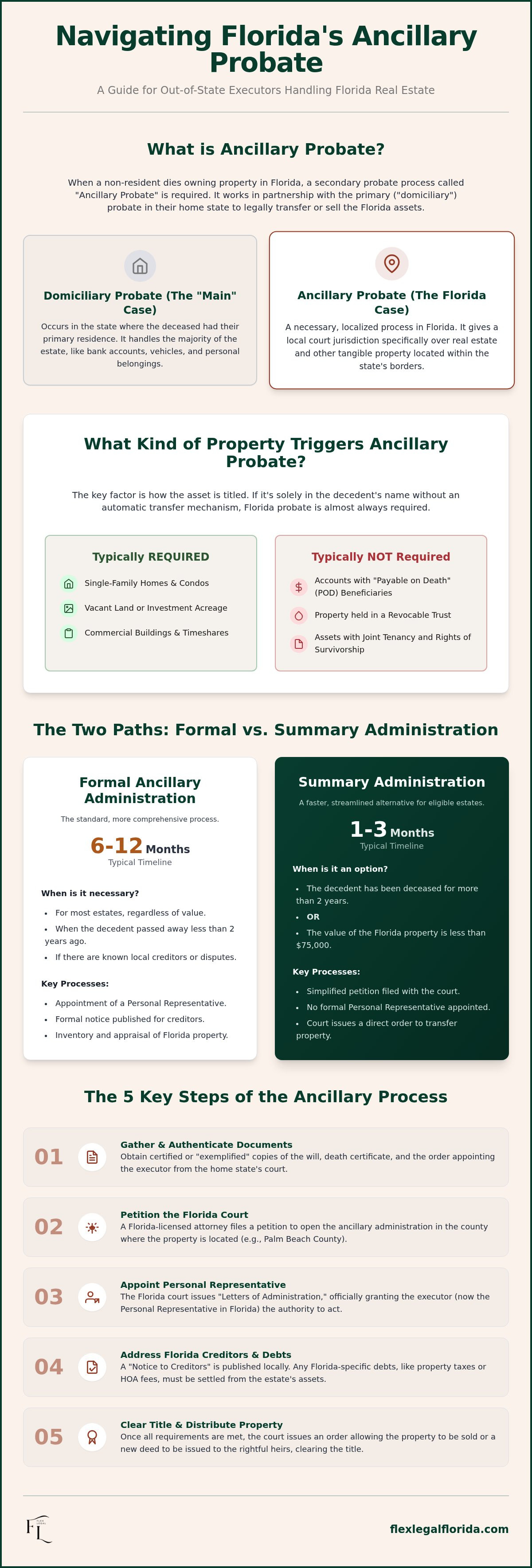
Not every Florida asset requires a trip to probate court. The process is almost always triggered by "real property" that doesn't have a built-in transfer mechanism. This includes:
Single-family residences and high-rise condos.
Vacant land or investment acreage.
Commercial buildings or timeshares.
Beyond real estate, tangible personal property like a boat or a vehicle titled in Florida might also trigger these requirements. However, bank accounts or brokerage funds usually don't require formal probate administration florida if they were set up with "payable on death" beneficiaries or held in a trust. The key is how the asset is titled. If the deed is solely in the decedent's name without a trust or survivorship rights, the ancillary path is generally the only way to unlock that value for the family.
The Florida Ancillary Administration Process Explained
Florida law is strict regarding the management of local assets. If you're dealing with the formal probate administration florida requires, you must generally hire a Florida-licensed attorney. This isn't just a practical recommendation; it's a procedural mandate for most cases. The individual already serving as the executor in the home state usually qualifies to be the "Personal Representative" in Florida. However, they must still meet specific Florida criteria regarding their relationship to the decedent or their residency status. We act as your local advocate to ensure these qualifications are met without requiring you to make constant trips to West Palm Beach.
Even though the primary estate case is active elsewhere, Florida creditors still have rights that must be addressed. This involves publishing a local "Notice to Creditors" to ensure any local debts, like utility bills or property taxes, are settled. The timeline for this process often mirrors the domiciliary case, typically spanning 6 to 12 months for a full administration. Efficiency depends heavily on how quickly we can synchronize with your out-of-state lead counsel to move documents through the system.
The Role of the Florida Probate Court
The process begins by filing authenticated copies of the home-state probate documents with the Palm Beach County Clerk of Court. These are not standard photocopies. They must be certified and exemplified by the original court to prove the will is valid and the executor has been officially appointed. Under Florida Statutes Chapter 734, the court uses these records to open the ancillary case. This effectively "domesticates" the foreign probate, allowing the Florida court to issue the orders necessary to sell or transfer local real estate.
Managing Florida Homestead Issues for Non-Residents
Florida’s famous homestead protections rarely extend to non-residents. If the decedent did not live in Florida as their primary residence, the property won't qualify for the tax caps or the broad creditor shields that Florida residents enjoy. This means a West Palm Beach condo is treated as a standard investment asset, making it subject to full property taxes and potential claims from the estate's creditors. Florida Statute 734.102 governs these proceedings by granting the Florida court jurisdiction over the local property while acknowledging the primary probate happening in the decedent's home state.
If you're feeling stuck between two different sets of state laws, reaching out for modern probate administration support can help bridge the gap and keep the formal probate administration florida process moving forward without unnecessary friction.
Ancillary vs. Summary Administration: Which is Right for You?
Choosing the right path for a Florida estate doesn't depend on the total value of the deceased person’s worldwide assets. Instead, the court looks specifically at the value of the property physically located within Florida. If your loved one had a multi-million dollar estate in their home state but only owned a modest West Palm Beach condo, you might have more options than you realize. Working with a Probate Lawyer in Palm Beach County can help you determine which process fits your specific needs and timeline.
The "Two-Year Rule" is another critical factor. If the decedent passed away more than two years ago, the estate typically qualifies for a streamlined process regardless of the property's value. This is because the window for most creditor claims has already closed under Florida law, reducing the court's need for oversight. For newer estates, the decision usually rests on a cost-benefit analysis between speed and the complexity of the formal probate administration florida requires for larger assets.
When Summary Administration is an Option
Effective July 1, 2026, Florida law increased the threshold for summary administration to $150,000 for non-exempt assets. This change makes the streamlined process available to a much larger group of out-of-state families. Summary administration is generally faster and less expensive, often concluding in just one to three months. However, it isn't always the best choice if the estate has significant Florida-based debts. Because this process doesn't involve the appointment of a Personal Representative, it can be difficult to manage complex tasks like negotiating with creditors or handling litigation.
When Formal Ancillary Administration is Required
If the Florida real estate is valued at over $150,000 and the decedent passed away recently, you'll likely need to proceed with a formal ancillary case. This is common for high-value West Palm Beach homes or investment properties. Under Florida Statute 734.102, this process requires the appointment of a Personal Representative who receives broad powers to manage the estate’s affairs. This is essential when you need to:
Sell the property to a third-party buyer during the probate period.
Manage a Florida-based business or commercial lease.
Defend the estate against local lawsuits or contested claims.
Provide formal notice to all potential Florida creditors to permanently bar future claims.
While the formal probate administration florida mandates is more involved, it provides the highest level of legal certainty. It ensures that once the property is transferred or sold, the title is completely clear and the heirs are protected from lingering liabilities.
Steps to Complete Ancillary Probate for a Florida Condo or Home
Once you've determined that the formal probate administration florida requires is the necessary path for your situation, the focus shifts to the logistical execution of the case. This isn't just about filing paperwork; it's about following a specific sequence that satisfies both Florida law and title insurance companies. Missing a single step can delay a real estate closing for months, so precision is your best tool for speed. We act as your local guide to ensure every filing happens in the correct order.
Gathering the Necessary Documentation
The process actually begins in your home state's court. You can't use standard photocopies of the will or the executor’s appointment. Instead, you need "exemplified" or "triple-seal" copies. These documents carry multiple signatures from the clerk and the judge in your local court, proving their authenticity to the Florida judge. You'll generally need to collect:
The Last Will and Testament.
The petition for probate from the home state.
The order admitting the will to probate.
Letters of Authority or Letters Testamentary.
We often work directly with your home-state lawyer to coordinate this document collection. This partnership ensures the paperwork meets the exact standards of the Palm Beach County court system before it ever reaches a judge's desk.
After filing the petition in Florida, the court will issue local Letters of Administration. One of the most critical phases follows: publishing the "Notice to Creditors" in a local Palm Beach County newspaper. This starts a mandatory three-month clock during which creditors can file claims. While this clock runs, we work to resolve any Florida-specific tax or title issues. If you're planning to sell the property, we use this time to coordinate with your realtor, ensuring the title is clear and ready for a smooth transfer the moment the court gives the green light.
Closing the Florida Estate
The final stage involves filing a final accounting and a petition for discharge. Once the judge signs the "Order of Discharge," the Personal Representative is officially released from their duties in Florida. We then record the certificate of distribution in the Palm Beach County official records. This acts as the final link in the chain of title, legally moving the deed to the heirs or the new buyer. This final step is what allows you to finally close the book on the Florida property.
If you're ready to start this process without the stress of travel, our team can manage the formal probate administration florida timeline for you. Contact us today for a probate administration consultation to get your Florida assets moving.
How a West Palm Beach Probate Attorney Simplifies the Process
Managing a property from several states away adds a layer of complexity to an already emotional time. When you're tasked with the formal probate administration florida requires, having a "boots on the ground" partner in West Palm Beach isn't just a luxury; it's a strategic advantage. We act as your local eyes and ears, handling the physical and legal requirements of the 15th Judicial Circuit Court of Florida so you don't have to spend your time in airport terminals. Our team manages the entire process remotely, allowing you to focus on your family while we handle the courtroom logistics.
Our firm coordinates directly with local West Palm Beach realtors to ensure the property is maintained and prepared for sale while the court process moves forward. This integrated approach means we're not just filing papers; we're actively protecting the asset's value. We understand the specific local rules that can trip up out-of-state counsel, ensuring your case doesn't stall due to minor procedural oversights. Consulting with an Estate Planning Attorney in West Palm Beach now can help you understand these local nuances before they become obstacles in your administration path.
Agile Legal Support for Modern Families
Flex Legal, PLLC prioritizes a partnership-based model that feels more like an agile ally than a distant, rigid institution. We use modern communication tools to keep you informed in real-time, providing clarity without the dense jargon often found in traditional law firms. This adaptability allows us to customize the probate strategy for every client, whether you're dealing with a single condo or a complex portfolio of Florida investments. We've built our firm to mirror the speed and transparency that modern families expect from their professional partners.
Avoiding Ancillary Probate in the Future
While we're currently managing your formal probate administration florida case, it's also the perfect time to look ahead. You can prevent your own heirs from facing this same "double probate" hurdle by implementing modern planning tools today. A revocable trust is one of the most effective ways to hold Florida real estate, as it allows the property to pass directly to beneficiaries without any court intervention.
Another uniquely Floridian solution is the "Lady Bird Deed," also known as an Enhanced Life Estate Deed. This document allows you to maintain complete control of your property during your lifetime while automatically transferring the title to your heirs upon your passing. It’s a simple, effective tool that bypasses the probate court entirely. By planning today, you ensure that your Florida legacy remains a gift rather than a legal burden for the next generation.
Securing Your Florida Estate Legacy
Managing out-of-state property shouldn't be a source of constant stress or frequent travel. You now have a clear roadmap for identifying whether you need the formal probate administration florida requires or if a streamlined summary process is an option. By focusing on local expertise and gathering the right authenticated documents early, you can clear the title on a West Palm Beach home with confidence and speed. Our firm specializes in acting as your local ally, providing remote-friendly support that keeps you informed without requiring you to leave your home state.
We're here to help you navigate the specific local rules of the Palm Beach County courts while coordinating with your existing legal team. Whether you're currently in the middle of an estate settlement or looking to prevent "double probate" for your own heirs through modern planning, we offer the specialized support out-of-state executors need. Schedule a consultation with Flex Legal, PLLC to streamline your Florida ancillary probate and move forward with clarity. You've done the hard work of managing the primary estate; let us handle the local details to cross the finish line.
Frequently Asked Questions
Do I need to travel to Florida for ancillary probate?
No, you generally don't need to visit Florida to complete the process. Most probate hearings are conducted remotely or handled entirely through written filings by your attorney. Modern communication tools and digital signatures allow us to manage your West Palm Beach property transfer while you remain in your home state. You can sign and notarize necessary documents locally and mail them to our office for filing.
Can my out-of-state lawyer represent me in Florida probate court?
No, Florida law requires a Florida-licensed attorney to represent a personal representative in most probate proceedings. While your home-state lawyer can stay involved as lead counsel for the overall estate, they can't file motions or appear in a Florida court. We work as a local partner to your existing attorney, ensuring the formal probate administration florida mandates is handled correctly under local statutes.
How long does ancillary probate take in Florida?
A typical formal administration takes between six and twelve months to complete. This timeline includes the mandatory three-month creditor claim period that begins once we publish the notice in a local newspaper. If the estate qualifies for summary administration because assets are under $150,000, the process is much faster. Those cases often conclude within one to three months depending on the court's current schedule.
What happens if the decedent did not have a will (intestate)?
If there's no will, Florida’s intestacy laws determine who inherits the local real estate. The court will look at the decedent’s family structure, typically prioritizing a surviving spouse and children. Even without a will, you must still go through the ancillary process to legally clear the title. We'll help you identify the lawful heirs and file the necessary petitions to transfer the property according to Florida’s default rules.
How much does ancillary probate cost in Palm Beach County?
Costs vary based on the estate's complexity, but you should budget for specific court fees. As of 2026, the filing fee for formal or ancillary administration is approximately $401 to $402 in Palm Beach County. Summary administration fees are lower, ranging from $235 to $346. Beyond court costs, you'll also have expenses for publishing the notice to creditors and statutory attorney’s fees, which are often based on the property’s value.
Can I sell the Florida property while probate is still pending?
Yes, you can often sell the property before the probate case is fully closed. Once the court issues Letters of Administration, the personal representative generally has the authority to enter into a sales contract. We coordinate with the title company to ensure the court grants any necessary orders to clear the sale. This allows you to liquidate the asset and place the proceeds into the estate account while the remaining legal steps conclude.
What if the home-state probate is already closed but we forgot the Florida property?
You can still open an ancillary probate even if the primary estate case in your home state is finished. We'll need to obtain exemplified copies of the closed probate records from your local clerk. Once we have those authenticated documents, we can petition the Florida court to address the "omitted" property. This is a common situation for families who discover a deed or a timeshare late in the process.
Is ancillary probate required for a timeshare in Florida?
Yes, if the timeshare is a deeded interest, it's considered real property and requires probate to transfer ownership. Many Florida timeshares are set up this way, meaning they don't automatically pass to heirs without a court order. If the timeshare is the only Florida asset and its value is low, it may qualify for a simplified process. We can review the deed to determine the most efficient path for your family.


Comments