
2026 Florida Guardianship Guide for Special Needs Adults

On your child's 18th birthday, Florida law suddenly views them as a legal stranger to you, regardless of their developmental needs. This "legal cliff" is a source of intense anxiety for many families who realize they can no longer sign medical forms or manage financial affairs for their loved one. You've spent years acting as their fiercest advocate, and the thought of losing that authority feels like a direct threat to their safety and stability. It's a heavy burden, but you don't have to face the court system alone.
The process of establishing guardianship for special needs adult florida residents doesn't have to be an intimidating maze of jargon and high costs. This guide provides a clear, modern roadmap for protecting your child’s future while prioritizing their maximum independence. You'll learn how to choose the least restrictive legal path, from the streamlined Guardian Advocacy process to the latest 2026 legislative updates on ward rights. We'll explore how to maintain eligibility for government benefits and use tools like Supported Decision-Making to create a customized support system. By the end of this article, you'll have the clarity needed to move from confusion to a confident, legally secure plan.
Table of Contents
The 'Cliff at 18': Why Legal Guardianship Matters in Florida
Comparing Florida Guardianship Options: Plenary, Limited, and Guardian Advocacy
Beyond Guardianship: Exploring Less Restrictive Alternatives in Florida
The Florida Guardianship Process: A Step-by-Step Legal Roadmap
How Flex Legal Simplifies Special Needs Planning in West Palm Beach
The 'Cliff at 18': Why Legal Guardianship Matters in Florida
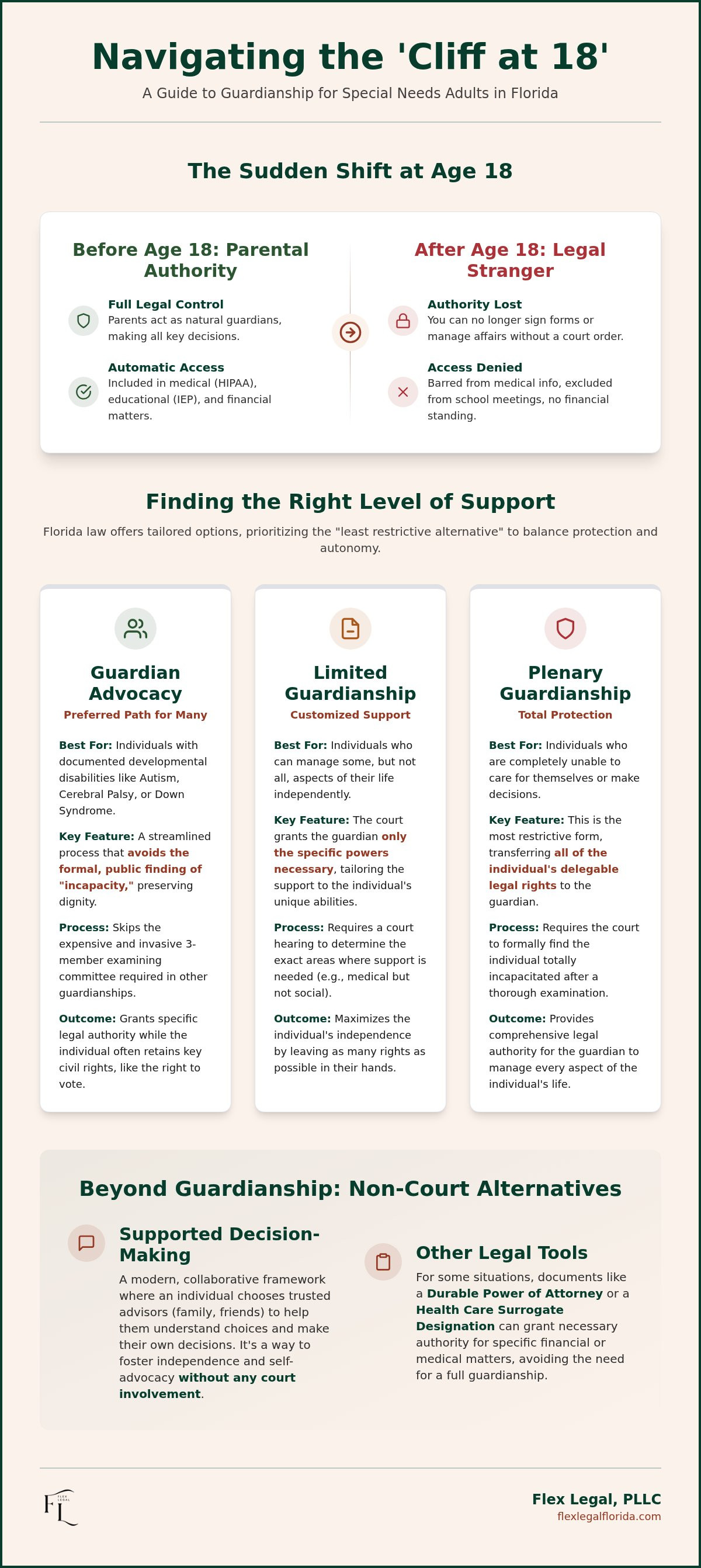
In Florida, the transition to adulthood happens in a heartbeat. On their 18th birthday, your child is legally considered capable of managing their own affairs, regardless of their actual cognitive or developmental abilities. This shift is often called the "Cliff at 18." It's the moment when your role changes from a legal decision-maker to a bystander in the eyes of the law. Without proactive steps, you may find yourself locked out of the very systems your child relies on for survival and growth.
Securing legal guardianship or exploring options for guardianship for special needs adult florida is about more than just paperwork. It's about maintaining your ability to advocate for someone you love. The Florida Probate Court oversees these transitions to ensure that adults who cannot care for themselves are protected. While the court's involvement can feel heavy, it serves as a vital safeguard. Waiting for a crisis to occur often leads to emergency proceedings. These are far more stressful, expensive, and rigid than a planned, agile approach started before the milestone birthday.
The Impact on Medical and Financial Decisions
The legal shift at 18 triggers immediate barriers in everyday life. You've likely managed every doctor's appointment and bank statement for years, but the law doesn't recognize that history once the clock strikes midnight on their birthday. Common obstacles include:
HIPAA Roadblocks: Doctors and hospitals are legally barred from sharing medical information or discussing treatment plans with you unless you have established legal authority.
Educational Exclusion: Schools are no longer required to include parents in IEP meetings or share progress reports once the student reaches adulthood.
Financial Vulnerability: Without a legal protector, your child may be at a higher risk for financial exploitation. You also won't have the standing to manage their bank accounts or specific government benefits if they're unable to do so.
Balancing Independence and Protection
Florida law follows the "least restrictive alternative" doctrine. This means the court's goal isn't to strip away rights, but to provide only the support that's truly necessary. It's a delicate balance between safety and self-determination. For many families, guardianship for special needs adult florida acts as an empowering safety net rather than a cage. It allows the adult to live with as much autonomy as possible while you handle the complex legal or medical hurdles they can't manage alone. This emotional transition is significant. It marks the shift from being a "parent" to becoming a "legal partner" in your child's adult life, ensuring their dignity remains intact while their future stays secure.
Comparing Florida Guardianship Options: Plenary, Limited, and Guardian Advocacy
Families often feel overwhelmed by the legal terminology involved in Florida guardianship options. However, the system is designed to be adaptable. The main difference between these paths lies in how much authority is transferred and how the court determines the need for support. One of the most important distinctions to understand is the difference between "incapacity" and a "need for advocacy." Traditional guardianship requires a formal adjudication of incapacity, which can feel like a harsh legal label. Guardian Advocacy focuses instead on the practical support the individual needs to navigate the world. This distinction allows families to bypass the stigma of a total loss of rights while still securing the legal standing necessary for lifelong care.
Guardian Advocacy: The Preferred Path for Many Families
Guardian Advocacy is a unique legal tool under Florida Statute 393.12. It's specifically designed for individuals with developmental disabilities such as autism, cerebral palsy, or Down syndrome. Unlike traditional routes, this process skips the invasive and expensive three-member examining committee. This makes it a faster, more accessible option for families who already have clinical documentation of their child's condition. Under this framework, the adult can often retain important civil rights, like the right to vote, while you maintain the authority to manage their medical care or government benefits. It's a streamlined way to establish guardianship for special needs adult florida without the heavy burden of a full competency trial.
Plenary vs. Limited Guardianship
When a person's needs fall outside the specific criteria for Guardian Advocacy, the court looks at Limited or Plenary options. A Limited Guardianship is highly customized. The court only removes specific rights the individual cannot safely exercise, such as the right to enter into contracts or the right to marry. This preserves as much autonomy as possible. In contrast, Plenary Guardianship is the most comprehensive form of guardianship for special needs adult florida. It's reserved for situations where the individual is unable to perform any of the tasks necessary to care for their person or property. In both cases, the court appoints an attorney for your child to ensure their interests are independently represented throughout the proceedings. This ensures that the legal safety net is built on a foundation of fairness and protection.
Choosing the right level of support requires a deep look at your family's unique situation. If you're feeling uncertain about which path fits best, our team at Flex Legal acts as an agile ally to help you weigh these options and move forward with confidence.
Beyond Guardianship: Exploring Less Restrictive Alternatives in Florida
Florida law mandates that courts consider every possible alternative before granting a full guardianship for special needs adult florida. This "least restrictive" requirement isn't just a legal hurdle; it's a philosophy that prioritizes your child's dignity and self-determination. For many families, a combination of private legal documents and informal support networks provides the safety they need without the ongoing oversight and expense of the court system. By building a customized framework, you can protect your loved one while allowing them to retain as many civil rights as possible.
Supported Decision-Making in Practice
Formalized in Florida law in July 2024, Supported Decision-Making (SDM) allows an adult with disabilities to choose a "support team" to help them understand, communicate, and make their own choices. In practice, these agreements are becoming vital tools in West Palm Beach schools and clinics. They allow a young adult to remain the primary decision-maker while having a trusted advocate by their side during IEP meetings or doctor visits. However, SDM has its limits. It's a voluntary agreement that doesn't grant the supporter the right to sign for the individual. If a situation requires a binding legal signature for someone who lacks the capacity to understand a contract, SDM alone may not be enough to satisfy institutional requirements.
Legal Documents for Incapacity Planning
When more formal authority is required to manage a loved one's life, specific legal documents can often replace the need for a full court case. A durable power of attorney is a cornerstone of this strategy. It grants a parent or advocate the power to manage financial affairs and legal matters. A common pitfall families face is the "bank problem." Many financial institutions reject generic or older forms, leaving families stranded during a crisis. Using a modern, Florida-specific document ensures your authority is recognized by local banks and creditors when it matters most.
Similarly, a Designation of Health Care Surrogate names an individual to make medical choices during an emergency or when the adult is unable to communicate. When you combine these tools with a Special Needs Trust, you create a robust ecosystem of protection. The trust manages assets without jeopardizing government benefits, while the legal documents provide the authority to act. This layered approach is often more agile and less intrusive than a traditional guardianship for special needs adult florida, allowing your family to adapt as your child’s needs evolve over time.
The Florida Guardianship Process: A Step-by-Step Legal Roadmap
The transition from parent to legal guardian involves a series of specific milestones. It's a structured path designed to ensure the safety of the individual while verifying the fitness of the guardian. For families seeking guardianship for special needs adult florida, this process usually takes between two to four months for uncontested cases. While the legal system can feel slow, following a clear roadmap helps you avoid common pitfalls that lead to delays or rejected filings. This journey is about building a permanent safety net that grows with your child’s needs.
Preparing Your Petition in Palm Beach County
Your journey begins in the Probate Division of the Circuit Court. In Palm Beach County, judges look for concrete evidence of the need for support. You'll need to gather medical or psychological evaluations, such as recent Individual Education Plans (IEPs) or Individual Program Plans (IPPs). You must also identify "next of kin" for mandatory notification. Under 2026 Florida law, specifically HB 1099, the court order must now identify by name specific individuals entitled to receive notice of the ward’s death, medical transfers, or changes in residential settings. Gathering this information early ensures your petition meets the newest transparency requirements.
The formal process typically follows these five steps:
Step 1: Filing the Petition. You submit the initial paperwork for Guardian Advocacy or a traditional Appointment of Guardian.
Step 2: Appointment of Counsel. The court appoints an attorney to represent your child's interests, ensuring their rights are protected throughout the case.
Step 3: The Vetting Process. For plenary or limited cases, an examining committee reviews the individual’s capacity. For Guardian Advocacy, this step is often bypassed.
Step 4: Mandatory Education. You'll complete a state-approved training course to understand your new legal role.
Step 5: The Final Hearing. A judge reviews all evidence and, if satisfied, issues the "Letters of Guardianship."
Becoming a Qualified Guardian
Florida sets high standards for those who hold legal authority over another adult. You'll need to complete a mandatory 8-hour guardian training course. This course covers your legal responsibilities and the ethics of your fiduciary duty. Additionally, you must pass an FDLE background check and a credit history review. These steps aren't meant to be intrusive; they're safeguards to protect the ward from potential financial or physical harm. Understanding that you're acting as a fiduciary means you must always put your child’s interests above your own, especially when managing their assets or government benefits.
Once you are appointed, your responsibility shifts to ongoing compliance. You'll be required to file an initial report and subsequent annual plans. These documents outline the ward's medical status, residential setting, and financial well-being. If these procedural steps feel overwhelming, Flex Legal acts as your agile ally to manage the complex filings and ensure your family remains in good standing with the court.
How Flex Legal Simplifies Special Needs Planning in West Palm Beach
Protecting your child’s future involves more than just a single court filing. It requires a dynamic strategy that adapts as their life changes. At Flex Legal, we don't just process paperwork; we act as an agile ally for families entering this new chapter. Transitioning from being a parent to a legal partner is a significant emotional and legal shift. Our goal is to make the process of establishing guardianship for special needs adult florida as seamless as possible. We focus on local expertise to help you navigate the Palm Beach County court system with confidence and clarity.
A successful plan often means integrating your legal authority with a robust Special Needs Trust. This ensures that any assets intended for your child's care don't accidentally disqualify them from essential government benefits like SSI or Medicaid. We offer a blend of flat-fee options for foundational estate planning documents and hourly support for guardianship proceedings. This approach provides the transparency you need to plan your budget effectively while receiving high-level, customized legal support.
A Comprehensive Approach to Your Child's Future
We look at the entire landscape of your child’s life to ensure no gaps remain in their protection. This includes coordinating government benefits with your legal structures to maintain long-term eligibility. We also focus on drafting a Last Will and Testament specifically designed to fund special needs trusts upon your passing. Another critical piece is the designation of a pre-need guardian for the parents themselves. These documents allow you to name who should step in if you are ever unable to serve as guardian, creating a multi-generational safety net that prioritizes your child’s stability.
Modern Legal Solutions for Florida Families
Traditional law firms often feel rigid and slow, but we take a different approach. By using modern communication methods and efficient workflows, we reduce the friction and anxiety typically associated with probate court. You'll have a clear understanding of the path forward without the dense jargon that often alienates families. We prioritize adaptability as a core value, framing our services as a dynamic support system rather than a static set of rules. If you're ready to secure your child’s future with a partner who values speed and clarity, it's time to take the next step. Schedule a Special Needs Planning Consultation with Flex Legal to begin building your roadmap today.
Building a Secure Path for Your Loved One’s Adulthood
The transition to legal adulthood doesn't have to be a source of fear. By understanding your options for guardianship for special needs adult florida, you move from reaction to resolution. Whether you choose the streamlined path of Guardian Advocacy or implement a layered approach with special needs trusts and powers of attorney, you're creating a safety net that honors your child's dignity. You've spent years advocating for their growth, and now you have the tools to ensure that advocacy remains legally binding.
Navigating the West Palm Beach Probate Court requires more than just legal knowledge; it requires an agile ally who understands the emotional weight of these decisions. Our firm provides specialized special needs planning designed to fit your family's unique life. We prioritize transparent communication and empathetic expertise to help you cross the legal cliff with confidence. Secure your child's future today—Book a Special Needs Consultation with Flex Legal. Your child’s future is bright, and with the right legal framework, it can stay that way.
Frequently Asked Questions
What is the difference between guardianship and guardian advocacy in Florida?
Guardian Advocacy is a streamlined process designed specifically for individuals with developmental disabilities. It allows families to skip the three-member examining committee required in traditional guardianship, which saves time and reduces administrative costs. Traditional guardianship requires a formal adjudication of incapacity, while Guardian Advocacy focuses on the practical support the adult needs. It's often the preferred route for families of young adults who need a safety net while maintaining maximum independence.
How much does it cost to get guardianship for a special needs adult in Florida?
While costs vary by county, families should budget for filing fees, attorney fees, and potential court-appointed experts. Attorney fees are typically billed hourly for these proceedings, and the total initial setup for an uncontested case often ranges from $4,000 to $10,000. These figures cover the legal professionals and administrative requirements necessary to ensure the ward’s interests are fully protected by the Florida court system during the legal transition to adulthood.
At what age should I start the guardianship process in Florida?
You should ideally start the process six months before your child turns 18. This lead time allows you to gather medical records, file the petition, and complete the hearing before their birthday milestone. Starting early prevents the "legal cliff" where you lose access to medical and school records the moment they reach legal adulthood. It's an agile way to ensure a seamless transition into their adult support system without a gap in legal authority.
Can I get guardianship without a lawyer in Florida?
No, Florida law requires that every guardian be represented by an attorney. This rule exists because the guardian acts as a fiduciary, and the court must ensure all legal procedures are followed correctly. Even in simplified processes like Guardian Advocacy, a lawyer is necessary to file the petition and represent you at the hearing. Having an expert ally ensures that your child’s rights are protected while you fulfill your legal duties under state law.
Does a guardian have to live in Florida?
A guardian must generally be a Florida resident. However, there's a significant exception for close family members. Non-resident relatives, such as siblings, parents, or grandparents, can serve as guardians even if they live out of state. This allows families to maintain their support network across state lines. If the proposed guardian isn't a relative and lives outside Florida, they're usually disqualified from serving as a guardian for special needs adult florida under current state statutes.
What happens if a parent/guardian passes away?
If a guardian passes away, the court must appoint a successor to manage the ward's affairs. To avoid a legal gap, it's vital to include a Designation of Pre-need Guardian in your estate plan. This document names your preferred successor before a crisis occurs. Without this proactive step, the court will decide who takes over, which can lead to delays or family disputes. Planning for this transition ensures your child’s care remains uninterrupted and their future stays secure.
Can guardianship be reversed if the adult's condition improves?
Guardianship for special needs adult florida isn't necessarily permanent. If an individual’s capacity improves or they gain new skills, you can petition the court to restore some or all of their rights. The court will review medical evidence and evaluations to determine if the legal safety net is still required. This flexibility supports the "least restrictive alternative" doctrine by encouraging independence as the adult develops and demonstrates the ability to manage specific life tasks independently.
Is a background check required to become a guardian in Florida?
Yes, all prospective guardians must undergo a mandatory background check and credit history review. The Florida Department of Law Enforcement processes these checks to ensure the safety and financial security of the ward. You must also complete a state-approved 8-hour training course. These requirements confirm that you're fit to handle the significant fiduciary responsibilities that come with managing another person’s legal and personal affairs while maintaining transparency and accountability to the local probate court.


Comments