
Top 5 Estate Planning Myths in West Palm Beach: What Every Florida Resident Needs to Know in 2026

What if the legal advice you're relying on today actually triggers a 12-month court battle for your family tomorrow? Many West Palm Beach residents believe a simple will is enough to stay out of court, but working with a strategic estate planner reveals that Florida's probate system often tells a different story. You've likely felt the anxiety of wondering if your legal documents are just expensive paper or if they truly protect your business and your family's future. It's exhausting to deal with complex rules when you just want a clear, modern path forward.
We understand that you want a seamless way to protect what you've built without getting buried in high legal fees. This guide will debunk the five most dangerous misconceptions about Florida law to ensure your plan is ready for 2026. We'll show you how to bypass the typical 6 to 12-month probate delay, ensure a child with special needs keeps their Medicaid benefits, and minimize taxes for your West Palm Beach business. This article provides a flexible roadmap to replace legal confusion with absolute confidence in your security.
Key Takeaways
Learn how a strategic estate planner crafts tailored protections for West Palm Beach families of every income level, preventing unnecessary losses to the probate system.
Understand the hidden risks of DIY legal documents and why generic software often fails to navigate the specific complexities of Florida’s "Homestead Trap."
Discover why a standard Will doesn't guarantee a bypass of the probate court and how to avoid the typical 6-to-12 month administration timeline in Palm Beach County.
Explore the vital importance of incapacity planning to ensure your medical and financial decisions remain in your hands during an unexpected crisis.
Identify the specific Florida constitutional nuances that could prevent your primary residence from passing to your heirs exactly as you intended.
Table of Contents Myth #1: An Estate Planner is Only for the Ultra-Wealthy in Palm Beach County Myth #2: DIY Online Forms Are "Just as Good" as a Professional Plan Myth #3: Having a "Last Will and Testament" Means You Avoid Probate Myth #4: Florida Homestead Laws Automatically Protect Your Heirs Myth #5: Estate Planning is Only About What Happens After You Die
Myth #1: An Estate Planner is Only for the Ultra-Wealthy in Palm Beach County
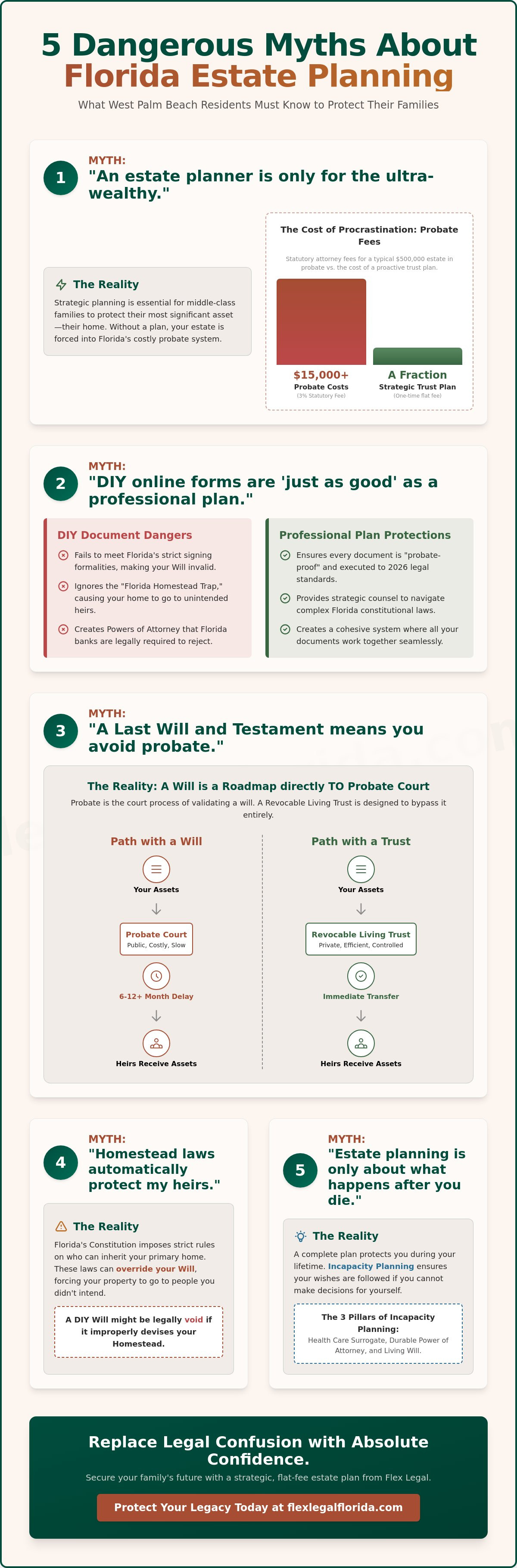
Many West Palm Beach residents assume an estate planner is a luxury reserved for those with oceanfront zip codes or multi-million dollar portfolios. This misconception leaves thousands of Florida families vulnerable every year. In 2026, the reality is that estate planning is a vital tool for the middle class. Whether you own a single-family home in Royal Palm Beach or a small business in the Warehouse District, you have an estate. If you don't create a plan, the state of Florida decides who gets your assets through a rigid, public, and often expensive process. Modern planners have moved away from the opaque hourly billing models of the past. Instead, they offer transparent, flat-fee packages that provide price certainty from day one.
Planning protects modest assets just as much as it protects grand ones. A family home is often a person's most significant investment. Without a strategic plan, that home could be tied up in court for months, preventing heirs from living in it or selling it to cover expenses. A professional estate planner acts as a strategist for families of all income levels, ensuring that even a small savings account or a modest life insurance policy reaches the intended beneficiary without unnecessary interference.
What Does an Estate Planner Actually Do?
An estate planner isn't just a document preparer. While basic software can generate a generic will, it can't coordinate your life insurance beneficiaries with your retirement accounts or protect a child's inheritance from future creditors. This is where a legal strategist provides real value. They offer a tailored approach that adapts to your specific family dynamics and goals. For a foundational understanding of these concepts, you can consult this comprehensive guide to estate planning which details how trusts and directives function together. A professional ensures your documents work as a cohesive system rather than a collection of unrelated papers.
The Real Cost of Procrastination in Florida
Waiting to plan is often the most expensive choice a Florida resident can make. Florida Statutes section 733.6171 defines "reasonable" compensation for attorneys in probate. For a standard $500,000 home, the statutory fee can reach 3% of the estate's value. That's $15,000 before court costs or filing fees are even considered. Contrast this with the one-time cost of a trust, which usually costs a fraction of those probate fees. Flex Legal focuses on efficiency by providing fixed-price document preparation. This eliminates the fear of hidden costs and allows you to secure your family's future without the stress of an open-ended bill.
Myth #2: DIY Online Forms Are "Just as Good" as a Professional Plan
The convenience of a $50 digital template is tempting, but Florida's legal landscape is uniquely complex. Store-bought wills often fail to comply with Florida Statute 732.502; this requires specific signing formalities that generic software frequently overlooks. If your document isn't executed with the precision required by Palm Beach County courts, your family faces a contested estate. An experienced estate planner ensures your documents are "probate-proof" by validating every signature and notary seal according to current 2026 standards.
One of the most dangerous oversights in DIY forms is the "Florida Homestead Trap." Under Article X, Section 4 of the Florida Constitution, there are strict limits on how you can devise your primary residence if you have a spouse or minor children. A generic form won't warn you that your attempt to leave the house to a sibling could be legally void. This mistake forces your heirs into the very process of Probate in Florida that you intended to avoid. Working with a professional ensures these constitutional nuances are respected, keeping your home within the family as intended.
The Failure of General Software in Florida
Generic software often produces a Durable Power of Attorney that Florida banks simply won't honor. Since the 2011 legislative overhaul, Florida requires specific "superpowers" to be individually initialed to grant authority for certain financial actions. Without these precise designations, your agent might be unable to sell property or manage your taxes during a crisis. Florida Health Care Surrogate forms also require specific language regarding the immediate or triggered release of medical information. A Florida-specific Power of Attorney functions as a comprehensive toolkit that grants your agent the exact legal "superpowers" needed to manage your affairs without court intervention.
Special Needs and Complex Family Situations
DIY templates are particularly risky for families with vulnerable heirs. A standard inheritance can instantly disqualify a child from receiving Medicaid or Supplemental Security Income benefits if the assets exceed $2,000. Proper special needs planning utilizes specific third-party trust language to protect those benefits while providing for the child's quality of life. A professional estate planner helps you select a trustee who understands the fiduciary duty of managing these funds for a vulnerable heir. If you want to ensure your legacy remains a blessing rather than a legal burden, consulting with a strategic ally can help you build a plan that actually works when it matters most.
Myth #3: Having a "Last Will and Testament" Means You Avoid Probate
Many West Palm Beach residents view a Will as a "get out of court free" card. In reality, it's quite the opposite. A Will is essentially a formal letter to a probate judge, asking them to oversee the distribution of your assets. It doesn't bypass the court; it initiates the court process. Without a Will, the state decides who gets what. With a Will, the judge decides who gets what based on your instructions, but they still have to sign off on every major move.
In Palm Beach County, probate administration typically lasts between 6 and 12 months. During this window, your assets are effectively "frozen." Your family often can't sell your home, access specific bank accounts, or manage investments without direct court approval. The Florida Bar explains in its guide on Probate in Florida that this supervised process is mandatory for any assets held solely in the deceased person's name. There's also the issue of privacy. Once a Will is filed with the clerk, it becomes a public record. This means anyone can see the value of your estate and the names of your beneficiaries, which is a significant concern for those who value discretion.
The Revocable Living Trust Alternative
For those seeking a more streamlined approach, a revocable trust offers a modern solution. A trust allows for the immediate transfer of assets without the 12 month wait associated with probate. It keeps your financial affairs private and keeps your family out of the courtroom. To benefit from this, your estate planner will help you "fund" the trust. This involves retitling specific assets into the trust's name, such as:
Primary residences and West Palm Beach investment properties
Non-retirement brokerage accounts and cash holdings
Business ownership interests and LLC memberships
Valuable personal property and art collections
Probate Litigation: When a Will is Not Enough
A Will can sometimes create more problems than it solves. We frequently see probate litigation in South Florida triggered by claims of "undue influence" or lack of mental capacity. These disputes can drain an estate's value and cause lasting family friction. A proactive estate planner builds layers of protection into your documents to minimize these risks. If a conflict does arise, Flex Legal provides strategic representation in probate litigation. We act as your agile ally, working to resolve disputes with the efficiency and clarity you deserve, ensuring that the legal process doesn't become a permanent obstacle for your heirs.
Myth #4: Florida Homestead Laws Automatically Protect Your Heirs
Many West Palm Beach homeowners assume their primary residence is a "set it and forget it" asset that will pass seamlessly to their children. This assumption is a dangerous mistake. Florida Constitution Article X, Section 4 provides some of the strongest homeowner protections in the United States, but it also creates a complex maze of restrictions that can override your written will. If you don't coordinate your plans with an experienced estate planner, your home could trigger a probate nightmare that lasts for years.
The law is designed to protect families from losing their homes, yet these same rules often lead to "improper devises." When a property owner attempts to leave their home to someone other than a spouse or minor child in a way that violates state law, the transfer fails. The result is a legal vacuum where the court dictates who owns the property, often resulting in shared ownership between parties who may not get along.
Understanding the Florida Homestead Trap
Florida law strictly limits how you can distribute your home if you're survived by a spouse or minor children. You cannot legally disinherit a spouse from the homestead unless they've signed a valid post-nuptial or pre-nuptial waiver. If you try to leave the house to an adult child while a spouse is still living, the law automatically grants the spouse a "Life Estate" and the children a "Remainder" interest. This split ownership creates immediate friction regarding who pays for taxes, insurance, and maintenance.
The Florida Homestead exemption serves as a shield against forced sale by most judgment creditors, a protection that has been a cornerstone of the state's legal framework since the 1968 constitutional revision. However, this protection doesn't mean the transfer process is automatic or easy for your heirs to manage without a clear strategy.
Strategic Deeds for West Palm Beach Property
Smart property owners use modern tools to bypass these constitutional hurdles. The Enhanced Life Estate Deed, frequently called a Lady Bird Deed, allows you to maintain total control over your home during your lifetime while ensuring the property transfers to your heirs the moment you pass away. This method avoids the delays and costs of the probate court entirely. For residents with high-value real estate, integrating asset protection into your deed structure is vital to securing equity against future liability.
Working with a estate planner allows you to align your homestead status with a Living Trust. While putting a home in a trust is common, the language must be precise to ensure you don't lose your Save Our Homes tax cap or your creditor protection. We focus on creating flexible solutions that adapt to Florida's unique property laws while keeping your family out of the courtroom.
Don't leave your most valuable asset to chance. Contact Flex Legal Florida today to ensure your West Palm Beach home is fully protected for the next generation.
Myth #5: Estate Planning is Only About What Happens After You Die
Many West Palm Beach residents view estate planning as a final act, something strictly reserved for the distribution of assets after they pass away. This misconception leaves a massive gap in your personal protection. In 2026, a comprehensive plan is less about death and more about "incapacity planning." If a sudden medical emergency or cognitive decline leaves you unable to manage your finances or healthcare, your family faces a legal vacuum. Without a designated estate planner to help you establish "living" protections, your life decisions fall into the hands of the state.
When you lack a proactive plan, Florida courts must step in through a process known as guardianship. This is a public, invasive, and expensive court proceeding. According to Florida's Chapter 744, the court appoints a guardian to manage your affairs, which can cost thousands in legal fees and monthly reporting costs. It often creates friction among family members who may disagree on who should lead. Proactive planning ensures you choose your own advocates now, keeping your private life out of the courthouse and your assets under your family’s control.
Essential "Living" Documents Every Adult Needs
A modern estate planner prioritizes documents that function while you are still alive. The Designation of Health Care Surrogate is your first line of defense; it names a trusted person to make medical decisions if you're incapacitated. This works alongside a Living Will, which explicitly states your preferences for end-of-life care, such as the use of ventilators or feeding tubes. These documents ensure your wishes are followed without forcing your family to make agonizing guesses during a crisis.
To prevent court interference, you also need a Pre-need Guardian Designation. This document tells the judge exactly who you want to manage your person and property if guardianship ever becomes necessary, effectively blocking "professional guardians" from taking over your life. Finally, a HIPAA release is vital. Without it, federal privacy laws may prevent doctors from sharing even basic status updates with your spouse or adult children, leaving them in the dark during a medical emergency.
The Flex Legal Approach: Agile and Accessible
Jennifer L. Flexer, Esq. understands that your life is dynamic, not static. The Flex Legal approach rejects the "set it and forget it" mentality of traditional law firms. We use modern communication tools to streamline the planning process, making it easy to build a strategy that fits your current lifestyle. As Florida laws evolve in 2026, staying agile is essential. We prioritize regular "plan check-ups" to ensure your living documents still reflect your wishes and comply with the latest state statutes.
Don't wait for a crisis to find out your protections are missing. Our firm acts as your strategic ally, providing clear, flexible paths to security that prioritize your comfort today. We focus on clarity over legalese, ensuring you understand exactly how your plan protects you during your lifetime. Schedule a strategy session with a West Palm Beach estate planner today to secure your future.
Take Control of Your Florida Legacy Today
Waiting until a crisis hits to organize your affairs often leads to avoidable legal hurdles. Florida probate cases can stretch between 6 to 12 months; leaving families in limbo while assets remain frozen. You've learned that a simple will doesn't bypass this process and generic DIY forms frequently fail to address complex Florida Homestead laws. By partnering with a dedicated estate planner; you can replace uncertainty with a strategic roadmap tailored to your specific needs.
Jennifer L. Flexer, Esq., founded Flex Legal to provide West Palm Beach residents with a modern alternative to traditional law firms. We offer specialized expertise in Florida-specific probate and Special Needs laws; ensuring your plan is robust and compliant for 2026 and beyond. Our transparent flat-fee pricing removes the guesswork from document preparation; so you can focus on what matters most. It's time to stop worrying about the "what ifs" and start building a foundation that protects your loved ones for years to come.
You deserve the peace of mind that comes with a professional plan; and we're here to help you achieve it.
Frequently Asked Questions
Is a Florida estate planner different from a financial advisor?
Yes, a Florida estate planner focuses on the legal transfer of assets while a financial advisor manages your investment growth. Your advisor helps you build wealth through market strategies, but an attorney ensures those assets pass to heirs through legally binding documents. According to Florida Bar Rule 4-1.1, legal professionals must provide competent representation tailored to state laws. This partnership ensures your financial goals align with your legal protections.
Can I change my Florida estate plan after it is signed?
You can modify your estate plan at any time as long as you possess the mental capacity to do so. Changes are typically made through a Codicil for Wills or an Amendment for Trusts. Florida Statute 732.502 requires these updates to follow specific signing formalities to remain valid. It's a flexible process that allows your documents to evolve alongside your life changes and new financial goals.
How much does a typical estate plan cost in West Palm Beach?
Costs for legal planning vary based on the complexity of your specific family and asset situation. The 2024 Caring.com Estate Planning Study shows that 32 percent of Americans have a will, yet many cite cost as a primary barrier. National industry data from 2023 suggests basic professional plans often start around $1,000. Investing in a strategic plan now prevents the significantly higher costs and delays associated with Florida probate later.
What happens if I die in Florida without a Will or a Trust?
Your assets enter the intestate succession process governed by Florida Statutes Chapter 732. The state uses a fixed formula to distribute property to your heirs regardless of your personal wishes. If you're married and have children from that same marriage, your spouse receives 100 percent of the estate. This rigid legal default makes working with a professional estate planner essential for anyone who wants to choose their own beneficiaries.
Does a Florida Revocable Living Trust protect my assets from lawsuits?
No, a Revocable Living Trust doesn't offer asset protection from creditors during your lifetime. Because you maintain total control over the trust assets, Florida Statute 736.0505 allows creditors to reach those funds. If you're looking for lawsuit protection, you might consider irrevocable trust structures or Florida's robust homestead exemptions. We focus on creating modern solutions that balance your need for control with your desire for long term security.
How often should I update my estate plan with a professional?
You should review your plan every 3 to 5 years or immediately following a major life event. Significant changes like a divorce, a 20 percent shift in net worth, or the birth of a child require immediate document updates. Legislative shifts, such as the 2024 tax law adjustments, can also impact how your plan performs. Regular checkups ensure your strategy remains agile and responsive to the current legal landscape.
Do I need a lawyer for a special needs trust in Palm Beach County?
Hiring a lawyer is vital for creating a special needs trust that doesn't jeopardize government benefits. The Social Security Administration (SSA) follows strict guidelines under POMS SI 01120.200 regarding how these trusts must be drafted. A single phrasing error can disqualify a loved one from receiving Supplemental Security Income or Medicaid. We provide the precise legal language needed to protect your family's most vulnerable members while securing their financial future.
Can a Lady Bird Deed replace a full estate plan in Florida?
No, a Lady Bird Deed only manages the transfer of real estate and doesn't cover your other assets. While it's an efficient tool for keeping a home out of probate, it can't designate guardians for minors or distribute bank accounts. Relying solely on a deed leaves 100 percent of your personal property and healthcare decisions unaddressed. A comprehensive plan integrates various tools to ensure every part of your legacy is protected.


Comments