
Third-Party vs. First-Party Special Needs Trust: A 2026 Florida Planning Guide

What if the inheritance you carefully saved to protect your child actually becomes a mandatory gift to the government instead? It's a heavy thought for any Florida family, but failing to understand the third-party vs first-party special needs trust distinction can lead to the state claiming assets as "payback" for Medicaid expenses. You've worked hard to build a safety net, and you shouldn't have to worry that a simple oversight might jeopardize your loved one's SSI or Medicaid eligibility.
We're here to help you replace that anxiety with a clear, adaptable strategy. This guide simplifies complex legal concepts into actionable steps, ensuring your planning reflects a modern understanding of Florida's evolving laws. You'll learn how to shield assets effectively while providing the high quality of life your family deserves without the fear of government interference or complex legal jargon causing unnecessary friction.
We'll break down the latest 2026 updates, including the $2,982 Medicaid income limit and the expanded age limits for ABLE accounts. This overview provides a streamlined path toward maintaining essential benefits while avoiding the pitfalls of probate and state reimbursement.
Key Takeaways
Learn how a special needs trust acts as a protective shield for assets while keeping your loved one eligible for essential means-tested benefits.
Discover why the distinction between a third-party vs first-party special needs trust determines whether the government can claim a "payback" from the remaining funds.
Identify the specific funding sources for each trust type, ranging from personal injury settlements to life insurance policies and family gifts.
Explore how modern planning allows for a hybrid approach, combining different tools to maximize your loved one's independence and financial security.
Gain clarity on Florida's latest 2026 regulations to ensure your estate plan remains compliant and effective for years to come.
Table of Contents
What is a Special Needs Trust (SNT) in Florida?
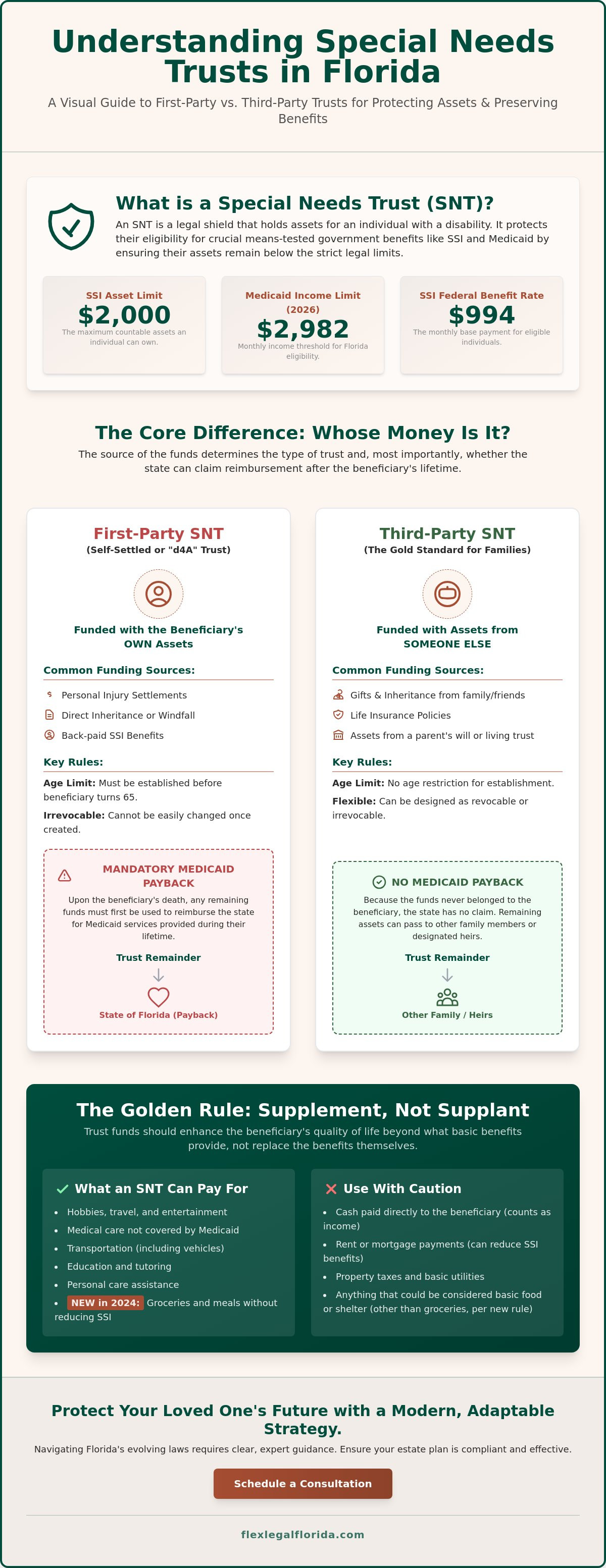
A Special Needs Trust (SNT) serves as a specialized legal vehicle that holds assets for an individual with a disability while protecting their access to vital government benefits. Think of it as a dynamic support system rather than a static legal requirement. It provides a way to improve a loved one's quality of life without triggering the strict $2,000 asset limit enforced by Supplemental Security Income (SSI) and Florida Medicaid. In 2026, the Florida legal landscape remains complex. With the SSI federal benefit rate at $994 for individuals, every dollar counts. A well-structured trust acts as an agile ally, ensuring these funds remain available for things the government won't cover.
For many families, the primary goal is empowerment. Modern planning focuses on creating a foundation where a beneficiary can thrive, rather than just surviving on the bare minimum. By using a trust, you aren't just checking a compliance box. You're building a customized framework that adapts to your family's evolving needs while maintaining a high standard of care.
Preserving SSI and Medicaid Eligibility
Florida's Medicaid rules are rigorous. If an applicant's assets exceed the $2,000 threshold, they risk losing coverage for medical care and long-term support. The Social Security Administration (SSA) maintains strict oversight to ensure trust funds don't count as "available" resources. The golden rule of this planning is to "supplement, not supplant." This means trust funds should pay for enhancements to life, like hobbies or travel, rather than basic needs already covered by benefits. A major 2024 rule change by the SSA significantly increased flexibility by no longer counting food as in-kind support. This allows a Supplemental Needs Trust to pay for groceries and meals without reducing the beneficiary's monthly SSI payment.
The Core Difference: Whose Money Is It?
The fundamental question at the heart of your planning is simple: whose money is it? The distinction in a third-party vs first-party special needs trust boils down to the source of the funding. This source dictates the rules of the trust and whether the state can demand reimbursement after the beneficiary passes away. If the funds come from the beneficiary's own assets, such as a legal settlement, different restrictions apply than if the funds are a gift from a parent. In some cases, families may also consider a pooled trust, where a non-profit organization manages the assets, as an alternative to an individual trust arrangement.
First-Party Special Needs Trusts: Managing the Beneficiary's Own Assets
A first-party special needs trust, often referred to as a "d4A" trust, is a specific legal tool used when the assets being protected already belong to the person with a disability. This differs from other options because the beneficiary is technically the owner of the funds before the trust is established. When weighing a third-party vs first-party special needs trust, the source of the money is the deciding factor. If a loved one receives a sudden windfall directly in their name, a first-party trust is usually the necessary path to maintain benefit eligibility.
Common funding sources for these trusts include personal injury settlements, back-paid SSI benefits, or an unplanned inheritance where a well-meaning relative left money directly to the individual rather than a trust. There is a strict age requirement for this setup. The trust must be established and funded before the beneficiary turns 65. It's a "solo" arrangement in the sense that it can be created by the individual themselves, a parent, grandparent, legal guardian, or a court, provided the beneficiary meets the legal definition of disability.
The Medicaid Payback Requirement
The most significant feature of a first-party trust is the mandatory reimbursement rule. Because the trust is funded with the beneficiary's own money, Florida's Agency for Health Care Administration (AHCA) requires a "payback" upon the beneficiary's death. This means the state has the first right to any remaining funds to recover the costs of Medicaid services provided during the person's lifetime. The payback provision is the mandatory legal trade-off that allows a beneficiary to keep their assets while remaining eligible for government benefits for special needs trusts. Any funds left over after the state is reimbursed can then be distributed to other heirs.
When to Use a First-Party Trust
Imagine a West Palm Beach resident who receives a significant medical malpractice settlement. Without a trust, that settlement would immediately disqualify them from Medicaid and SSI, potentially cutting off access to essential therapies and medications. By placing those funds into a first-party SNT, the individual can use the money for a higher quality of life, like specialized equipment or home modifications, while their basic medical needs remain covered. If you find yourself managing a sudden windfall, exploring special needs planning is a vital step to ensure those assets are handled with the right professional oversight to avoid accidental disqualification.
Third-Party Special Needs Trusts: The Gold Standard for Family Inheritance
When families look to secure the future of a loved one with a disability, the third-party special needs trust stands out as the most powerful tool available. Unlike the first-party version we discussed earlier, this trust is funded exclusively with assets that never belonged to the beneficiary. It serves as an "inheritance shield," allowing parents, grandparents, or even siblings to set aside funds without jeopardizing the recipient's access to Supplemental Security Income (SSI) or Medicaid. This distinction is the cornerstone of the third-party vs first-party special needs trust decision. By keeping the assets separate from the beneficiary's legal ownership, you maintain complete control over how the money is eventually distributed.
Flexibility is a major hallmark of this arrangement. You can establish a third-party SNT as a standalone document that exists right now, or you can build it into your Last Will and Testament. This adaptability ensures your planning can grow alongside your family's needs. Whether you are gifting a small amount today or planning for a significant transfer of wealth later, this trust provides a secure, modern framework for long-term support.
The No-Payback Advantage
The single most compelling reason to choose a third-party SNT is the absence of a Medicaid payback requirement. Because the funds never belonged to the beneficiary, the State of Florida has no legal claim to them after the beneficiary passes away. This allows you to leave a lasting legacy. Any funds remaining in the trust can be passed down to other children, grandchildren, or even a favorite charity. For West Palm Beach families, this provides immense peace of mind. You don't have to worry that your hard-earned savings will eventually be seized by the government to reimburse years of medical expenses. Instead, your assets stay within your family circle.
Strategic Funding and Life Insurance
Many families choose to fund these trusts through life insurance, particularly "second-to-die" policies that pay out after both parents have passed. This ensures a significant pool of resources is available exactly when it's needed most. To create a truly robust plan, it's essential to coordinate this with a broader revocable trust. This integrated approach prevents assets from accidentally falling into the wrong hands or triggering benefit disqualification. As your circumstances change, you can update the trust to reflect new goals, ensuring your loved one always has an agile support system in place.
Choosing the Right Path: Third-Party vs. First-Party Special Needs Trust
Deciding on a third-party vs first-party special needs trust requires a clear look at the source of your funds and your long-term goals for heirs. The best trust depends on whose money is being protected. While a first-party trust is a reactive tool designed to shield a sudden windfall like a settlement, a third-party trust is a proactive legacy tool. Some families even choose a hybrid approach. They might use a first-party trust for the beneficiary's own assets while maintaining a separate third-party trust for family inheritance. This keeps the "payback" requirement limited only to the first-party funds, protecting the rest of the family's wealth.
Selecting a trustee is another vital decision for West Palm Beach families. You can choose a trusted family member, but many prefer a professional trustee to handle the complex accounting and SSA reporting requirements. Avoid the common "sibling trap" at all costs. This happens when parents leave money to a non-disabled sibling with the informal request to "take care of" their brother or sister. Legally, that money belongs to the sibling. If they face a divorce, a lawsuit, or a bankruptcy, those funds could vanish, leaving your loved one with nothing.
A Quick Comparison Framework
Choosing the agile path for long-term stability means understanding these core differences at a glance.
Florida-Specific Considerations
In Palm Beach County, first-party trusts often require court involvement and annual accountings, which adds a layer of oversight. A modern approach to special needs planning also integrates ABLE accounts into the strategy. As of January 1, 2026, individuals whose disability began before age 46 can now open these accounts. With a 2026 contribution limit of $20,000, an ABLE account works perfectly alongside an SNT. It gives the beneficiary more autonomy over daily spending while the trust handles larger, long-term expenses. If you're ready to build a dynamic support system for your family, start your planning journey with a partner who understands these regional nuances.
Special Needs Planning in West Palm Beach: How Flex Legal Simplifies the Process
Flex Legal approaches special needs planning with a focus on partnership rather than just paperwork. We've intentionally moved away from the traditional, stuffy law firm model to act as an agile ally for West Palm Beach families. Our philosophy centers on modern, empathetic support that prioritizes your comfort and long-term stability. Instead of intimidating jargon and rigid structures, we offer a solution-oriented partnership that feels like working with a peer who happens to be an expert. We understand the emotional weight of these decisions, and we're here to make the process feel steady and logical.
One of the ways we prioritize transparency is through our flat-fee approach. We know that special needs families already face significant financial planning challenges. By removing the stress of hourly billing, we provide total certainty for your family's budget. This allows us to focus entirely on the quality of the strategy, ensuring your third-party vs first-party special needs trust is built to adapt to future changes in Florida law. You won't have to worry about unexpected costs while we work to secure your loved one's financial future.
We don't work in a vacuum. A truly effective special needs plan requires seamless coordination with your financial advisors and care teams. We ensure that your investment strategies, life insurance policies, and daily care plans all work in harmony with your trust. This holistic approach prevents the common errors that lead to benefit disqualification or probate complications. When everyone is on the same page, the path forward becomes much clearer and more efficient.
Our Process for Florida Families
Our streamlined process begins with an initial consultation where we identify your loved one's specific medical and financial needs. We then move into the customization phase. Here, we draft a trust that reflects your family's unique values while strictly adhering to 2026 Florida Medicaid and SSI regulations. Finally, we guide you through implementation. We make sure the trust is properly funded and operational so it can immediately begin serving as a dynamic support system. This ensures that the third-party vs first-party special needs trust you choose actually performs when it matters most.
Next Steps: Securing Their Future Today
Procrastination is often the biggest threat to a loved one's financial security. Waiting to establish a trust can leave benefits vulnerable to sudden changes in income or unplanned inheritances that exceed the $2,000 asset limit. Working with a special needs planning attorney shouldn't feel like a burden. We've designed our service to be efficient, transparent, and responsive to your regional needs. We invite you to schedule your consultation with Flex Legal today to take the first step toward a secure, high-quality future for your loved one.
Build a Dynamic Future for Your Family
Securing your loved one's financial well-being shouldn't feel like navigating a maze of rigid rules. By understanding the nuances of a third-party vs first-party special needs trust, you've already taken the most important step toward protecting their quality of life. Whether you are shielding a sudden settlement or planning a lasting family legacy, the right trust ensures that essential benefits like SSI and Medicaid remain untouched. These tools aren't just legal documents. They are adaptable systems that grow with your family's needs.
Flex Legal brings a modern, agile perspective to special needs planning. We combine deep expertise in Palm Beach County trust administration with a transparent, flat-fee pricing model that respects your family's budget. You deserve a partner who prioritizes clarity over complexity and results over traditional formality. Our team is ready to help you coordinate your estate plan with your broader care goals and financial advisors.
Secure your loved one's future with a custom Special Needs Trust at Flex Legal. You don't have to face these complex decisions alone. We're here to provide the steady, professional support you need to move forward with confidence.
Frequently Asked Questions
Can a first-party special needs trust be established after age 65 in Florida?
No, you cannot establish an individual first-party special needs trust if the beneficiary is 65 or older. Federal and Florida laws require these "d4A" trusts to be funded before the beneficiary's 65th birthday. If an individual over 65 receives a windfall, they typically utilize a pooled trust managed by a non-profit organization to maintain eligibility for Florida Medicaid programs and other means-tested benefits.
What happens to the money in a third-party SNT when the beneficiary passes away?
Residual funds in a third-party trust remain with your family or chosen charities after the beneficiary passes. Because the money never belonged to the beneficiary, Florida does not require a Medicaid payback. This allows you to name secondary beneficiaries, such as siblings or grandchildren, who will receive the remaining assets. It is a key benefit when comparing a third-party vs first-party special needs trust for legacy planning.
Can I use a special needs trust to pay for my child's housing expenses?
Yes, a trust can pay for housing, though it may result in a reduction of Supplemental Security Income (SSI) payments. The Social Security Administration views these payments as "In-Kind Support and Maintenance." While this reduces the monthly cash benefit by about one-third, the trust provides a higher standard of living by covering rent or mortgages that the beneficiary's limited income couldn't otherwise afford.
Is a pooled trust better than a first-party special needs trust?
Neither is universally better, as the choice depends on your specific goals and asset levels. A first-party trust offers more control and the ability to choose your own trustee, which is ideal for larger settlements. A pooled trust is often more cost-effective for smaller amounts of money because a non-profit organization manages the funds alongside assets from other beneficiaries, reducing administrative overhead and professional fees.
Does a special needs trust protect against all government creditors?
A special needs trust protects assets from being counted as resources, but it doesn't shield them from all legal obligations. For first-party trusts, the state is a primary creditor via the mandatory payback provision upon the beneficiary's death. However, while the trust is active, the funds are generally protected from outside creditors and lawsuits, ensuring the money is reserved exclusively for the care of the beneficiary.
Can a parent be the trustee of a special needs trust in West Palm Beach?
Yes, a parent can serve as a trustee, but it requires a high level of diligence. Trustees must manage strict reporting requirements for the SSA and Florida's AHCA. Many West Palm Beach families choose to appoint a professional co-trustee or a trust company to handle the complex accounting. This ensures the trust remains compliant while the parent focuses on the daily care and advocacy for their child.
How much money can you put into a third-party special needs trust?
There is no legal limit on how much money you can place into a third-party special needs trust. Whether you are transferring a modest life insurance payout or a multi-million dollar estate, the trust protects any amount from being counted toward the beneficiary's asset limits. This makes it an ideal vehicle for extended family members to contribute gifts or inheritances without coordinating their individual contribution amounts.
Do I need a lawyer to set up a special needs trust in Florida?
While Florida law doesn't strictly forbid drafting your own trust, it's highly discouraged due to the extreme complexity of Medicaid and SSI regulations. A single phrasing error can lead to a total loss of benefits or an accidental payback requirement. Working with a professional ensures your third-party vs first-party special needs trust is compliant with the latest 2026 Florida laws and tailored to your family's needs.



Comments