
Florida Will Requirements: A 2026 Guide to Making Your Legacy Legally Binding
- Kelly Mata
- 23 hours ago
- 14 min read

Your will is signed, witnessed, and tucked safely away. But what if a single procedural misstep means Florida's probate court treats it as though it never existed? That's not a hypothetical. Under Florida law, a will that fails to meet its strict execution requirements can be declared invalid, leaving your estate to be divided by state intestacy rules rather than your own wishes.
If that feels unsettling, you're not alone. Understanding Florida will requirements causes real anxiety for a lot of families, and the confusion is understandable. The rules around witnesses, signatures, and legal capacity aren't just formalities you can approximate. Florida courts apply a doctrine of strict compliance, meaning intent doesn't save a document that wasn't executed correctly.
This guide cuts through the confusion. You'll learn exactly what makes a Florida will legally valid, why the witness rules matter more than most people realize, and how getting the details right protects your heirs from costly probate disputes. By the end, you'll have a clear roadmap to a document that holds up when it matters most.
Table of Contents
The Core Legal Requirements for a Valid Florida Will
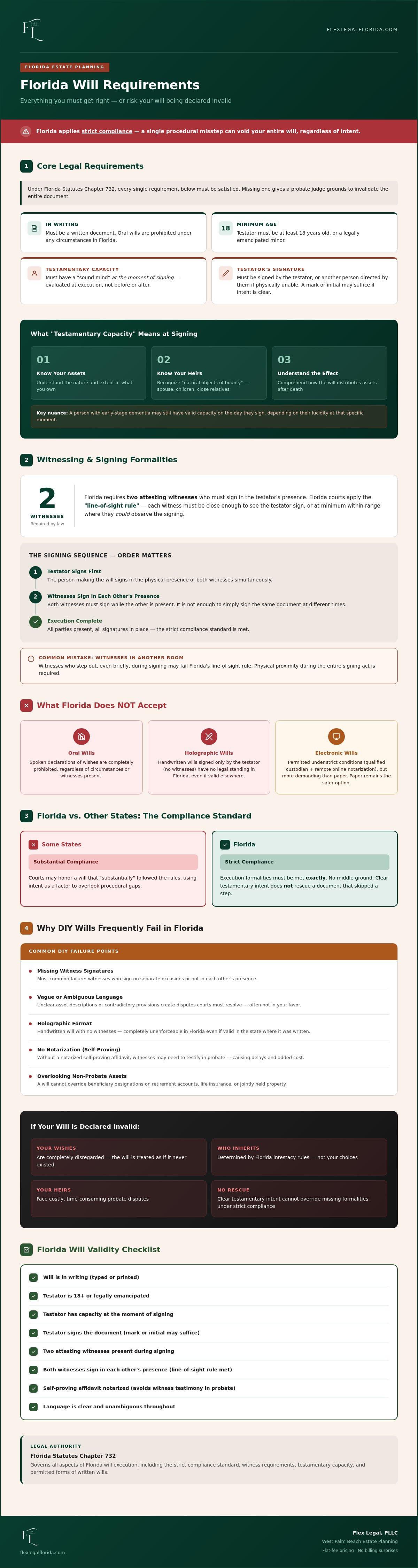
Florida law doesn't leave much room for interpretation when it comes to what makes a will legally enforceable. The Florida Statutes, specifically Chapter 732, lay out a clear set of baseline requirements, and every single one must be satisfied. Miss one, and a probate judge has grounds to invalidate the entire document. Understanding these foundations is the first step toward a will that actually does what you intend.
Here's what Florida law requires at the core level:
The document must be in writing. Florida does not recognize oral wills under any circumstances.
The testator must be at least 18 years old, or a legally emancipated minor.
The testator must have testamentary capacity at the moment of signing, not just generally.
The testator must sign the will, or direct another person to sign it in their presence if physically unable to do so.
That last point is often misunderstood. A signature doesn't have to be a full legal name written in cursive. Florida courts have accepted a mark, an initial, or any deliberate act intended as a signature, provided the intent is clear. What courts won't accept is ambiguity about whether the testator actually authorized the document.
Testamentary Capacity: Defining a 'Sound Mind'
Capacity is a precise legal concept, not a general impression of someone's mental state. Under Florida law, testamentary capacity means the testator must, at the time of signing, understand the nature and extent of their assets, recognize the natural objects of their bounty (meaning the people who would ordinarily inherit from them, such as a spouse or children), and comprehend the effect the will has on distributing those assets after death. Critically, capacity is evaluated at the moment of execution, not before or after. A person living with early-stage dementia may still have valid capacity on the day they sign, depending on their lucidity at that specific time.
The 'In Writing' Requirement in 2026
The writing requirement sounds straightforward, but it carries real complexity in the current environment. Oral wills, sometimes called nuncupative wills, are flatly prohibited in Florida regardless of the circumstances. Handwritten wills without witnesses, known as holographic wills, are equally unenforceable here, even though some other states recognize them. Florida's position is unambiguous: a handwritten document signed only by the testator has no legal standing.
Electronic wills occupy a more nuanced space. Florida was actually an early adopter of electronic will legislation, and the law does permit them under specific conditions, including the use of a qualified custodian and remote online notarization (RON). However, the execution requirements for electronic wills are, if anything, more demanding than those for traditional paper documents. The general will and testament requirements that apply across jurisdictions still apply here; Florida simply adds a digital-specific layer on top. For most families, a properly executed paper will remains the more straightforward and litigation-resistant option.
These foundational Florida will requirements set the stage for everything else. Getting them right isn't optional. It's the difference between a document that protects your family and one that unravels in court.
The Strict Formalities of Witnessing and Signing
Florida doesn't grade on a curve. Unlike some states that allow courts to honor a will that "substantially" followed the rules, Florida applies a strict compliance standard. Either the execution formalities were met exactly, or they weren't. There's no middle ground, and no amount of clear testamentary intent rescues a document that skipped a step. This is where most DIY wills collapse under scrutiny.
Under Florida Statutes Chapter 732, a will must be signed by two attesting witnesses in the testator's presence. That phrase, "in the testator's presence," carries more legal weight than most people realize. Florida courts apply what's sometimes called the line-of-sight rule: each witness must be close enough to see the testator sign, or at minimum be within a range where they could observe the signing if they chose to look. Witnesses who are in another room, even briefly, may not satisfy this requirement.
There's a second layer to this that competitors rarely explain clearly. The witnesses must also sign in each other's presence. It's not enough for both people to sign the same document at different times or in different locations. All three parties, the testator and both witnesses, must be present as a group during the signing sequence. One person stepping out to take a phone call at the wrong moment can create a legitimate basis for a later challenge.
On the question of who can serve as a witness, Florida law doesn't technically prohibit interested witnesses, meaning people who stand to inherit under the will. However, using a beneficiary as a witness is a serious practical risk. If the will is contested, that witness's credibility becomes immediately suspect, and in some circumstances their bequest could be affected. The cleaner approach is always to use two disinterested adults who have no financial stake in the estate.
The Signing Ceremony: A Step-by-Step Protocol
Think of the signing as a brief, structured ceremony rather than a casual paperwork task. The testator signs first, in front of both witnesses simultaneously. Then each witness signs, also in the presence of the testator and each other. The sequence matters. Interruptions matter. Everyone should remain in the same physical space from start to finish, with no gaps in observation. For electronic wills, Florida law permits authorized virtual presence, but the requirements are layered and the risk of procedural error is higher.
The Role of the Self-Proving Affidavit
A self-proving affidavit is a notarized statement, signed by the testator and both witnesses immediately after the will, that confirms the execution was properly completed. It doesn't change the will itself. What it does is eliminate the need for witnesses to appear in court and testify during probate. Without it, a probate judge may require live witness testimony to authenticate the document, which adds time, cost, and uncertainty. This is especially relevant for probate in Palm Beach County, where a self-proving affidavit is consistently one of the most effective ways to streamline estate administration. The notary language must follow the specific statutory form; a generic acknowledgment won't do.
Getting these details right from the start is exactly where working with a flat-fee estate planning attorney pays for itself. If you want confidence that your will's execution is airtight, connect with Flex Legal's estate planning team before you sign anything.
Why DIY Wills Often Fail in West Palm Beach Courts
A will that looks finished isn't necessarily a will that works. Palm Beach County probate courts see this pattern regularly: a document that was signed with genuine intention, filed after a death, and then challenged or invalidated because the person who drafted it didn't understand Florida's specific rules. The problem isn't effort or sincerity. It's the gap between what people assume is legally sufficient and what Florida Statutes Chapter 732 actually demands.
Start with the holographic will trap. Florida flatly refuses to recognize handwritten wills, full stop. No exceptions for terminal illness, no exception for remote locations, no exception for urgency. A person who writes out their wishes by hand, signs it, and leaves it for their family has left behind a document with zero legal standing in this state. That's not a technicality. It means the estate passes under Florida's intestacy laws, which distribute assets according to a fixed statutory formula that has nothing to do with what the deceased actually wanted.
Vague language creates a separate category of failure. Courts call these "latent ambiguities," situations where a will appears clear on its face but becomes impossible to interpret when applied to actual facts. Phrases like "my jewelry to my daughters equally" or "the house to whoever is taking care of me" invite disputes that cost far more to resolve in litigation than they ever would have cost to draft precisely. Once ambiguity enters a will, it becomes a probate problem, not a drafting problem, and the people paying to resolve it are your heirs.
Life changes also expose the limits of DIY documents. A will drafted before a marriage, divorce, or the birth of a child may not reflect the testator's current intentions, and Florida's automatic revocation rules don't always fill the gap the way families expect. An outdated will can disinherit someone unintentionally or, worse, create competing claims that drag the estate into contested proceedings.
The Danger of Online Templates
Generic templates are built for a generic legal environment that doesn't exist. Many of the most widely used online forms are drafted to comply with California or New York law, which means they're missing Florida-specific requirements entirely. Mandatory clauses governing Personal Representative powers, for example, are frequently absent. A $50 template can generate $50,000 in probate litigation when a court determines the document doesn't meet Florida will requirements and the estate has to be administered as though no will existed at all.
Common Execution Errors in Home Signings
Beyond the document itself, the signing process is where DIY attempts most frequently break down:
Using a beneficiary as a witness. Florida law doesn't automatically void a will for this, but it creates an immediate credibility problem in any contested proceeding and can affect the beneficiary's inheritance depending on circumstances.
Signing on the wrong line or skipping page initials. These errors signal to a probate court that the execution wasn't supervised or understood, and they invite challenges about whether the testator reviewed the full document.
Improper notarization of the self-proving affidavit. A generic notary acknowledgment doesn't satisfy Florida's statutory form requirement. Without the correct language, the affidavit is worthless, and witnesses may need to appear in court to authenticate the will.
Each of these mistakes is entirely preventable. Working with a flat-fee estate planning attorney means the execution is structured correctly the first time, with no ambiguity and no gaps for a future challenge to exploit.
Protecting Your Assets Beyond a Simple Will
A valid will is essential. But it's not a complete estate plan. Once you understand Florida will requirements and execute a proper document, the next question is whether a will alone actually does what you need it to do. For many West Palm Beach families, the honest answer is no.
The core limitation is probate. Every asset that passes through a will must go through Florida's probate process before your heirs receive anything. That means court filings, statutory timelines, and administration costs that come directly out of the estate. Probate in Palm Beach County is a public process, which means your assets, your debts, and your family relationships become part of the court record. If you'd prefer your estate to transfer privately and efficiently, a will alone won't get you there.
A Revocable Living Trust is the most direct alternative. Assets held in trust pass to your beneficiaries outside of probate entirely, without court involvement and without the associated delays. The trust remains private, it can be amended during your lifetime, and it provides a seamless mechanism for managing your assets if you become incapacitated before you die. For families with real estate, investment accounts, or beneficiaries in multiple states, the efficiency advantage is substantial.
Another tool worth knowing is the Lady Bird Deed, also called an enhanced life estate deed. It allows you to transfer Florida real estate to a named beneficiary at death while retaining full control during your lifetime, including the right to sell or mortgage the property. No probate. No trust required. For a single-property owner who wants a clean transfer without the overhead of a full trust structure, it's an elegant solution.
For families with a loved one who has a disability, Special Needs Planning deserves its own conversation. Leaving an inheritance directly to a beneficiary who receives means-tested government benefits can disqualify them from Medicaid or SSI. A properly structured Special Needs Trust preserves those benefits while still allowing inherited assets to improve the beneficiary's quality of life.
Avoiding the 'Homestead Trap'
Florida's constitutional homestead protections can actually override your will. If you're married or have minor children, you cannot freely devise your primary residence to someone else. A surviving spouse has specific rights to the homestead that no will can extinguish. Coordinating your will with your deed, and in some cases using a trust or Lady Bird Deed, is the only way to ensure your home transfers the way you intend without triggering a legal conflict.
Incapacity Planning: The Will's Missing Half
A will only speaks at death. It does nothing to protect you while you're alive but unable to make decisions. A Durable Power of Attorney authorizes someone you trust to manage your finances if you're incapacitated. A Designation of Health Care Surrogate names the person who can make medical decisions on your behalf. A Living Will documents your wishes for end-of-life care. Together, these documents handle the situations your will can't. Satisfying Florida will requirements is the starting point; a complete plan covers what happens before death too.
If you want an estate plan that actually covers every scenario, talk to Flex Legal's team about a flat-fee package tailored to your family's needs.
Consulting a West Palm Beach Estate Planning Attorney
Knowing the rules is one thing. Having a local attorney who applies them correctly to your specific situation is another. Florida will requirements aren't a checklist you complete once and forget. They intersect with your assets, your family structure, your business interests, and your long-term goals in ways that a generic template or out-of-state attorney simply can't anticipate. That's the gap a West Palm Beach estate planning attorney fills.
Strict compliance with Florida Statutes Chapter 732 isn't something you approximate. A local attorney who works within Palm Beach County's probate system regularly understands exactly how judges interpret execution formalities, what language holds up under scrutiny, and which document structures create problems down the road. That institutional knowledge isn't available in a form you can download.
Before your consultation, gather the following to make the session as productive as possible:
A current list of your assets, including real estate, bank accounts, retirement accounts, and life insurance policies, along with how each is titled or designated.
Names and contact information for your intended Personal Representative and any alternate.
Information about any beneficiaries with special needs or circumstances that require customized planning.
Business ownership documents if you have a business interest that needs to be addressed through succession planning.
Any existing estate planning documents, even outdated ones, so your attorney can identify gaps or conflicts.
Asset protection and business succession planning add complexity that a simple will can't handle alone. Coordinating ownership structures, buy-sell agreements, and trust provisions requires an attorney who builds plans holistically, not document by document.
The Flex Legal Approach: Agile and Modern
Flex Legal, PLLC was built on a straightforward premise: estate planning shouldn't feel like a confrontation with a bureaucracy. Founded by Jennifer L. Flexer, Esq., the firm operates on a flat-fee model that removes the anxiety of open-ended billing. You know the cost before you commit. The communication is clear, the process is structured, and the plan adapts as your life changes. That's not how traditional firms typically operate, and the difference is felt immediately.
Secure Your Future Today
A legally sound estate plan isn't a luxury. It's the document that protects your family when they're least equipped to fight for themselves. Working with Flex Legal means your will meets every Florida will requirement, your execution is airtight, and your broader plan covers incapacity, probate avoidance, and asset transfer without gaps. Start your flat-fee estate plan with Flex Legal today and get the clarity your family deserves.
Your Legacy Deserves More Than a Best Guess
Florida will requirements are unforgiving by design. A missed witness signature, a vague bequest, or a handwritten document can unravel years of planning in a single probate hearing. What you've learned here is that getting it right means understanding Florida Statutes § 732.502, executing every formality precisely, and thinking beyond the will itself to cover probate avoidance, incapacity, and asset protection.
The good news is that none of this has to feel overwhelming. A properly structured estate plan, built to Florida's exact standards, is entirely achievable when you work with an attorney who knows the local courts and brings flat-fee pricing to the table. No billing surprises. No guesswork about whether your documents will hold up.
Flex Legal, PLLC brings West Palm Beach families the legal precision and modern accessibility that traditional firms rarely offer together. Your family's future is worth doing right the first time. Start your flat-fee estate plan with Flex Legal today and move forward with confidence.
Frequently Asked Questions About Florida Will Requirements
Does a will have to be notarized in Florida to be valid?
No, notarization is not required for a Florida will to be legally valid. The core Florida will requirements are a written document, the testator's signature, and two attesting witnesses. Notarization only becomes relevant if you're adding a self-proving affidavit, which is a separate document attached after the will itself.
That said, skipping the self-proving affidavit is a practical mistake. Without it, your witnesses may need to appear in probate court to authenticate the will, adding time and cost to an already difficult process for your family.
Can I write my own will in Florida without a lawyer?
Florida law doesn't require an attorney to draft your will, but the risks of going it alone are substantial. Florida prohibits holographic wills, doesn't accept generic out-of-state templates as sufficient, and applies a strict compliance standard to execution. A document that feels complete to you may have gaps that a probate judge will use to invalidate it entirely.
The cost of fixing a poorly drafted will in probate court typically far exceeds the cost of having it done correctly from the start. A flat-fee estate planning attorney removes both the financial uncertainty and the legal risk in one step.
What happens if a will is not witnessed correctly in Florida?
A will that doesn't satisfy Florida's witness requirements can be declared invalid by a probate court. That means your estate passes under Florida's intestacy laws, distributed according to a fixed statutory formula that has nothing to do with your actual wishes. Your intended beneficiaries may receive nothing, while relatives you never considered could inherit instead.
Common witness failures include signing at different times, witnesses being absent during the testator's signing, or using only one witness instead of two. None of these errors are correctable after death.
Who can be a personal representative (executor) in Florida?
Florida has specific eligibility rules for personal representatives. The person must be at least 18 years old, mentally and physically capable of performing the duties, and either a Florida resident or a close relative of the testator such as a spouse, child, sibling, or parent. Non-relatives who live outside Florida are generally disqualified, regardless of how much the testator trusted them.
Naming an ineligible personal representative in your will doesn't void the document, but it does create a gap that the court will fill by appointing someone else, potentially someone you wouldn't have chosen.
Does Florida recognize wills from other states?
Yes, Florida generally recognizes a will executed in another state if it was valid under the laws of that state at the time it was signed. This is sometimes called the "foreign will" doctrine. However, recognition isn't automatic, and the will still must go through Florida probate for any Florida-based assets.
If you've recently moved to Florida, it's worth having your existing will reviewed by a local attorney. Some provisions that work perfectly in other states create conflicts with Florida's homestead laws, spousal rights, or personal representative eligibility rules.
Can I disinherit my spouse in my Florida will?
Not entirely. Florida law gives a surviving spouse the right to claim an "elective share," which is 30% of the decedent's elective estate, regardless of what the will says. You also cannot freely devise your homestead if you have a surviving spouse or minor children; constitutional protections override your will on that specific asset.
Prenuptial or postnuptial agreements can modify these rights if properly structured. If disinheriting or limiting a spouse's share is part of your planning, that conversation needs to happen with an estate planning attorney before you sign anything.
How much does a simple will cost in West Palm Beach?
We don't quote specific prices here, as estate planning costs vary based on your family's complexity and the documents involved. What we can say is that Flex Legal, PLLC operates on a flat-fee model, meaning you know the full cost before committing to anything. There are no open-ended billing surprises tied to hourly rates or unexpected complexity.
The more useful question is what it costs not to have a properly executed will. Contested probate proceedings, intestacy administration, and court-appointed personal representatives routinely cost estates far more than the original planning would have.
What is a self-proving affidavit and do I need one?
A self-proving affidavit is a notarized statement signed by the testator and both witnesses immediately after the will is executed. It confirms that the signing ceremony followed Florida's legal requirements. When a will includes a valid self-proving affidavit, the probate court can admit it without requiring witnesses to appear and testify in person.
You don't legally need one, but skipping it creates unnecessary risk. If a witness has moved, died, or becomes unavailable by the time your estate is administered, proving the will's validity becomes significantly harder and more expensive. It's a small step that protects against a large problem.


Comments